





Killer Drones: Ready or Not, Here They Come | American Enterprise Institute
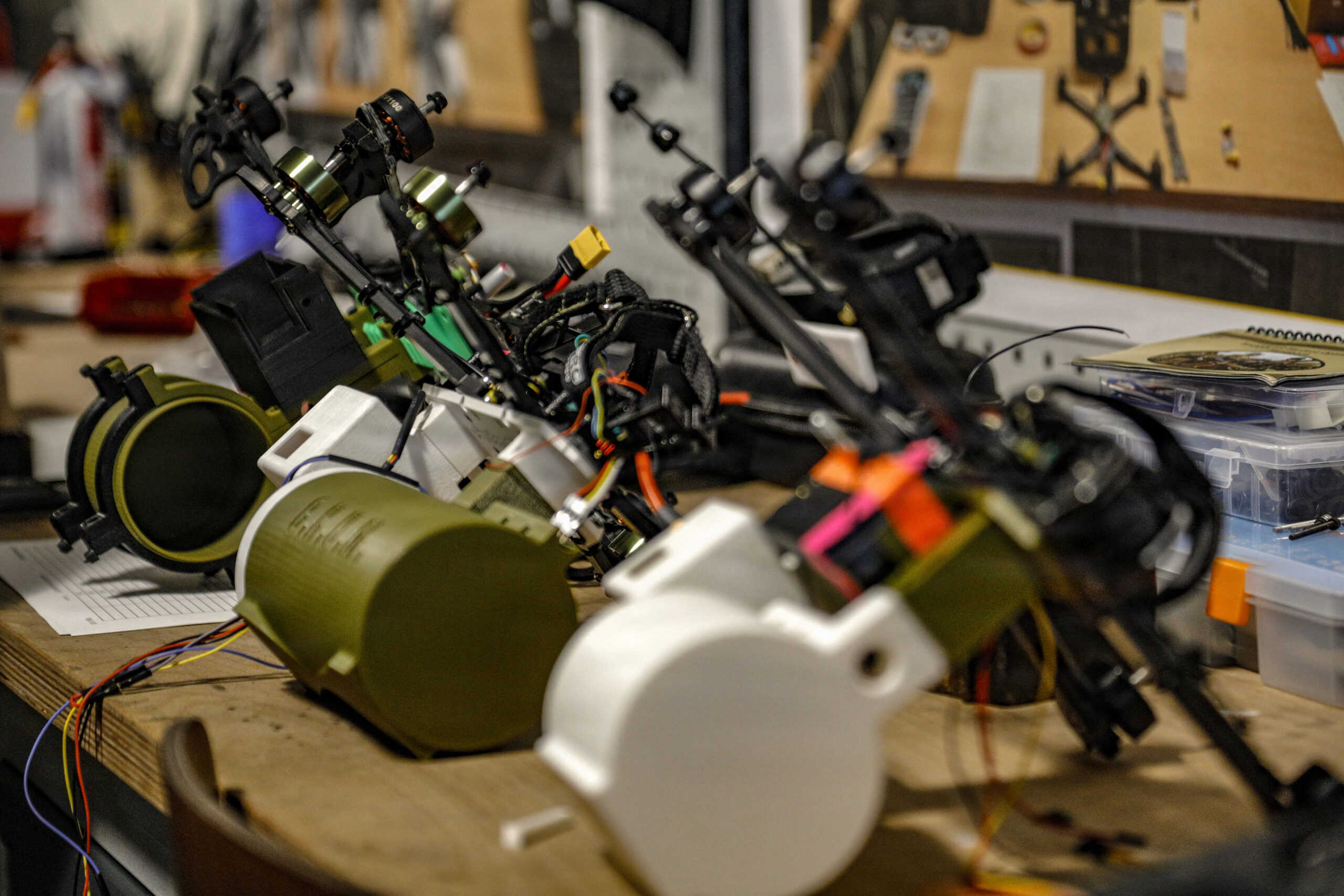

The American Enterprise Institute (AEI) released a report titled “Killer Drones: Ready or Not, Here They Come” that discusses challenges associated with integrating “killer drones” into the US military. Authors John Ferrari and Dillon Prochnicki focus on the core problem created by the proliferation of killer drones: cheap drones necessitate dispersion to protect valuable but easily targetable assets on the battlefield, but dispersion requires increasingly vulnerable dataflows which are themselves targetable. They also identify institutional barriers like an acquisition model focused on fixed platforms as well as service cultures resistant to change affecting entrenched communities. The authors propose reforms rooted in funding allocation within National Defense Authorization Act, particularly “operator-technologist” incubators within the services that fulfill gaps in force structure. They propose a model that allows the US military to gain the initiative over adversaries without flagrantly violating legal or ethical barriers.
“In this world, American reliance on large, heavy platforms concentrated at massive bases has proven a massive vulnerability, as demonstrated by the destruction of US Air Force planes and other assets on the ground across US Central Command’s area of responsibility during Operation Epic Fury.”
“The central weakness in the current US approach is that the services have accepted the operational logic of dispersal faster than they have built the forces needed to realize or sustain it.”
“We contend that the principal barrier to the capabilities is not technological but institutional. The capabilities are feasible in principle, but that is weak sauce when the institutional mechanisms needed to produce them are not there.”
“The Pentagon knows how to sustain platforms and munitions. It has less experience sustaining models as recurring combat consumables.”
The Small Wars Journal has numerous articles that discuss this same topic. “Drone Dominance in Contact: sUAS Challenges and Adaptations at the Brigade Level” highlights many of the same institutional barriers to full adoption of killer drones in the US Army, namely an acquisition model that is not well-suited to sustain attritable, rapidly evolving platforms like small UAS. “Small Drones, Big Limits: A Smarter Drone Strategy” discusses a concurrent approach to drone implementation, highlighting the need for a coherent procurement strategy, defensive drone capabilities, and the supremacy of combined arms maneuver. “The New Arms Race: Global Drone Dominance and America’s Tactical Wake-Up Call” highlights many of the same challenges as well. Whereas AEI argues for more de-centralized “operator-technologist incubators”, “Transforming in Contact: The Army Needs an Unmanned Systems Command Now” argues for a more centralized approach to drone innovation within the US Army.
AEI is right to assert that funding and acquisition rather than technology are the biggest roadblocks to proactive and effective implementation of killer drones across the US military. Without a deliberate force structure and intent for implementing drones in a manner that nests with overarching force design, the US military is at the mercy of the newest “shiny object” of the US defense industry and their salesmen. Discussion across SWJ and elsewhere highlights the continuing tension between the rush to procure emerging technologies and their effective adaptation. This report proposes a realistic model that centers the problem around the US military’s deliberate force design choices rather than drone technology in isolation. As borne out by military history on numerous occasions, the true “revolution” of military technology is in adoption and integration, not just possession.

