





Part 4: The U.S. Munitions Problem
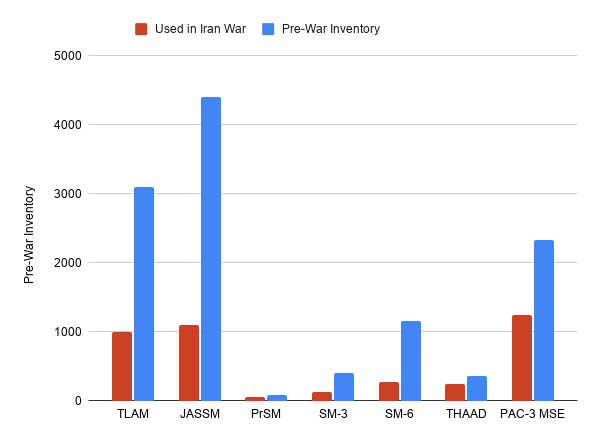

The Center for Strategic and International Studies (CSIS) published a report in late April analyzing the status of U.S. munitions inventories following the 39-day air campaign against Iran. “Last Rounds? Status of Key Munitions at the Iran War Ceasefire” concludes that U.S. missile expenditure won’t constrain current operations, but significantly weakens preparedness for future wars. The New York Times and Wall Street Journal reported similar findings when the ceasefire began. In this discourse series, we comb through these reports for key numbers, themes and takeaways.
In this series, we’ve gone into the numbers of seven munitions used in the Iran War that analysts deem critical for both strike and missile defense capabilities. This has not been an exhaustive list, and as noted previously, the U.S. retains other key munition stockpiles that would allow it to continue the war should one or more critical inventories run out.
On the other hand, preparation for a future war against a more capable adversary in the Western Pacific is where critical stockpile depletion will pose problems.
We can gain insights from the way– and the rate at which– these seven munitions were used in the 39-day Iran War. These insights should be considered as stocks are restored and expanded in the months and years to come. Exactly where money, time, and political capital should go is key.
That’s the goal of this last segment. Here are some of our takeaways:
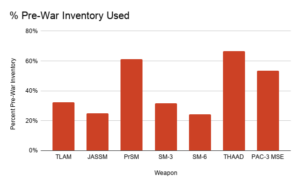
- PrSM and THAAD stocks sit at roughly 30 to 40 percent of pre-war numbers. PAC-3 MSEs are just under half.*
- Raw inventory numbers matter here too. PrSM stocks were small to begin with, which makes the percentage drop even more meaningful in absolute terms.
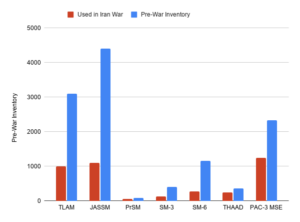
The defensive interceptor gap is the most acute and under-appreciated problem. Strike missiles dominate the procurement conversation, but it is the defensive inventory that determines whether allies and partners survive the opening salvos of a future conflict.
- Resumption of bombing against Iran, assuming Iranian defenses are still operating, could drive THAAD and PAC-3 MSE stocks to zero in a matter of weeks.
- Launching the next war without an adequate interceptor supply risks American service members and platforms, but also exposes partners across the Indo-Pacific to strikes the U.S. cannot reliably absorb on their behalf.
Drones are important, but not the end-all-be-all.
- Systems like APKWS, Anduril’s Roadrunner, and Raytheon’s Coyote represent meaningful progress toward a credible, cost-effective counter-UAS layer. These are important developments in creating a modern, credible counter-UAS strategy. They matter.
- They are not, however, a strategy in themselves. Drones reach their operational ceiling at range, and combined arms remains the answer for high-end, large-scale conflict. The temptation to jump headfirst into a drone-heavy strategy should be resisted.
The important question we are left with is prioritization. More is not a strategy when production timelines run four years and defense budgets are finite.
- The Pentagon’s new framework agreements to acquire 10,000 low-cost cruise missiles, announced May 13th, is a good start. The strategic task is identifying which munitions are most critical to the most likely and most dangerous contingencies—and resourcing those first.
The Iran War gave the U.S. a live-fire data set on exactly how it consumes precision munitions in sustained high-intensity operations. That data should drive the procurement and alliance burden-sharing conversation going forward.
This is the final installment in a four-part series on U.S. munitions inventories following Operation Epic Fury. Here are the first, second, and third.
Find the complete CSIS report by Mark F. Cancian and Chris H. Park here: “Last Rounds? Status of Key Munitions at the Iran War Ceasefire.”
Find the New York Times report by Eric Schmitt and Jonathan Swan here: “Iran War Has Drained U.S. Supplies of Critical, Costly Weapons.”
Find the Wall Street Journal report by Alexander Ward, Shelby Holliday, and Yoko Kubota here: “Iran War Complicates Contingency Plans to Defend Taiwan, Some U.S. Officials Say.”
* Estimates may be averages of ranges.

