Stop Chasing the Shiny Object: Focus First on a Comprehensive Counter-UAS Training Program
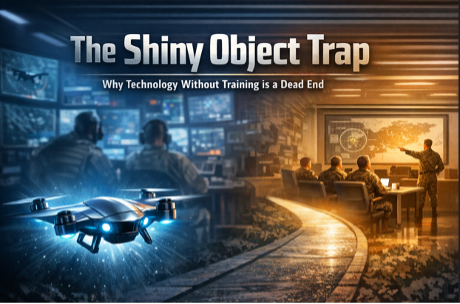

The modern security environment is increasingly defined by the rapid proliferation of unmanned aerial systems. Yet amid this transformation, organizations often fall into a predictable trap: they chase the newest technological countermeasure while overlooking the more fundamental requirement of education and training. The result is a growing inventory of sensors, software platforms, and counter-drone tools that promise protection but frequently deliver only partial solutions when employed by organizations that lack a coherent understanding of the operational environment. Before institutions rush toward procurement, they must first build a foundation of knowledge. A comprehensive Counter-UAS training program is therefore not simply an educational offering but the central organizing mechanism for air-domain security in the drone age.
The urgency of this issue is evident across recent conflicts and operational environments. Small drones first appeared in large numbers during operations in Iraq, where insurgent groups recognized that inexpensive commercial systems could be repurposed for reconnaissance and harassment. In the years since, the conflict in Ukraine has demonstrated the full operational potential of small, unmanned aircraft (sUAS). There commercial drones, improvised first-person-view attack platforms, and increasingly sophisticated autonomous systems have transformed the tactical landscape. Urban combat in Gaza and the evolving conflict environment involving Iran have likewise shown how unmanned systems can dominate both the battlefield and the information environment. These examples reveal a consistent pattern: small drones are no longer peripheral technologies but central tools of modern conflict and security competition. The lesson for public safety agencies, infrastructure operators, and private organizations is clear. The air domain at low altitude can no longer be assumed to be uncontested. Legacy security programs are outdated and require the same attention given to cyberattacks 15 years ago.
Commercial and recreational drones have evolved rapidly from niche hobby devices into powerful, accessible platforms capable of performing tasks once reserved for sophisticated military systems. Modern drones carry high-resolution sensors, advanced navigation systems, encrypted communications links, and increasingly autonomous capabilities. They are widely used for legitimate purposes such as photography, infrastructure inspection, emergency response, logistics experimentation, and environmental monitoring. At the same time, they have become tools for surveillance, contraband delivery, interference with aviation operations, and lethal attack in conflict zones. The dual-use nature of the technology complicates any response. Drones can be operated legally and beneficially in one context while presenting a significant risk in another. As a result, organizations must develop the ability to distinguish between benign and malicious activity while remaining compliant with regulatory and legal constraints.
One of the defining characteristics of the drone environment is the low barrier to entry. Commercial platforms are widely available, affordable, and capable of long-range operations with minimal training. A small team with modest resources can acquire equipment that provides aerial surveillance, precision navigation, and remote operation from miles away. Operators can remain physically separated from the aircraft, making attribution difficult. First-person-view systems allow pilots to control drones with remarkable precision from concealed locations. Autonomous navigation software allows preprogrammed routes that require little or no operator input once launched. In some cases, new command-and-control methods such as fiber-optic systems have emerged in conflict environments, further complicating detection and mitigation strategies.
These developments create significant challenges for organizations tasked with protecting critical infrastructure, mass gathering public venues, transportation networks, correctional institutions, and other sensitive facilities. Drones can approach from unexpected directions, exploit terrain masking, and operate in dark modes to avoid radio frequency detection. They can be used for reconnaissance before a physical intrusion or to deliver payloads ranging from contraband to hazardous materials. In more complex scenarios, small drones may support coordinated hybrid tactics involving cyber operations, information campaigns, or physical sabotage. The operational versatility of small drones makes them attractive tools for both state and non-state actors seeking asymmetric advantages, and this is where the challenge becomes real.
The difficulty of attribution further complicates the problem. Detecting a drone does not necessarily reveal the identity or location of the operator. Modern systems allow pilots to remain concealed at considerable distances, and the aircraft itself may carry little identifying information. The growing concept of “dark drones,” systems designed to minimize electronic emissions or evade common detection techniques, increases the challenge. When organizations detect suspicious activity, they must still determine who is responsible, what their intent may be, and what legal authorities apply to any response. These questions cannot be answered solely through technology; they require trained personnel who understand the operational, legal, and strategic context of drone operations, including how the technology performs.
Another critical dimension of the challenge lies in the regulatory environment. In the United States, authority to detect, track, and mitigate unmanned aircraft is tightly controlled by federal law, with some relief coming from the SAFER SKIES Act. While many organizations may perceive drones as security threats, most lack the legal authority to employ electronic countermeasures or direct mitigation techniques. Misunderstanding these constraints can lead to significant legal liability. Consequently, organizations must develop a clear understanding of what actions are permissible under federal, state, and local regulations. Legal literacy is, therefore, as essential as technical capability, which is why a training program is not only encouraged but needed.
Despite these realities, many institutions approach the drone challenge primarily through procurement. Radar systems, radio-frequency sensors, optical cameras, acoustic arrays, and electronic countermeasure tools are marketed as solutions to the problem. While these technologies are valuable components of a comprehensive defense architecture, they cannot substitute for trained leadership, coordinated operational plans, and clear legal frameworks. Without those foundations, technology often becomes an expensive but underutilized asset. Sensors generate data, but organizations lack the procedures or training to translate that data into timely decisions.
This dynamic has been observed repeatedly in security environments where new technologies are introduced without corresponding doctrinal development. Focusing on operational leadership and security practices remains undervalued in military and law enforcement communities; organizations must first develop a shared understanding of the operational problem before attempting to solve it with equipment. Institutional readiness and command responsibility underscore the principle that effective capability begins with education, planning, and disciplined execution rather than with the acquisition of hardware. That insight is particularly relevant to the evolving drone environment.
A comprehensive Counter-UAS training program addresses this gap by creating an integrated framework for understanding, planning, and responding to drone activity. Such a program is not a single course but a layered ecosystem of instruction, planning, and practical application. It is designed to build competence across leadership, operational teams, and emergency response organizations. Executives must understand how the air domain has evolved and how drone threats intersect with enterprise risk management. Security professionals must understand detection technologies, operational indicators, and coordination procedures. Emergency managers must rehearse response protocols that integrate with broader crisis management systems. Without this shared foundation, organizations remain reactive rather than proactive.
Leadership education is a particularly important component of this framework. Senior decision-makers determine resource allocation, policy direction, and organizational priorities. If they do not understand the implications of the drone environment, initiatives aimed at improving air-domain security will struggle to gain traction. Executive-level engagement, therefore, focuses on strategic awareness, risk assessment, and integration of drone security into broader organizational planning. When leadership understands the challenge, they can align investments, policies, and operational structures accordingly. Operational planning represents the next stage of capability development. Once leaders recognize the importance of air-domain security, organizations must translate that awareness into practical procedures. Drone emergency response planning provides a structured framework for managing incidents involving unmanned aircraft. Such planning defines communication channels, establishes coordination with law enforcement or aviation authorities, and identifies responsibilities for security teams during an incident. Just as important, it ensures that personnel understand what actions they are authorized to take under existing laws and regulations.
Another critical concept in modern Counter-UAS planning is the idea of operating “left of launch.” This approach emphasizes prevention rather than reaction. Instead of waiting for a drone to appear over a facility, security teams analyze multiple factors, including behavioral indicators that might suggest preparations for drone activity. Organizations can develop early warning capabilities and disrupt malicious activity before it occurs. This mindset shift from reactive response to proactive prevention represents a fundamental evolution in security thinking. This is the information data layer that, when understood, begins to form the intelligence picture. Education and training form the backbone of this entire capability. Personnel must understand the drone ecosystem, the legal framework governing drone operations, and the technological tools used for detection and tracking. They must also learn to conduct structured vulnerability assessments that identify weaknesses in physical infrastructure and operational procedures. Through practical exercises and scenario-based training, participants develop the ability to interpret sensor data, coordinate with external agencies, and manage incidents under pressure.
Technology still plays an essential role within this ecosystem, but its value emerges only when integrated into a coherent architecture. Detection technologies such as radio-frequency, radar, electro-optical cameras, and acoustic sensors each provide different types of information – no single sensor offers a complete picture. Effective systems combine multiple detection methods, allowing organizations to correlate data and improve situational awareness. This layered approach mirrors principles long recognized in military air defense, where overlapping capabilities create resilience and reduce the risk of single-point failure. In the end, a layered sensor package is the only answer, with radar providing an essential and critical component based on the advent of new and emerging dark drone capabilities.
Yet even layered detection architectures create their own challenge: the overwhelming volume of data produced by modern sensors. Multiple platforms may simultaneously detect, track, and analyze drone activity, each presenting information through its own interface and operational workflow. Without integration, operators are forced to monitor multiple screens, interpret separate alerts, and manually correlate information during time-sensitive events. The result is cognitive overload at precisely the moment when clarity is most required.
This challenge is addressed in my Small Wars Journal article “C-UAS Operations: Why We Need A Single Pane of Glass,” where modern security operations must move toward unified operational visualization rather than fragmented technological solutions. The article described how complex security environments increasingly rely on numerous digital systems – sensors, cameras, analytics platforms, communications networks, and command software – that often operate independently of one another. While each system may perform its function effectively, the absence of integration forces operators to mentally assemble a common operational picture from disparate sources. In high-tempo environments, that fragmentation slows decision-making and increases the risk of misinterpretation. In the end, decision-makers need “time and space” to make decisions concerning sUAS operations.
The concept of a “single pane of glass” refers to the creation of an integrated operational dashboard that consolidates information from multiple sensors and systems into a unified command-and-control interface. Instead of monitoring a collection of isolated feeds, operators can view correlated data within a single environment that presents alerts, tracks, and contextual information in real time. The concept is not simply a technical convenience; it is fundamentally a leadership and training issue. A unified interface supports faster decision-making, reduces cognitive load, and allows organizations to coordinate responses across multiple operational teams. This concept has relevance to the Counter-UAS mission. Drone detection systems frequently operate across different technical domains – radio frequency, radar detection, electro-optical confirmation, and sometimes acoustic or network-based analytics. When these systems operate independently, organizations may detect a drone but struggle to confirm its identity, track its movement, or coordinate a response quickly enough to matter. Operators may waste valuable time shifting between systems while attempting to determine whether multiple alerts represent the same aircraft. The absence of integration can therefore turn technological capability into operational friction. A training-centered approach to Counter-UAS programs directly addresses this challenge. Personnel must not only understand how individual sensors work but also how information from those sensors should be fused and interpreted within a larger operational picture. Training exercises should simulate the decision-making environment created by multiple data streams, teaching operators how to correlate alerts, verify tracks, and escalate responses quickly. When organizations adopt the “single pane of glass” concept as part of their training doctrine, technology becomes an enabler rather than a distraction. The insight reinforces the central argument of this article: the problem facing many organizations is not the absence of technology but the absence of integration and understanding.
Agencies often purchase multiple detection tools, believing that additional hardware will close capability gaps. In reality, these purchases frequently produce fragmented systems that operators struggle to use effectively. Without training, doctrine, and integration, the proliferation of sensors simply multiplies the number of screens an operator must watch. Furthermore, the current construct of these data layers requires careful thought to cybersecurity and the implications if security is compromised. The solution lies not in acquiring more equipment but in building a coherent operational architecture supported by training. When organizations develop a shared understanding of the drone threat, establish clear operational procedures, and integrate technologies into a unified command environment, they begin to achieve the kind of situational awareness envisioned in this thought piece. In this environment, technology supports human decision-makers rather than overwhelming them. Providing time and space is the most critical factor that technology can give the “human in the loop” to make a decision.
Analysis and testing are, therefore, critical components of any comprehensive program. Organizations must understand the strengths and limitations of different sensor technologies and evaluate them within the specific context of their facilities. Environmental conditions, terrain features, and operational requirements all influence system performance. Without careful analysis, organizations may deploy equipment that performs well in controlled demonstrations but poorly in real-world conditions. Physical hardening represents another layer of defense. Infrastructure modifications can reduce vulnerability by limiting potential drone approach paths or protecting critical assets from overhead observation or attack. Adjustments to lighting, perimeter design, and structural features can improve both detection and resilience. These measures do not replace technological solutions but complement them, creating multiple barriers that adversaries must overcome. The broader value of a comprehensive Counter-UAS training program lies in its ability to unify diverse components of the security ecosystem. Drone threats intersect with cybersecurity, physical security, intelligence analysis, aviation operations, emergency management, and public safety. Each of these domains possesses its own terminology, procedures, and institutional culture. Without deliberate integration, organizations may find that these communities operate in isolation, leading to fragmented responses and missed opportunities for coordination.
Training provides the common language and conceptual framework necessary for collaboration. When executives, security professionals, and emergency managers share an understanding of the drone environment, they can coordinate their efforts more effectively. Legal compliance improves because personnel understand the boundaries of their authority. Decision-making accelerates because leaders possess the contextual knowledge required to interpret technical data. Technology investments become more effective because operators understand both the capabilities and limitations of the systems they employ.
The importance of institutional culture in achieving operational readiness and training must be an enduring component of institutional identity rather than a one-time event. Organizations that internalize this principle develop the ability to adapt continuously as technologies and threats evolve. Those who rely solely on equipment acquisition often struggle to keep pace with change. The rapidly evolving drone environment illustrates this dynamic vividly. The democratization of the air domain represents one of the most significant shifts in modern security. For most of the twentieth century, control of the skies belonged almost exclusively to nation-states with advanced military aviation capabilities. Today, small unmanned aircraft allow individuals and small groups to access that domain with minimal resources. This transformation has profound implications for both military operations and civilian security. Facilities that once focused primarily on ground-based threats must now consider vulnerabilities from above. sUAS has changed legacy physical security, and there is no turning back.
Adapting to this reality requires more than incremental adjustments. It demands a conceptual shift in how organizations approach security. Air-domain awareness must become as routine as perimeter surveillance or cybersecurity monitoring. Planning processes must account for aerial reconnaissance and potential drone incursions. Emergency response protocols must incorporate procedures for managing incidents involving unmanned aircraft. Achieving this level of integration requires sustained education and practice.
A well-designed Counter-UAS training program, therefore, represents a form of institutional transformation. It brings together strategy, planning, technology, and operational execution within a coherent framework. It prepares leaders to make informed decisions about investments and policies. It equips security professionals with the knowledge required to detect and interpret drone activity. It enables emergency managers to coordinate effective responses during incidents. Most importantly, it creates an organizational culture that recognizes the importance of air-domain security in an era when the skies above critical infrastructure and public spaces are no longer empty.
The challenge posed by drones will not disappear. On the contrary, it will intensify as autonomy, artificial intelligence, and distributed systems continue to evolve. Costs will decline while capabilities expand, making advanced features accessible to an ever-wider range of users. Adversaries will continue to experiment with new tactics, just as they have done in conflicts around the world. Organizations that respond by continually purchasing new technologies without addressing underlying knowledge gaps will find themselves perpetually behind the curve. Those who invest in training, however, will develop a sustainable advantage. Education enables organizations to interpret emerging trends, evaluate technologies critically, and integrate new capabilities into coherent operational strategies. It transforms equipment from isolated tools into components of a broader security architecture. It ensures that personnel understand not only how to operate systems, but why they are employed and how they support organizational objectives. For these reasons, the most effective response to the drone challenge begins not with procurement but with education. A comprehensive Counter-UAS training program provides the intellectual foundation upon which all other capabilities are built. It aligns leadership, operations, and technology within a shared strategic vision. It reinforces the principles of readiness and disciplined planning, which prepare institutions to operate confidently in a contested air domain.
For these reasons, the most effective response to the drone challenge begins not with procurement but with education.
In the end, the lesson is straightforward: don’t chase the shiny object. The temptation for the newest technological solution will always exist, particularly in an era defined by rapid innovation. Yet technology alone cannot compensate for the absence of understanding. Organizations that recognize this reality and prioritize training will be far better positioned to navigate the complexities of the drone age. It is often the case that many organizations may find themselves equipped with impressive tools but lacking the knowledge required to use them effectively. In a world where the airspace above us is increasingly active, education remains the most reliable path to preparedness. Do your leadership a favor, give them the ability to decide before a threatening drone makes it to the target.