





Africa’s Drone Revolution, By the Numbers

An open-source dataset compiled by Military Africa Magazine maps 234 drone procurement records across 34 African nations from 1980 to 2026. It comprises 1,959 total units, 21 supplier countries, and 150+ distinct platforms. Yes, this is a continent in the middle of a military transformation. It’s also one where competition for influence among outside powers is being projected through buzzing, four-bladed flying objects.
The Surge
More than half of all recorded units—1,054 of 1,959—were procured between 2020 and 2026. The single largest procurement year on record is 2022 at 247 units, followed by 2020 at 237.
Who’s Supplying
The China-Turkey-Israel triad now controls over 60% of recorded procurement volume:
- China: 587 units across 20 countries, dominant in active conflict zones, no human rights conditionality
- Israel: 325 units, concentrated heavily in Morocco (176 units alone), focused on surveillance and precision strike
- Turkey: 291 units, with the Bayraktar TB2 now deployed in 11 countries and 143 units recorded—the single most widely distributed drone platform on the continent
- United States: 247 units, but only 29 post-2020, reflecting tighter export controls and political constraints
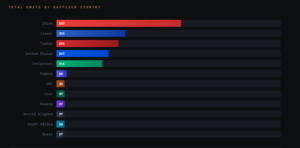
(Fig. 3)
Iran and Russia supply exclusively to conflict-affected states (Sudan, Libya, Ethiopia, and Mali) through opaque channels, signaling deliberate conflict-exploitation rather than conventional arms relationships.
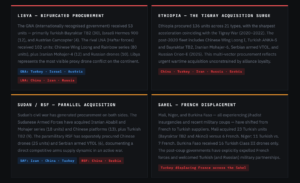
(Fig. 6)
Where the Drones Are Going
North Africa leads with 1,026 units, with Egypt (313), Morocco (279), Algeria (128) driving high-end MALE (Medium-Altitude, Long-Endurance) and HALE (High-Altitude, Long-Endurance) procurement. Libya has the continent’s most visible proxy drone war. There, Turkey and Israel back the Government of National Accord (GNA) and China, Iran, and Russia supply the Libyan National Army (LNA).
The Sahel is the most geopolitically significant emerging theater. Mali, Niger, and Burkina Faso have all expelled French forces and shifted procurement to Turkish platforms. Drone supply there is a visible instrument of political realignment.
Ethiopia’s Tigray-era procurement surge demonstrates what wartime acquisition looks like when alliance loyalty is irrelevant. There, 136 units (21 different types) have been sourced from China, Turkey, Iran, Russia, and Serbia.
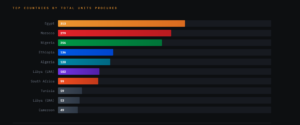
(Fig. 4)
The Indigenous Angle
Nine countries are now manufacturing domestically. South Africa leads at 94 units, followed by Nigeria (36), Algeria (29), and Ethiopia (21). Nigeria’s 34-type procurement diversity and active domestic R&D make it the most likely next major Class III producer.

