





Expanding Taiwan’s Resistance Area Complex by way of Japan and the Philippines

Introduction
Taiwan has a strategic depth problem. If invaded, it has no land border, no neighboring state to retreat into, and no hinterland to buy time. In the case of Taiwan, military and resistance forces that survive a Chinese landing would be geographically compressed and operating in close proximity to the occupying forces, with nowhere to fall back. The idea of “stay-behind forces,” those intended to hide, survive, and eventually operate in the rear area of an advancing enemy, is extremely challenging – if not impossible – in the Taiwan scenario. The island’s isolation would make it difficult to import weapons, medical supplies, foreign fighters, and communications equipment, even where the political will to send them existed. Taiwan’s geography is both a defensive asset against invasion and a liability against occupation.
Background Information
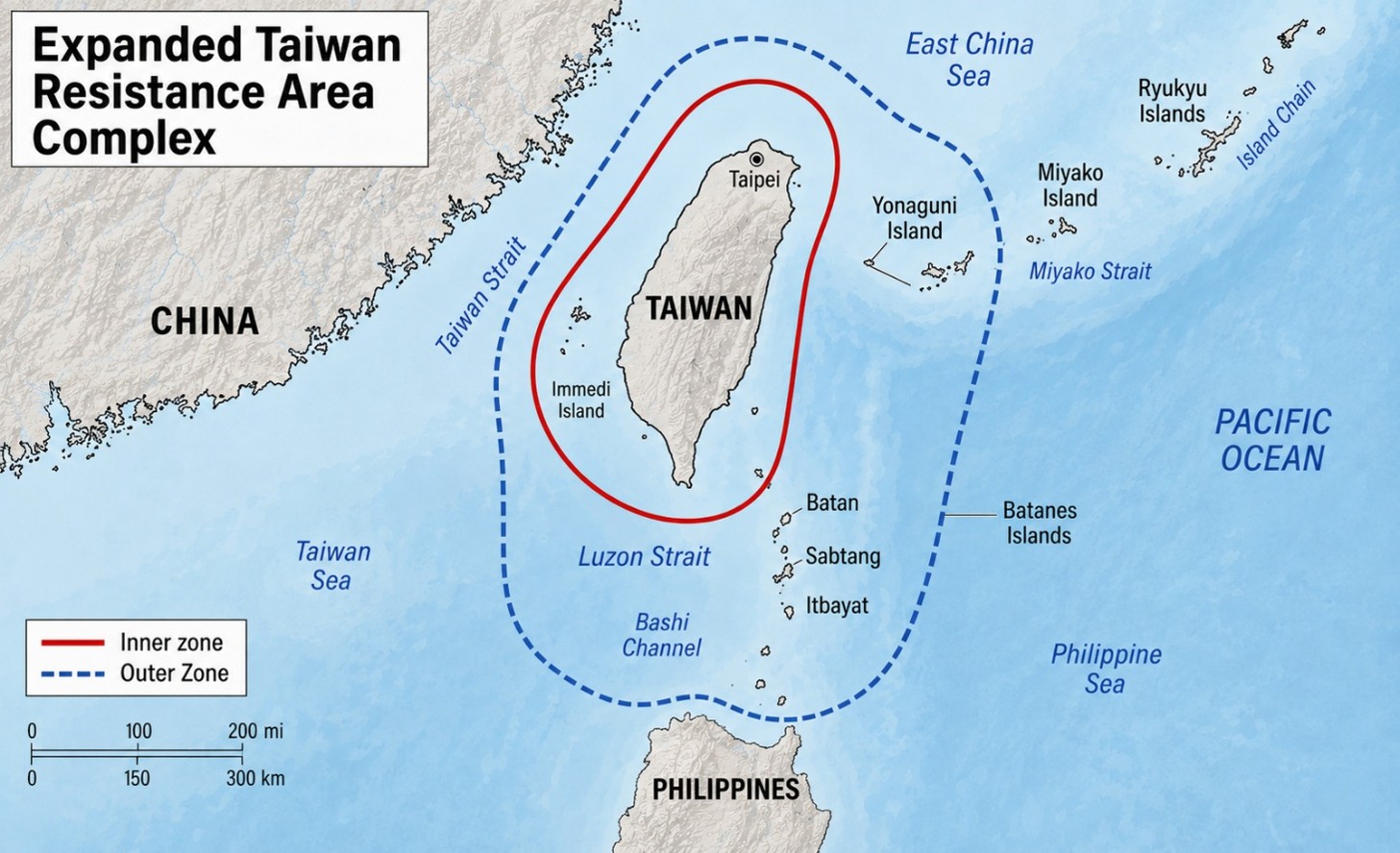
Planning Taiwan’s physical resistance architecture across time and space, prior to invasion, demands creativity. American doctrine is informative in this case but not particularly well-suited to the island’s one-of-a-kind situation. US Army Special Forces Unconventional Warfare doctrine, including Field Manual 3-05.201, defines an “area complex” as a clandestine, dispersed network of facilities that gives a resistance movement security, control, dispersion, and flexibility, in effect, a liberated zone built and held by the resistance itself. The manuals recommend that the area complex include a security system, base camps (which will be unlikely in Taiwan, but safehouses will be possible and needed), communications, logistics, medical facilities, supply caches, training areas, and escape and recovery mechanisms. It subdivides the complex into an outer and an inner security zone, built around the resistance area command, which would likely be distributed rather than consolidated in Taiwan. The doctrinal model assumes contiguous, expandable ground: territory a resistance force can grow into, use to separate its outer zone from its inner one, and absorb pressure before it reaches command cells. Taiwan can plan and organize an inner zone. Practically, it cannot build the outer one that doctrine assumes sits alongside it, because there is no adjoining territory to put it in. Unfortunately for Taiwan, the people are “prisoners of geography,” as Tim Marshall’s book of the same name suggests.
The outer security zone has several jobs that normally happen on the same landmass as the resistance itself: organizing and developing fighters and civilian support infrastructure, serving as a source of recruits, providing the first line of in-depth security and warning, and feeding the resistance area command cells with timely, accurate intelligence on enemy activity within the zone. Members in that zone screen, select, and train new resistance members, with the most capable moving into the regular armed element, while the civilian support element, built alongside them, gathers intelligence and delivers logistical and psychological operations support to resistance area command cells. None of that doctrine assumes the outer zone sits across open water from the force it supports. Taiwan’s geography forces an adaptation rather than an abandonment of the concept: recruitment and vetting of volunteers, intelligence collection on Chinese naval movements through the straits, and logistics and communications support to area command cells all shift. These functions must be performed at a distance that the doctrine never anticipated.
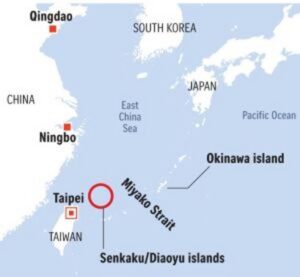
Miyako Strait (Image Credit: The Straits Times)
Japan and the Philippines
Japan and the Philippines are where the missing outer zone of the area complex can go. In fact, they may be the only realistic locations immediately adjacent to Taiwan that can perform that function. While Guam, Palau, Okinawa, and other places may play a role, the requirement here is to develop locations that can serve as immediate, geographically close extensions of the resistance area complex.
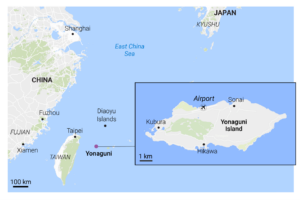
Yonaguni Island (Image Credit: South China Morning Post)
Both countries are already part of the conversation about a Taiwan contingency, and both have said so in their own words rather than having the role assigned to them by outsiders. Sanae Takaichi, Japan’s Prime Minister, told Japan’s parliament on November 7, 2025, that China’s use of armed force against Taiwan could constitute what Japanese law calls a “survival-threatening situation,” the threshold that permits Japan to exercise collective self-defense. Philippine President Ferdinand Marcos Jr. said in August 2025 that a war over Taiwan would draw the Philippines into the conflict regardless of its own preferences, citing proximity and the roughly 180,000 Filipinos residing on the island, and that hope is not a plan. To be clear, neither statement commits either government to a specific military role.
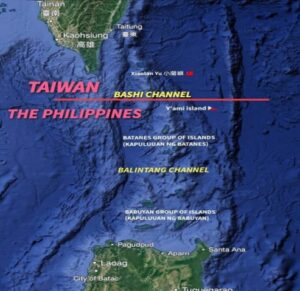
The Bashi Channel and Batanes Islands (Image Credit: Robert Luster, StongerNavy.org)
Just as geography limits maneuver depth on the island itself, it also narrows where the expanded area complex, depth-by-proxy, could realistically land. Japan’s southwestern Sakishima Islands, particularly Yonaguni, sit 110 kilometers from Taiwan and overlook the Miyako Strait, one of the two principal maritime corridors through which the PLA Navy would seek access to the Western Pacific during a Taiwan conflict. The Philippines’ Batanes Islands sit across the Bashi Channel from Taiwan’s Orchid Island, the second passage, which is 80 kilometers wide. Note that Osumi Strait and Tokara Gap are also available for limited traffic, but for Taiwan operations, the Miyako Strait and Bashi Channel are by far the two principal deep-water exits. Japan is already fortifying Yonaguni with missiles and sensors, while the Philippines has rehearsed rapid anti-ship missile deployments to Batanes during joint exercises with the United States. In addition to the geography requirements of the area complex equation, what is also missing is a special operations mission that’s built to move people, equipment, and information through those same two islands into an occupied Taiwan, and to keep moving them for the resistance once a blockade is in place. Such a mission could include at least four functions.
The Resistance Mission
The first is communications relay. China has already shown a willingness to sever Taiwan’s connectivity through means short of war: a Chinese-owned vessel was accused of cutting a fiber-optic cable near Keelung Harbor in January 2025, following earlier damage to cables serving Taiwan’s Matsu Islands in 2023. In an actual invasion, isolating Taiwan from the outside world would be an early objective. Relay infrastructure staged on Yonaguni and Batanes, built and rehearsed in peacetime, could keep resistance networks and civilian authorities in contact with the outside world after primary infrastructure fails.
The second is unmanned insertion, extraction, and resupply, which helps address the logistics and supply caches that doctrine expects an area complex to maintain internally. Small unmanned surface vessels and unmanned aerial systems, launched at night from Batanes or the Sakishima Islands and running beneath a blockade line, are within current technical reach. This is a mission-planning, basing, and personnel management problem more than a technology problem. Building local relationships, expertise, and staging sites is a peacetime preparation task that retired Special Forces Colonel Brian Petit argued requires a long-dwell, host-embedded advisory presence. Applied to the area-complex concept proposed in this paper, Petit’s idea of a persistent advisory mission adapted to this paper would include US Special Forces not only in Taiwan, but also on the two islands and other locations that would run the resistance pipeline once Taiwan is cut off.
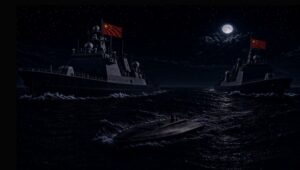
An Unmanned Surface Vessel (USV) Penetrates A Chinese Blockade with Ammunition, Medical, and Communication Supplies for The Resistance (Fictional Image. Image Credit: Grok AI)
The third is facilitating the introduction of foreign volunteers who want to fight for Taiwan, which supports the doctrinal escape-and-recovery mechanism in reverse: instead of moving evaders out of denied territory, the same tradecraft moves vetted personnel in. Ukraine’s International Legion drew thousands of foreign fighters within weeks of the 2022 Russian invasion, staging through Poland and other neighboring states that were not themselves combatants. Taiwan has no land border and no neighbor that could serve that role by geographic accident. Japan and the Philippines are plausible staging grounds for screening, inserting, and, if necessary, extracting foreign volunteers.
A fourth function is kinetic interdiction of Chinese naval forces from Japanese or Philippine soil. This function is more challenging to plan, organize, and train during peacetime because of the obvious political sensitivity. Japan’s “survival-threatening situation” authority and the Philippines’ Mutual Defense Treaty with the United States both provide a legal path to this kind of involvement. But activation would likely occur only once Tokyo or Manila has determined that it is already a party to the conflict and pre-determined thresholds have been crossed.
Treating Japan and the Philippines as two more US Special Forces advisory locations alongside Taiwan introduces a harder problem: what sustains a pipeline like this over the years is whether the people running it understand how all three nodes connect, rather than knowing only their own. Not unlike Petit’s concept for Green Berets on long-term Taiwan rotations, a dedicated cadre in this model would instead rotate its personnel sequentially through all three countries, on tours lasting several years each rather than a series of unrelated deployments in which entire teams move in and out at the same time. Optimally, this would include the rotation of not just American advisors but also Japanese, Philippine, and Taiwanese operators. An operator serves a tour in the Philippines, then Japan, then Taiwan, for example, or some ordering suited to the mission, carrying forward what worked in one place and testing it against the next. The result is a body of institutional knowledge about running the resistance pipeline that travels with the people who built it, rather than resetting with every new team that arrives.
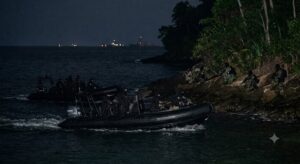
Foreign Fighters Infiltrate Taiwan to Assist the Resistance (Fictional Image. Image Credit: Google Gemini)
Objections
Three potential objections to this proposal deserve acknowledgment. The first is consent. Takaichi’s and Marcos’s statements support self-defense and the evacuation of their own nationals. In January 2026, Japan and the Philippines signed a new defense pact amid growing Chinese aggression. Despite this, these actions cannot be interpreted as consent to host an active pipeline built to resupply and reinforce a resistance movement within a state whose government does not formally recognize it. No one should treat public statements from these leaders as a blank check, but the positions from both may serve as a starting point for an expansion of activity. The second is provocation. Beijing’s response to one sentence from Takaichi in the Diet, a halt on Japanese seafood imports, travel advisories, and roughly 500,000 canceled airline tickets, shows how little China needs before retaliating economically. A standing cadre and physical infrastructure on Yonaguni and Batanes will draw an exponentially sharper reaction. The third objection is effectiveness. The Bashi Channel and Miyako Strait are dense, monitored waterways, and unmanned traffic crossing them in wartime will likely be detected and attributed, no matter how careful the tradecraft is, which raises a fair question about whether the pipeline can move enough volume to matter, or perhaps what other functions it may accomplish.
Addressing issues related to consent and provocation will be consequential to the success or failure of this proposal. Whether this happens before or after the invasion is also significant. If the Philippines and Japan, or perhaps only one, consider the costs of escalation with China to be borne as a result of embracing this area-complex construct in peacetime, and weigh them against the benefits to be gained for their country in war, they may conclude that the return on investment is worth it. As mentioned earlier, leaders of both countries have articulated that a fight for Taiwan will not be just about Taiwan but will have regional implications, including for their countries. Admittedly, this is not a mitigation of negative costs so much as an acceptance of them. As for the risks associated with establishing communications relay functions and the resistance cadre developing personal relationships on the ground on these adjacent islands, these activities also create similar political and diplomatic costs to those mentioned above. There are genuine, dual-use benefits to establishing communication mechanisms and human-to-human trust networks that come with persistent engagement on these islands, extending beyond conflict or preparation for conflict. Humanitarian Assistance and Disaster Relief preparation, for example, is the most honest example of a capability that would benefit from establishing these systems now. The reality is, however, that building these capabilities prior to invasion may invite retaliation from China. Strategic ambiguity, a constant theme for nearly every country in the world regarding Taiwan, is the first option for the Philippines and Japan as it pursues dual-use preparations discussed here. Or, secondly, both countries may decide to clearly declare their willingness to begin preparing for conflict out of genuine concern for their national security. Or, a third option is that establishing such resistance-support mechanisms may not occur until after hostilities have broken out, and leaders are forced to make hard decisions. The latter outcome doesn’t mean the expanded area complex doesn’t become an operational reality, but it may mean it isn’t optimally planned and exercised. The higher-risk, higher-signature functions involved with the expanded area complex, unmanned insertion runs, and foreign fighter staging become branch plans that would almost certainly not activate until Tokyo or Manila has crossed its own legal thresholds, the same gating already applied to kinetic interdiction. The intent of this paper is not to presuppose what Tokyo or Manila will do or to assume the level of risk these countries are willing to take, but rather to put forth a resistance-support concept and acknowledge the costs associated with it. How these two countries proceed will ultimately be based on what they perceive best for their own survival, not anyone else’s.
Effectiveness is a different kind of problem, since it isn’t a matter of managing political risk but of surviving physical detection. There are at least three approaches as to what “success” actually means for this expanded area complex. There is the ambitious one in which the pipeline sustains the resistance movement; the modest one in which the network survives and complicates the enemy’s occupation; and the third, a combination of the two. As for sustaining the resistance itself, it is important to remember that this expanded area complex is the terrestrial-based manifestation of the complex. While the inner and outer zones are where a considerable amount of physical support originates, there will also be maritime (surface and sub-surface), air, space-based, and virtual support to the resistance. Ideally, all of these lines of effort will be well orchestrated. The point here is that it is not only the land-based resistance area complex on Japanese and Philippine islands that will be tasked with supporting the resistance. As for disruption, history provides a useful example. Detachment A, the Cold War Special Forces unit that ran stay-behind operations in West Berlin, never had full deniability, surrounded as it was by Soviet and East German intelligence services, and its value lay in persistence and complication rather than invisibility. This pipeline’s job will include a similar mission: survive attrition and impose cost. In reality, the expanded resistance area complex, together with the other support efforts mentioned, will serve several functions simultaneously. Furthermore, depending on the reality on the ground, one part of the network may serve one function while another serves a different purpose.
Summary
This paper provides a modern adaptation of the doctrinal “area complex” needed to support resistance on an island facing a realistic threat of invasion and occupation. The overarching strategic concept is outlined here, but the operational and tactical realities of the architecture require additional scrutiny. The idea of a Chinese invasion is often discussed among the US, Taiwan, Japan, the Philippines, and other like-minded partners. The integration of mechanisms across international borders to build depth of resistance to compensate for geographic shortfalls, however, is not explored in practical terms, as it is here. Expanding the area complex’s footprint on the ground is possible if the aperture is spread onto two pieces of partner territory that are not Taiwan’s own.
Disclaimer: The views expressed here are the author’s alone and do not reflect the official policy or position of the US Government or the Department of War.



Commenting is available to active SWJ members and staff.