





The VFW National Home: Shaping Hope and Horizons in Michigan’s Heartland
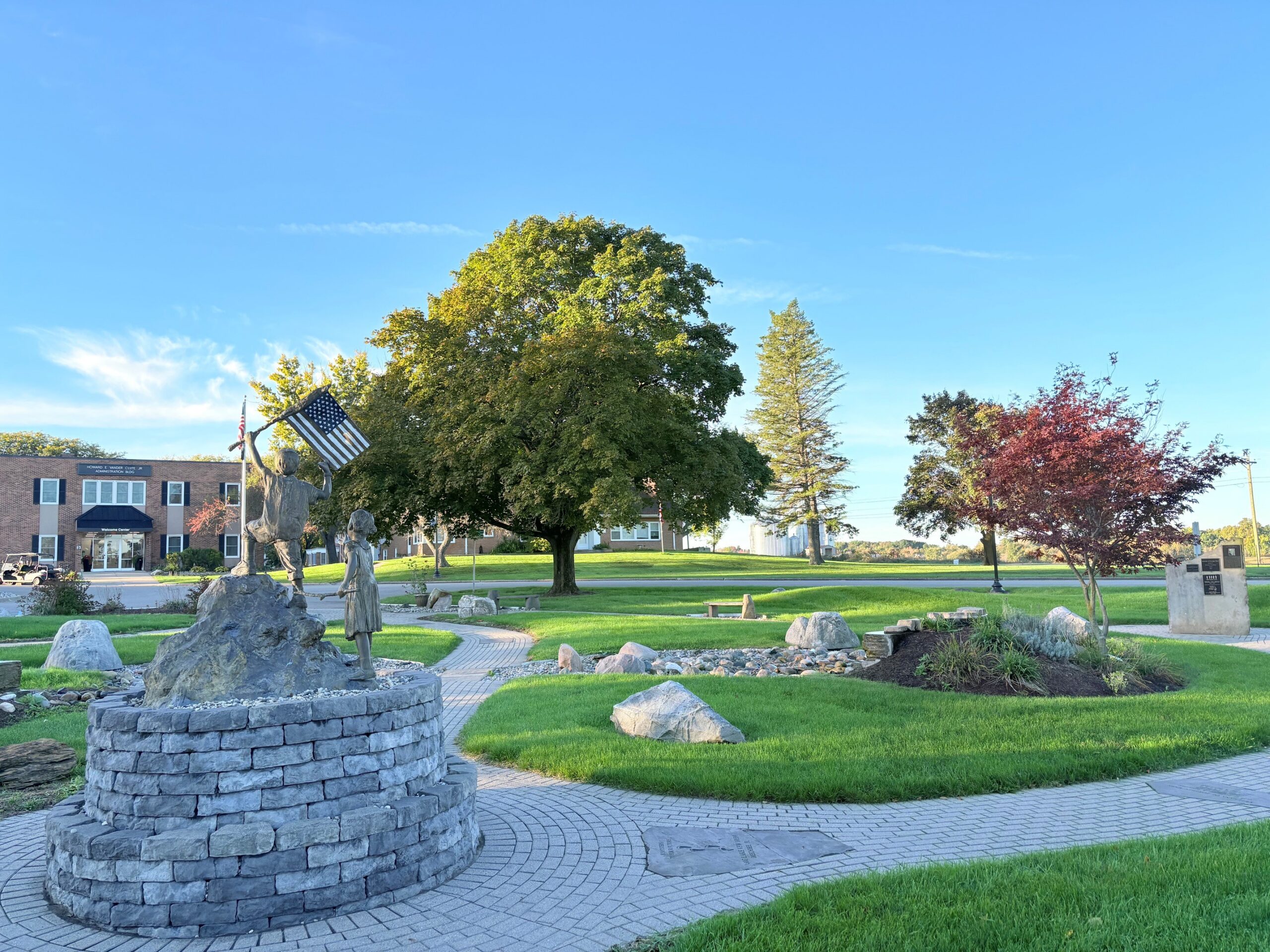

Editor’s Note: This essay is part of Small Wars Journal’s Veterans Day 2026 Showcase, a special series recognizing veterans’ service and the work of charities, nonprofits, and civic organizations supporting veterans, military families, and their communities. Published during Veterans Day week, the showcase highlights how service continues beyond the uniform and marks the second anniversary of SWJ’s relaunch. Publication of the essay does not constitute an endorsement of the featured organization.
Abstract
The Veterans of Foreign Wars National Home, located in Eaton Rapids, Michigan, is a 640-acre community founded in 1925 that provides free housing and extensive support to military and veteran families in transition. Its structured programming helps residents build financial stability and independence. The Home combines on-campus amenities—including childcare, educational programs, and recreational facilities—with individualized case management and financial education. These resources help residents achieve concrete goals such as eliminating debt, purchasing a home, and advancing their careers. Through the experiences of residents such as Connor, a recently separated veteran, the article illustrates how this mission-driven community transforms lives by giving families the foundation they need to regain stability, pursue their goals, and move confidently into their next chapter.
Fruitful Ground
Not all soils are created equal.
Ask any veteran what the ground was like on the last deployment, then ask for a comparison with where you are standing now. The answer will likely make the two places sound as different as Earth and Mars.
Consider the almond-flour moon dust of southern Syria—the kind that flows freely through your fingers like baby powder yet somehow wedges itself into the spaces between your fingerprints. Comparing it to the loamy, black topsoil of Eaton Rapids, Michigan, is what one might call apples and oranges. Both are fruit. Both grow on trees. But one makes a far better pie.
I like writing about a place’s dirt because it provides a tangible connection to the natural elements surrounding us. It is the substrate that serves as our figurative and literal path to where we go in life. What soil can yield and support often determines how the land will be used: agriculture, industry, or residential neighborhoods.
Connecting with the earth is entirely human and relatable across cultures. It knows few boundaries, at least until cities in the sky displace us from terra firma. Until that future date in parts unknown, the soils of Eaton Rapids support aspiration, hope, serenity, healing, and direction across the 640 acres of the Veterans of Foreign Wars National Home. The campus provides these things for 45 of our country’s most deserving veterans and their families.
Eaton Rapids
The roads of central Michigan extend from the urban outskirts of Lansing, the state capital, and gradually narrow into two-lane highways such as M-99. Centennial farms fill Clinton, Ingham, and Eaton counties. Wind bends around pumpkin patches and apple orchards. Dairy cows graze beneath weeping willows. Mighty oaks protect roadside stands selling honey and eggs, their ceramic money jars operating on the honor system.
As you continue south from the city limits—and especially when you enter the grounds of the VFW National Home—you feel as if you have broken through the physical plane between space and time.
Eaton Rapids is the kind of place where high school football games dominate Friday night schedules. Ice cream parlors are filled with patrons and operated by generations of owners unfamiliar with Mr. Baskin or Mr. Robbins. Granite blocks, tranquil fountains, and bronze plaques flank the downtown Memorial Park as Cub Scouts salute and lay wreaths in honor of veterans and their sacrifices.
If not for the Grand River flowing nearby, adorned with golden leaves fallen from cottonwoods and aspens, you might think you had found a movie set or television soundstage for a Hallmark classic.
After a brief reality check, you confront the idea that pockets of reverence for service, patriotic programs, and links to the past remain in communities throughout America. You are simply lucky enough to be standing in one of them.
Follow the river southeast, and you eventually reach the campus of the VFW National Home. What I love most about Eaton Rapids is not the farms, football Fridays, ice cream, monuments, fall colors, or small-town America feel. It is the mission of the VFW National Home and the people who inhabit its campus.
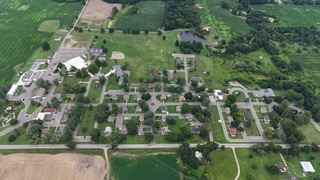
An aerial view of the VFW National Home campus in Eaton Rapids, Michigan, shows family homes, educational and recreational facilities, agricultural areas, walking trails, and green space. (Photo by Katie Darling, director of marketing, courtesy of the VFW National Home)
A Promise Made in 1925
The VFW National Home was founded in 1925 to support the Veterans of Foreign Wars’ core ethos: “Honor the Dead by Helping the Living.” Its original purpose grew from a painful and practical recognition. When service members do not come home, the children and families left behind carry consequences that can last for generations.
The first family to live at the Home was the widow and children of Sgt. Edward Pollett. On March 2, 1925, Pollett, a World War I veteran, was traveling from the family’s residence in Halfway, Michigan—now Eastpointe—to Fort Wayne in Detroit. He intended to pick up his retirement check from a federal office. While crossing a busy city street, Pollett was struck by a speeding automobile. He later died in a hospital.
After identifying his body at the morgue, his wife, Annie, found herself penniless and in dire straits. The Army retirement checks upon which the family depended would cease following her husband’s death.
Word travels fast in veteran communities. The Pollett family’s local VFW post petitioned the organization’s state leadership to support the family and find a long-term way to help Annie and her six children.
Amy Ross, a young woman committed to helping veterans, had already secured hundreds of donated acres for future use. With her vision and the leadership of the VFW Department of Michigan and its commander, Dr. Clarence Chandler, the Pollett family was rehoused seven days after Edward’s death. Their new home was a farmstead in Eaton Rapids. Annie and her children became the first residents of what would eventually grow into the VFW National Home.
Though the Home has evolved with the changing needs of America’s military and veteran families, its central premise remains remarkably simple: Military service should not leave a family to face instability alone. That commitment to veterans and their families remains rooted in the VFW’s national tradition of service and in the bond shared by generations of its members, a connection recognized each year on National VFW Day.
The historical shift from a home focused on children affected by war to a family-centered program reflects a larger truth about military service. The nature of the challenge has changed, but the need has not.
A family may not be facing the loss of a parent to war in the same way as earlier generations did. It may instead be confronting the cascading effects of a difficult transition, an unexpected discharge, debt, deployment-related strain, childcare costs, isolation, a lost job, or the unsettling question of where to go next.
The VFW National Home’s answer does not entail handouts with an expiration date. Its structured program gives families the opportunity to regain their footing. Through continued land donations and expansion since the Pollett family arrived, the National Home has become a safe and welcoming community where families can heal, grow, and build a future together. Its 640-acre campus includes 45 homes, an early education and childcare center, a community center, a gymnasium and fitness center, education and training spaces, a library, a computer lab, parks, playgrounds, green spaces, and miles of hiking trails.
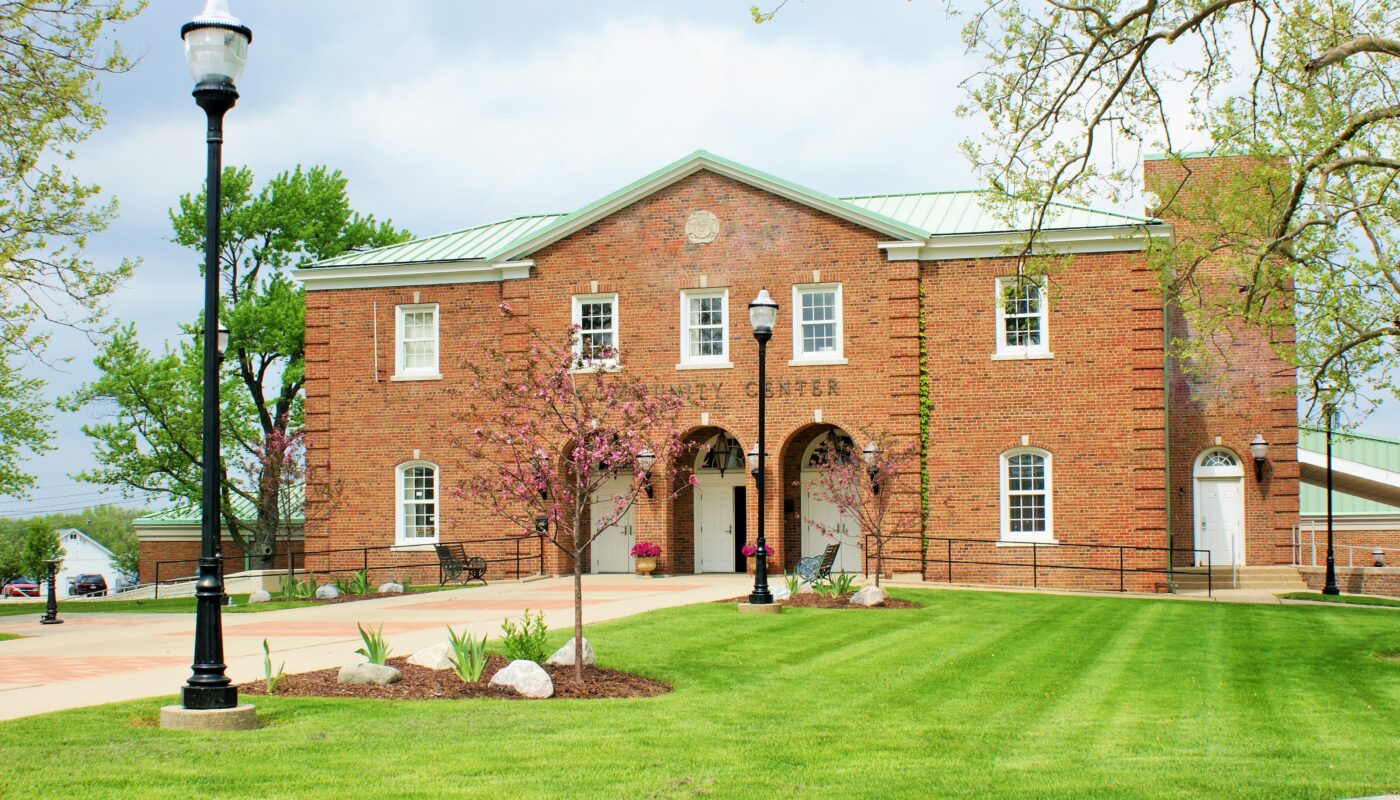
The community center serves as a gathering place for families living at the VFW National Home. Campus facilities support education, recreation, physical fitness, and community life. (Photo courtesy of the VFW National Home. Photo by Katie Darling, director of marketing)
At the time of my visit, 42 homes were occupied. Two new homes were under construction, and another historic home was undergoing extensive renovation before it could welcome a family from the waiting list. These 45 homes are lifelines of hope for veteran families struggling to thrive in their current circumstances.
Many residents have recently left active-duty military service or returned from overseas deployments. Some are National Guard members or reservists. These families know the inherent stress of giving up the military’s routines and structure. Some arrive after struggling with problems that can quickly overwhelm the guardrails of civilian life: debt sent to collections, overdue rent, utilities at risk of being shut off, or a mortgage moving toward foreclosure. A new address alone will not solve those problems. Lives change when structure, community, and individualized support work together over time.
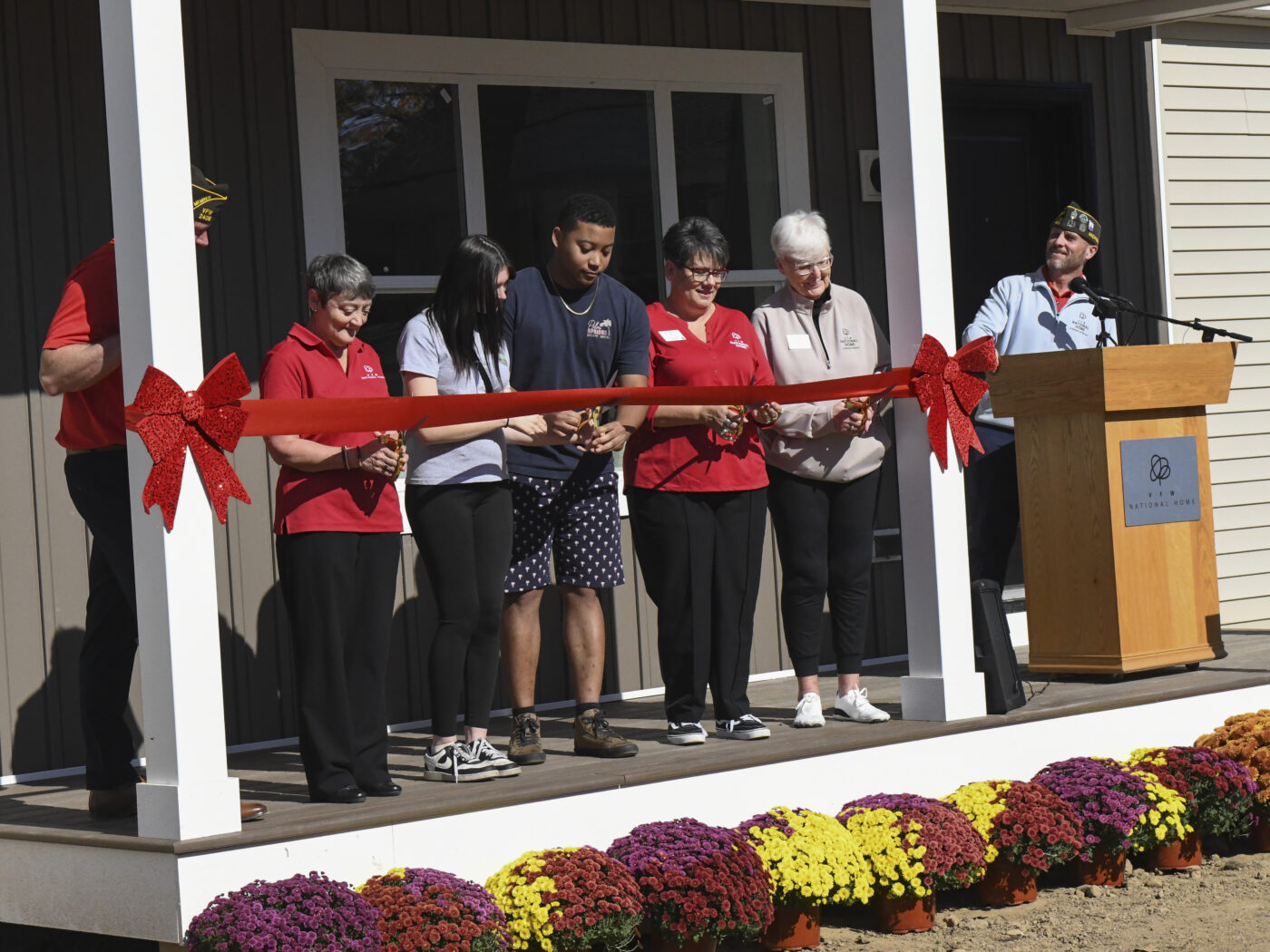
An October 23, 2026 ribbon-cutting ceremony for a newly constructed house on the National Home campus. The veteran family moving into the residence participates in the ceremony, alongside national-level representatives from the VFW Auxiliary, National Home staff, and nonprofit board members. (Photo by Trevor B. Kay)
More Than a Place to Live
Families may first become interested in the VFW National Home because of the opportunity to live in America’s heartland without paying rent or utility bills. That is understandable. Housing instability can become the first domino in a long chain of setbacks.
Families leave the neighborhood between Auxiliary Memorial Drive and Aloha Hawaii Parkway as success stories because of the tailored programs available during their time at the National Home. The on-campus program provides housing and utilities for up to four years, along with dedicated case management, day care, school-age programs, Specific, Measurable, Achievable, Relevant, and Time-Bound goal planning, homeownership preparation, and a safe, supportive community.
The program is organized into Red, White, Blue, and Transition phases. Sound familiar?
- The Red Phase lasts approximately six to 18 months and focuses on stability and support. Families meet weekly with a case manager, identify immediate barriers, receive financial guidance, connect with veteran resources, and address food or financial insecurity. It is the phase when families can finally exhale long enough to see their problems clearly.
- The White Phase can last up to 24 months and centers on growth and confidence. Families continue refining their goals, strengthening financial habits, building relationships, pursuing education or employment, and preparing for life beyond the campus.
- The Blue Phase lasts up to 12 months and shifts attention toward transition. Families conduct long-term planning, build connections outside the National Home, and explore available grant opportunities.
- During the final Transition Phase, the plan becomes real. Families put their next steps into action, strengthen outside support networks, and celebrate earned independence.
The goals are personal but concrete. Pay off debt. Build an emergency fund. Start a 529 college savings account for a child. Finish a degree. Help a spouse start a business. Grow closer as a family. Begin a health and wellness journey. Save for a first home.
Financial education is a cornerstone of the program. Residents attend financial classes offered through fiduciary partners, learning practical skills to budget, save money, pay down debt, and prepare financially for the future.
The campus has a baseball field, a basketball court, a fishing pond, and a bus stop for the Eaton Rapids School District. During an earlier visit, I watched an after-school foam party in progress. A dedicated bubble machine produced plenty of the good stuff for children to chase downwind, pop, or commandeer into piles of suds to throw at siblings—dealer’s choice. The Home also offers day care for residents whose children are too young for school.
Those details might appear small to someone reading a brochure. They are not small to a parent trying to work, attend school, pay down debt, and build a future. They create the room a family needs to shape its transition instead of merely surviving it.
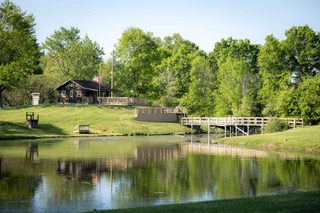
A recreational cabin overlooks a fishing pond on the VFW National Home campus. Families participating in the program receive housing and utilities while working with case managers toward financial stability and independent living. (Photo courtesy of the VFW National Home. Photo by Katie Darling, director of marketing.)
Connor’s Story
Connor’s story embodies the mission of the VFW National Home.
Out of respect for his family’s privacy, I will identify him only as Connor. I met him for an interview at 7 a.m. on a foggy Thursday morning. Driving from my home in Grand Ledge to the National Home’s chapel, I dodged deer moving through the rolling mist.
Connor was tall, athletic, intelligent, and well-spoken. He had the presence of a recently separated veteran: a sharp haircut, a firm handshake, and comfortable clothes consisting of a flannel shirt and trail pants. The interview began cordially, like two acquaintances with a mutual friend talking about a shared experience.
When I asked why he joined the military and what sense of purpose it gave him, Connor considered the question.
“I always wanted to be in the Army, ever since I was little,” he said. “Later, I knew that I wanted to be a good husband and a good father.”
Connor and his wife both grew up in mid-Michigan. He served on active duty as a special operations medic for 11 and a half years, with assignments at Fort Benning, Fort Bragg, and, most recently, Joint Base Lewis-McChord.
When Connor decided to leave active-duty service, he and his wife found themselves trying to understand what would come next for them and their children. They wanted to retain some measure of the stability Army life had provided while confronting an endless list of civilian possibilities.
“The military takes care of on-post housing,” Connor said. “Coming straight from active duty, there can be a culture shock when working with civilians. Veterans can be a lot less dramatic; we put our heads down and get through things. Even little things, like your kids leaving their toys all over the yard—that might bother some people, but it doesn’t bother veterans.”
I laughed and smiled. Anyone who has lived on an active-duty post knows the front-yard sea of sun-bleached, secondhand Playskool and Little Tikes plastic. Red and blue slides. Greening dollhouses. Brittle Wiffle Ball bats.
Military families regard this menagerie of playthings as a physical harbinger of joy and chaos bound to pour from the school bus when the youthful masses are released from Omar Bradley Elementary School. It is a homeowners association’s nightmare.
Connor’s family has goals familiar to most people facing a major job change and life transition: becoming debt-free, building a substantial emergency fund, and saving for a home. When Connor learned about the VFW National Home, the prospect sounded too good to be true.
“It’s unbelievable,” he told me. “I asked, ‘What’s the catch?’”
Even before Connor had officially separated from military service, the National Home staff welcomed his wife and two young children. They helped the family settle into a new home and handed them the keys. Connor remained at Joint Base Lewis-McChord to finish clearing the post and arrange shipment of the family’s belongings from Washington state to Michigan.
Then life intervened, because it always does.
After receiving his DD Form 214, the military’s “Certificate of Release or Discharge from Active Duty,” Connor hitched a moving trailer to his 2005 Ford F-150. He started the long drive from the West Coast to the Fresh Coast. Somewhere near Bozeman, Montana, the truck died and refused to restart.
“Happy DD-214 Day,” Connor said to the universe.
Connor laughed while recounting the story. He had maintained the truck himself from the day he bought it. He had replaced broken parts, serviced every system, and personally turned every wrench and ratchet used to keep it running.
“Thank the Lord it broke down in Bozeman,” Connor said, “because there wasn’t much past that.”
It was an awful day, but Connor knew his wife and children were safe. They had a home, the things they needed, and a supportive community waiting for him 23 hours away.
That peace of mind was everything.
After the truck was repaired and Connor reunited with his family, they began saving. When the F-150 finally gave out for good after its first Michigan winter, the family bought a newer truck with cash.
“I was in disbelief,” Connor said. “It still doesn’t feel real sometimes.”
Connor now works as a paramedic, continues serving in the National Guard, and is building a small business based on the medical skills he developed during his military career. His concept is straightforward and needed: teach people how to respond to traumatic injuries before professional first responders arrive.
Veterans pursuing similar goals can receive counseling, training and mentorship through the U.S. Small Business Administration’s Veterans Business Outreach Centers.
“Everyone teaches CPR; everyone learns CPR,” Connor said. “What I want to teach is trauma response in a similar context, using the skills they teach every service member, starting with stopping the bleeding.”
His long-term goal is to continue practicing medicine and helping people, potentially through a physician assistant school or a medical school. Both options are viable. He and his family now have the stability to choose.
Michigan as an Incubator for Agriculture and Opportunity
After my interview with Connor, I stopped at the Regenerative Agriculture for Veterans farm stand outside the campus on Waverly Road. For the privilege of buying a National Home-grown pumpkin and a pint of cherry tomatoes, I paid $5 dollars into a yellow metal cashbox.
The adjacent shelves carried bouquets of hand-cut flowers. Several confused pollinators bounced among collections of blooms rarely packaged together this way in nature.
The care with which the produce and flowers were arranged made it clear that the little farm stand mattered to someone. Real-life skills. Real purpose. A real difference.
Regenerative Agriculture for Veterans, known as RAVE, gives veterans hands-on experience in sustainable farming on the National Home campus. Participants help build and maintain a demonstration farm. They install fencing and irrigation, prepare soil, grow transplants, and harvest crops.
The program also connects veterans with educational and volunteer opportunities, including harvest events, cooking demonstrations, and family activities.
The program’s value comes from the process rather than the vegetables, fences, or flower bouquets. Veterans reconnect with the satisfaction of working with their hands while learning skills that can lead to an agricultural career, a small business, or further education.
Put in the time. Hone your skills. Consolidate gains. Breathe in, breathe out. Move on.
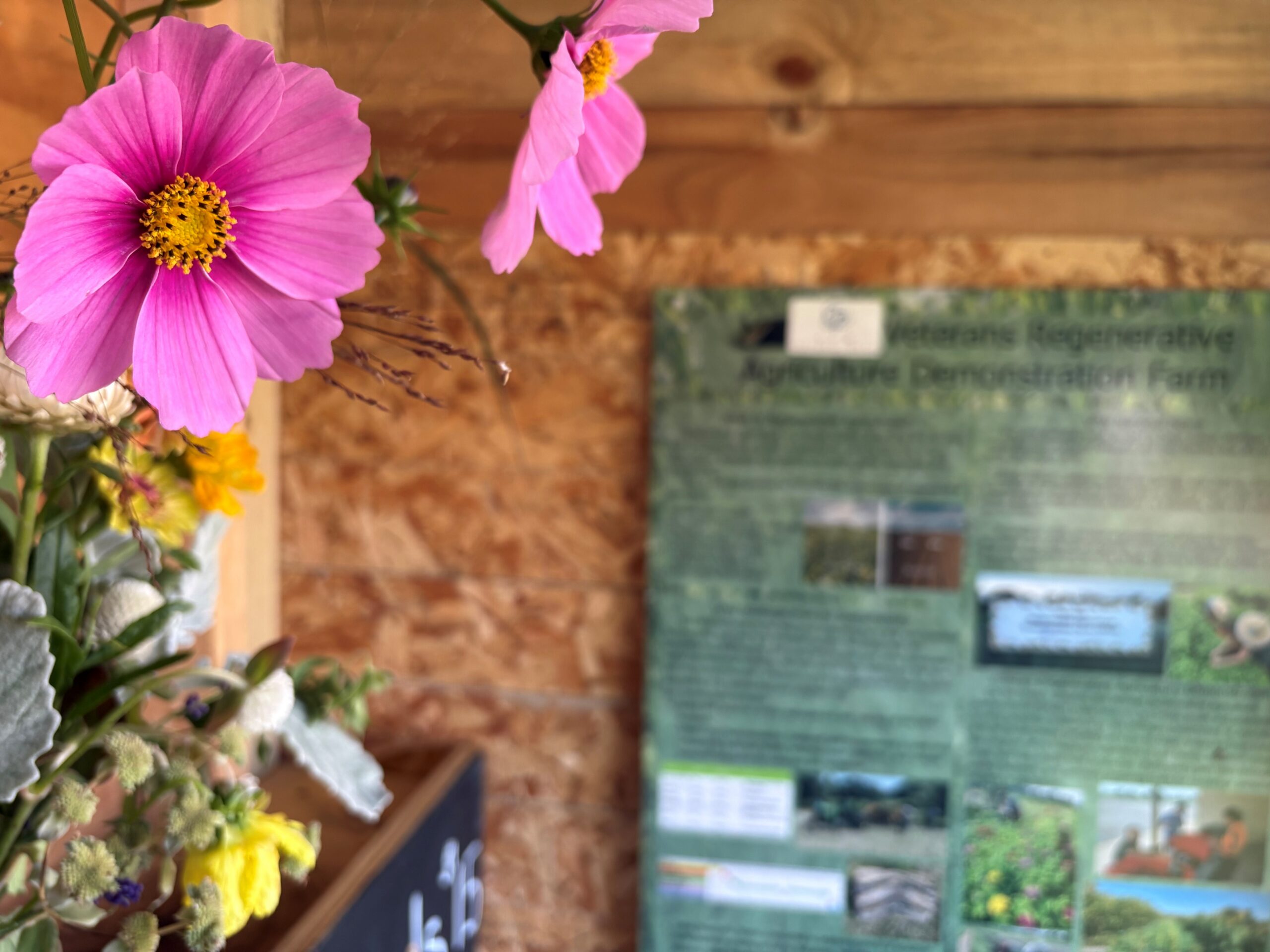
Flowers grown through the Regenerative Agriculture for Veterans program are displayed at the campus farm stand. Agricultural programs provide veterans with hands-on work, new skills, and opportunities to reconnect with the natural world. (Photo by Trevor B. Kay)
The National Home also hosts Heroes to Hives, a program where veterans learn the art and science of beekeeping. Participants study hive management, bee health, honey production, and the business side of beekeeping under experienced instructors. They also gain a community in which to work, learn, and reconnect with the natural world.
These programs belong here for a reason. The open fields and black soil of Eaton Rapids do not erase a veteran’s past. They create an agricultural canvas upon which a person can make something new and meaningful.
Meet The Staff
Residents are not the only veterans on campus. The VFW National Home is staffed by people who understand military service and transition through personal experience.
Dr. Jerred Johnson, the National Home’s executive director, is a retired Michigan Army National Guard officer and a veteran of Operation Iraqi Freedom and the North Atlantic Treaty Organization’s Kosovo Force mission. He served in the National Guard for more than 23 years, including as a company commander.
“For more than two decades, I knew my mission,” Johnson said. “When you leave the military, suddenly that mission can look very different. I think that transition can be difficult for many veterans. You’re trying to figure out, ‘Where do I fit now? What am I supposed to be doing? Where can I still make a difference?’ I quickly realized I still needed a purpose. I still wanted to serve. I found my answer at the VFW National Home.”
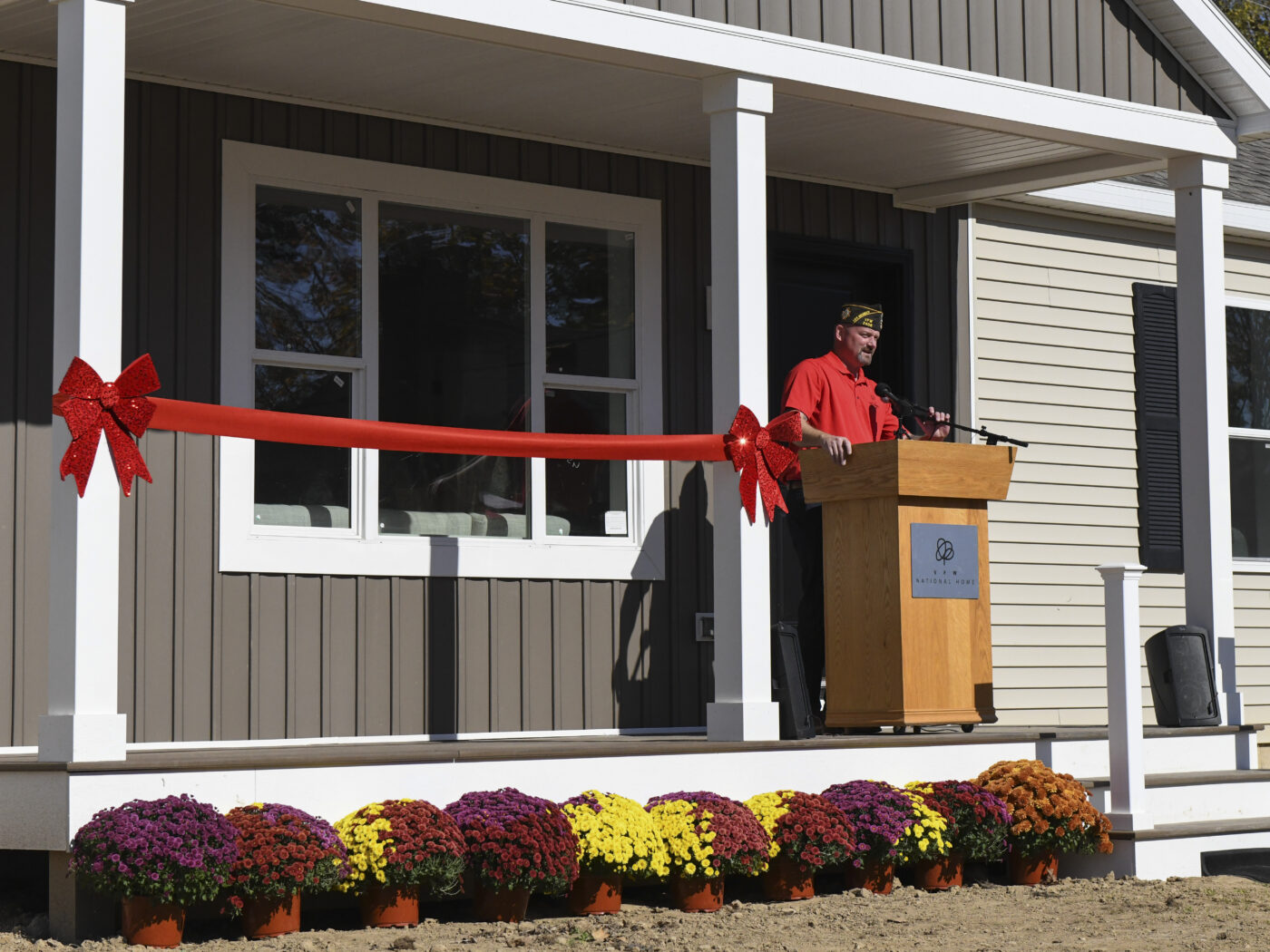
Dr. Jerred Johnson, Executive Director of the VFW National Home and veteran of the Michigan National Guard, speaks at an October 26, 2026 ribbon-cutting ceremony for a newly constructed house on the National Home campus. (Photo by Trevor B. Kay)
Johnson’s task is practical and urgent: connect families’ needs with resources and make sure veterans know those resources exist.
I get to serve veterans and their families every day,” he said. “I get to help make sure they have stability, resources, support, and, most importantly, hope. Sometimes, everyone needs somebody in their corner. Veterans are no different. I want people talking about the National Home. I want veterans telling other veterans about it. I want military leaders, VFW members, families, community partners, and organizations across the country to know what is available here.
Katie Darling, the VFW National Home’s director of marketing, described the National Home as a foundation for lasting change rather than a temporary refuge.
“The VFW National Home is so much more than a place to live,” Darling said. “It’s a completely free program that provides veterans and their families with a house to call home, stability, a safe and supportive community, and the resources they need to achieve their goals. Every family comes to us with a different story, different challenges, and different dreams for their future.”
For Darling, the visible indicators of progress are found in ordinary life: children playing, parents finishing school, families paying down debt, veterans finding confidence, and neighbors building relationships that will remain after they leave campus.
“Sometimes it’s a huge milestone, like a family purchasing their first home or graduating from our program,” she said. “But sometimes it’s the smaller moments that mean just as much.”
The Future
The future of the VFW National Home rests on continued service and deliberate expansion. Its strategic plan charts the organization’s direction as new families occupy their homes and families who have completed the program move into the next phase of life.
That departure can be bittersweet. Closing the door on a home filled with love, learning, struggle, and triumph can be hard. So can leaving neighbors who helped carry a family through good days and bad. Moving toward an unfamiliar community can feel like leaving a military installation for a new duty station: strangers in a strange land.
Families leaving the National Home do not leave as they arrived. They carry shared achievements, personal growth, and practical skills that can help them face the challenges ahead. Leaving the VFW National Home does not guarantee an easy life. It means the family departs with a stronger foundation capable of carrying life’s weight—financially, mentally, emotionally, and socially.
For me, seeing the peaceful environment created by the VFW National Home hurts. More than a little. Somewhere between a deep paper cut and getting hit in the head with a hammer. The pain changes depending on the memory recalled and the connection it brings back. Persistent and apparent, I cannot quite remove the feeling from my head.
This beautiful existence is tangible and real. The program is not a 1-800 number on a PowerPoint slide or a self-printed business card handed out at a leadership conference. This place embodies hope, provides resources, and offers support—so long as its recipients work toward their own growth, healing, and stability.
It makes me think about the veterans I have known who could have benefited from a program like this, had they known it existed.
Which soldiers’ lives could have been changed? Why is this program not mentioned in every mental health brief or financial brief? Which brothers and sisters, who hurt so much and felt so deeply, could have been set on a new path?
I am not alone in reaching that realization.
Before I started with the VFW National Home, the more I learned about the mission and the resources, the more I kept thinking, ‘Why didn’t I know about this?’” Johnson said. “I knew veterans who could have benefited from a place like this. There were times in my own life when knowing these resources existed could have made a difference. That became very personal for me.
Johnson added that veterans are often trained to “adapt, overcome, and accomplish the mission.” Those qualities serve them well, but they do not solve every problem encountered after military service.
“I think sometimes those of us who have served can become very good at carrying things ourselves,” he said. “Those are incredible qualities, but life after service can bring challenges that you can’t solve by simply pushing harder.”
The farm fields of Eaton Rapids abut the 640-acre VFW National Home campus. We know that routine care, time, the opportunity to take a knee and drink water, and a little sunshine in the forecast may be all a plant—or a person—needs to flourish.
“I believe veterans need that same sense of community after they leave the military,” Johnson said. “They don’t have to have all the answers. They don’t have to pretend everything is fine. They can come here, take a breath, and begin figuring out what comes next with people beside them. That sense of belonging is powerful.”
The VFW National Home has spent more than a century proving that service does not end when the uniform comes off.
Sometimes it looks like a case manager helping a family make a budget. Sometimes it looks like a child chasing bubbles across a field. Sometimes it looks like a veteran standing at a farm stand with dirt on his hands, a new skill to learn, and a future he can finally picture.
And sometimes it looks like a home in Michigan’s heartland, where a veteran family can begin again.
To learn more about the VFW National Home, visit its website.
If you are an active-duty service member, National Guard member, military reservist, veteran, or veteran’s spouse and think the VFW National Home could be the right fit for your family’s circumstances, learn how to apply to the on-campus program. If you are considering supporting the VFW National Home, learn how to donate. More than 90% of the program’s funding comes from private donations. Your contribution matters.
(The views expressed are those of the author and do not reflect the official policy or position of the VFW National Home, the Veterans of Foreign Wars, the Michigan Department of Military and Veterans Affairs, the Michigan National Guard, the U.S. Army, the Department of War, or the U.S. government.)


Commenting is available to active SWJ members and staff.