





After the Silence: Peer Support, Spiritual Stigma, and Camaraderie Foundation

Editor’s Note: This essay is part of Small Wars Journal’s Veterans Day 2026 Showcase, a special series recognizing veterans’ service and the work of charities, nonprofits, and civic organizations supporting veterans, military families, and their communities. Published during Veterans Day week, the showcase highlights how service continues beyond the uniform and marks the second anniversary of SWJ’s relaunch. Publication of the essay does not represent an endorsement of the organization featured.
Abstract
In 2008, while serving at Langley Air Force Base, I experienced cardiac arrest and what I describe as a profound near-death experience. I kept that story mostly private for about twelve years because I feared stigma more than I feared dying again. This essay connects that silence to the peer-support gap many veterans still face and to the practical work of Camaraderie Foundation in helping service members, veterans, and families address invisible wounds through counseling, emotional support, and community.
Introduction
In my experience, the military expects you to fit within an operational box. There is room for religious diversity within that expectation of uniformity. But talking about my own experience of the afterlife felt like something that could be taboo.
I am a medically retired U.S. Air Force Public Affairs journalist. On April 1, 2008, while serving at Langley Air Force Base, I experienced cardiac arrest and what I describe as a profound near-death experience. I was twenty.
Continued Service Through Peer Support
This essay is not proof of heaven. It presents a case study in stigma, disclosure, and continued service after the uniform. It connects twelve years of personal silence with nonprofit peer support through Camaraderie Foundation, where I now serve on the board.
The base hospital and my command knew about the air embolism that caused my heart to stop. Afterward, I received no follow-up mental health care, and no one recommended that I speak with a chaplain. Everyone knew what had happened, but it felt as though nobody knew how to handle it, so everyone simply pretended it had never happened.
For about twelve years, I mostly stayed quiet. No one ordered me to. I thought I would be labeled crazy, a liar, or an embellisher. Worse, I feared being kicked out of the military over concerns about my mental health. I could not easily say what I remembered of light, love, laughter, and joy without worrying I would be managed, medicated, or written off.
That gap matters for force health and for transition. This fear and silence affect force health and military-civilian transition. We have published literature on traumatic brain injury, moral injury, and post-traumatic stress. We still have thin language, and thinner patience, for the service member who returns from a medical crisis with a sacred story and nowhere safe to put it. Silence is not always denial. Often, it is a practical decision about safety, work, and belonging.
After my near-death experience, I threw myself into things I had always wanted to try, including dancing, comedy, and photography. Later, I started to feel I needed to get serious and live the corporate life I saw others living. I dropped my hobbies. I came home from work and thought about work until I went to bed. Eventually, I was asked to list my hobbies on a questionnaire, and I struggled to think of anything beyond spending time with my family. I loved my family, but I had let the other things that made me feel happy and fulfilled slip away. I found myself questioning my purpose again.
In October 2020, Wounded Warrior Project’s Project Odyssey became a turning point. After I returned home, a therapist asked during a follow-up counseling session whether I had ever had a near-death experience. I burst into tears. Nobody had used that term with me before. When I asked how she knew to ask, she explained that her husband had experienced one.
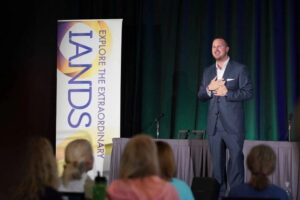
I later keynoted the IANDS International Conference in Phoenix in 2024 and have hosted conversations with military and veteran experiencers. Even in a room made up entirely of other veterans, gathered specifically to talk about these experiences, I have seen people look over their shoulders in fear that someone else might hear them.
My story offers personal testimony. Qualified professionals provide clinical guidance. Peer support can help people connect with appropriate care and support them throughout that process.
Camaraderie Foundation’s mission is to provide healing for the invisible wounds of war through counseling and emotional and spiritual support for military service members, veterans, and their families. What I value about Camaraderie Foundation is the real sense of…camaraderie. The foundation understands and embraces the need to meet veterans and spouses where they are in their growth journey.
I want SWJ readers to see this work as an expression of civil-military continuity. Veterans continue serving their communities by building institutions that reduce stigma and expand access to care. Peer support and nonprofit counseling pathways work alongside command climate initiatives and clinical systems. They catch people whom those systems still miss, especially when the presenting issue is isolation wrapped around experiences that are hard to name in a uniform way.
Commanders, chaplains, clinicians, and policymakers should initiate conversations with service members after a medical crisis. Create confidential, grounded listening spaces connected to qualified care. Resource local nonprofits that have earned veterans’ trust and evaluate their work through access and outcomes. Protect listening spaces that are confidential, non-sensational, and linked to real care options. Resource local nonprofits that already hold veteran trust, and evaluate them on access and outcomes rather than on marketing volume.
A Lifetime Commitment to Service
When I say Chase the Light, I mean choosing to notice presence, laughter, purpose, and love in everyday life. Those words describe how I try to live after my experience. They are not a medical approach, and I do not expect everyone to interpret an experience like mine in the same way. I wish someone had asked me that simple question years before the therapist did in 2020.
Service continued for me in a different form after medical retirement. I used to tell other people’s stories as a Public Affairs journalist. Now I am willing to speak about an experience I kept private for twelve years, and I serve on the board of a foundation that helps veterans find support. I remember the relief of finally answering a question I had been afraid to hear.


Commenting is available to active SWJ members and staff.