SWJ–El Centro Book Review – A Guerra: A Ascensão do PCC e o Mundo do Crime no Brasil
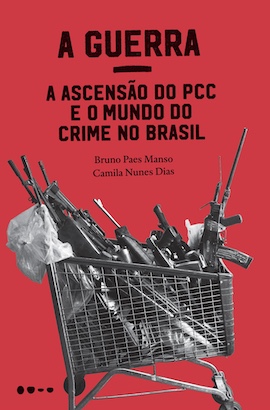

Bruno Paes Manso and Camila Nunes Dias, A Guerra: A Ascensão do PCC e o Mundo do Crime no Brasil (The War: The Rise of the PCC and the World of Crime in Brazil). São Paulo: Todavia, 2018. [ISBN: 978-8588808034, Softcover, 344 pages]
The authors of A Guerra are Bruno Paes Manso, a journalist with a doctorate in political science from the University of São Paulo, and Camila Nunes Dias, a sociologist trained there who teaches at the Federal University of ABC. The book combines his reporting with her prison research, including interviews with members of the Primeiro Comando da Capital (PCC) and rivals.
The book is written in Portuguese and was published in 2018. This transnational gang since 5 June 2026 it has taken on new relevance for American readers. On that date, the US State Department’s designation of the PCC and its main rival, the Comando Vermelho (CV), as Foreign Terrorist Organizations (FTOs). This designation took effect with its publication in the Federal Register, and it is now a federal crime to knowingly provide material support to either group.
A Guerra contains nine chapters and ends with an essay titled “Ubuntu,” diagrams called “Radiografia do PCC,” a bibliography, and eight explanatory notes. The book opens with the 2016 war between the PCC and the CV and then moves back in time to explain how the PCC got there. Because the chapters are non-linear in order (jump between places and years), I summarize the gang’s history and activities chronologically in this review with references to which chapters and notes this information appears.
Eight prisoners from a soccer team founded the PCC on 31 August 1993 in the Taubaté prison complex. The authors tie its rise to the Carandiru massacre of October 1992, in which police killed 111 prisoners. The massacre became the group’s founding grievance, cited in its 1997 statute (Ch. 4). In the late 1990s the PCC was still a hierarchy whose leaders called themselves “generals.” It sought to unite prisoners under the motto of peace, justice, and freedom, at first invoking an alliance with the older CV, itself born in a Rio de Janeiro prison in 1979 (Chs. 4, 6, & 7).
The PCC first showed its strength on 18 February 2001, when simultaneous rebellions hit 29 prisons across the state, with nearly 10,000 visiting relatives held hostage (Ch. 4). The years that followed brought internal war. Marcos Camacho, known as Marcola, broke with the founders and generals, who favored direct confrontation with the state, and after a series of deaths in 2001 and 2002 took control. Under Marcola, the PCC made the drug trade its main business and, from 2003, began replacing the pyramid with a shared command (Chs. 5 & 7). Its conflict with the state came to a head in May 2006, after the state moved 765 PCC leaders to two maximum-security prisons in a single night and the group ordered attacks on police and buses across São Paulo. “Before nightfall, the city came to a halt,” the authors write. Citing a 2008 university study, they count 564 dead between 12 and 21 May: 59 police and prison officers and 505 civilians, hundreds of them in killings attributed to police (Ch. 4).
The book’s picture of the PCC’s structure was largely what I expected. Top decisions came from a small council of imprisoned leaders known as the Sintonia Geral Final. A former leader, marked for death, was interviewed and compared the Sintonia Geral Final to Brazil’s Supreme Federal Court, the Supremo Tribunal Federal (STF)(Ch. 1). The book reproduces many PCC orders, known as salves, spelling mistakes and all, to show the gap between the prisoners’ schooling and their organizational skill (Note 2).
One clear point the book makes is that PCC authority rests on rules and procedure, and every major decision had to come from the faction’s council. In July 2011, the leadership created a new statute, dictated from inside prison by phone to members in other regions. The new statute added “equality and unity” to the motto, gave street-level units more autonomy, declared that the PCC had no territorial limit, and set death as the penalty for theft and betrayal (Chs. 3 & 4). In the PCC’s internal trials, known as debates and called tribunais do crime (crime courts) by the press, members heard both sides of the accused’s case and, as in a court, set the penalty, which could be simple expulsion or death. The PCC did not invent these rules, the authors write; it spread them through statutes, salves, and prison networks, and by settling disputes among members and nonmembers alike it came to rule criminal activity it did not own (Ch. 5).
After 2012 the PCC grew quickly outside São Paulo, from roughly 10,000 members at the end of that year to more than 29,000 by early 2018 (Ch. 1). The book’s best contribution is its use of the PCC’s internal messages to explain how that expansion, the growing autonomy of regional leaders, and business conflicts contributed to the war with the CV. A November 2013 salve banned crack and cocaine base paste in the prisons. The decision hurt imprisoned dealers’ interests and bred discontent. Tensions with the CV also rose when the CV began admitting members of PCC rival groups in different states. In a letter, the PCC challenged Marcinho VP, a CV leader held in a federal prison, over the admission of PCC enemies. According to the authors, Marcinho VP could not control the CV’s regional leaders. In June 2016, the PCC publicly announced its break with its old ally (Ch. 1).
In the same month as the split, a separate struggle for Paraguayan border drug routes ended in the assassination of Jorge Rafaat, the drug boss of Pedro Juan Caballero. On 15 June he was ambushed and killed in an attack of over five hundred shots being fired in some fifteen minutes (Ch. 3). Rafaat’s armored Hummer was pierced by a .50-caliber Browning anti-aircraft machine gun mounted on a tripod inside an SUV. Authorities named a consortium of PCC members, a gunman identified as being from the CV, and the network of a Brazilian trafficker jailed in Paraguay. The authors argue that none of those named held a position in the PCC, and suggest that the initiative probably came from the PCC’s border cell rather than its imprisoned leadership (Chs. 3 & 9). The Rafaat case shows the book’s real significance for international readers: it separates those who do business with PCC members from those who act on the PCC’s orders, a distinction investigators and analysts often miss.
The split turned Brazil’s prisons into battlefields: in January 2017, PCC rivals massacred 56 prisoners in Manaus (Ch. 2). In February 2018 the account reaches the murders of the only Sintonia Geral Final members at liberty, Gegê do Mangue and Paca. Their autonomy and business interests had caused internal friction, yet responsibility for the killings remained contested. The leadership first blamed the killers and sentenced them to death. In a second salve it changed its account, stating that Gegê and Paca had used the organization for their own benefit, but that their executions had still not been authorized (Ch. 9).
Some components of the book are less effective. With only eight notes, readers cannot always tell which claims were checked against court records, and a rival leader’s claim that the PCC’s enemies got help from “other South American groups” goes unconfirmed (Ch. 1). The closing essay, “Ubuntu,” criticizes mass incarceration and confrontational policing as drivers of the PCC’s growth and proposes regulating and decriminalizing drugs, a proposal the book does not test.
Three developments after the period the book covers deserve mention. In February 2019, Marcola and 21 other PCC leaders were moved to federal prisons. In 2025, prosecutor Lincoln Gakiya estimated that the organization had about 40,000 members and a presence in 28 countries. In August of that year, Operation Carbono Oculto raised suspicions that people tied to the PCC had entered the fuel sector, using payment companies and investment funds to move money and hide assets. Those suspicions still await proof in court. The book already describes gas stations, real estate, and car dealerships being used for money laundering (Ch. 5). The 2025 investigation points to more complex financial structures and a wider presence in the formal economy.
In summation, A Guerra was written in Portuguese for a general Brazilian audience, but its natural readers are those who are focused on the PCC in their work—both within Brazil and internationally: police and prison officials, prosecutors, intelligence and sanctions analysts, and scholars of organized crime. For those professionals, it is one of the most complete histories of the PCC through early 2018, and a fascinating, informative read.
El Centro readers can additionally draw upon the works “El Centro Annotated Subject Bibliography: Criminal Insurgencies in Mexico and Latin America” (March 2026) and Competition in Order and Progress: Criminal Insurgencies and Governance in Brazil (March 2022) for further resources on criminal organizations in Brazil and the wider region.