Counter-Drone Weapons Have Arrived

Why The Next Phase of Drone Warfare Will Be Defined By The Weapons Built To Stop Them
In Ukraine, exquisite hardware that dominated battlefields for a century has been turned into an expensive liability by cheap airframes carrying improvised payloads. A few hundred dollars’ worth of quadcopter now routinely kills a few million dollars’ worth of tank. While drone warfare has quickly surpassed ‘emerging’ status, the purpose-built weapons to fight drones have lagged behind the threat. The counter-drone industry promised lasers and microwaves that fire for pennies, restoring the cost-exchange ratio drones inverted. This year, many of those systems finally saw their first meaningful deployments. None of them has reversed the ratio. The pennies-per-shot advertised by the industry is a measure of the cheapest element in a system whose real expense sits in the sensors and cameras needed to acquire the target and expensive hardware to enable the kill.
Counter-Unmanned Aerial Systems
Counter-unmanned aerial systems (CUAS) are the technologies used to defeat drone attacks. Jamming, which attacks the control link rather than the aircraft, has been the most widely deployed and effective countermeasure. In response, drone operators installed fiber-optic cables and frequency hoppers, reducing the effectiveness of countermeasures. The future of CUAS will depend on the established jamming practices pioneered in Ukraine, and the emerging market of physical CUAS technologies. Physical CUAS can be divided into three major categories: firearms, lasers, and microwaves. In order to be effective, all physical CUAS systems require robust detection, and are usually paired with cameras and advanced computer vision tracking.
The attempted drone attack on Leipzig/Halle Airport in August 2026, which Germany has since attributed to Russia, highlights the vulnerability of critical infrastructure like airports and the need for better CUAS systems. The explosive-laden drone struck a Ukrainian cargo plane and failed to detonate, lying on the ground for four hours before being discovered by a bus driver.
Every system described here presumes the CUAS has already found the target, but no one realized they were under attack in Germany until workers found the drone lying on the tarmac. Drone detection is critical to deterrence, and cases like Leipzig show the robust non-military market waiting for counter-drone technology that implements a full detect-and-intercept stack.
Firearms are the most widely used physical CUAS in the Russia-Ukraine war, providing the most efficient cost-per-kill in the conflict. Handheld shotguns have proven to be the most effective of legacy kinetic options, but within the bespoke CUAS field innovators are attempting to provide a spectrum of solutions that combine kinetics with autonomous targeting and tracking systems. At one end, software helps the soldier aim. In the middle, robotics physically correct the weapon. At the far end, the firearm, vision system, and targeting software become a self-contained autonomous turret. These weapons can function with a human approving each shot, or with no human decision at all as part of a fully autonomous and decentralized kill chain.
In its most basic form, a handheld firearm is outfitted with a computer vision system and targeting robotics. Smart Shooter, an Israeli company, mounts the vision system on the soldier’s own rifle where the fire control optic tracks the target and holds the trigger until the shot will connect. A New York-based company named Zero-Mark uses a similar optical mounting technique, but integrates a motorized stock which adjusts in the soldier’s hands to mimic a computer-guided rifle and make drone targeting more accurate. Outside combat zones, firearms can employ subsonic nonlethal rounds for drone deterrence in domestic settings, limiting collateral liability. Because firearms are ubiquitous and integration of CUAS technology on them is straightforward, fully autonomous firearms may begin their lifecycle as CUAS but will likely spread into every domain of warfare. As the targeting and computer vision systems that enable these technologies improve, it will allow militaries to operate more comfortably in the gray zone of AI-enabled warfare.
A fully integrated kinetic system combining vision, tracking, and kinetics into a single platform is the most expensive firearm CUAS system. Allen Control Systems’ Bullfrog turret can be deployed without the need for human control. Ukraine’s Sky Sentinel, which has been operating as an AI turret system for over a year, is being deployed to protect factories and military-industrial hubs. These turrets require AI targeting software, advanced optical systems for target identification and tracking, and robotics systems to actuate the firearm. While these industries might promise pennies per kill, the upfront hardware costs make it a high-value target with a bigger price tag than a precision-guided interceptor.
Lasers have already been deployed in combat against drones, with Israel becoming the first country to use high-power laser interception in combat, fielding prototypes during the Swords of Iron war. The US has spent years developing and deploying similar capabilities, particularly through the Navy which has tested and fielded shipborne laser systems such as LaWS and HELIOS. Most recently, in August 2026, Joint Task Force–Southern Border used the Army Multipurpose High Energy Laser to defeat three hostile, cartel-linked drones near the US-Mexico border. The Army’s emerging production systems are estimated to cost roughly $21–25 million apiece. Pennies to shoot, millions to field.
Laser systems designed for high-altitude drones like the Shahed are emerging as a promising frontier for CUAS. High-energy laser systems use AI targeting to focus on a target long enough to damage it. Beyond the focal point, the beam diverges and its irradiance decreases, which can reduce the risk of collateral damage downrange. Lasers are classically vulnerable to large swarms, and weather can materially diminish their effectiveness. For customers like airports, factories, or government buildings in urbanized environments, a laser-based system or subsonic kinetic solution will provide some protection with the least possibility of collateral damage, physical or economic. However, the Army laser deployed along the southern border targeted a Border Patrol drone in an apparent friendly-fire accident. Two weeks earlier, the same system fired on balloons, prompting a 10-day closure of El Paso airspace by the FAA.
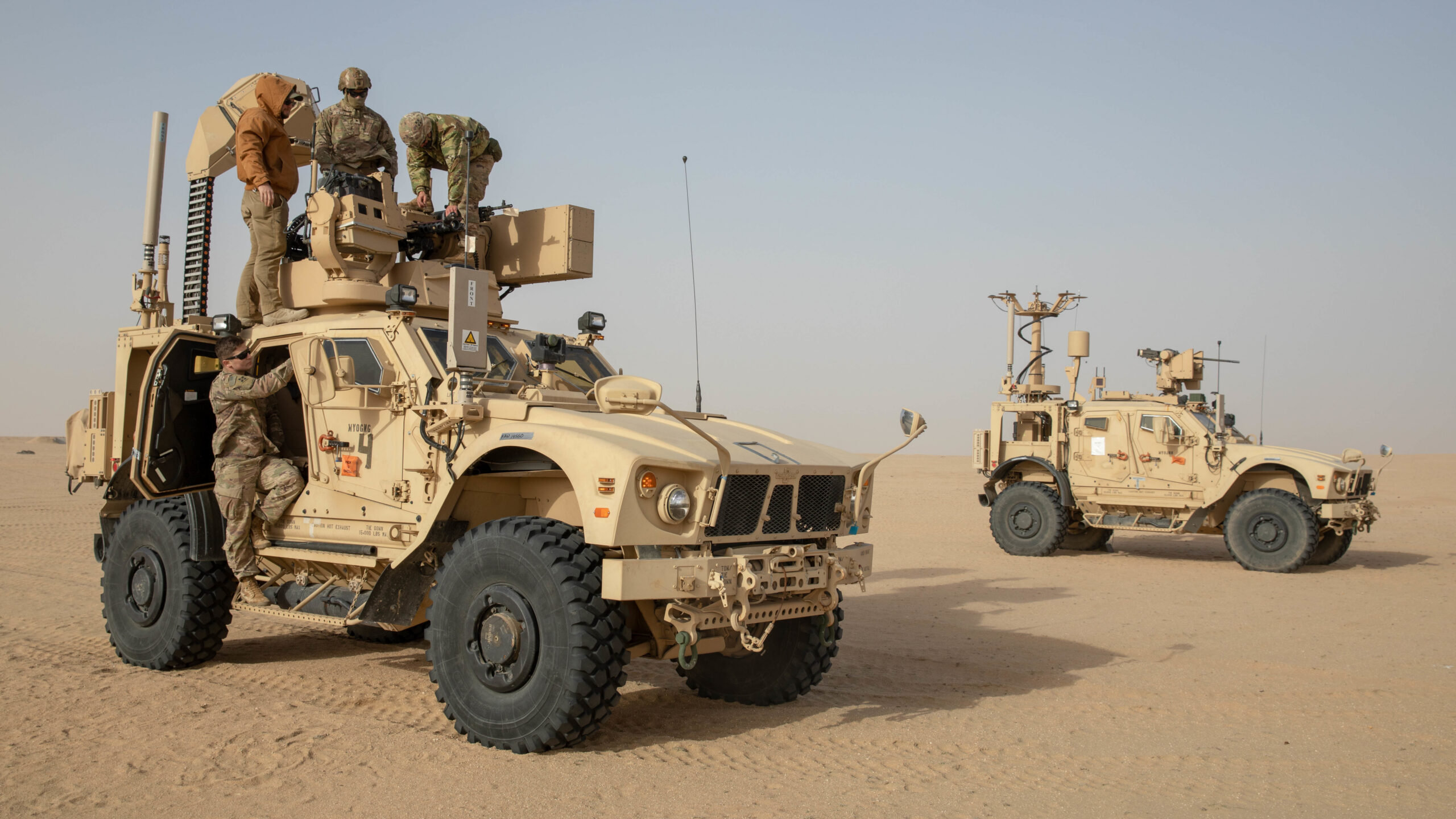
Microwaves are the least proven technology, yet the most likely to provide credible defense against large swarms at low cost. Deployable in both mobile and stationary systems, a high-power microwave pulse has the capability to defeat fiber-optic equipped drones. This solution is potentially the most cost-effective, a decisive advantage in asymmetric warfare. In March of this year, Epirus unveiled a mobile Leonidas at the Association of the US Army’s Global Force symposium, mounting the microwave emitter on a self-driving vehicle. A second-generation system has been through Army developmental testing, but there is no credible reporting that Leonidas has yet engaged a hostile drone in combat.
Each Army Leonidas unit is estimated to run between $10 and $20 million. In October 2024 Epirus announced the Army would spend a further $17 million on a radar and optical/infrared suite to find and track what the emitter would fire at, after testing showed the pulse’s effectiveness. The pulse is nearly free, but the sensing layer is not, and the upfront capital costs for the entire system make the whole assembly a high-value target the moment it emits.
For civilian and industrial domestic markets, firearm and microwave solutions face steeper adoption barriers, owing to the liability of targeting malfunctions and the threat of collateral damage. Microwaves are the hardest case. Epirus markets Leonidas as a directional system with a shaped beam and tunable power. Yet the pulse affects any unhardened electronics on that bearing — the hostile drone, a friendly one, or the avionics of the aircraft on approach. Near an airport or a port, the economic damage from a single pulse could outweigh the damage of the drone it stopped.
The Next Cost-Exchange Battle
As CUAS countermeasures mature, drone makers will continue to innovate to defeat them. Just as drone operators in Ukraine switched to fiber-optic cables and frequency hoppers to avoid jammers, innovations will emerge to meet the new frontiers of CUAS. The question is which systems can reverse the economics drones created: cheap, manufactured at scale, and expendable enough to survive a battlefield where the interceptor itself will become a target.
At the moment, the CUAS frontier is likely innovating faster than any other military technology due to the sheer effectiveness and distribution of drone technology. In Ukraine, it is estimated that 80% of casualties come from drones, and both sides have used tens of millions of cheap, attritable FPV drones since the war’s inception.
In every case, the CUAS future relies on changing the cost-exchange ratio that drone warfare inverted. Every solution claims cheap CUAS kills, but each system requires expensive upfront costs with no guarantee of success: high-powered laser diodes, expensive cameras, bespoke tracking/targeting software, all designed to be durable enough to survive kamikaze attacks that routinely destroy armored personnel carriers and tanks.
The commercial market will not select the same winners as the military. Battlefield conditions mean the unit must tolerate stray rounds, electronic interference, or the loss of a multimillion-dollar system. An airport, factory, or government building is not the same. Civilian systems face a second cost-exchange problem, where the cure cannot cause more damage than the disease.
Whoever wins this market will not be whoever builds the most elegant interceptor, but whoever builds a good-enough one at volume and keeps pace with the speed of innovation. Most importantly, the winner will upend the cost-exchange ratio, not offset it.