The Ukraine Laboratory: How a Full-Spectrum War Is Rewriting Modern Warfighting

Introduction
More than three years into the largest interstate war in Europe since 1945, the Russo-Ukrainian conflict has become the most closely observed and most instructive military laboratory of the 21st century. It is unusual not because any single weapon system within it is novel, but because almost every category of capability that defense planners have debated for a generation is now being employed simultaneously, at scale, and in full view. From hand-launched quadcopters to intercontinental posturing, from commercial satellite imagery to electronic warfare and early battlefield applications of artificial intelligence, the war compresses the entire spectrum of modern combat into a single theater. As the International Institute for Strategic Studies and other institutions have repeatedly noted, this is a war that other militaries are studying in near real time, extracting lessons even as the fighting continues.
The purpose of this analysis is to identify the ways in which the Ukraine war is transforming warfighting strategy rather than merely warfighting technology. The distinction matters. Carl von Clausewitz’s enduring observation in On War that the nature of war is constant while its character changes is a useful anchor here. What Ukraine demonstrates is not a change in the fundamental logic of armed politics but a rapid and possibly irreversible shift in the character of combat: in how forces see, mass, move, strike, hide, and sustain themselves. This analysis examines six vectors of transformation, then turns to the strategic consequence that has attracted the closest attention from external powers, namely the emergence of the battlefield as a shared learning environment for a divided international order.
The Transparent Battlefield
The single most consequential development is the arrival of what analysts increasingly call the transparent battlefield. Persistent surveillance drawn from a dense mesh of satellites, uncrewed aerial systems, acoustic sensors, and open-source reporting has made concealment extraordinarily difficult. Commercial space imagery, in particular, has eroded a monopoly that great powers once held. Constellations operated by firms such as Maxar Technologies and Planet Labs, together with the battlefield connectivity provided by SpaceX’s Starlink terminals, have given a smaller state persistent access to capabilities that were previously the preserve of superpowers. The Center for Strategic and International Studies has documented how this democratization of space-based intelligence has reshaped targeting and situational awareness for Ukrainian forces.
The strategic implication is profound. If a force cannot hide, it cannot easily concentrate, and the concentration of force at a decisive point is one of the oldest principles of war. The result has been a battlefield that in places resembles the attritional stalemate of 1916 more than the maneuver warfare of 1991. Dispersed formations and dug-in positions have returned, alongside a premium on deception, dispersal, and the rapid displacement of any asset that reveals itself. As analysts at the Royal United Services Institute (RUSI) have argued in their assessments of Ukrainian operations, the interplay between transparency and lethality is now the defining tactical problem of the modern land campaign.
The Drone Revolution Across Every Scale
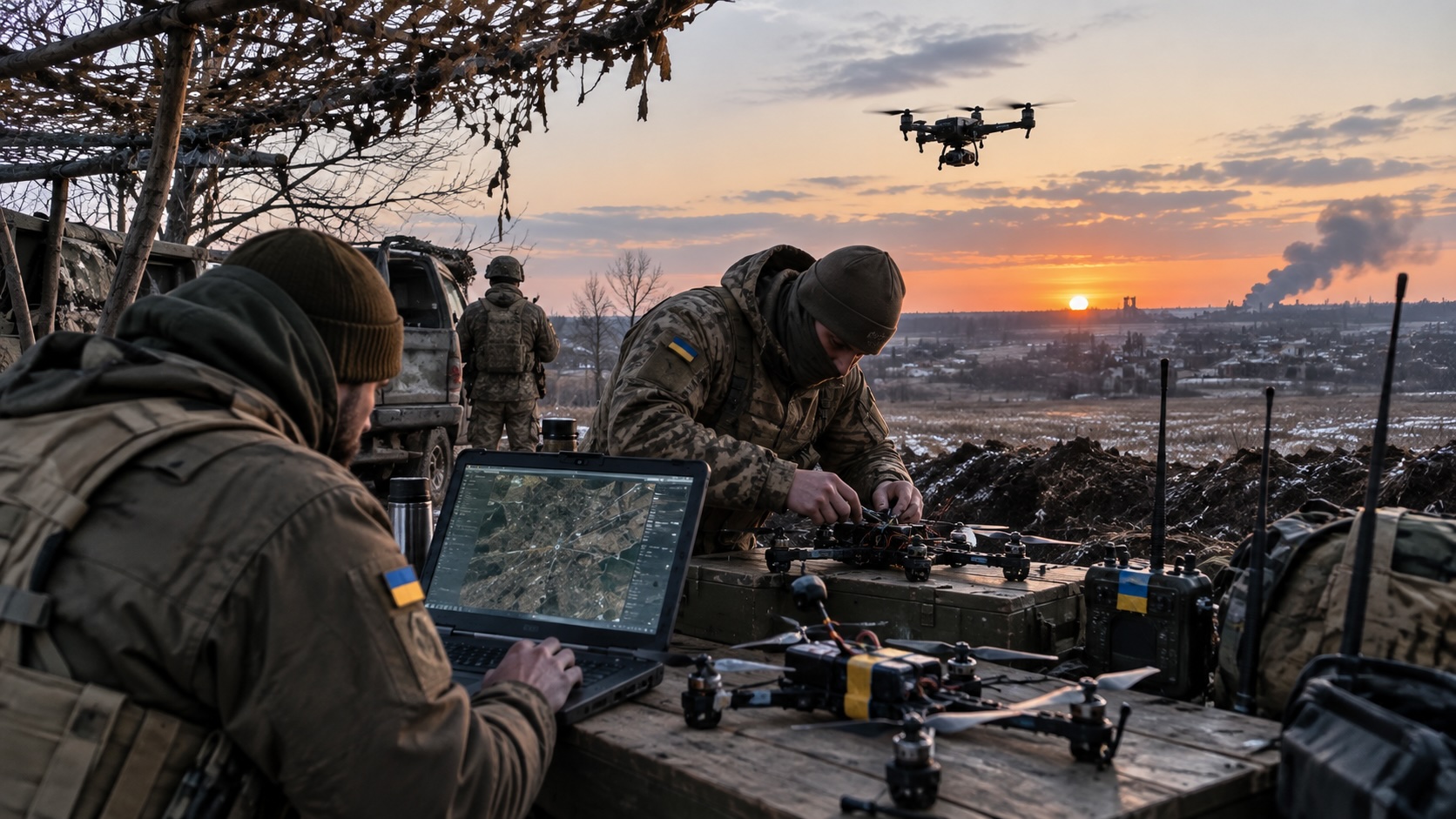
No feature of the war has captured attention more than the ubiquity of uncrewed systems. What distinguishes Ukraine is not the drone as such but the drone at every size and price point, integrated into a continuous kill chain. At the lowest end sit first-person-view (FPV) quadcopters costing a few hundred dollars, mass-produced and flown into vehicles, trenches, and individual soldiers. Above them operate reconnaissance and bombing octocopters, then fixed-wing strike and loitering munitions, and finally, long-range, one-way attack drones capable of striking targets deep inside Russia. Ukraine has also fielded uncrewed surface vessels that have neutralized a meaningful portion of Russia’s Black Sea Fleet, a striking demonstration of how cheap maritime drones can contest the sea denial of a far larger navy. The Center for a New American Security has described this as a preview of the affordable-mass problem that established militaries must now confront.
The strategic transformation here is one of cost imposition and industrial tempo. When a drone costing hundreds of dollars can destroy armor worth millions, the traditional economics of exchange are inverted. Equally important is the pace of adaptation: both sides iterate on airframes, payloads, and electronic countermeasures on cycles measured in weeks, forcing a shift from procurement built around decade-long programs to something closer to continuous, decentralized innovation. Iran’s Shahed-series loitering munitions, supplied to Russia and later produced under license, illustrate how a single design can be scaled into a campaign of attritional strikes against infrastructure and how a supplier state can learn from combat feedback to refine its own arsenal.
Missiles, Air Defense, and the Contest for the Sky
The war has become a live proving ground for the full ladder of missile technology and the air-defense systems built to counter them. Russia has employed cruise missiles, ballistic missiles, and hypersonic-capable systems such as the Kinzhal, while Ukraine has integrated a heterogeneous mix of Western air defenses, from Patriot batteries to NASAMS and legacy Soviet systems, into a layered shield. The interception of a Kinzhal by a Patriot battery was an early and closely studied data point on whether so-called hypersonic weapons are as unstoppable as their proponents claim. As the Arms Control Association has noted, the war has provided rare empirical evidence on missile-defense performance under sustained, real-world saturation attacks.
The strategic lesson is that neither offense nor defense has achieved decisive dominance and that the contest has instead become one of magazine depth and cost per intercept. Defending against cheap drones with expensive interceptors is economically unsustainable over time, a dilemma that has accelerated interest in directed-energy weapons, gun-based systems, and electronic rather than kinetic defeat. The fighter-jet dimension reinforces the point: the arrival of Western multirole aircraft has mattered less as a source of air superiority, which neither side has achieved, than as a mobile platform for standoff munitions and air defense, in a theater where the ground-based threat has pushed manned aviation to the margins.
The Electromagnetic and Cyber Dimensions
Beneath the visible war of drones and missiles runs a less visible but equally decisive struggle across the electromagnetic spectrum. Both sides have invested heavily in electronic warfare to jam navigation signals, sever the control links of drones, and blind sensors. The effectiveness of an FPV drone often depends less on its airframe than on whether its operator can maintain a signal against enemy jamming, which is why fiber-optic tethered drones, immune to radio interference, have proliferated. RUSI has published detailed technical assessments of how Russian electronic warfare has degraded the accuracy of precision munitions, including guided artillery rounds, forcing continuous adaptation in guidance and targeting.
Cyber operations have run in parallel, targeting critical infrastructure, command networks, and the information environment, though the war has also tempered earlier expectations that a cyber-attack alone could prove strategically decisive. The more durable lesson is that the electromagnetic and cyber domains are now inseparable from the kinetic fight and that control of the spectrum has become a precondition for the effective use of nearly every modern weapon. Space-based assets sit at the center of this contest, since the satellites that provide positioning, communications, and imagery are simultaneously the enablers of precision and the most tempting targets for disruption.
Artificial Intelligence and Software-Defined Warfare
Artificial intelligence has entered the battlefield less as autonomous killing machines than as an accelerant of the decision cycle. Ukrainian forces have used software platforms to fuse sensor feeds, identify targets, and pass firing solutions to the appropriate weapon far faster than manual staff work would allow. Firms such as Palantir Technologies have reported providing data-integration tools that compress the sensor-to-shooter loop, while machine-vision systems increasingly assist drones in the terminal phase of an attack, where jamming would otherwise sever the human link. This edges toward a degree of autonomy that raises serious legal and ethical questions, which bodies such as the International Committee of the Red Cross have pressed states to address.
The strategic transformation is the emergence of software as a primary determinant of combat power. When capability can be upgraded through a code update rather than a new production run, the military that controls the best data pipelines and the fastest iteration loops holds an advantage that traditional order-of-battle comparisons fail to capture. This is the deeper meaning of the phrase software-defined warfare, and it favors states and firms that can marry battlefield data to rapid engineering at scale.
The Great-Power Learning Laboratory
If the tactical story of Ukraine is about drones and transparency, the strategic story is about learning. The war has drawn in, directly or indirectly, virtually every consequential military power, and it has done so along the fault line of a broadly divided international order. On one side, NATO members have supplied Ukraine with weapons, intelligence, training, and financial support, using the conflict as an involuntary but invaluable test of their own doctrine, stockpiles, and industrial base. The war has exposed uncomfortable truths about the shallow depth of Western munitions inventories and the fragility of defense-industrial mobilization after decades of peacetime procurement, prompting a reassessment documented across European defense policy circles.
On the other side, Russia has been sustained by a coalition of partners whose involvement has itself become a subject of intense study. China has provided economic ballast and, according to Western governments, dual-use components that support the Russian defense industry, while stopping short of open belligerence. North Korea has supplied artillery ammunition and, in a significant escalation, deployed troops, gaining combat exposure that its forces had not seen in decades. Iran’s contribution of loitering munitions has been the clearest case of a supplier learning from the conflict, refining designs and doctrine on the basis of their performance against Ukrainian and Western air defenses. The Institute for the Study of War has tracked the deepening of these arrangements as a defining feature of the war’s later phases.
Beyond the immediate belligerents and their backers, a wider circle of states is watching without participating. Militaries across Asia and the Middle East are drawing conclusions about the survivability of armor, the vulnerability of surface fleets to cheap drones, the indispensability of resilient air defense, and the value of a deep, mobilizable industrial base. For observers focused on other potential flashpoints, the war has become a reference case for how a technologically mixed conflict between a great power and a smaller, externally supported state might unfold. The lessons are not uniform, and there is a real risk that different observers will extract contradictory conclusions, but the intensity of the study is unmistakable.
Industrial Attrition and the Problem of Mass
A recurring and sobering theme is that high-technology warfare has not abolished the demands of industrial attrition; it has intensified them. Ukraine consumes artillery shells, drones, and interceptors at rates that have strained the production capacity of its supporters, revealing that precision and mass are not alternatives but complements. The side that can field advanced systems and replace them at scale enjoys a compounding advantage. This has forced a reappraisal in Western capitals of the assumption that qualitative superiority could substitute for quantity, and it has elevated defense-industrial resilience to a first-order strategic concern. The war suggests that future conflicts between capable adversaries may be won less by a single decisive battle than by the capacity to out-produce, out-adapt, and out-last. That conclusion carries significant implications for how states structure their economies for security.
Implications for Future Warfare and Force Preparation
The cumulative effect of these transformations is a redefinition of what armed forces must be able to do and, therefore, of how they must be trained and organized. Several implications stand out. First, forces must operate under constant observation, which places a premium on dispersal, concealment, deception, and the discipline to displace quickly after firing. Second, they must integrate uncrewed systems at every echelon, from the individual soldier upward, and treat electronic warfare as a core rather than a specialist competence. Third, they must fight in a contested electromagnetic and space environment, retaining the ability to function when satellite links and precision guidance are degraded. Fourth, they must be prepared for a tempo of technological adaptation that renders equipment obsolete within a single campaign, demanding institutional flexibility that peacetime bureaucracies rarely possess.
Training establishments are already responding. Western and partner militaries are revising curricula to incorporate counter-drone drills, spectrum management, and the rapid fielding of commercial technology, while Ukraine itself has become an unlikely exporter of hard-won expertise. The broader point is that the war is transforming not only weapons but the human and organizational software of armed forces, the doctrines, training pipelines, and command cultures through which technology is turned into combat power. A force that fields advanced systems without adapting its people and its methods will not realize their value, a lesson the war teaches on both sides.
Conclusion
The Russo-Ukrainian war is a laboratory in the fullest sense. It is a place where hypotheses about the future of warfare are being tested under fire, where results are recorded and disseminated with unprecedented speed, and where a divided international order is drawing lessons that will shape the conflicts to come. The transformation it is driving is real but uneven. It has not repealed the enduring logic of war, the interaction of politics, chance, and force, but it has altered the character of combat in ways that established militaries ignore at their peril. Transparency has made concealment a central strategic problem, and cheap, uncrewed mass has inverted long-standing cost calculations. The electromagnetic and space domains have become preconditions for effective action, software and industrial depth have emerged as decisive determinants of combat power, and the whole has become a shared classroom for states preparing for their own contingencies. For a policy community charged with anticipating the next war, the imperative is to learn the right lessons from Ukraine rather than the convenient ones and to build forces capable of adapting faster than the battlefield itself.