





Forging the Undersea Arsenal: How to Build the Autonomous Fleet the US Navy needs to Compete

Introduction
On December 15, 2025, a Ukrainian underwater “Sub Sea Baby” drone penetrated harbor defenses at the Novorossiysk naval base and damaged a Russian Kilo-class submarine, with follow-on analysis concluding that it was “mission kill.” The strike marks the first combat engagement of a submarine by an uncrewed underwater vehicle in naval history. It follows sustained Ukrainian unmanned surface vehicle (USV) successes in the Black Sea, which Ukraine’s Ministry of Defense credits with helping destroy or seriously damage roughly 30 percent of Russia’s Black Sea Fleet since 2022. Building on this sea-denial strategy, Ukraine executed another historic first on July 13, 2026, with an entirely robotic amphibious assault by using a modified USV to beach and deploy a machine gun-armed uncrewed ground vehicle (UGV) onto the contested Kinburn Spit. This operation marks a critical paradigm shift, demonstrating how cross-domain robotic integration can project force directly onto hostile shores without risking human landing teams. Ukraine has transformed autonomous drone warfare, demonstrating lethal capabilities across the ground, maritime, and air domains. Ukrainian drone innovation is inflicting significant economic and military damage.
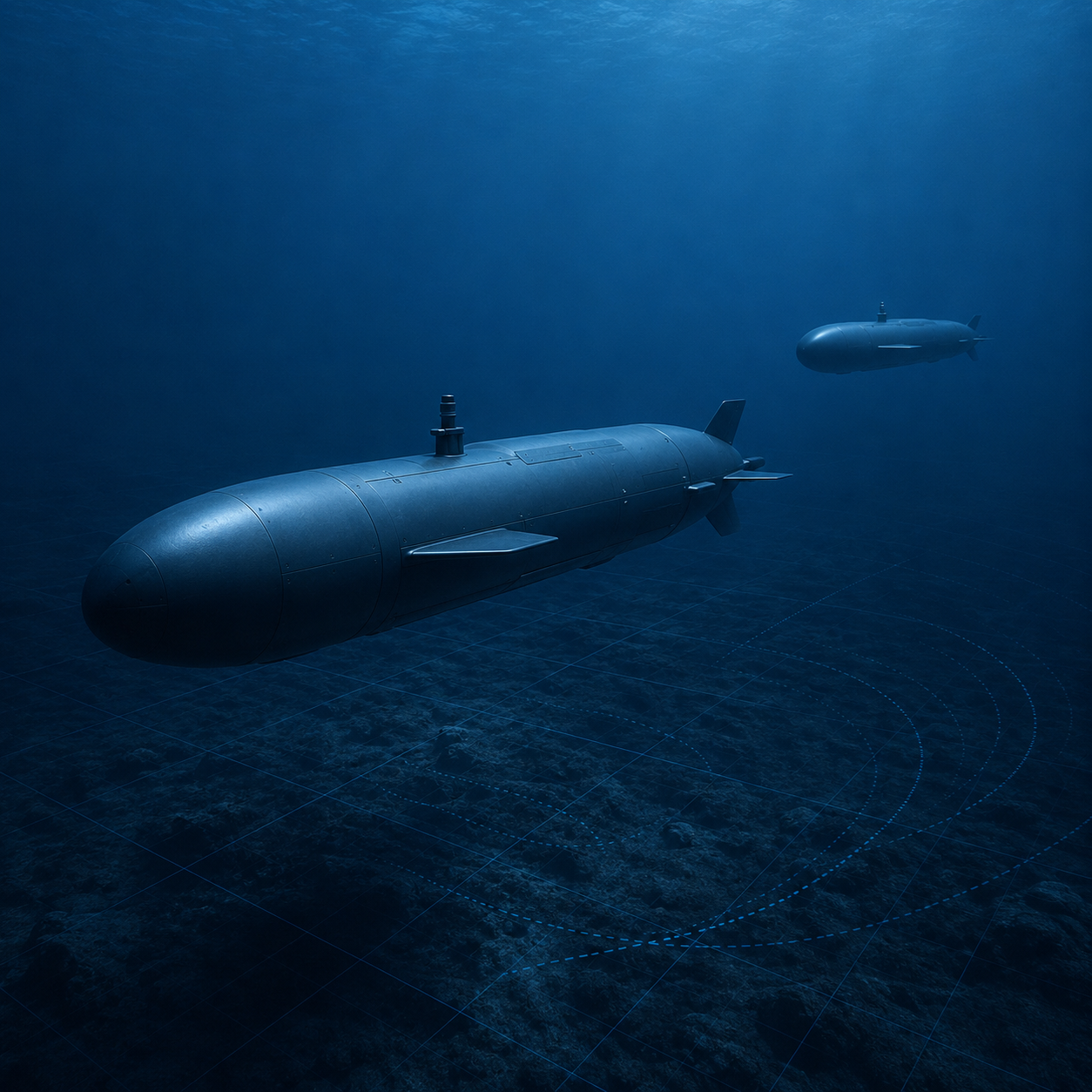
Autonomous underwater vehicles (AUVs) will reshape seabed warfare, subsea competition, and maritime force design by distributing sensing, extending operational reach, absorbing risk, and providing cheap undersea mass against much more expensive systems. They can monitor chokepoints, hunt adversarial submarines, protect seabed infrastructure, and persist inside heavily denied maritime spaces. AUVs will become a centerpiece of subsea dominance and easily threaten manned maritime vessels. Recognizing this reality, China is heavily investing in the unmanned technology. To ensure subsea supremacy, the United States and its allies need a maritime industrial base capable of building, testing, powering, maintaining, upgrading, and replacing AUVs at scale.
Unfortunately for America and its allies, that sort of industrial base for maritime drones does not yet exist.
The first major step in trying to fix this industrial deficit began in May 2026. The United States, United Kingdom, and Australia announced the first AUKUS Pillar II “signature project”: a joint effort to develop payloads and enabling systems for AUVs. The project prioritizes the protection of critical seabed infrastructure, strike and surveillance capabilities, logistics operations, anti-submarine warfare, mine countermeasures, and contested littoral operations. With initial system deliveries expected in 2027, it represents a fundamental shift in the force design of future navies. Crucially, AUKUS intends to build these capabilities around shared standards, trilateral operational concepts, and common control systems.
However, executing these aspirations requires Washington to apply its recent acquisition reforms to the maritime domain, solve the financial “valley of death” for innovative startups, and build an AUV production model that complements traditional defense primes with nontraditional firms, commercial technologies, and manufacturing methods designed for rapid iteration and volume. As noted in a June 2026 Government Accountability Office (GAO) report on Navy robotic and autonomous systems, traditional platform-centric acquisition pipelines force rapid-cycle unmanned technologies to compete directly for resources against multi-billion-dollar legacy platforms (e.g., aircraft carriers, submarines, etc.). To field subsea mass at scale, the Pentagon must transition from rigid, domain-siloed structures toward a capability-centric, commercial-first approach that leverages the innovation cycles of nontraditional tech sector suppliers.
The Case for Undersea Autonomy: Software, Lethality, and the Undersea Ecosystem
Unlike drones in the air and land domains that rely on continuous, high-bandwidth satellite links for real-time human piloting, the physics of the subsea domain constrain military capabilities. Radio frequency signals dissipate just several meters deep into saltwater. Acoustic communications are plagued by high latency, low bandwidth, and high probability of detection. These limitations mean real-time “human-in-the-loop” remote control is tactically unfeasible for submerged assets.
Consequently, AUVs need a high degree of operational autonomy, which new technologies are only just making widely available. AUVs must rely on onboard edge-computing, inertial navigation, and autonomous acoustic/optical sensing to navigate, avoid hazards, and identify targets during long-duration, communication-denied transits. This reality intersects with combat operations in Ukraine, where systems capable of killing without a human in the loop are becoming more commonplace. While DoD Directive 3000.09 has strict frameworks for requiring human judgment over the use of force, the policy is caught between modern battlefield realities and ethical oversight. Following a June 2026 executive push to eliminate barriers to AI deployment, the Senate Armed Services Committee advanced legislation attempting to strictly codify “ultimate human responsibility” in the AI-powered kill chain.
Unfortunately, efforts to mandate a human in the kill chain collide directly with the physics of the subsea domain. In contested waters, where communications may be jammed or physically impossible, future systems will require greater onboard autonomy for navigation, sensing, target recognition, and mission execution. This creates an increasingly difficult challenge for policymakers seeking to preserve meaningful human judgment over the use of force. Navies must transition toward edge-processed autonomous target-recognition and execution systems, regardless of onshore political discomfort and laws in Western capitals. Building an industrial base capable of manufacturing intelligent autonomous target-recognition and execution systems at scale is no longer an experimental luxury; it is a prerequisite for maintaining subsea deterrence and maritime warfighting dominance.
This undersea reality forces a paradigm shift in defense procurement. Traditional naval power relies on exquisite, heavily armored platforms, but the accelerating autonomous arms race prioritizes distributed, algorithmic agility. Modern AUVs rely entirely on onboard artificial intelligence, acoustic navigation, and simultaneous localization and mapping techniques. As defense analysts increasingly warn, software architectures (especially those for sensor fusion, real-time edge processing, and multi-agent coordination) will dictate the utility of these platforms in the next war. Rather than treating the physical vessel as the primary capability, code acts as the force multiplier that transforms underwater drones into intelligent, self-directed maritime sensors and effectors.
Mastering this software allows smaller militaries to turn an adversary’s massive size and expensive fleets into a fatally exposed weakness. Ukraine’s wartime tech ecosystem proved that rapid integration of commercial AI and off-the-shelf components can completely sever traditional supply lines and reshape the battlefield. To replicate this success undersea, allied countries must build sovereign drone ecosystems capable of fusing scaled hardware production with relentless, daily software updates.
Pacific allies are already aggressively moving to build such maritime drone capabilities. Mitsubishi Heavy Industries has developed a 10-meter extra-large uncrewed underwater vehicle (XLUUV) prototype, which includes Japan’s military pursuing extended-endurance propulsion options. Canada’s Cellula Robotics began sea trials for its hydrogen fuel cell-powered Solus-XR in August 2023, boasting an unprecedented 5,000-kilometer range and ability to stay submerged for 45 days. Simultaneously, Taiwan unveiled its 100-foot unmanned submarine prototype, Huilong. To accelerate these capabilities and bypass legacy procurement bottlenecks, Taipei is teaming up with American defense startups to co-develop scalable underwater drones, illustrating the exact model of transnational tech integration required to counter Chinese mass.
These allied investments signal a growing recognition of the need for unmanned weapon systems for the subsea domain. Deterring and fighting in this maritime domain necessitates massive, intelligent sensor networks.
China’s Weaponized Acceleration below the Surface
The United States has maintained an acoustic submarine warfare advantage since the Cold War. China is now trying to match and counter American capabilities of quietly operating submarines by mapping the seabed and deploying a sensor network, especially in the Indo-Pacific. A Department of Defense 2024 annual report to Congress projects that China’s crewed submarine fleet will reach approximately 65 boats by 2025 and 80 by 2035. Between 2021 and 2025, China launched ten nuclear-powered submarines, significantly outpacing the seven vessels produced by the United States over the same period.
While rapidly expanding its crewed fleet, Beijing is simultaneously constructing a massive drone ecosystem dedicated to unmanned undersea systems. The investment became most obvious in September 2025, when China unveiled two classes of XLUUVs. Subsequent open-source analysis indicates that there are at least five distinct Chinese XLUUV designs, with additional extra-extra-large prototypes undergoing testing. By pursuing multiple parallel design pipelines rather than a singular platform, China’s development portfolio represents one of the most structurally diverse uncrewed undersea initiatives globally.
Operating from protected South China Sea bastions, increasingly referred to as the “undersea Great Wall,” these assets are a dual threat. While researchers in China claim these subsea platforms are intended for regional security and coastal defense, US congressional testimony suggests a far more expansive operational arc. With an estimated range of 10,000 nautical miles, these trans-Pacific assets could bypass traditional near-seas chokepoints to threaten critical undersea cable infrastructure, disrupt US seabed sensor networks, or hold US West Coast ports and the Panama Canal at risk during a conflict. The reality of this trans-oceanic threat has already prompted the US Coast Guard to explore counter-UUV capabilities to defend domestic littoral waters.
These unmanned systems strengthen China’s anti-access and area-denial (A2/AD) capabilities across the Western Pacific. They can substantially increase sensor and weapon density in contested waters, imposing asymmetric costs on an American fleet reliant on a shrinking number of exquisite, multi-billion-dollar crewed assets. Most dangerously for the United States and its allies, these capabilities emerge from a heavily integrated Chinese industrial base with scaling abilities for rapid iteration in battery chemistry, electric propulsion, and autonomous AI systems.
American Distributed Maritime Power
The US Navy’s response to growing maritime competition is Distributed Maritime Operations (DMO). This warfighting doctrine deliberately disperses sensors, shooters, and platforms across a vast battlespace. The goal is to complicate adversary targeting while reducing American dependence on a small number of exquisite, highly vulnerable crewed assets. Unmanned systems form the core of DMO. Operating without crews, they can persist in high-risk environments, absorb combat losses, and be fielded in massive numbers that traditional shipbuilding cannot match.
Extra-large AUVs (XLUUVs) are specifically designed to execute missions that align directly with DMO requirements. These platforms conduct seabed warfare, including the clandestine deployment of encapsulated anti-submarine mines like the Hammerhead system. They provide persistent intelligence, surveillance, and reconnaissance deep inside denied waters. Furthermore, they conduct autonomous anti-submarine warfare using distributed sonar arrays, carrying payloads that massively augment the lethal reach of the crewed fleet. In the Indo-Pacific of vast distance and contested access, these systems enable clandestine undersea logistics and critical communications relays.
XLUUVs are no longer optional; they become mandatory force multipliers for crewed operations. Already, availability of US attack submarines has fallen short of the Navy’s stated 80 percent readiness goal, due to maintenance backlogs and workforce shortfalls. Acknowledging this physical limitation, Navy planning documents now envision a future fleet complemented by 150 large uncrewed vessels.
America’s Industrial Constraint
While the necessity for undersea autonomy is clear, the United States lacks the industrial capacity to deliver AUVs at scale.
This crisis is most visible across the conventional crewed submarine fleet. Between fiscal years 2015 and 2019, three-quarters of all submarine and aircraft carrier maintenance availabilities were completed late. Each delayed submarine overhaul averaged 225 days of excess downtime. A separate GAO review of the preceding decade, fiscal years 2008 through 2018, found that maintenance delays and shipyard idle time cost attack submarines nearly 1,900 lost operational days and an estimated $1.5 billion in operating and support costs for boats that provided no operational capability.
New construction is equally abysmal. Although the Navy planned to procure Virginia-class attack submarines at a rate of two boats per year since 2011, actual production has never achieved that metric. Worker shortfalls and brittle supply chains have kept output under 1.2 boats per year. The Virginia Block V program, essential for adding Tomahawk strike capacity to the fleet, is currently operating at 60 percent of its planned production goal. Further, the first Columbia-class ballistic missile submarine will be delivered late.
Public shipyards face massive maintenance demands projected to exceed physical capacity for most of the next three decades. The submarine industrial base requires more than 100,000 additional workers over the next ten years, yet only two private yards are currently capable of building nuclear submarines. Both General Dynamics Electric Boat and HII’s Newport News Shipbuilding report that over half their skilled trades personnel possess fewer than five years of experience.
These crises facing the maritime industrial base also undermine AUV production. At present, the Navy manages large AUVs through the same platform-centric acquisition pipelines as traditional warships. This means autonomous systems have to compete for the same finite maritime industrial base resources. An undersea drone navy requires thousands of specialized components, yet the AUV supply chain is tethered to the same Tier 2 and Tier 3 sub-tier suppliers already overwhelmed by nuclear submarine delays. Emerging AUV firms must compete with prime contractors for the same limited domestic pools of acoustic engineers, pressure-hull fabricators, and specialized manufacturers. Worse, these suppliers are choked by single-source dependencies and foreign supply chains. Chinese dominance in rare-earth magnets, specialized acoustic lenses, and advanced battery chemistries creates major vulnerabilities for American firms trying to make UUV pressure hulls and deep-sea propulsion systems.
The Boeing-built Orca XLUUV program illustrates the pathology of forcing autonomous platforms through legacy industrial pipelines. The program cost $885 million while delivering five prototypes years behind schedule and 64 percent over original cost estimates. A Government Accountability Office 2025 report assessed that it remained “unclear” whether the Orca would ever transition into a formal program of record. Although the Navy eventually committed to Orca as a program of record in its May 2026 shipbuilding plan, funding sixteen additional vehicles through fiscal year 2031, the cost growth and schedule delays that preceded that decision highlight the shortcomings of the existing industrial approach.
As noted earlier, the June 2026 Government Accountability Office report confirmed this structural paralysis, warning that the Navy lacks the cohesive acquisition strategies required to transition robotic and autonomous systems from experimental prototypes to fleet-wide integration. While the traditional defense prime contractor model is vital for nuclear platforms, it is structurally mismatched for the sort of innovation and iteration needed to make autonomous systems successful. While the Pentagon has increased its scrutiny of legacy contractors, Washington must pursue a new industrial path. Fielding capable subsea mass means the United States must establish a complementary, high-volume, low-cost industrial base. Legacy shipbuilding approaches will just further undermine American seapower.
Building the Industrial Base for Underwater Drones
Given these systemic failures, attempting to build the autonomous fleet using legacy procurement models will just cause more dithering. Washington needs a new approach to facilities, supply chains, and workforce development to construct dozens of massive XLUUVs and thousands of smaller drones. Ensuring subsea dominance means policymakers should take five steps to resolve this maritime vulnerability.
First, the Pentagon must create a dedicated AUV industrial-base strategy beyond the primes. Planners must treat AUVs as an entirely distinct production ecosystem rather than a subset of traditional shipbuilding. This requires aggressively “friend-shoring” the sub-tier suppliers responsible for sensors and defense-relevant battery chemistries, securing critical mineral supply chains, and integrating autonomy software with decentralized shipyards and sustainment hubs.
Second, the military must move past “innovation theater” and solve the financial reality of scaling. The Defense Innovation Unit has successfully funded early-stage prototypes, but the US lacks the defense-industrial mechanisms to finance the heavy infrastructure, real estate, and long-term facility leases required to mass-produce maritime autonomous hardware. The Pentagon must bridge this “valley of death” by creating dedicated capital pathways that traditional venture capital will not touch.
Third, Washington must provide predictable demand signals. Already there is a booming ecosystem of maritime autonomy startups, but the market is becoming oversaturated with boutique prototypes. Without dedicated Navy “programs of record” that guarantee multi-year, high-volume purchases, the best undersea drone startups go bankrupt.
Fourth, the Pentagon must leverage AUKUS Pillar II to manufacture mass. The agreement must establish common interfaces, shared payloads, and combined sustainment pathways across the allied fleet. As the Pentagon shifts toward affordable, submarine-launched “expendable undersea effectors,” AUKUS provides the framework to rapidly distribute this mass across the Indo-Pacific. Furthermore, establishing a robust, open-architecture AUV ecosystem offers an ideal entry point to integrate advanced partners, such as Japan, into AUKUS Pillar II co-development efforts.
Finally, the military must use AUVs as the test case for its new Warfighting Acquisition System. Autonomy programs cannot continue down the slow-moving path of legacy naval procurement. By advancing the administration’s call to action on commerciality and agile software acquisition, the Pentagon can bypass bureaucratic delays and directly contract with commercial tech firms.
Ultimately, policymakers must coordinate with allies, commercial technology firms, and defense producers into a shared, highly resilient industrial system. A serious, well-funded AUV program will pull dynamic new firms into defense production, grant commercial shipyards a pathway into naval manufacturing, and heavily fortify allied supply chains.
The US Navy risks losing the subsea domain to an adversary that has a commercial shipbuilding capacity more than 200 times greater than America’s. Building the arsenal of undersea autonomy is now a generational opportunity to construct and design a lethal, resilient, and new maritime production sector that produces cheap mass to compete against China.
Disclaimer: The views of the authors are their own and not those of the US Air Force, Department of War, or the US Government.



