




From Falange Vermelha to Drone Training: Five Decades of Comando Vermelho’s Evolution

In August 2026, police images showed a line of people on a sports court in Complexo da Penha, in Rio de Janeiro’s North Zone. Investigators described the episode as a drone operations course run by traffickers[1] in an area controlled by Comando Vermelho (CV).[2] Forty-seven years earlier, the men who would later carry that name were held together in a single prison gallery.[3] There they organized to contain gang wars and press for better prison conditions.[4]
Across those nearly five decades, Comando Vermelho progressively took up the instruments its environment offered and its criminal business came to require. That evolution began with machine guns and rifles and, four decades later, arrived at the drone. The record examined here does not show a faction that stopped being a criminal business and became an armed group seeking to take state power.
Limits of the record
This article relies primarily on reporting of police and prosecution findings, supplemented by official records and academic studies of the faction. Those materials reflect what authorities investigated and made public, and they give limited access to the faction’s internal decisions. The article uses no interviews and no internal faction documents; the only first-hand statements are a founder’s 1991 statement to police and a message cited by investigators. The account is organized around the six dimensions compared in Table 1, and it relies, wherever the sources allow, on episodes documented with a date and a place. The Penha course is documented through police images broadcast on television and reporting on the investigation. The available record does not establish how often such courses take place, whether comparable training occurs beyond Complexo da Penha and Complexo do Alemão, or what the faction spends on drones and rifles.
Formed under the national security law
Two decree-laws put political prisoners and bank robbers in the same legal category. Decree-Law 510 of March 1969 amended Decree-Law 314 of 1967 and brought bank robbery under the national security regime.[5] Decree-Law 898 of September 1969 treated the offense as a standalone crime regardless of motive, with a sentence of ten to twenty-four years in prison. Jurisdiction lay with the military courts, and even civilians, when charged under this law, now answered before military tribunals under a military regime.[6]
By absorbing bank robbery and declaring motive irrelevant, the national security law, created to punish political crimes, reclassified ordinary robbers as offenders against national security. The militant who robbed to finance the armed struggle was by definition an enemy of the regime. The thief who robbed for money came to be treated as though he were one too. That reclassification, not any similarity between the crimes, brought two distinct categories of prisoner into the same prison system.
The law left the choice between a military and a civilian establishment to the judge [7] and it did not require those prisoners to be held together. At the Cândido Mendes penal institute on Ilha Grande, the men charged under the national security law were concentrated in a single gallery, armed-struggle militants and ordinary robbers together.
In prison usage, falange was the name for any group of inmates that organized around a shared interest. In the gallery holding men charged under the national security law, a falange formed to protect its members from the violence of other prisoners and of the administration itself.
Red was the color the military regime associated with communists, and the name tied the prisoners in that gallery to the enemies the national security law existed to punish.[8] Falange Vermelha was the group’s first name, and Comando Vermelho replaced it.[9] According to a statement one of the founders gave to police in 1991, it was the police who applied the name Falange Vermelha, and the prisoners later traded it for Comando Vermelho.[10]
The group formed around a claim as well as a need. Under the motto paz, justiça e liberdade, it pressed for prisoners’ rights, sought to end wars between gangs inside the prison system, regulated relations among inmates, and articulated demands for better prison conditions.[11] Control of the prison came by force: before dawn on 17 September 1979, the men from the national security gallery surrounded the rival faction’s gallery. Carlos Amorim’s account records six prisoners killed; a later reconstruction puts the death toll at twenty-one.[12]
From prison association to territorial actor
With the 1979 amnesty, the political prisoners left Ilha Grande, while the common prisoners convicted under the same law remained. Some accounts hold that during those years those prisoners absorbed the ideology of the revolutionary left, paramilitary tactics, and organization into falanges. Others date the formation of the criminal organization to the consolidation of the drug markets in the favelas in the 1980s.[13]
The group’s first program outside prison was narrow and consisted of funding escapes and sustaining members still inside. More than a hundred escapes followed in 1980 [14] and were financed by the bank robberies that men already on the street carried out to sustain those still behind walls.[15] A pattern that research on prison gangs identifies helps explain what came next: when incarceration rises fast, they come out stronger on the street, because whoever controls the prison comes to control whoever passes through it.[16] The state itself sped that process up by transferring members of the group to other prisons in an attempt to break it up, which spread the faction through the system.[17]
In the early 1980s, Colombian cocaine began reaching the CV, and the faction took over the cannabis sales points that local traffickers already ran in Rio’s favelas and added cocaine. Between 1982 and 1985, those points, each with its own owner, came to operate under the same banner. What held them together was an exchange: the owner of each point aligned with the faction and, in return, had guaranteed protection if he was imprisoned.[18] The leadership remained in prison, and the protection it could offer applied inside the walls. Whoever ran the points on the street had day-to-day autonomy but knew that, if arrested, he would be protected. The attempt to control retail across the state failed when Terceiro Comando (TC) emerged in the mid-1980s.[19]
Those who left prison, by escape or by serving out their sentences, were the ones who carried the faction’s rules to the hillsides and organized the sales points. Among them was the trafficker known as Escadinha, lifted out of the Ilha Grande prison by helicopter on 31 December 1985.[20] In the 1990s, the bosses of the jogo do bicho, the illegal lottery that had sat at the center of organized crime in Rio de Janeiro for decades, were losing ground and giving way to the faction as the city’s principal criminal organization.[21] Fernandinho Beira-Mar, who would become one of the faction’s best-known leaders, began negotiating drugs directly in Paraguay and Colombia to supply the group’s business.[22] Buying at source, besides securing better prices, freed the faction from the middlemen who brought the drugs to Rio.
The leadership fractured in 1994, when the trafficker known as Uê was expelled for ordering the killing of Orlando Jogador, one of the faction’s bosses. In 1998, Uê founded the rival Amigos dos Amigos (ADA) with traffickers and current and former security-force personnel.[23] To counter Comando Vermelho, ADA joined forces with Terceiro Comando. Dissidents within TC who opposed that alliance broke away to form Terceiro Comando Puro (TCP).[24]
By the late 1990s, Beira-Mar, by then one of the faction’s principal leaders, had reportedly developed dealings with units of Colombia’s FARC. He spent years moving between Paraguay and Colombia. On 21 April 2001, the Colombian Army captured him amid accusations that he had supplied the FARC with weapons, ammunition, and explosives in exchange for cocaine.[25] Deported to Brazil, he has been in prison ever since and continues to exercise leadership over the faction to this day.[26]
Territory changed the requirements
Controlling drug sales points created obligations that prison had never imposed. The faction now had to defend entrances and maintain enough firepower to defend its territory.
In the 1980s, with territory to defend and a dispute with Terceiro Comando over drug retail, the CV entered an arms race.[27] The earliest heavy weapon in the record consulted is a machine gun seized at Morro da Mineira in 1984, when the faction was still consolidating its sales points.[28] In the decades that followed, the faction supplied itself from abroad, with Paraguay as the entrepôt for weapons crossing the Triple Frontier into Brazil.[29]
In January 2018, police seized eighteen unserialized rifles brought into Rio by an Army sergeant. Investigators later concluded that the early ghost rifles entering through the Triple Frontier were being assembled by gunsmiths in Paraguay.[30] In the same period, the deregulation of collector, sport-shooter, and hunter registrations opened a domestic and legal channel to the factions, and between 2018 and 2023 nearly six thousand weapons in that category were diverted to the illegal market.[31] In October 2023, twenty-one machine guns, thirteen of them .50-caliber weapons capable of bringing down aircraft, disappeared from an Army barracks in São Paulo, and eight of them were recovered days later in a Rio favela.[32]
In 2025, the Federal Police shut down a factory in the interior of São Paulo state, disguised as an aerospace parts manufacturer, with eleven precision industrial machines and the capacity to produce up to 3,500 rifles a year. Investigators estimate that the clandestine production network operating in São Paulo and Minas Gerais supplied about a thousand rifles to Rio’s factions, Comando Vermelho among them, in areas including Complexo do Alemão and Complexo da Maré.[33] Of the ninety-three rifles seized in the faction’s core territory in October 2025, at least half were unserialized ghost guns.[34] Of the ninety-one submitted for further forensic examination, at least twenty-five were AR-15s showing the same manufacturing pattern as rifles produced at that factory and at a second one in Minas Gerais.[35]
Clothing changed too. Before the operation of 28 October 2025, police drones filmed armed men in camouflage fatigues moving in coordination in territory held by Comando Vermelho.[36]
The decentralized structure already visible in the 1980s remained recognizable as the faction grew. The donos do morro ran drug sales in the favelas with relative autonomy from the leadership and no organizational tie to the suppliers who stocked them.[37] Analysts describe today’s faction as a set of local bosses and allied groups that share a name but answer to no single command. The recurring comparison is to a franchise.[38] The sources examined do not identify a single centralized chain of command coordinating multiple territorial fronts.
Territorial pressure and expansion
After the Bangu 1 rebellion in September 2002, in which Beira-Mar’s allies killed Uê and other ADA rivals, traffickers imposed mourning on the streets, and shops closed in nine neighborhoods.[39] Later that month, a broader shutdown closed schools and disrupted bus service, on an order traced to inside Bangu 1.[40] Men inside a prison had stopped part of a city.
The faction lost territory on two fronts, to the militias and to the state government. Comando Vermelho was thought to hold more than half of Rio’s most violent areas in 2005 and less than forty percent by 2008.[41] Pressure came first from the milícias, paramilitary-style groups of serving and former police officers that hold favela territory and profit by charging residents for services they are forced to buy.[42] Then came the Pacifying Police Units (UPP), which the state government began installing in 2008.[43]
Direct confrontation came in November 2010, when the armed forces and police occupied Complexo do Alemão. The faction’s arsenal there included grenades, rifles, mortars, and .30-caliber machine guns capable of piercing armor, but it abandoned the ground without using them, its traffickers dispersing into the population and leaving weapons, drugs, and money behind.[44] Guerrilla forces also withdraw, so the retreat alone settles little. If contact with a guerrilla force were enough to transform a faction, Comando Vermelho would already have become one, because Beira-Mar stood accused of trading weapons and cocaine with the FARC for years.
Claudio Ramos da Cruz and David Ucko interpret Comando Vermelho’s resistance during the UPP period, from 2008 onward, as a criminal insurgency that public authorities failed to defeat, with the faction fighting back and the pacification strategy coming apart by 2014.[45]
The accommodation with Primeiro Comando da Capital (PCC), which had held for roughly two decades, broke down in 2016 amid a dispute reportedly involving trafficking routes and prison systems in several states.[46] The rupture quickly manifested inside the prison system and then in conflicts beyond Rio de Janeiro.[47] Over the following year, the PCC drew close to Comando Vermelho’s enemies, pulled Comando Vermelho members to its side, and moved to take over trafficking in the faction’s traditional zones.[48] The dispute crossed the border, with both organizations fighting over routes in Mato Grosso and Bolivia’s Santa Cruz department [49] and by 2023 Comando Vermelho was considered active in thirteen states and the Federal District.[50] In the north, the faction broke its alliance with Família do Norte and attacked the group in Manaus in 2020, with hundreds killed, and came to dominate trafficking in Amazonas.[51] Some of the cocaine moved by the faction was already bound for Europe.[52]
Most of the UPPs were closed by 2021, and the program was judged a failure.[53] By 2023, the faction had overtaken the militias to hold the largest share of territory under armed control in Rio de Janeiro’s metropolitan region. In 2024, counting areas of control and influence, the militias again held the largest share, while Comando Vermelho controlled the largest population of any armed group, roughly 1.6 million people.[54]
Holding territory also became a source of revenue. In areas under CV control, armed groups came to run transport, internet, and cooking gas distribution and to charge fees on local commerce, extending criminal governance beyond drug retail.[55]
A February 2026 operation pointed to the faction’s reach inside public institutions. The Amazonas Civil Police targeted what investigators called the faction’s political core in the state. Those arrested included a member of the Manaus city procurement commission and former chief of staff to the mayor; former aides to three city councillors and a state court employee were also targets. Investigators said the group arranged fraudulent public contracts in transport and logistics, and that the crimes under investigation included active and passive corruption.[56]
The aerial layer
Drones entered the repertoire the way the rifle had, when available technology met an operational need. They appeared first as surveillance platforms, tracking police movement and rival positions. Civil Police investigators concluded that the aircraft ceased to be instruments of observation and surveillance and became offensive weapons.[57] The earliest armed case in this record dates to 15 February 2024, when, according to the Federal Police, traffickers used a drone fitted to release explosives against militia members in Gardênia Azul, in Rio’s West Zone. In July, armed drones appeared in the Quitungo favela, in Rio’s North Zone, during a territorial dispute between the CV and the TCP.[58] In September, in Operation Buzz Bomb, the Federal Police arrested a Navy corporal it identified as the operator of the February attack. Investigators also reported that the faction used drones to monitor police operations in Complexo da Penha.[59] Rival factions in Rio also use armed drones, including against the CV itself.[60]
Armored vehicle of the Civil Police tactical unit and a burning barricade during Operation Containment, Rio de Janeiro [Operação Contenção com veículo blindado do CORE e ao fundo uma barricada com veículo em chamas], 28 October 2025. Screenshot from video by CanalGov, via Wikimedia Commons, CC BY 3.0.
On 28 October 2025, the practice was used against the police. During Operation Containment, the deadliest police operation in Rio’s history, footage showed a drone releasing an explosive over police officers.[61] Governor Cláudio Castro called it narcoterrorism.[62] As of August 2026, the Civil Police was investigating eighteen cases involving bombs launched by drones and said the real figure was higher. Disque Denúncia, the state’s anonymous tip line, recorded its first report of a drone carrying a grenade in 2023, four reports in 2024, and seventy-three tips pointing to traffickers and fourteen to militia members in 2025.[63]
Intelligence officers of the Civil Police tactical unit compared satellite imagery of Complexo do Alemão from November 2025 with aerial photography from February 2026 and found that, within eighty-four days, streets and alleys had disappeared beneath new roofing in a stretch where police believe the faction leadership is sheltering. Investigators assess that the roofs were installed to stop explosives dropped by rival factions, and Marcos Motta, who heads unmanned-aircraft coordination for the Civil Police, says the covers also hinder police monitoring.[64]
What the capabilities show
Reports of drone training preceded the August 2026 course in Complexo da Penha. In December 2025, the Federal Police disclosed that information obtained during Operation Buzz Bomb concerned a Navy serviceman suspected of supplying drones to the faction and training its members. That information contributed to the investigation that led to Operation Tredo, which targeted suspected leaks of police operations.[65] In May 2026, Rio’s state security intelligence unit reported that a Brazilian who had returned from the war in Ukraine was teaching CV traffickers to operate large drones in Complexo do Alemão and Complexo da Penha.[66] Images released in August showed a large group receiving drone-operation instruction in Penha.[67]
The Navy corporal arrested in Operation Buzz Bomb had been in contact with a leader in Complexo da Penha. In February 2024, according to investigators, he sent that leader a video of drones used in the war in Ukraine and offered to reproduce their remote-release system for attacks against rivals.[68] Investigators say he also helped that leader plan territorial expansion.[69] In Complexo do Alemão, traffickers acquired large drones designed for agricultural and cargo operations, according to Rio’s state security intelligence unit.[70] The former combatant’s training took place where, according to police, some of the faction’s principal leaders still at large were hiding.[71] In both training cases, a specialist dealt directly with local traffickers. The sources examined do not show a central unit directing drone training across the faction.
In 2026, the United States designated Comando Vermelho as a terrorist organization.[72] The State Department designated it a Specially Designated Global Terrorist on 28 May 2026 [73] and the Treasury Department’s Office of Foreign Assets Control added it to the Specially Designated Nationals list the next day.[74] The Foreign Terrorist Organization designation took effect on 5 June 2026.[75]
US law allows a foreign organization to be designated as terrorist if it engages in terrorist activity or terrorism, or retains the capability and intent to do so, and if that activity threatens the security of US nationals or the national security of the United States. It does not require the organization to have become a guerrilla force.[76]
Ramos da Cruz and Ucko classify Comando Vermelho as a criminal insurgency.[77] That position is part of a literature on armed conflict between criminal groups and the state in Brazil, Colombia, and Mexico.[78] That classification does not mean that the faction has abandoned profit or that it seeks to take state power.
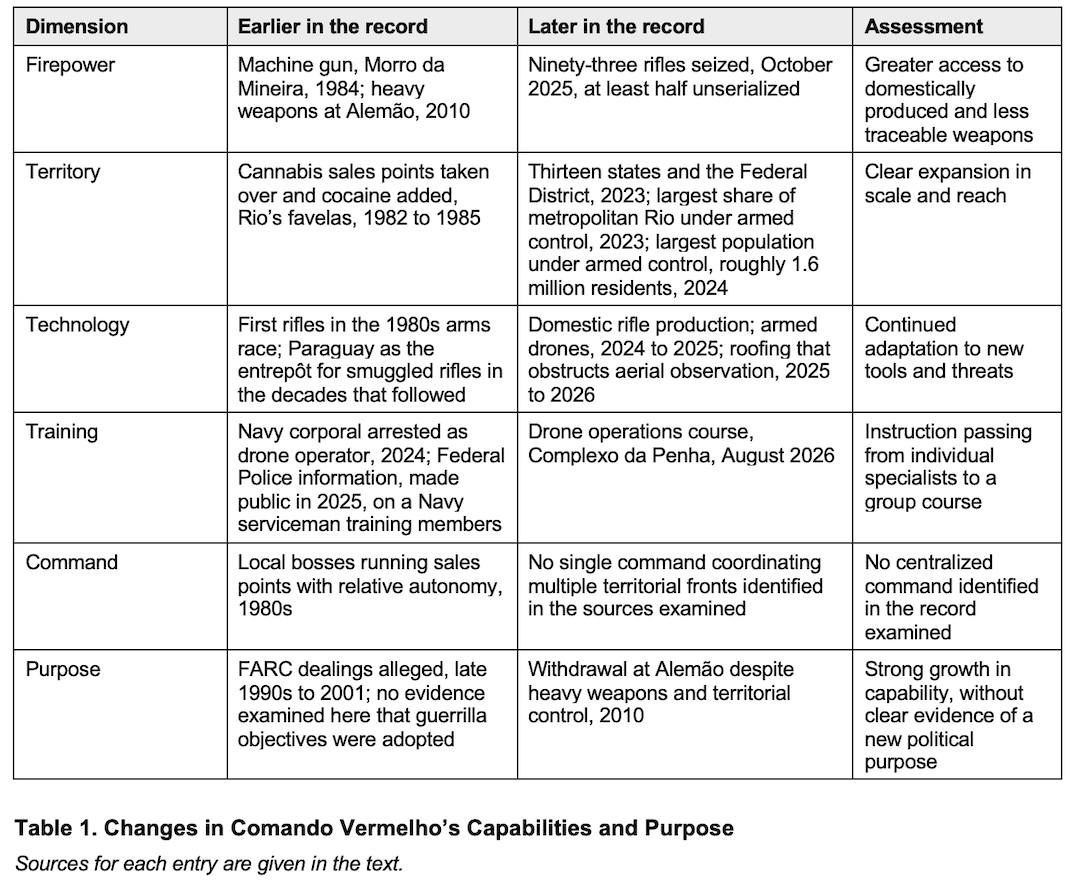
The prisoners held together in a gallery in 1979 and the organization that in 2026 controlled territory where a large group of people were being trained as drone operators are not the same thing. At each stage the faction took and used what was there to be taken: the bank robberies that sustained those still inside, the cannabis sales points taken over and cocaine added, the rifle that came to defend each hillside, the drugs bought directly at the source, the routes that carried its drugs beyond Rio de Janeiro and then to Europe, the drone that first watched and then dropped grenades, the camouflage fatigues, and finally a line of people on a sports court waiting to learn how to fly one. In this record, one earlier change in objective is clear: the group created for mutual protection inside the prison came to be organized around profit from crime. The record examined here does not show a second change of objective.
Endnotes
[1] Ana Clara Silva, “Traficantes promovem curso de drones e atraem fila de participantes no Rio.” Diário do Rio. 20 August 2026, https://www.diariodorio.com/traficantes-promovem-curso-de-drones-e-atraem-fila-de-participantes-no-rio; and “Polícia investiga curso dado por traficantes para operar drone em complexo no RJ.” Estadão Conteúdo, via Diario de Pernambuco. 20 August 2026, https://www.diariodepernambuco.com.br/brasil/2026/08/11721765-policia-investiga-curso-dado-por-traficantes-para-operar-drone-em-complexo-no-rj.html.
[2] “NACAC/MPRJ obtém prisão preventiva de dupla que transportava fuzis e pistolas.” Ministério Público do Estado do Rio de Janeiro. 14 April 2026, https://transparencia.mprj.mp.br/web/guest/visualizar?noticiaId=217205.
[3] Robson Pandolfi, “Como surgiu o Comando Vermelho, a maior facção criminosa do Brasil.” Dossiê Superinteressante, ed. 374-A, May 2017, produced by República Agência de Conteúdo and republished 29 October 2025, https://republicaconteudo.com.br/dossie-superinteressante-como-surgiu-o-comando-vermelho-a-maior-faccao-criminosa-do-brasil/.
[4] Daniel Veloso Hirata and Carolina Christoph Grillo, “Crime, guerra e paz: dissenso político-cognitivo em tempos de extermínio.” Novos Estudos CEBRAP. Vol. 38, no. 3, 2019: pp. 553–571, https://doi.org/10.25091/S01013300201900030002.
[5] “Decreto-Lei nº 510, de 20 de março de 1969.” Presidência da República, Casa Civil, https://www.planalto.gov.br/ccivil_03/decreto-lei/1965-1988/del0510.htm.
[6] “Decreto-Lei nº 898, de 29 de setembro de 1969.” Câmara dos Deputados, Legislação Informatizada, https://www2.camara.leg.br/legin/fed/declei/1960-1969/decreto-lei-898-29-setembro-1969-377568-publicacaooriginal-1-pe.html.
[7] Ibid.
[8] María Martín, “O Comando Vermelho, do presídio em uma ilha paradisíaca à guerra sangrenta por território.” El País Brasil. 15 January 2017, https://brasil.elpais.com/brasil/2017/01/13/politica/1484319135_043725.html; Bruno Shimizu, Solidariedade e Gregarismo nas Facções Criminosas: Um Estudo Criminológico à Luz da Psicologia das Massas. Master’s dissertation, Faculdade de Direito da Universidade de São Paulo, 2011, p. 103, https://bdtd.ibict.br/vufind/Record/USP_d3a41def6e99b0ac9970f760eb9ba5d2.
[9] Vitor Bonets, “Comando Vermelho: como surgiu e se espalhou a maior facção do Rio.” CNN Brasil. 29 October 2025, updated 31 October 2025, https://www.cnnbrasil.com.br/nacional/sudeste/rj/comando-vermelho-como-surgiu-e-se-espalhou-a-maior-faccao-do-rio/.
[10] Carlos Amorim, Comando Vermelho: A História Secreta do Crime Organizado. 3rd ed. Rio de Janeiro: Record, 1993, pp. 133-134, reproducing a statement given by William da Silva Lima to police in 1991.
[11] Op. cit., Hirata and Grillo at Note 4.
[12] Op. cit., Amorim at Note 10; and Op. cit., Pandolfi at Note 3.
[13] Thaíssa Fernanda Kratochwill De Oliveira, Adriano da Silva, and Patrícia Constantino, “Abordagens da história das facções criminais do Rio de Janeiro na literatura científica: uma revisão de escopo.” Dilemas: Revista de Estudos de Conflito e Controle Social. Vol. 19, no. 1, 2026, e66069, https://doi.org/10.4322/dilemas.v19.n1.66069.
[14] Op. cit., Bonets at Note 9.
[15] “Red Command (Comando Vermelho).” InSight Crime. Organized crime profile, updated 12 November 2026, https://insightcrime.org/brazil-organized-crime-news/red-command-profile/.
[16] Benjamin Lessing, “Counterproductive Punishment: How Prison Gangs Undermine State Authority.” Rationality and Society. Vol. 29, no. 3, 2017: pp. 257-297, https://doi.org/10.1177/1043463117701132.
[17] Op. cit., Oliveira et al. at Note 13.
[18] Michel Misse, “Crime organizado e crime comum no Rio de Janeiro: diferenças e afinidades.” Revista de Sociologia e Política. Vol. 19, no. 40, 2011: pp. 13-25, https://www.scielo.br/j/rsocp/a/78Yc5DQfpnMV8QGhjTCnkcM/?lang=pt.
[19] Ibid.
[20] “Traficante usou helicóptero para escapar.” Folha de S.Paulo. 10 May 1996, https://www1.folha.uol.com.br/fsp/1996/5/10/cotidiano/23.html.
[21] Op. cit., “Red Command” at Note 15.
[22] Marcelo Godoy, “Comando Vermelho atua em 13 Estados e no DF: conheça a história da facção que esteve no MJ.” Terra. 14 November 2023, https://www.terra.com.br/noticias/brasil/politica/comando-vermelho-atua-em-13-estados-e-no-df-conheca-a-historia-da-faccao-que-esteve-no-mj,25dbc53924d2938abdb0df113863d132azsaw61t.html.
[23] “Amigos dos Amigos.” InSight Crime. Organized crime profile, updated 3 July 2026, https://insightcrime.org/brazil-organized-crime-news/amigos-dos-amigos/.
[24] Ibid.
[25] “Colômbia teve de derrubar avião para capturar Beira-Mar.” Reuters/Folha Online. 21 April 2001, https://www1.folha.uol.com.br/folha/reuters/ult112u742.shtml; and Op. cit., “Red Command” at Note 15.
[26] Estanislau Maria, “Beira-Mar é deportado para o Brasil.” Folha de S.Paulo. 25 April 2001, https://www1.folha.uol.com.br/fsp/cotidian/ff2504200101.htm; Elijonas Maia, “Líderes do CV são transferidos para mesmo presídio de Fernandinho Beira-Mar.” CNN Brasil. 12 November 2025, https://www.cnnbrasil.com.br/nacional/sudeste/rj/lideres-do-cv-sao-transferidos-para-mesmo-presidio-de-fernandinho-beira-mar/; Aiuri Rebello, “Mesmo atrás das grades, principais lideranças do crime organizado seguem dando as cartas nas ruas.” Gazeta do Povo. 22 January 2026, https://www.gazetadopovo.com.br/brasil/principais-lideres-crime-organizado-pcc-cv-presos/.
[27] Roberto Uchôa, “A indústria do fuzil: como a produção clandestina em São Paulo coroa quatro décadas de escalada bélica do crime organizado.” Fonte Segura, Fórum Brasileiro de Segurança Pública. 3 September 2025, https://fontesegura.forumseguranca.org.br/a-industria-do-fuzil-como-a-producao-clandestina-em-sao-paulo-coroa-quatro-decadas-de-escalada-belica-do-crime-organizado/.
[28] Hermano Freitas, “Facções criminosas do Rio tiveram origem nos presídios.” Terra. 1 December 2010,https://www.terra.com.br/noticias/brasil/policia/faccoes-criminosas-do-rio-tiveram-origem-nos-presidios,d04970e46f6ea310VgnCLD200000bbcceb0aRCRD.html.
[29] Op. cit., Uchôa at Note 27.
[30] “Fuzis ‘fantasmas’ alimentam o terror do Comando Vermelho no Rio de Janeiro.” O Sul. 2 November 2025, https://www.osul.com.br/fuzis-fantasmas-alimentam-o-terror-do-comando-vermelho-no-rio-de-janeiro/.
[31] Roberto Uchôa de Oliveira Santos, “Descoberta de indústria clandestina de fuzis coroa quatro décadas de escalada bélica do crime no Brasil.” The Conversation Brasil. September 2025, https://theconversation.com/descoberta-de-industria-clandestina-de-fuzis-coroa-quatro-decadas-de-escalada-belica-do-crime-no-brasil-265657.
[32] Léo Rodrigues and Bruno Bocchini, “Polícia do Rio recupera 8 de 21 armas furtadas do Exército em Barueri.” Agência Brasil. 19 October 2023, https://agenciabrasil.ebc.com.br/geral/noticia/2023-10/policia-do-rio-recupera-8-de-21-armas-furtadas-do-exercito-em-barueri.
[33] “Exclusivo: fuzis feitos em fábricas clandestinas de SP e MG abastecem o Comando Vermelho no Rio.” G1 Fantástico, 2 November 2025, https://g1.globo.com/fantastico/noticia/2025/11/02/exclusivo-fuzis-feitos-em-fabricas-clandestinas-de-sp-e-mg-abastecem-o-comando-vermelho-no-rio.ghtml.
[34] Op. cit.,““Fuzis ‘fantasmas’” at Note 30.
[35] Wellington Barbosa, “Fábrica clandestina em BH produzia fuzis para o Comando Vermelho, aponta PF.” Estado de Minas. 3 November 2025, https://www.em.com.br/gerais/2025/11/7284222-fabrica-clandestina-em-bh-produzia-fuzis-para-o-comando-vermelho-aponta-pf.html.
[36] Letícia Guedes, “CV é filmado com fuzis e roupas de guerra antes da megaoperação no Rio. Veja vídeo.”Metrópoles. 30 October 2025, https://www.metropoles.com/colunas/mirelle-pinheiro/cv-e-filmado-com-fuzis-e-roupas-de-guerra-antes-da-megaoperacao-no-rio.
[37] Op. cit., Misse at Note 18.
[38] Op. cit., “Red Command” at Note 15.
[39] “Guerra pelo comando do tráfico provoca rebelião em Bangu I.” Diário do Grande ABC. 12 September 2002, https://www.dgabc.com.br/Noticia/141849/guerra-pelo-comando-do-trafico-provoca-rebeliao-em-bangu-i.
[40] Ben Penglase, “The Shutdown of Rio de Janeiro: The Poetics of Drug Trafficker Violence.” Anthropology Today. Vol. 21, no. 5, 2005: pp. 3-6, https://doi.org/10.1111/j.0268-540X.2005.00379.x.
[41] Op. cit., “Red Command” at Note 15.
[42] Marina Cavalari, “Inside the Battle for Rio de Janeiro: Red Command Versus Militias.” InSight Crime. 11 September 2024, https://insightcrime.org/news/inside-battle-rio-de-janeiro-red-command-versus-militias/.
[43] Claudio Ramos da Cruz and David H. Ucko, “Beyond the Unidades de Polícia Pacificadora: Countering Comando Vermelho’s Criminal Insurgency.” Small Wars & Insurgencies. Vol. 29, no. 1, 2018: pp. 38-67, https://doi.org/10.1080/09592318.2018.1404772.
[44] Op. cit., Pandolfi at Note 3.
[45] Op. cit., Ramos da Cruz and Ucko at Note 43.
[46] “Mortes em Roraima podem pôr fim a duas décadas de união entre PCC e Comando Vermelho.” R7. 18 October 2016, https://noticias.r7.com/cidades/mortes-em-roraima-podem-por-fim-a-duas-decadas-de-uniao-entre-pcc-e-comando-vermelho-18102016/; and Op. cit., Bonets at Note 9.
[47] Ibid.
[48] Op. cit., “Red Command” at Note 15.
[49] Ibid.
[50] Op. cit., Godoy at Note 22.
[51] Op. cit., “Red Command” at Note 15.
[52] Roberto Uchôa, “A internacionalização do Comando Vermelho: expansão, disputas por rotas e efeitos na segurança, no ambiente e nos territórios urbanos.” Fonte Segura, Fórum Brasileiro de Segurança Pública. 22 January 2025, https://fontesegura.forumseguranca.org.br/a-internacionalizacao-do-comando-vermelho-expansao-disputas-por-rotas-e-efeitos-na-seguranca-no-ambiente-e-nos-territorios-urbanos/.
[53] Op. cit., “Red Command” at Note 15.
[54] “Atualização do Mapa Histórico dos Grupos Armados.” Grupo de Estudos dos Novos Ilegalismos, Universidade Federal Fluminense, and Instituto Fogo Cruzado. April 2024, https://geni.uff.br/2024/06/04/atualizacao-do-mapa-historico-dos-grupos-armados/; “Atualização do Mapa Histórico dos Grupos Armados.” GENI/UFF and Instituto Fogo Cruzado. December 2025, https://geni.uff.br/2025/12/04/atualizacao-do-mapa-historico-dos-grupos-armados-2/.
[55] Mirelle Pinheiro, “Combustível, imóveis e agronegócio: o novo mapa financeiro das facções.” Metrópoles. 14 June 2026, updated 15 June 2026, https://www.metropoles.com/colunas/mirelle-pinheiro/combustivel-imoveis-e-agronegocio-o-novo-mapa-financeiro-das-faccoes; Marina Cavalari, “Brazil’s Red Command Turned Turf Control Into Ride-Hailing Monopoly.” InSight Crime. 26 August 2025, https://insightcrime.org/news/brazil-red-command-turns-turf-control-into-ride-hailing-monopoly/; and Júlia Quirino, “The Comando Vermelho’s Mobile App: Criminal Innovation, Illicit Economies, and Armed Governance in Rio de Janeiro.” Small Wars Journal. 21 August 2025, https://smallwarsjournal.com/2025/08/21/the-comando-vermelhos-mobile-app-criminal-innovation-illicit-economies-and-armed-governance-in-rio-de-janeiro/.
[56] Caio César, “Polícia mira ‘núcleo político’ do Comando Vermelho em megaoperação no Amazonas.” InfoMoney. 20 February 2026, https://www.infomoney.com.br/politica/policia-mira-nucleo-politico-do-comando-vermelho-em-megaoperacao-no-amazonas/.
[57] Carlos Carone, “Ataque de drone do TCP explode piscina de chefão do Comando Vermelho.” Metrópoles. 1 August 2026, https://www.metropoles.com/distrito-federal/na-mira/ataque-de-drone-do-tcp-explode-piscina-de-chefao-do-comando-vermelho.
[58] “PF combate o uso de drones lançadores de granadas utilizados por organização criminosa no RJ.” Polícia Federal. 16 September 2024, https://www.gov.br/pf/pt-br/assuntos/noticias/2024/09/pf-reprime-uso-de-drones-lancadores-de-granadas-utilizados-por-organizacao-criminosa; and Cleber Rodrigues, “Criminosos adaptam técnicas da Guerra da Ucrânia ao uso de drones no Rio.” CNN Brasil. 6 August 2026, https://www.cnnbrasil.com.br/blogs/cleber-rodrigues/nacional/sudeste/rj/criminosos-adaptam-tecnicas-da-guerra-da-ucrania-ao-uso-de-drones-no-rio/.
[59] Manuel Marçal, “Quanto ganha o cabo da Marinha acusado de pilotar drones para o CV.” Metrópoles, column of Tácio Lorran. 18 September 2024, https://www.metropoles.com/colunas/tacio-lorran/quanto-ganha-o-cabo-da-marinha-acusado-de-pilotar-drones-para-o-cv; and Op. cit., Polícia Federal at Note 58.
[60] Op. cit., Carone at Note 57.
[61] John P. Sullivan and José de Arimatéia da Cruz, “Third Generation Gangs Strategic Note No. 59: Police Raid ‘Megaoperação Contenção’ on Comando Vermelho Leads to 132 Killed.” Small Wars Journal. 2 November 2025, https://smallwarsjournal.com/2025/11/02/third-generation-gangs-strategic-note-no-59-police-raid-megaoperacao-contencao-on-comando-vermelho-leads-to-132-killed/.
[62] “Megaoperação contra o Comando Vermelho no Rio deixa cerca de 20 mortos.” Agence France-Presse, via O Povo. 28 October 2025, https://www.opovo.com.br/noticias/brasil/2025/10/28/megaoperacao-contra-o-cv-no-rio-deixa-ao-menos-18-mortos.html.
[63] Bianca Lobianco, “Tráfico cria treinamento de drones no Rio enquanto facções usam tecnologia para atacar rivais.” Correio da Manhã. 20 August 2026, https://www.correiodamanha.com.br/rio-de-janeiro/2026/08/312647-trafico-cria-treinamento-de-drones-no-rio-enquanto-faccoes-usam-tecnologia-para-atacar-rivais.html.
[64] “Ruas estão ‘sumindo’ no Complexo do Alemão para impedir vigília de drones; veja imagens.” Disque Denúncia. 18 August 2026, https://disquedenuncia.org.br/noticia-item?id=7962.
[65] “PF prende dois sargentos da PMERJ por suspeitas de vazamento de operações contra o crime organizado.” Polícia Federal. 8 December 2025, https://www.gov.br/pf/pt-br/assuntos/noticias/2025/12/pf-prende-dois-sargentos-da-pmerj-por-suspeitas-de-vazamento-de-operacoes-contra-o-crime-organizado.
[66] “Ex-combatente da guerra da Ucrânia treina CV para usar drones de grande porte no Rio.” InfoMoney. 21 May 2026, https://www.infomoney.com.br/brasil/ex-combatente-da-guerra-da-ucrania-treina-cv-para-usar-drones-de-grande-porte-no-rio/.
[67] Op. cit., Silva at Note 1.
[68] Marina Verenicz, “Militar da Marinha ajudou CV a usar drones-bomba no Rio, diz investigação.” InfoMoney. 29 October 2025, https://www.infomoney.com.br/politica/militar-da-marinha-ajudou-cv-a-usar-drones-bomba-no-rio-diz-investigacao/; and Op. cit., Marçal at Note 59.
[69] Op. cit., Marçal at Note 59.
[70] “Drones de carga, bunker e criptos: como o Comando Vermelho expandiu sua atuação no RJ.” InfoMoney. 23 May 2026, https://www.infomoney.com.br/brasil/drones-de-carga-bunker-e-criptos-como-o-comando-vermelho-expandiu-sua-atuacao-no-rj/.
[71] Op. cit., “Ex-combatente” at Note 66.
[72] SWJ Staff, “State Designates CV and PCC as Specially Designated Global Terrorists | Press Release.” Small Wars Journal. 1 June 2026, https://smallwarsjournal.com/2026/06/01/state-designates-cv-and-pcc-as-specially-designated-global-terrorists-press-release/.
[73] “Terrorist Designation of Comando Vermelho and Primeiro Comando da Capital.” U.S. Department of State, Office of the Spokesperson. 28 May 2026, https://www.state.gov/releases/office-of-the-spokesperson/2026/05/terrorist-designation-of-comando-vermelho-and-primeiro-comando-da-capital/; and “Specially Designated Global Terrorist Designations of Primeiro Comando da Capital and Comando Vermelho.” Federal Register, Public Notice 13031, 91 FR 34266, FR Doc. 2026-11324. 5 June 2026, https://www.federalregister.gov/documents/2026/06/05/2026-11324/specially-designated-global-terrorist-designations-of-primeiro-comando-da-capital-and-comando.
[74] “Counter Terrorism Designations; Issuance of Amended Iran-related Frequently Asked Question.” US Department of the Treasury, Office of Foreign Assets Control. 29 May 2026, https://ofac.treasury.gov/recent-actions/20260529.
[75] “Foreign Terrorist Organization Designation of Primeiro Comando da Capital and Comando Vermelho.” Federal Register, Public Notice 13030, 91 FR 34267. 5 June 2026, https://www.federalregister.gov/documents/2026/06/05/2026-11323/foreign-terrorist-organization-designation-of-primeiro-comando-da-capital-and-comando-vermelho.
[76] “8 U.S. Code §1189 – Designation of Foreign Terrorist Organizations.” Legal Information Institute, Cornell Law School, https://www.law.cornell.edu/uscode/text/8/1189.
[77] Op. cit., Ramos da Cruz and Ucko at Note 43.
[78] Benjamin Lessing, Making Peace in Drug Wars: Crackdowns and Cartels in Latin America. Cambridge: Cambridge University Press, 2017; and John P. Sullivan and Robert J. Bunker, Eds., Competition in Order and Progress: Criminal Insurgencies and Governance in Brazil (A Small Wars Journal–El Centro Anthology). Bloomington: Xlibris, 2022, https://smallwarsjournal.com/2022/03/11/competition-order-and-progress-criminal-insurgencies-and-governance-brazil-2/



Commenting is available to active SWJ members and staff.