Why Al-Qaeda Is Bringing Hamza bin Laden Back

The group has gone four years without naming a leader. On the 25th anniversary of 9/11, it reached for the founder’s son instead.
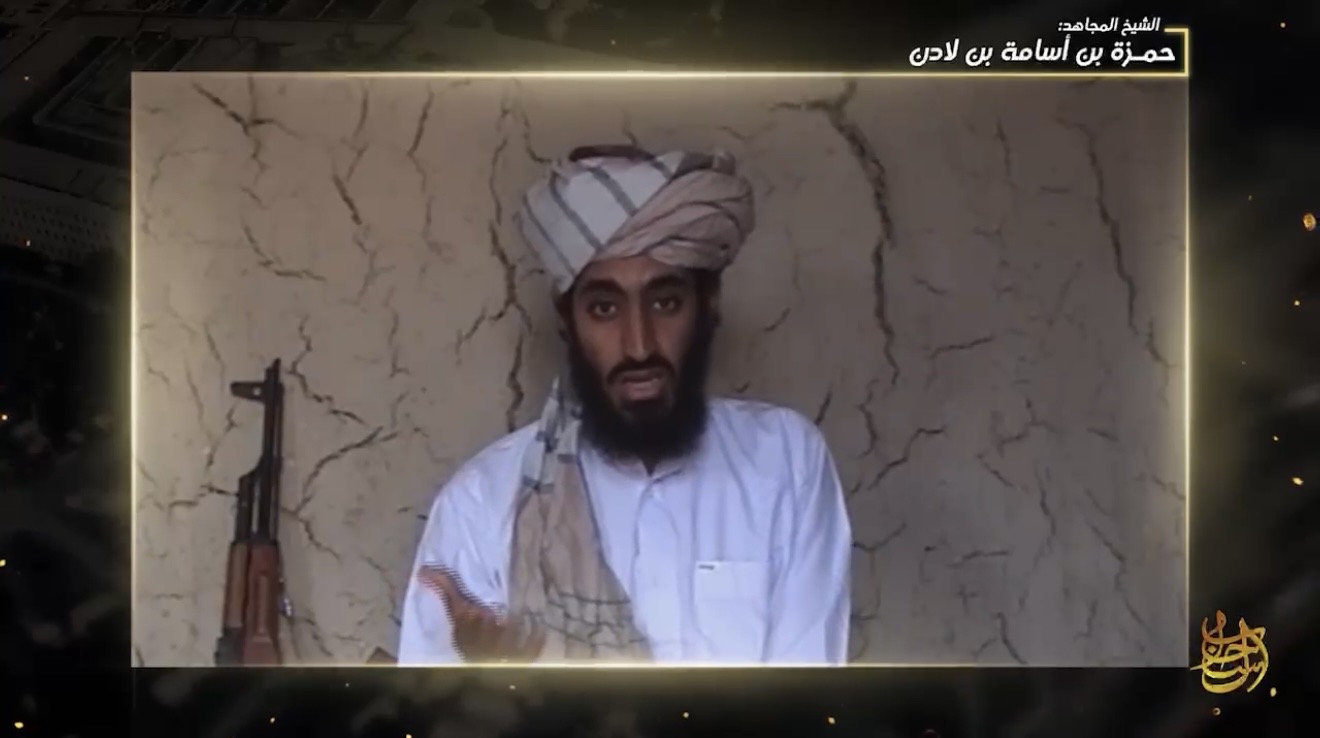
A man in a white turban appears sitting against a cracked mud wall, a rifle beside him. Twenty-five years ago, that image would have immediately called to mind Osama bin Laden. But now it’s his long presumed dead son, Hamza—the star of a 52-minute video released by al-Qaeda’s As-Sahab Media Foundation to commemorate the 25th anniversary of the September 11 attacks. Unlike previous As-Sahab productions, this video had no English translation, suggesting that its primary audience was al-Qaeda’s Arabic-speaking base.
Hamza appears three times in the video titled, “A Quarter Century of the 11 September Raids,” and is identified as “the mujahid sheikh.” The on-screen caption does not include the customary blessing used for the dead after Hamza’s name—a conspicuous omission given that the narrator uses such blessing when referring to his father, while invoking al-Qaeda’s current de facto leader, Saif al-Adel, with “may God preserve him,” a formula reserved for the living. Hamza receives neither. This is also the second time in three months that al-Qaeda has resurrected his voice.
U.S. officials nonetheless maintain that Hamza was killed in a July 2019 counterterrorism operation in the Afghanistan-Pakistan region that President Donald Trump confirmed two months later. If that assessment is correct, why did al-Qaeda choose the 25th anniversary of 9/11 to bring Hamza back from the dead and present him as carrying forward the war his father proclaimed three decades ago?
The answer may lie in the fact that al-Qaeda has yet to officially proclaim a new leader. It was after all, four years ago that a U.S. drone strike killed Ayman al-Zawahiri in Kabul—an event that al-Qaeda has never acknowledged. The United Nations Analytical Support and Sanctions Monitoring team, whose reports are among the most authoritative on al-Qaeda, ISIS, and the Taliban, has long described al-Adel, one of al-Qaeda’s most experienced extant commanders, as the group’s de facto leader. This may explain why the perennially camera-shy al-Adel is physically absent from the video but his strategy for al-Qaeda is omnipresent.
Al-Adel’s own writings dominate the video’s message. Prominent among them is his commentary on Robert Greene’s The 33 Strategies of War. A narrator explains the titular al-Qaeda leader’s longstanding argument that 9/11 was never intended to destroy the United States or annihilate its population. The objective, al-Adel claims, was to undermine U.S. prestige, draw Washington into prolonged overseas military campaigns and exacerbate America’s political, social and economic divisions. The video supplies the images to match, cutting from crowds in Tahrir Square to the American evacuation from Kabul, both presented as evidence that this strategy worked.
The video also draws on al-Adel’s writings on the 2000 USS Cole bombing, the attacks two years earlier on the U.S. embassies in Kenya and Tanzania, the 2020 attack on Camp Simba in Kenya, and 9/11’s targeting of what he describes as four pillars of American power. The passage ends with a warning al-Adel has previously issued: “God willing, there is no obstacle to striking [the United States] again.”
Hamza meanwhile focuses on Islam under siege. It is facing “severe real tests” during a difficult period of “all-out war,” waged by enemies who do not want Islam to prevail, “the word of truth” to triumph or Sharia to rule. The response, Hamza proclaims, is the spread of jihad which now “terrifies the enemies of God in Washington, London and Tel Aviv.” Then comes his “ask”: If the faithful previously missed the opportunity to join “the blessed caravan, catch up with it now, join it, and take from its blessing.” Here, Hamza is referring to the seminal Salafi-Jihadi treatise, Abdullah Azzam’s “Join the Caravan.” This 1987 call to arms played a pivotal role in galvanizing Arab fighters to come fight the Soviet Union’s invasion and occupation of Afghanistan. Hamza’s final appearance in the video is a recitation of a poem honoring fighters who race toward jihad and martyrdom. The video thus intertwines al-Adel’s strategic pronouncements with the bin Laden name and imprimatur.
Osama bin Laden once did it all. He was emir, strategist, fundraiser, symbol and the movement’s most recognizable public face. Al-Qaeda today likely no longer expects—or could even hope for—one person who can do all of that. Al-Adel can shape strategy without appearing publicly. Hamza provides something he cannot: an avatar tied directly to the bin Laden name. Given how decentralized al-Qaeda has become since Osama’s killing in 2011, al-Adel is hoping to maintain organizational cohesion and promote strategic conformity. It is likely al-Adel’s scheme to ensure al-Qaeda’s survival.
Al-Adel has out-lived virtually all of his terrorist contemporaries—and appears determined to keep it that way. A named emir is inevitably a target. Al-Adel is the consummate survivor, having been present at every critical juncture in al-Qaeda’s history since the 1980s, and has thus opted to continue the charade that he is not the movement’s leader. He also has made it difficult to pin him down geographically. The two locations most often cited are Iran, which sheltered him after 9/11, and Afghanistan. But his whereabouts remain uncertain.
Maintaining this ambiguity also circumvents the problem of bay‘ah. Succession in al-Qaeda is not simply about appointing a CEO. It must bind together the affiliates with the core through personal oaths of allegiance. Accordingly, naming a new emir might force a choice at this moment in time that some of al-Qaeda’s affiliates may not wish to make. We have seen jihadist organizations use this ambiguity before. The Taliban, for instance, concealed Mullah Omar’s death for more than two years while continuing to issue statements bearing his name.
Al-Qaeda may also see an advantage in leaving al-Zawahiri’s seat publicly vacant. Any successor would inevitably be compared with bin Laden—and almost anyone would come up short. Al-Adel has experience and credibility inside the organization, but his longstanding relationship with Iran—a Shi’a state fundamentally at odds with al-Qaeda’s Salafi-jihadi worldview—has provided its main rival, the Islamic State, with ammunition to use against him. A formal succession could also force increasingly autonomous affiliates to clarify their relationship with a new emir and potentially accept a new top-down strategic direction they do not want.
That alone creates risks to the movement. Hamza obviates that problem because he does not need bay‘ah to be useful. This gives the organization a way to draw on the founder’s authority without forcing its branches to resolve the succession question in public.
The video connects those two ambiguities. Bin Laden’s message is reprised in the video. He is heard urging the Arab Spring’s exponents to “hold the initiative” and reject compromise just as the footage cuts directly to Hamza. The editing choice is deliberate: al-Qaeda is linking its present strategy to its founding lineage.
For a movement whose affiliates increasingly fight local wars on their own terms, symbolic authority may matter precisely because central operational control has weakened. Al-Qaeda’s affiliates now raise their own money, adapt to local political environments and run campaigns that are not micromanaged from a central headquarters. This is not the al-Qaeda of 2001 but a different operation with different priorities.
But decentralization creates its own problem: What holds the movement together when the affiliates no longer need detailed instructions from the center? Part of the answer has always been bay‘ah and a shared strategic identity. Affiliates can build their own constituencies and military capabilities. What they cannot recreate locally is al-Qaeda’s founding mythology. The bin Laden name gives them access to a mythologized past they all share.
The generation al-Qaeda is now trying to reach and recruit has no direct memory of 9/11. Someone born in 2001 is 25 today. For many potential recruits, Osama bin Laden is not a leader they knew. He is a historical figure they encountered through jihadist media, old videos of speeches and other propaganda. Linking Hamza to his father can make that history feel less distant and turn the bin Laden story into an inheritance.
That matters because this anniversary video is not simply a retrospective. Al-Qaeda is not rebuilding the centralized organization Osama bin Laden once led; it has spent years adapting to leadership losses, territorial setbacks and increasingly autonomous affiliates. Its handling of succession is another adaptation. Al-Adel can remain in the background, which suits both his history and the strategy he has spent years articulating. Hamza, whether dead or alive, provides needed continuity.
That may be the point of resurrecting Hamza now. The message is less about whether he survived than whether al-Qaeda did. Twenty-five years after 9/11, al-Qaeda wants its supporters to know that the war Osama bin Laden began did not end with him, that it still sees a future for the movement he built and that another generation is expected to carry it forward. Hamza may be dead. But al-Qaeda is still open for business.