Taipei: Before Beijing Can Govern
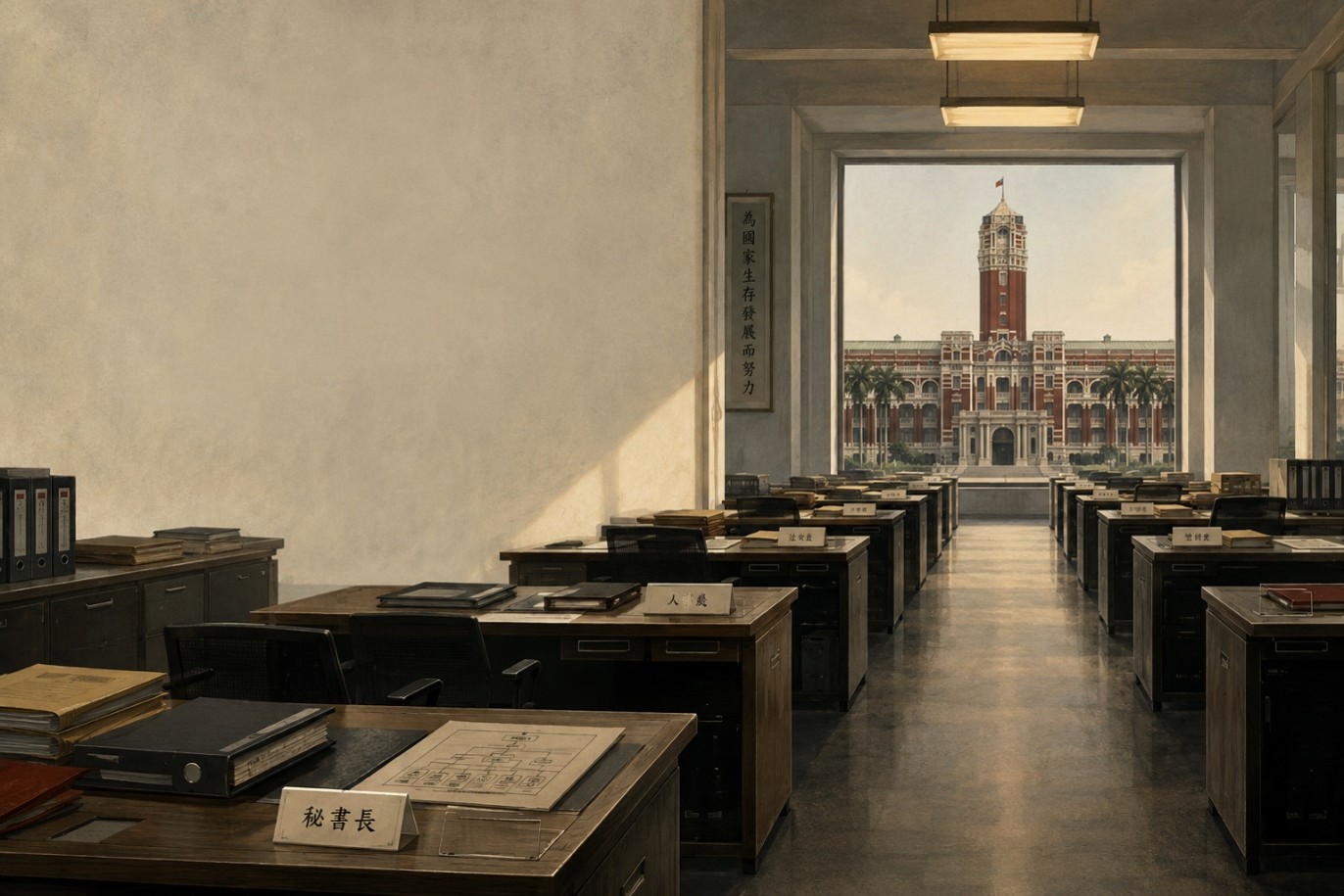

The Governance Gap
Annexation would break Taiwan’s legal and commercial architecture the moment it happened because no successor authority has been negotiated in advance. Accommodation appeals to Beijing precisely because it defers that rupture instead of confronting it.
This article examines what that absence of authority would mean after the initial crisis: first for the officials who would have to operate Taiwan’s bureaucracy, then for the small group who currently lead its government, and finally for the 23 million people who would live under the resulting system. Moving through these groups shows how administrative uncertainty scales from institutions to society.
Most of what follows draws on material already in the public record. Hong Kong’s civil service attrition is well documented. Historians have studied the Baltic deportations and Vietnam’s re-education camps for decades. Beijing’s legal framework for prosecuting individuals it designates as “die-hard” Taiwan independence figures, issued in June 2024, has been widely reported since it appeared.
These precedents are not equivalent. Hong Kong lacked both Taiwan’s military and a constitution of its own making. That difference matters unevenly. The dynamics of bureaucratic attrition can be examined independently of sovereignty, while Hong Kong’s dismantling of an elected opposition depended on legal authority Beijing already possessed.
The analysis therefore follows two distinct pathways to how that authority would actually be exercised: a milder route, resembling Hong Kong’s gradual, legally-instrumented absorption, available where Beijing already holds recognized authority to work through; and a harsher route, resembling the Baltic states in 1940 or South Vietnam in 1975, where no such authority exists and control is established through more sudden, category-based means. These are not variations of the same process, but two structurally different ones.
What has received far less attention is the relationship between Beijing’s published target list and these competing historical precedents. Rather than asking which precedent Taiwan will follow, this article asks what the unresolved gap between them means for the officials already named and for those around them.
That is the contribution of this article. The facts are borrowed. The argument is not.
The Bureaucrat Beijing Cannot Screen For
Any occupying or absorbing authority faces the same challenge with a professional civil service. It cannot know in advance who will remain loyal, who will quietly hedge while appearing to comply, and who will choose to leave.
Research on China’s own anticorruption vetting shows that this uncertainty distorts personnel decisions even within a system Beijing already controls. Formal models of bureaucratic behavior reach much the same conclusion.
Officials facing an unfriendly political transition are more likely to feign compliance than resign outright, particularly if they doubt their replacements will be any better. Turnover also tends to be highest in the strongest parts of the bureaucracy. Competence becomes a liability rather than a safeguard.
That pattern produces a form of adverse selection: the officials with the strongest skills and the best outside options are the ones most likely to hedge or leave, so the authority that needs competence most is left administered by those with the least mobility, the most domestically embedded, least externally credentialed staff, whether or not they are the most capable.
Hong Kong under Chinese sovereignty offers the clearest example of adverse selection at work, but it is not the only sign that political transitions put loyalty under strain. Taiwan’s first transfer of power in 2000 revealed a milder version of the same pressure, expressed through reassurance rather than exit. Senior military leaders were visibly uneasy about serving under a president many had long associated with a Cold War enemy, prompting the Chief of the General Staff to pre-record a televised pledge of loyalty.
One contemporaneous academic account also describes a “loyalty investigation” policy that restricted civil servants with mainland family ties from holding sensitive posts. Even a peaceful constitutional transition created pressure to screen officials by their perceived ties to a rival authority.
Hong Kong shows what adverse selection produces at scale. Civil service resignations reached 3,734 in 2021-22, more than double the previous year and the highest since the handover. The Intellectual Property Department lost 7.94 percent of its staff, the highest rate in government. Radio Television Hong Kong (RTHK) lost 5.53 percent after mandatory editorial review was imposed on politically sensitive programming.
Two mechanisms operated side by side, voluntary departure and effective removal.
Naming Before Governing
On 21 June 2024, five of China’s top legal and security bodies jointly issued the Opinion on Punishing Die-hard Taiwan Independence Elements, commonly known as the “22 Articles,” building on the existing Anti-Secession Law and Article 103 of the Criminal Code. The measures allow penalties up to the death penalty in serious cases, impose no statute of limitations on those who evade investigation, and permit trials in absentia.
Beijing describes the targets as an “extremely small number” of die-hard separatists. The document’s own language runs broader: it criminalizes actions or expressed dissent against unification under the PRC, a standard resting on political alignment rather than a narrow category of separatist conduct. That breadth is what makes the published list consequential: it defines a category that can be enlarged by office, association, and alignment.
The list has continued to grow. It began in August 2024 with ten names, including then Vice President Hsiao Bi-khim. By March 2025 it had expanded past 20, adding a sitting interior minister, a legislator, prosecutors, and a businessman. Beijing has paired these designations with concrete measures, including a Guangzhou bounty notice and reported efforts to use Interpol against legislator Puma Shen.
One Taiwanese cross-strait analyst argues the list’s real purpose is not to punish those named but to encourage wider self-censorship, echoing Hong Kong’s National Security Law.
Two Paths to Rule
Hong Kong shows absorption where Beijing already has legal authority to work with, the milder of the two paths this article traces. Its opposition was not dismantled through one mass arrest but weakened over five years.
Four legislators were disqualified in 2017 over oath-taking; four more in 2020, prompting the remaining pro-democracy lawmakers to resign together. In January 2021, 53 organizers were arrested for running unofficial primaries; 47 were charged with subversion, sentencing delayed until November 2024, a four-year gap observers read as part of the pressure itself. Political parties faded alongside their leaders.
Demosistō, the pro-democracy party founded by Joshua Wong and other Umbrella Movement activists, dissolved within hours of the National Security Law taking effect; the Democratic Party lasted until December 2025, its membership fallen from 636 to 121. None were formally banned.
Nothing about that sequence resembles the Baltic states in 1940 or South Vietnam in 1975, where no comparable legal authority existed to work through. Soviet officials began compiling lists of “anti-Soviet elements” before Baltic annexation was formally complete.
Estonia’s president went into exile within weeks; its commander-in-chief was deported the same summer, his own constitutional authority offering no protection against a sweep based purely on category rather than conduct. Mass deportations followed a year later, carried out using lists that had expanded from individuals to entire families.
In Vietnam, registration orders went out within days of Saigon’s fall, and hundreds of thousands of former South Vietnamese officers, officials, and associated personnel spent years in re-education camps without trial.
The distinction is straightforward. Where legal authority already exists, political consolidation can proceed through institutions over time. Where it does not, control depends more heavily on administrative rupture.
The Tier Beneath the List
For individuals already named by Beijing, the difference is significant. Under the milder route, a figure such as Hsiao Bi-khim faces what the 22 Articles already describe: sanctions, prosecution in absentia, and a legal process that unfolds over years, where conduct may still influence outcomes. Under the harsher, rupture route, office itself becomes the defining criterion. What matters is not what a person has done, but the position they hold.
An elected mandate would not necessarily prevent a category-based sweep, any more than Estonia’s constitutional presidency prevented deportation. Its significance lies elsewhere. Removing an internationally recognized elected leader would be more difficult to present as routine domestic administration.
If the immediate purpose of the 22 Articles is to encourage caution rather than secure convictions, then the uncertainty surrounding Beijing’s intentions is itself part of the strategy. The list signals risk without revealing which historical pathway, if either, will ultimately apply.
That shifts attention to those around her. The relevant structure here is the Office of the President, a single body, led by one Secretary-General, that administers affairs for both the president and vice president together. These are the officials most likely to hedge or leave first: close enough to the named tier to share the risk, and skilled enough to have somewhere else to go.
Under the milder, accommodation route, they face the same pattern Hong Kong’s own elite policy cadre already shows: only nine Administrative Officers resigned in 2017-18, but 32 resigned in 2021-22, and elite departures have stayed elevated since, with 36 leaving in 2025-26, prompting official calls to rethink senior recruitment.
Under the harsher, rupture route, a unified office with no separate identity for vice-presidential staff offers little apparent separation under a sweep applied by association rather than role, as Baltic deportations expanded through family ties and Vietnam’s camps held junior officers who had simply served the previous government.
Taiwan’s own standing force adds a scale neither precedent case had to contend with. Active personnel stood near 170,000 for most of the past decade, rising to nearly 230,000 by November 2025. A further reserve numbering close to two million exists on paper, though roughly 700,000 could realistically be mobilized on short notice.
What a rupture-style sweep would do against officers holding their own commands remains a genuinely open question no case built here can answer.
The 23 Million
Everything above concerns roughly 30 named people and the few hundred who may sit close enough to be caught in the same net. Most of Taiwan’s population is nowhere near that list.
Under the milder, accommodation route, Hong Kong again provides the closest precedent, not for its prosecutions but for what happened to everyone never charged. Four years under the National Security Law produced a society that, by most accounts, learned to filter its own speech unprompted.
Under the harsher, rupture route, two channels emerge. The first has nothing to do with political identity: contracts, banking, and courts cease functioning coherently when no recognized successor authority exists, as this article’s companion piece on the immediate aftermath of annexation has already argued. The second depends on categorization, the same associational logic that swept Baltic families and Vietnamese junior officers into detention.
One further variable sits outside both channels. Taiwan’s chip manufacturing, concentrated overwhelmingly in Taiwan Semiconductor Manufacturing Company (TSMC), has no equivalent in any precedent case used here. It could push Beijing toward the slower, more careful path, or be judged worth disrupting regardless. Nothing in the evidence gathered here settles which reading is closer to correct.
Living Between Two Futures
What sets the named individuals apart is not simply higher risk, though it probably is. It is that they cannot judge it. Someone already on a published list faces two futures that share almost nothing, one unfolding over years and still responsive to what they do next, the other unfolding in days and indifferent to it. That is not uncertainty that can be managed. It is waiting to see which future arrives.
Most political risk still allows for a strategy. Someone under routine surveillance can calculate that caution helps, that some actions are riskier than others. Nothing here offers that comfort. The two paths do not just differ in speed. They reward opposite behavior. On the slower path, restraint might still matter, since a prosecution built on conduct can be shaped by that conduct.
On the faster path, none of it matters. The qualifying fact is the title, not the record. Holding office does not forbid restraint. It also does not help someone prepare for both futures at once. One path still rewards caution. The other ignores the record entirely.
The list sharpens that problem. It grows by office and category, yet it still leaves out some of the highest titles. From the outside, that looks like an open question about method. From the inside, it is simply not knowing which future is coming.
Limits of the Comparison
Hong Kong’s limits bear on every claim drawn from it; each should be weighed on its own terms.
The sectoral claims about civil service hollowing still rely mainly on Hong Kong, with Taiwan’s 2000 loyalty investigation offering a single, viewpoint-inflected domestic example. The Office of the President’s structure reflects its official organization, not confirmed current staffing, and tests the compounding hypothesis at the institutional level, not the individual one.
The claim to originality rests on five searches across general and Taiwan-specific academic sources, firmer than earlier drafts but not exhaustive. Taiwan’s own 1949-1991 experience, when a different government ran a structurally similar apparatus against a different population, gets only brief mention here.
The list itself is still growing, and the futures it may point toward remain far enough apart that nobody on it, and perhaps not even Beijing itself, can say with confidence which one is coming.