Military Modernization Paradox: Technology and the Lag of Institutions

Abstract
The character of war is changing faster than the institutions that wage it. Artificial intelligence, autonomous systems, cyber operations, hypersonic weapons, and space-based capabilities are reshaping not only the instruments of the battlefield but also the strategic thought and training that govern their use. Yet many armed forces continue to plan, educate, and organize around paradigms inherited from the industrial age. This article examines the resulting military modernization paradox: the coexistence of advanced technology with comparatively slow-moving doctrine, professional military education, and organizational culture. It argues that advanced and emerging technology has done more than expand the inventory of military capabilities; it has accelerated the tempo of strategic change itself, widening the gap between what forces can field and what they are prepared to think and do. Drawing on the experiences of the United States, China, and European militaries, the article contends that the decisive variable in future conflict will be institutional adaptation, in particular the reform of strategic thought and training, rather than technological acquisition alone.
Introduction
Few propositions command as much agreement in contemporary defense debate as the claim that warfare is being transformed by new technology. Far less settled is whether the institutions that must wield that technology are changing with it. Across the world, armed forces continue to train, strategize, and conceptualize around paradigms inherited from earlier epochs of industrial warfare, even as the tools at their disposal bear little resemblance to those of the twentieth century. This tension between rapid technological advance and gradual doctrinal evolution constitutes a military modernization paradox. Armed forces readily acknowledge the imperative of innovation, but their institutions, cultures, and systems of professional education frequently lag behind the technologies they aspire to field. The result is a widening disparity between conventional military doctrine and the demands of contemporary conflict.
This disparity is not merely theoretical. It shapes operational readiness, procurement priorities, and the capacity of states to deter or prevail in future wars, and strategists increasingly regard it as a defining strategic challenge of the twenty-first century. The central argument of this article is that advanced and emerging technology has done more than expand the inventory of military capabilities; it has accelerated the tempo of strategic change itself so that the binding constraint on military power is no longer access to technology but the ability of institutions, especially their strategic thought and training, to absorb it.
Advanced and Emerging Technologies
Analytical clarity begins with terminology. The phrase “emerging technologies” has become standard in national defense strategies, North Atlantic Treaty Organization publications, and the academic defense-studies literature, yet it is imprecise, for it implies capabilities that are nascent or not yet mature. In practice, the technologies reshaping contemporary war span a wider spectrum. Some, such as precision-guided munitions, advanced sensors, and networked communications, are already mature and deeply integrated, whereas others, such as generative artificial intelligence, quantum sensing, and autonomous swarming, remain genuinely nascent. Treating the whole field as merely “emerging” obscures this distinction and can distort both analysis and procurement. As argued in a recent conceptual audit of the term, the more accurate umbrella is Advanced and Emerging Technologies (AET), which captures both the mature-but-advancing and the genuinely novel, and which better reflects how militaries actually combine established and new systems. This article adopts the AET frame throughout Table Two.
The scholarly literature on military modernization converges on a common insight: technological acquisition is necessary but not sufficient. Studies of emerging technologies and military capability emphasize that new systems disrupt established doctrine rather than simply augmenting it, while work on digital leadership shows how command cultures mediate the absorption of digital tools. Research on the cognitive and technical demands of new systems locates the challenge as much in people as in platforms, and analyses of defense innovation identify talent and skills as recurring constraints. At the doctrinal level, multi-domain operations and converging effects have become the organizing concepts through which advanced militaries attempt to translate capability into advantage. Comparative studies of the United States, the People’s Liberation Army, and European forces show that the gap between capability and institutional readiness is common to established and rising powers alike. Taken together, this body of work frames modernization as a sociotechnical problem in which doctrine, education, and organizational culture, not hardware alone, determine effectiveness.
Table One: Distinguishing advanced, emerging, and advanced-and-emerging technologies.| Defining Features | Examples | Doctrinal Implication | |
|---|---|---|---|
| Advanced | • Mature • Fielded • Continuously refined | • Precision-guided munitions • Advanced Intelligence, Surveillance, and Reconnaissance (ISR) sensors • Networked communications | Integration and scaling within existing force structures |
| Emerging | • Nascent • Rapidly evolving • Not yet fully fielded | • Generative artificial intelligence • Quantum sensing • Autonomous swarming • Directed energy | Experimentation, doctrine development, and risk management |
| Advanced and Emerging | Combined spectrum employed in practice | Human-machine teams pairing platforms with novel autonomy | Simultaneous integration and innovation across the force |
Persistence of Industrial-Era Military Thought
Modern military organizations are deeply embedded in tradition. Many doctrines and command frameworks were established during the industrial era, when warfare centered on mass mobilization, attrition, and large-scale conventional operations. These concepts shaped command hierarchies and professional military education systems that continue to exert influence today. Despite rapid technological advance, organizational culture and training practice tend to evolve more slowly.
Strategists observe that advanced and emerging technologies often disrupt established doctrine rather than simply augmenting it. Systems that unsettle existing training and organizational frameworks generate friction within military institutions. Historically, innovations such as mechanized warfare and precision munitions compelled armies to reconsider doctrine only after costly lessons in combat. Contemporary digital and autonomous technologies are producing analogous tensions at a markedly accelerated rate.
The problem, however, extends beyond mere resistance to innovation. The deeper challenge lies in assimilating new capabilities into complex organizations characterized by entrenched cultures and bureaucratic processes. Studies of digital leadership within military organizations indicate that reconciling conventional command methods with new digital technologies remains a significant obstacle. The paradox resides in the simultaneous presence of sophisticated hardware and comparatively antiquated cognitive frameworks. Forces may acquire drones, cyber tools, and AI-enabled systems while retaining hierarchical, linear decision-making structures suited to slower forms of war.
Acceleration of Strategic Change
What distinguishes the present moment is not only the novelty of individual technologies but also the speed and convergence of their development. Advanced and emerging technologies, among them artificial intelligence, machine learning, autonomy, quantum sensing, advanced communications, and directed energy, are maturing and combining faster than doctrine can codify their use. Where earlier military revolutions unfolded over decades, today’s capabilities iterate in months, driven by a commercial technology sector whose research cycles far outpace traditional defense acquisition.
This acceleration reshapes the paradox in three ways. First, it compresses the time available for institutional adaptation, so that doctrine written for one generation of systems is overtaken before it is fully implemented. Second, it shifts the locus of innovation from state arsenals to a diffuse ecosystem of private firms, universities, and start-ups, obliging militaries to absorb capabilities they neither designed nor fully control. Third, it multiplies the interactions between domains and technologies, so that the strategic consequences of any single system become harder to anticipate. The cumulative effect is that the gap between technological possibility and doctrinal readiness is not merely persisting but widening, precisely because the pace of change has increased.
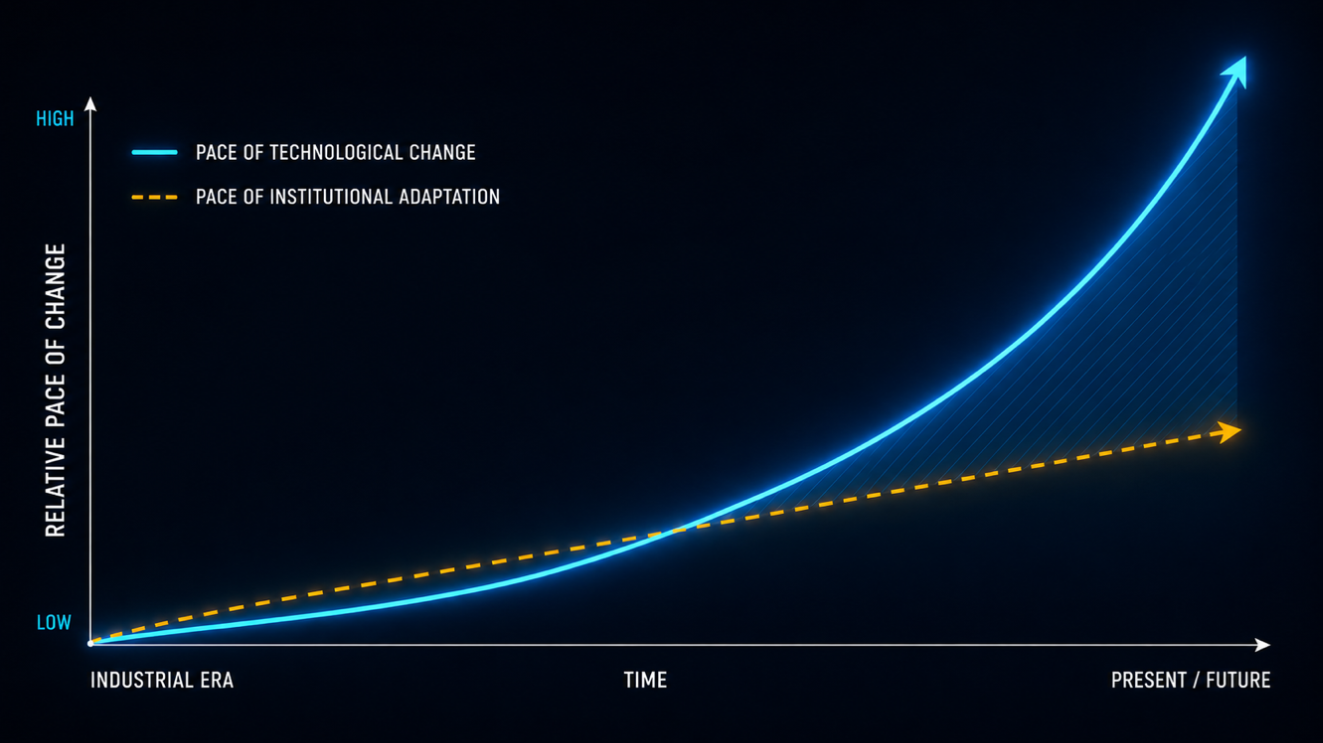 Figure One: Conceptual schematic: Widening gap between technological change and institutional adaptation.
Transformation of Strategic Thinking
Technology has transformed not only the instruments of war but also the intellectual frameworks that govern their employment. Strategic thought, once organized around the mass and maneuver of industrial armies, is being reconstituted around data, tempo, and the contest for decision advantage. The proliferation of sensors, autonomous platforms, and AI-enabled analytics has compressed the decision cycle, shortening the interval between observation and action to a degree that strains both human cognition and existing command arrangements.
Three shifts are particularly consequential. The first is the elevation of speed from a tactical advantage to a strategic value in its own right. When adversaries can sense, decide, and strike in near real time, the ability to process information and act faster can determine who gains and sustains the initiative. Conversely, a force that is slower to perceive changes, make decisions, or translate decisions into action risks surrendering the initiative before it can respond. The second is the growing centrality of the information and cognitive domains, as strategy becomes increasingly concerned with the collection, protection, and exploitation of data and with contesting an adversary’s ability to perceive and understand the battlespace. The third is the reconfiguration of command itself. Hierarchical, centralized models designed for linear operations sit uneasily with technologies that reward distributed initiative. When sensing and analysis occur at the tactical edge, routing every decision up and back down the chain of command forfeits the very speed those technologies provide, and so forces are pushed toward mission command and the delegation of authority to lower echelons. Strategic thinking must therefore accommodate human-machine teaming, in which algorithms assist or accelerate judgment without displacing the human responsibility that law and ethics demand.
These changes explain why acquiring advanced systems is insufficient. A force equipped with modern hardware but wedded to industrial-era strategic assumptions may misjudge the speed and complexity of contemporary war. The transformation of strategy is, at root, a transformation of thought, and it is here that institutions have proved slowest to adapt.
Training, Professional Military Education, and the Human Dimension
If strategic thought is being remade, so too must be the training and education that prepare personnel to exercise it. Advanced and emerging technologies impose new cognitive and technical demands on soldiers and commanders, requiring skills and decision-making frameworks that traditional training pipelines were not designed to provide. The challenge is simultaneously technological and human: complex systems must be integrated into operational practice, and personnel must be able to employ them proficiently and adaptively under conditions of uncertainty.
Training itself is being transformed by the very technologies it must teach. Synthetic environments, simulation, virtual and augmented reality, and AI-enabled wargaming allow forces to rehearse multi-domain operations at a scale and tempo that live exercises cannot match, and to expose commanders to the compressed decision cycles that characterize modern conflict. These tools promise faster, more realistic, and more repeatable preparation, but they also demand new competencies of instructors and institutions and new methods for assessing readiness.
Professional military education carries particular weight. Officers and strategists must be educated to reason about multi-domain operations, data-informed decision-making, and human-machine collaboration, and to interrogate the assumptions embedded in inherited doctrine. Reform of curricula and pedagogy is essential if future leaders are to integrate technology into strategy rather than merely operate it. Yet reforming how officers think matters little if the right people cannot be recruited and retained in the first place. Many armed forces struggle to attract and keep expertise in fields such as artificial intelligence and cyber operations, competing for scarce talent with a commercial sector that often offers greater reward and flexibility. Research on defense innovation consistently identifies talent acquisition and skills development as among the most persistent constraints on modernization.
Technological Transformation Across Operational Domains
The transformation of warfare is occurring across all operational domains: land, air, sea, cyberspace, and space. Multi-domain operations have become a pivotal concept in contemporary strategy, seeking to combine capabilities across domains to generate synchronized effects at the tempo of modern conflict.
Human-machine collaboration, autonomous systems, and networked sensors are reshaping combat operations. The rapid convergence of artificial intelligence, robotics, and communications is revising doctrine and hastening the transition to integrated operations. Global expenditure on human-machine integration and manned-unmanned teaming continues to rise as forces pursue greater agility and survivability. Multi-domain integration in turn requires interoperability among services: land, air, and maritime forces must synchronize in real time with cyber and space capabilities, which demands new command structures and decision-making processes. Many armed forces, however, still operate under service-centric doctrines that impede joint operations, a further illustration of how institutional structure lags technological possibility.
Great-Power Responses
The United States and China exemplify major efforts to address the modernization paradox, and both recognize that technological superiority is insufficient without doctrinal and organizational transformation (Table Two).
The United States has embraced concepts such as Joint All-Domain Operations and Multi-Domain Operations to unify capabilities across the services, seeking to harmonize action across land, air, sea, cyber, and space while integrating AI-enabled decision-making. Implementation nonetheless remains difficult. The cost is not only financial: legacy platforms must be re-engineered to interoperate with newer systems, personnel retrained, and doctrine rewritten, and because such efforts span procurement cycles measured in years rather than months, they demand consistent funding and leadership attention across successive budgets.
China has undertaken comprehensive reforms to modernize the People’s Liberation Army into a technologically advanced force, restructuring its organization to improve readiness and to field advanced capabilities across domains, but it too faces obstacles. Reporting suggests that corruption and organizational disruption may impede progress toward modernization objectives, a reminder that institutional factors can obstruct technological transformation even where political will and resources are abundant.
European militaries are pursuing digital transformation while contending with legacy systems, bureaucratic processes, and shortages of skilled personnel. Analyses of European defense priorities underline the difficulty of assimilating new technologies, achieving interoperability, and building digital literacy across the force. Together these cases show that the modernization paradox is universal: even technologically advanced states struggle to align doctrine, training, and organizational culture with new capabilities.
Table Two: Comparative great-power responses to the modernization paradox.| United States | China | Europe | |
|---|---|---|---|
| Approach | Integrate AI-enabled decision-making across the joint force | Structural reform of the People's Liberation Army toward a “world-class” force | Digital transformation across national and allied forces |
| Organizing Concepts | • Joint All-Domain Operations • Multi-Domain Operations | • Informatized warfare • Intelligentized warfare • Systems confrontation | • Interoperability • Digital literacy • Allied integration |
| Obstacles | • Legacy systems • Institutional culture • Sustained investment | • Corruption • Organizational disruption • Integration | • Legacy systems • Bureaucracy • Skills shortages |
Risks of Inaction
Should the gap between conventional thought and contemporary technology persist, the consequences may be considerable. Forces that fail to adapt may find their sophisticated equipment underused or misapplied, for technological superiority does not by itself confer operational advantage. Absent suitable doctrine and training, new systems may generate confusion rather than effect.
A first risk is strategic miscalculation. Commanders reliant on outdated concepts may misjudge the speed and complexity of modern war, particularly as autonomous systems, cyber operations, and real-time analytics compress decision-making, and forces unable to operate at this tempo may forfeit the initiative. A second is organizational fragmentation, for new technologies are often assigned to specialized units that remain poorly integrated into wider force structures; dedicated cyber, drone, and space organizations, for example, have frequently been established before the doctrine for integrating their effects into joint operations matured. A third concerns human capital, for successful innovation depends on skilled personnel able to manage complex systems and adapt to new modes of war. Finally, there is the danger of strategic obsolescence: states that do not modernize their thinking may be outmatched by adversaries who exploit technology more effectively. The history of war suggests that institutional adaptation shapes outcomes as decisively as technological advance.
Difficulty of Bridging the Gap
Recognizing the problem does not resolve it. Reconciling traditional doctrine with contemporary technology requires time, resources, and expertise. Military organizations are large, hierarchical institutions with settled cultures and procedures, so transforming them entails not only the acquisition of new equipment but also the reform of training, education, and leadership.
The integration of technology is fundamentally a sociotechnical challenge. Investment in hardware must be matched by change in organizational culture, workforce preparedness, and leadership commitment. Studies of digital transformation in defense organizations consistently find that technological investment is insufficient without accompanying institutional reform. At the same time, it is important to preserve what remains valuable in existing doctrine. Not every legacy system or practice is obsolete, and many provide stability, discipline, and institutional continuity. The objective is to adapt these traditions to contemporary realities rather than to discard them wholesale.
Preparing for the Future
States are beginning to respond to the paradox. Several are developing joint doctrines that emphasize multi-domain integration, and new joint doctrines and technology roadmaps are intended to synchronize operations across land, sea, air, space, and cyberspace while guiding long-term modernization.
Alliances and partnerships are also significant. The United States, for example, is deepening technological cooperation with allies to draw commercial innovation into defense and sustain competitiveness, accelerating adaptation through the exchange of knowledge and resources. Innovation ecosystems linking military institutions with industry and academia help connect technological advance with operational application. Effective modernization ultimately requires a comprehensive approach that aligns doctrine, training, procurement, and organizational culture with technological change, sustained by enduring political and financial commitment.
Conclusion
The military modernization paradox reflects a fundamental tension in contemporary security: the coexistence of advanced technology with conventional habits of mind. As war becomes more complex and more thoroughly multi-domain, the capacity to assimilate new capabilities into doctrine, strategic thought, and training will determine military effectiveness. Advanced and emerging technology has accelerated this challenge, widening the gap between what forces can field and what they are prepared to think and do.
The task, therefore, is not merely to acquire new technology but to transform the institutions that must use it. Failure to close the gap may weaken deterrence, degrade operational effectiveness, and raise the risk of strategic mis-judgement. Reconciling traditional doctrine with contemporary technology will require time, resources, and persistent leadership, and it will demand the reform of professional military education, the restructuring of organizational frameworks, and the cultivation of a culture of innovation. States that succeed in this transformation will help to shape the future of warfare. Those that do not may find themselves prepared for the wars of the past rather than the conflicts of the future.