





Review: Western Military Expatriates in the Armed Forces of the UAE
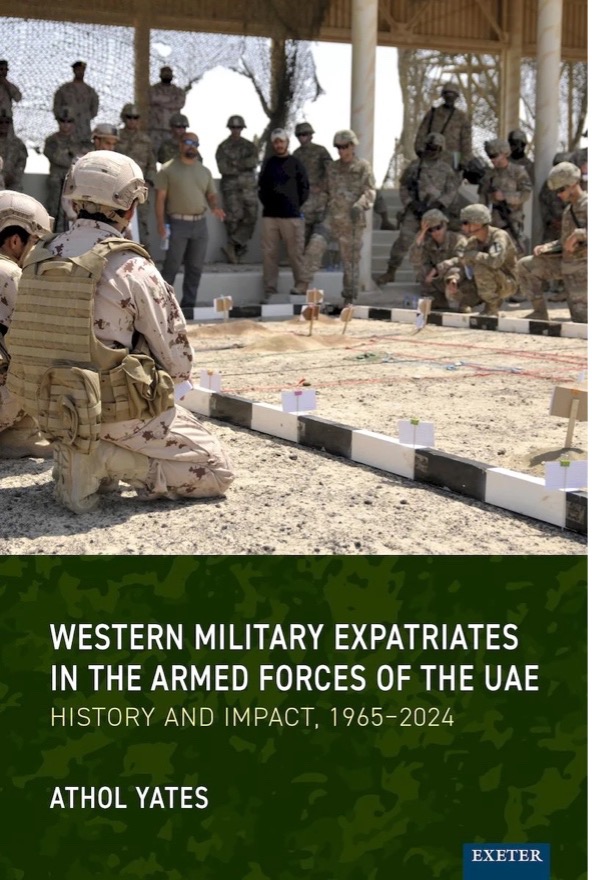

Western Military Expatriates in the Armed Forces of the UAE: History and Impact, 1965–2024 by Athol Yates. Exeter: University of Exeter Press, 2026. ISBN: 978-1-80413-152-7. pp. 304. $124
Athol Yates’s Western Military Expatriates in the Armed Forces of the UAE is the first systematic test of a claim asserted far more often than examined: that western professionals were the decisive enabler of Emirati military capability. Yates finds that the roughly 5,000 westerners who served since 1965 did deliver real capability, but that the advantage this purchased depends entirely on which rival is in view. Against western-aligned Gulf states, which draw on the same labor market, expatriates have produced not superiority but competitive parity. Against regional adversaries they have produced a genuine edge, one the Emirates has never organized itself to use. For any state buying capability through foreign personnel, the gap between holding an advantage and using it is what matters.

Athol Yates heads the Institute for International and Civil Security at Khalifa University in Abu Dhabi, and previously directed Canberra’s Australian Security Research Centre. His earlier volumes, The Military and Police Forces of the Gulf States: Trucial States & United Arab Emirates, 1951–1980 (2019, with Cliff Lord) and The Evolution of the Armed Forces of the United Arab Emirates (2020), established him as the principal English-language chronicler of these forces. The book rests on testimony from more than 130 expatriates, diplomats, and defense attachés, supported by British archival records at Kew, freedom-of-information requests, Wikileaks cables, and the private correspondence of the first commander of the Abu Dhabi Defence Force. Yates is candid about the holes: the UAE Armed Forces archive stayed closed to him and he abandoned interviews with former Emirati officers when language and cultural barriers made them unproductive, naming the thinness of Emirati input as a limitation rather than burying it, and testing his analysis informally with Emirati scholars and security force officers to offset it. A book that admits what it cannot know is worth more inside what it can.
Seven chapters are followed by eleven historical case studies, kept as a discrete section rather than woven through the analysis, which Yates says keeps the cross-case comparison transparent. Eleven cases make this a medium-n study, a rarely attempted middle ground between small-n work and large-n datasets. The introduction lines up the claims to be tested, quoting Samaan, Krieg, Pollack, Barany and Wood, the last calling westerners the central enabling factor, then asking flatly how valid they are. Chapters two to five answer four descriptive sub-questions: who the expatriates were, how they clustered into groups with definable lifecycles, how they were governed and managed, and what work they performed. Chapter six feeds these into the VRIO (Value, Rarity, Inimitability, Organizational support) assessment answering the main question of what it was all worth; a final chapter draws implications for the UAE, western countries, rival states and individual expatriates. The cases run from British secondees in Abu Dhabi’s military in 1966 to a US Marine Corps mission still running. The movement is patient and cumulative rather than narrative: six decades, eleven groups, one question.
The book’s central achievement is to convert an article of faith into a measured quantity. Where earlier scholarship described expatriate roles in the loosest terms, such as trainers, advisers, overseers, Yates counts. Twenty-eight nationalities. A presence ranging from a single westerner in the Sharjah National Guard in 1971 to roughly 1,300 in the UAE Armed Forces by the early 2010s, and from 0.02 percent of total military manpower in 1982 to two percent in 2015. Most usefully for planners, he prices them: each western expatriate cost the Emirates approximately US$230,000 in direct salary and benefits in 2024, nearer US$300,000 once on-costs and contractor margins are included, putting the annual bill for the 940 then serving at some US$282 million. That figure does more analytical work than any adjective could. It establishes expatriates not as a marginal input to be gestured at, but as a major recurring commitment whose return can, and should, be interrogated.
Yates also makes several durable conceptual contributions. The most important is the expatriate group: the observation that westerners have almost never served as scattered individuals but as bounded cohorts moving through a four-phase lifecycle, from high-level proposal through detailed planning and ongoing implementation to decline and end, and that the group is therefore a key unit of analysis. He pairs this with a taxonomy of eleven work roles, running from organizational leading and staff work through doctrine development to materiel fielding and facility development, and shows that groups spanned an average of seven of them, with the three earliest covering all eleven. Underpinning everything is his application of the resource-based view from strategic management, still little used in military studies, operationalized as a VRIO assessment testing expatriates for value, rarity, inimitability and organizational support. That framework is what allows the book’s central distinction (advantage against one class of rival, parity against another) to be stated as a finding rather than an impression.
Most valuably, Yates declines to let his subjects off. Alongside the three mechanisms by which expatriates generated value, he sets those by which they destroyed it, including the importing of practices unsuited to local conditions. The illustration is exact: a 1973 field exercise designed by Brigadier Ronald Pope on a British Army of the Rhine template, requiring an infantry regiment to dig into defensive positions in open desert. The regiment’s British commanding officer wrote home that the scheme was “completely out of touch with what we should be doing out here,” since an enemy need only drive around them. Expatriates themselves supplied further examples, mission command among them, whose demands for delegation and junior initiative many judged fundamentally at odds with Arab cultural norms. Yates then leads the charge himself: Emirati adaptive responses, consent followed by quiet evasion, absorbed much of the damage, leaving no significant net cost to capability. He is equally clear-eyed about oversight: roughly 200 US Emoluments Clause approvals were issued between 2010 and 2020, yet one contractor alone employed more than 200 former American personnel between 2011 and 2016, only sixteen of whom appear in the approval data, a gap he allows may reflect US-registered subsidiaries rather than evasion.
The book’s rigor is also its principal constraint. The resource-based view holds the external environment constant, so it cannot weigh expatriates against shifting technology, alliances, or the strategic priorities of rivals. Nor does it consider the thousands of Omanis, Jordanians and Egyptians serving alongside them, so a reader wanting to know how much of “Little Sparta” westerners specifically explain will not find out here. Yates concedes both. The rival-by-rival verdict would also carry further if tested from the other side; a matched examination of how Qatar or Kuwait has drawn on the same labor market would turn a reasoned parity finding into a demonstrated one.
Ultimately, Western Military Expatriates in the Armed Forces of the UAE is a valuable and disciplined study. Defense policymakers in western capitals will find a sober account of what security assistance can and cannot purchase, and a warning that the personnel instrument is only as good as the recipient’s willingness to organize around it. Scholars of Arab military effectiveness, and of expatriate management more broadly, gain both a dense empirical base and a portable framework that can be turned on non-western expatriates, on material, or on other client states. Military professionals, including the 940 in Emirati service at the end of 2024, will recognize the working life described, and may take some comfort in the finding that the frustrations they meet are structural rather than personal. The Emirates spent six decades hiring the people it needed. Yates’s lasting contribution is to show that hiring them was the easy part.


