





Damn Fine Soldiers: Resilience, Brotherhood, and the Fight for Baghdad
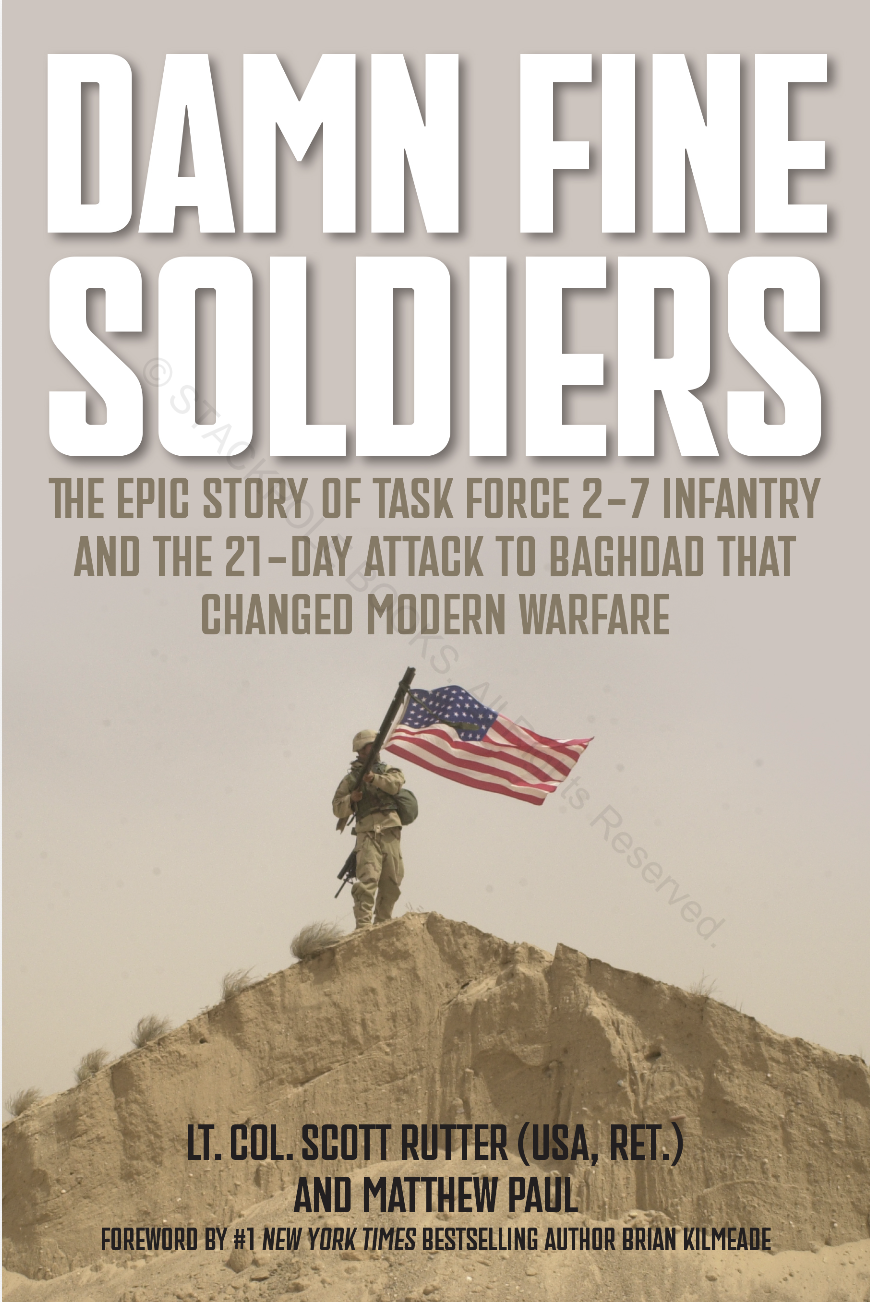

Damn Fine Soldiers By Lt. Col. Scott E. Rutter (USA Ret.) and Matthew C. Paul. Essex, Connecticut: Stackpole Books, 2026. ISBN: 978-1-4930-9699-2. pp.340. $24.95
“In every generation, there are warriors who stand at the edge of history and push forward”
– Damn Fine Soldiers
Introduction
Damn Fine Soldiers provides a harrowing direct account that chronicles Task Force 2-7 Infantry’s 21-day campaign, as part of the 3rd Infantry Division, from Kuwait to Baghdad during the 2003 invasion of Iraq. Through an immersive and comprehensively dynamic narrative, US Army Lieutenant Colonel Scott E. Rutter and then-Captain Mathew C. Paul provide a vivid portrayal of the opening phase of Operation Iraqi Freedom (OIF), including planning, training, and execution.
At the onset of the book, Rutter and Paul recount the radical shift from the pre-9/11 military environment to the dire realities following September 11, tracing the infantry’s progression from intense and humbling simulations in the Box at Fort Irwin’s National Training Center, to the emotional farewells with loved ones and spouses on January 23, 2003, and finally, to the deployment to Kuwait, where the unit awaited its marching orders. Encompassing the poignant and unforgiving emotional gravity of war, the authors write, “[w]ives said goodbye to ‘Honey,’ girlfriends to ‘Baby,’ and confused yet teary-eyed children said goodbye to ‘Daddy.’ Is there a right way to bid farewell to the ones you love and may never see again?”
Resolute in both mission and purpose, the 3rd Infantry Division entered Iraq with a unified understanding that the uncertainty of combat had replaced the comfort and familiarity of training. Under Lieutenant Colonel Rutter’s command of Task Force 2-7 and then-Captain Paul’s command of a mortar platoon, the narrative engrosses the reader, capturing the unrelenting camaraderie, resilience, and heroic fighting spirit forged through soldiers’ shared experiences at the front lines of war.
Into the Crucible
Commencing on March 20, 2003, OIF placed Task Force 2-7 at the forefront of a US-led multinational joint military campaign following international disputes regarding Iraq’s compliance with United Nations Security Council Resolution 1441 and concerns surrounding its stockpile and importation of weapons of mass destruction. Notably, the campaign sought to dismantle then-dictator Saddam Hussein’s regime and eliminate perceived weapons of mass destruction threats.
In Damn Fine Soldiers, the authors explain complex operational strategies and technical systems seamlessly and cogently. This adaptable narrative allows readers from any background to feel fully immersed in both the dynamics of the battlefield and the intense environmental stressors of ground operations. Within the operational context outlined in the book, the authors carefully and skillfully demonstrate the inherent uncertainties associated with campaign planning, including the challenges of analyzing enemy capabilities and developing adaptive courses of action in response to anticipated adversarial capabilities, stating “[w]e could have played the ‘what-if’ game forever, but the truth was that we wouldn’t know what we were up against until we were on the ground.” Spearheading into the unknown, into the crucible, and into the abyss of war, Task Force 2-7 crossed the threshold between localized preparation and the bitter friction of war, a transition that determined success and failure, and, more importantly, life and death. Combat was immediate, a shell-shocking blitz towards the north, a bombardment of pressure from the opposition forces, as well as externalities, including ambushes and suicide bombers.
Leadership, Resilience, and Brotherhood
Looking beyond documenting the tactical progression of Task Force 2-7’s advance towards Baghdad, Rutter and Paul predominantly redirect the reader’s attention to the demands of tactical leadership and the unforgiving consequences of failure. Despite entering Iraq as a highly prepared force structure augmented with avant-garde assets, training, and the resolve only a post-September 11 hegemony can provide, the authors elicit an onerous sense of anticipation and a heightened awareness of camaraderie found within the group dynamic.
Typical military campaign analysis hyperfixates on stripping the humanizing effects of conflict; instead, it emphasizes the quantifiable and intangible variables of warfare: established goals, data aggregation, CEP precision impacts, flight telemetry, or underwater bathymetry. However, Rutter and Paul position phenomenology as the prevailing theme, highlighting lived experiences that defined the moments calcified throughout the pages of the book. Throughout Damn Fine Soldiers, the authors instead continually share that the operational success did not wholly originate exclusively from the advantageous US military apparatus, but from the brotherhood hammered throughout the 21-day, 400-mile advancement towards Baghdad.
And while success drew in celebration, the authors share the grim truth of war – loss. The loss of a soldier, the loss of a brother, the loss of a friend, and the loss of a loved one. Authors Rutter and Paul share the irreversible human cost often found behind operational success, a cost not measured through battlefield statistics, strategic readiness, or tactical objectives, but through the empty spaces left behind and the feeling of loss from the perspective through the eyes of leadership, the visceral guilt and profound somber realization that metrics of success can’t outweigh.
Conclusion
Overall, the book is well written, well-paced, hauntingly emotional, and absolutely exhilarating to read. The book serves as more than a compelling first-hand experience through the eyes of leadership, an ordeal not typically allotted to civilians. At its nucleus, the book shouldn’t strictly be perceived as a fundamentally generic run-of-the-mill military memoir but should be understood as a profound examination of the human experiences – the unspoken experiences – of war and the gravity of such an operational campaign. Notably, when examining through the works of prominent military theorists, including Mao or Clausewitz, warfare is often examined through an austere lens of strategy, doctrine, and the mechanisms that produce operational success. The human experience, while inherently present, is often abstracted beneath the focal point of campaigns. Damn Fine Soldiers, however, challenges this abstraction by having the prevailing theme of the bonded brotherhood and leadership that defined Task Force 2-7’s success. Zooming out, practitioners, analysts, researchers, and those interested in military analysis should read this book because it provides a unique perspective on OIF, but also because the book adds practical value for professionals through experiential knowledge that cannot be obtained through rudimentary analytical frameworks such as doctrine, models, or planning strategies alone.


