The Wars We Failed to Understand: A Review of Peter Bergen’s All the Presidents’ Wars
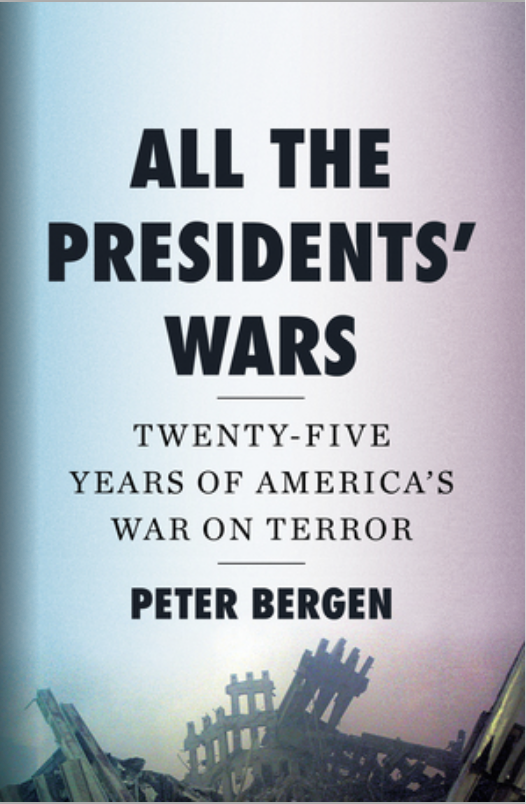

All the Presidents’ Wars by Peter Bergen. Norton, 2026. ISBN: 978-1-324-12406-1. pp. 432. $32.99
When I was a college student in 1991, a friend made an ignorant comment about the Vietnam War. I no longer remember his exact words – probably some painfully simple lesson absorbed from popular culture and repeated with the confidence only available to the young and ignorant. I do remember my professor’s response: “Read a Damn Book!”
The rebuke was deserved, and it stung. I was politely nodding in agreement as my friend reduced a complicated war into a parable. For my professor’s generation, Vietnam was a lived history, a complicated sequence of decisions, constraints, mistakes, theories, and consequences that shaped their adult lives. I eventually took his advice with books such as Stanely Karnow’s Vietnam: A History.
Now, the roles have reversed. Most of my graduate students, and certainly most of my undergraduates, were born after September 11, 2001. The post 9/11 wars stand at roughly the same time-distance from their first memories that Vietnam once stood from mine. They have inherited a vocabulary: “war on terror,” “nation-building,” “counterinsurgency,” and “forever war.” A vocabulary inherited without living through the fear, uncertainty, bureaucratic conflict, and political passions attached. Too often, the result is a simple story that was anything but simple.
That is why Peter Bergen’s All the Presidents’ Wars: Twenty-Five Years of America’s War on Terror, written with David Sterman, arrives at the right moment. It is a timely book for more than one demographic. For those of us whose personal and professional lives were shaped by these wars, it offers an opportunity to reflect, reconsider, and place our own small parts within a larger chronology. For those who know the period only as history, it supplies something even more necessary: context without exoneration and judgment without political or partisan caricatures.
Bergen examines the most consequential national-security decisions of four presidents across seven presidential terms. Producing the first television interview with Osama bin Laden and decades spent reporting on al-Qaeda, Afghanistan, Iraq, counterterrorism, and the people who shaped U.S. policy, qualify him for the task. His access and experience are evident as he uses his eyewitness account to dispel disinformation about the killing of bin Laden after the raid. The book is a collection of Bergen’s disciplined journalism alongside recent history and organized around what presidents and their closest advisers knew, when they knew it, and what they did anyway.
Bergen repeatedly returns to that great dictum of Carl von Clausewitz, which will be all too familiar to the readers of Small Wars Journal:
“The first, the supreme, the most far-reaching act of judgment that the statesman and commander have to make is to establish…the kind of war on which they are embarking; neither mistaking it for, nor trying to turn it into, something that is alien to its nature. This is the first of all strategic questions and the most comprehensive.”
This may seem simple, but it works. Bush tried to turn a counterterrorism problem into a project of political and societal transformation. Obama tried to turn war into a campaign of targeted killing that could proceed without being called war. Trump treated a small and sustainable stability mission as an intolerable “forever war” and turned it into what Bergen portrays as a negotiated surrender. Biden attempted to turn that inherited surrender into a graceful exit. The formulation highlights important differences and a commonality: presidents of different parties, temperaments, and strategic preferences shared a tendency to define conflict how they wanted rather than understand the conflict they had.
Bergen is unsparing in tracing events. He follows Bush’s decision to shift attention and resources from Afghanistan to Iraq to the disastrous consequences of Paul Bremer’s de-Baathification and the dissolution of the Iraqi military. He criticizes the Obama administration for passing on opportunities to negotiate a settlement with the Taliban. In the chapter, “The Art of the Giveaway,” Bergen dissects the logic that led the Trump administration to the Doha agreement. He then recounts Biden’s choice to execute the withdrawal despite clear warnings that the Afghan state and security forces could rapidly collapse. Bergen ties the pattern of the preceding quarter century to the current U.S. war with Iran.
The book’s tone is one of its great strengths. Bergen is nonpartisan without treating every error as equal. He identifies false claims and actions that ran contrary to evidence, and he distinguishes debatable decisions from the strategically indefensible. None of the presidents receive special protection, and none are reduced to cartoons.
Bergen does not ignore success. The U.S. has not suffered another foreign terrorist attack on the scale of 9/11; Bush eventually changed course and supported measures that mitigated damage caused in part by his earlier decisions. The U.S. military and its civilian partners learned the value of small-footprint approaches that enable capable local partners. Bergen also shows the striking continuity between the Obama and Trump administrations in the campaign against ISIS – an approach that succeeded by most reasonable operational measures. Such passages keep the book from becoming a catalogue of folly. Bergen’s record is a mixture of adaptation and error, competence and hubris, lives protected, and opportunities squandered.
For those who lived through these years, the book can be painful. Civilian and military veterans will encounter episodes they would rather not revisit and information they may not have known at the time: this is the book’s value. Most of us were not in the rooms where decisions were made. We received the order, executed the program, built the partnership, watched the news, buried a friend, maybe wrote an article for Small Wars Journal, or tried to explain to our families why the work mattered. Bergen converts those memories into a useful chronology by identifying the decisions that produced the orders and events we experienced downstream. He makes it possible to reconsider our own judgments within the context we lacked in the moment.
This is not an invitation to indulge in nostalgia or retrospective self-justification. Even when memory is vivid, it is not history. Those of us who participated in a small part of these wars can mistake our part for the whole, just as senior leaders mistook a preferred theory for the war itself. Bergen helps correct both errors. He shows how much was happening elsewhere and how little any one participant could see.
The book may be even more important for readers who do not remember 9/11. My students are currently trying to understand why the United States spent so much blood, treasure, and attention across so many theaters, and why successive presidents made decisions that now appear foolish. They are right to demand answers. But they can also be tempted by retrospective inevitability: the belief that outcomes were fated, alternatives were obvious, or a single motive explains twenty-five years of policy. Bergen restores the context and tames the temptation of path dependency. He highlights choices made under pressure with incomplete information, ignored evidence, untested assumptions, and unpursued alternatives.
Bergen’s deeper lesson is about judgment. The country needs presidents and senior officials willing to cultivate dissent rather than punish it, distinguish activity from progress, and resist the recurring temptation to let fear, anger, or political passion displace reason and national interest.
Bush, Obama, Trump, and Biden differed substantially, but at crucial moments tried to rename, resize, transform, or terminate a conflict without first accepting its character. This is why Clausewitz remains central to Bergen’s account. The first strategic failure was not the misuse of a particular weapon or the selection of the wrong operational approach; it was the failure to understand the political and social context. Bergen shows how often the U.S. paid for that intellectual failure.
The book has limitations imposed by its chosen lens. For example, readers with experience in the Pacific Theater will notice omissions. I wanted more on the Philippines and Southeast Asia, quiet capacity-building partnerships, and the relative effectiveness of specific programs and operational approaches. Others will miss different campaigns or dispute the weight Bergen assigns to familiar decisions. A comprehensive operational history of every American counterterrorism effort would, however, be a different book. Bergen remains disciplined about his subject: presidential decisions and the information available to the people who made them. The omissions are worth noting, but do not diminish that achievement.
I strongly recommend All the Presidents’ Wars, especially to readers of Small Wars Journal. Veterans, practitioners, and officials will find a lucid account that connects their fragment of experience to the decisions above it. Students and younger readers will find a history that complicates the slogans through which the period is increasingly remembered. Both audiences will find a book that is critical without being cynical and accessible without becoming simplistic.
Years ago, my professor was not telling me to find a book that would confirm his interpretation of Vietnam. He was demanding that I replace cliché with history and confidence with inquiry. Bergen does not settle every argument about America’s post-9/11 wars. He gives us the chronology, context, evidence, and judgment necessary to have those arguments more honestly. It is the book I can hand to a student whose explanation has become too simple, and the book I need when my own memory of these years begins to do the same. That, I now understand, was my professor’s point.