





Western Thoughts on Counterinsurgency: From 17th Century to the Present
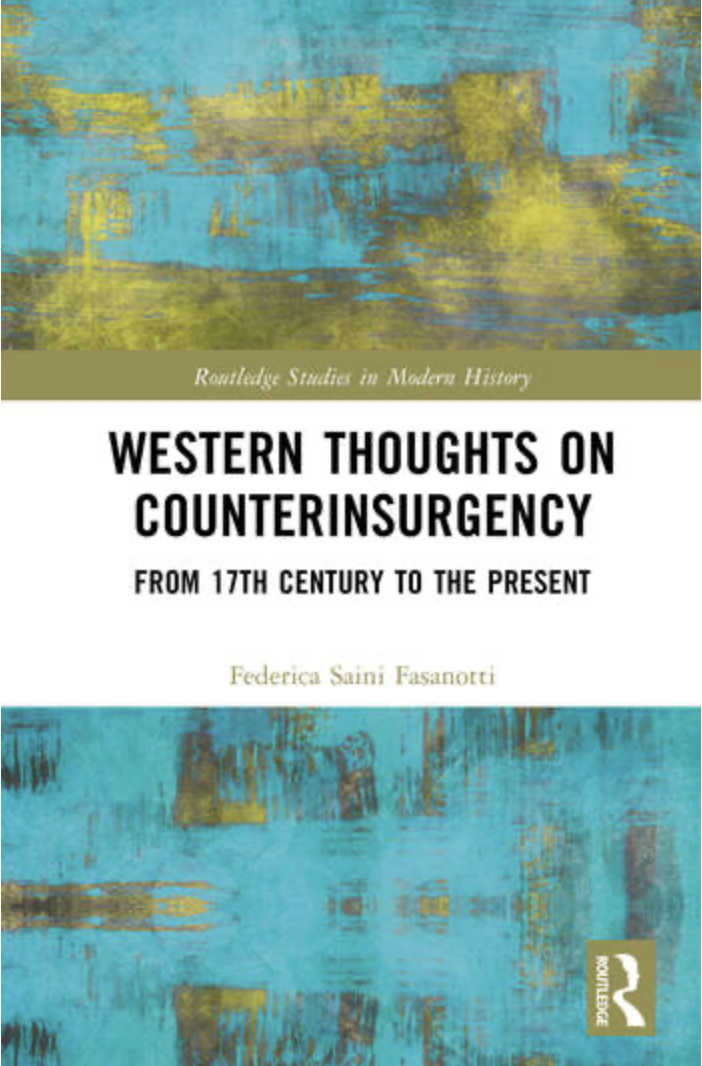

Western Thoughts on Counterinsurgency by Dr. Federica Saini Fasanotti. Routledge, 2026. ISBN: 9781041124252. pp. 350. Ebook: $58.49
The study of insurgency and counterinsurgency, once a flourishing industry after 9/11, has taken a back seat in national security studies to more topical subjects such as China and the Thucydides Trap, the war in Ukraine and the impact of drone warfare, or the struggle to control the Straits of Hormuz and Bab el-Mandeb. However, those still interested in counterinsurgency would do well to consult Dr. Frederica Saini Fasanotti’s book, Western Thoughts on Counterinsurgency: From the 17th Century to the Present, recently published by Routledge Studies in Modern History. Dr. Saini Fasanotti is a Senior Associate Fellow at the Institute for International Political Studies in Milan and is the author and coauthor of several works on Italy’s colonial wars as well as the war in Afghanistan where she conducted field research.
Western Thoughts on Counterinsurgency provides the reader with a panoramic view of the field of counterinsurgency – its past antecedents and possible future directions. Dr. Saini Fasanotti has researched not just the standard tomes on the subject familiar to most American readers but also delved into rarely studied figures and campaigns from the Middle Ages to the early modern era to explain how what began as a study in the elimination of brigandry, or some other similar past name for guerrilla fighters, evolved into today’s complex enemy or population-centric counterinsurgency strategies.
The book is divided into four parts. The first provides a methodological framework for studying counterinsurgency with subsections on counterinsurgency aspects of international humanitarian law, civil war, revolutionary war, partisan war, low intensity conflict, the use of terror, and the meaning of victory. The next part is a study of the history of counterinsurgency thought with chapters on the Italian, Spanish, German, French, British, and American experiences, the point of view of guerrilla fighters, and a summary of the works of several well-known strategic theorists such as Bernard Fall and David Galula and rarely mentioned figures such as Charles Lacheroy and Jacque Hogand. Dr. Saini Fasanotti’s review of these last two French military officers illustrates how their works, somehow ignored by many scholars, set the stage for the theories of Galula and Roger Trinquier and puts their later works into a fuller context of French counterinsurgency thinking of that era.
The final two parts are the book’s key strengths. In the section described as the “Pillars,” Dr. Saini Fasanotti pulls together the collective wisdom of almost five centuries of thinking on what is known today as counterinsurgency theory for strategic and tactical elements including surprise, initiative, sanctuaries, external support, terrain, maneuver, logistics, intelligence, and information operations. The final unit provides the same for the human element describing how past theorists have described the necessary types of commanders and troops needed for this type of warfare as well as the human dimension of the enemy they will fight, the population they will interact with, and the home front they must conquer.
An interesting facet of this book is the description of the campaigns and writings of obscure historical figures whose observations of this form of warfare predate by decades or centuries the works of previously considered pioneers in counterinsurgency theory such as C.E. Callwell or Marshal Louis Hubert Lyautey. Until reading this book, the reviewer was not aware of the pacification campaigns of the Spanish military figure the Marquis Alvaro Navia-Osoro de Santa Cruz de Mercenado (1684-1732) or the Italian general Emilio Pallavicini di Priola (1823-1901). The Marquis de Santa Cruz was a soldier and diplomat who died trying to pacify Spain’s colony of Oran in today’s northwestern Algeria. Before his death, he wrote Reflexiones Militares, which covered the gamut of military operations for both conventional and irregular wars. It would later be translated into French, German, and Italian, but unfortunately never into English. Santa Cruz conducted considerable research into ancient warfare believing that the “Ancients” invented while the “Moderns” merely imitated. Book VIII of his Reflections is entirely devoted to dealing with rebellions including prophylactic measures to prevent rebellions, the warning signs rebellion is near, how to end a rebellion, and how to deal with rebels afterwards. He believed that rebellions were often the fault of poor colonial overseers who should be severely punished for letting events deteriorate to the extent that rebellion became both possible and necessary.
General Emilio Pallavicini di Priola literally wrote the book for the suppression of guerrillas almost four decades before Callwell’s pioneering work Small Wars. Southern Italy in the early 1860s was engulfed in conflict between peasants and ex-soldiers from the former Bourbon army versus nationalist-liberals supported by the Army of Savoy, which would become the Italian army. Mixed in to the fray were bands of common criminals exploiting the chaotic nature of the political situation and the difficult mountainous terrain of the region. Pallavicini was given the task of ending this disorder and brigandry, which he succeeded in doing between 1860-1869. His tactics included now familiar methods of flying columns, intelligence collection, attacks against sanctuaries, ambushes, convoy security, etc. Near the end of this fight, he codified his guidance from previous circulars to his subordinates into a book, Istruzione Teorica, that was published in 1868. Dr. Saini Fasanotti described him as a “true pioneer of the doctrine of counter-guerrilla warfare” and noted how his doctrine greatly influenced future Italian counterinsurgency operations in Libya (1922-1931) and Ethiopia (1936-1940).
While an interesting and extremely well researched work, the reviewer has one criticism regarding Dr. Saini Fasanotti’s inclusion of a discussion of Low Intensity Conflict (LIC) in her work and separating the British expert Frank Kitson as a LIC theorist despite his obvious contributions to the theory and practice of counterinsurgency. The reviewer found the discussion of various sub-elements of LIC such as peacekeeping operations, terrorism, etc., and the works of Martin van Creveld in this context as a distraction from the book’s core purpose of reviewing Western approaches towards counterinsurgency. This chapter’s historical case study of Malayan Emergency (1948-1960) was not a good example as it was a classic counterinsurgency campaign (which is admittedly a sub-element of LIC) and would have fit better in the previous chapter on counterinsurgency theorists. However, this is a minor quibble with the book’s organization that does not take away from its intrinsic value as already stated.
Dr. Saini Fasanotti’s footnotes and bibliography alone are a treasure trove of data and unique sources for those interested in learning or writing about insurgencies and counterinsurgencies. Western Thoughts on Counterinsurgency: From the 17th Century to the Present should be a standard research tool for future authors on this subject as the century unfolds and counterinsurgency specialists try to mine the past to deal with future insurgencies.


