





Designing Strategic Effects: Special Operations in Contemporary Warfare
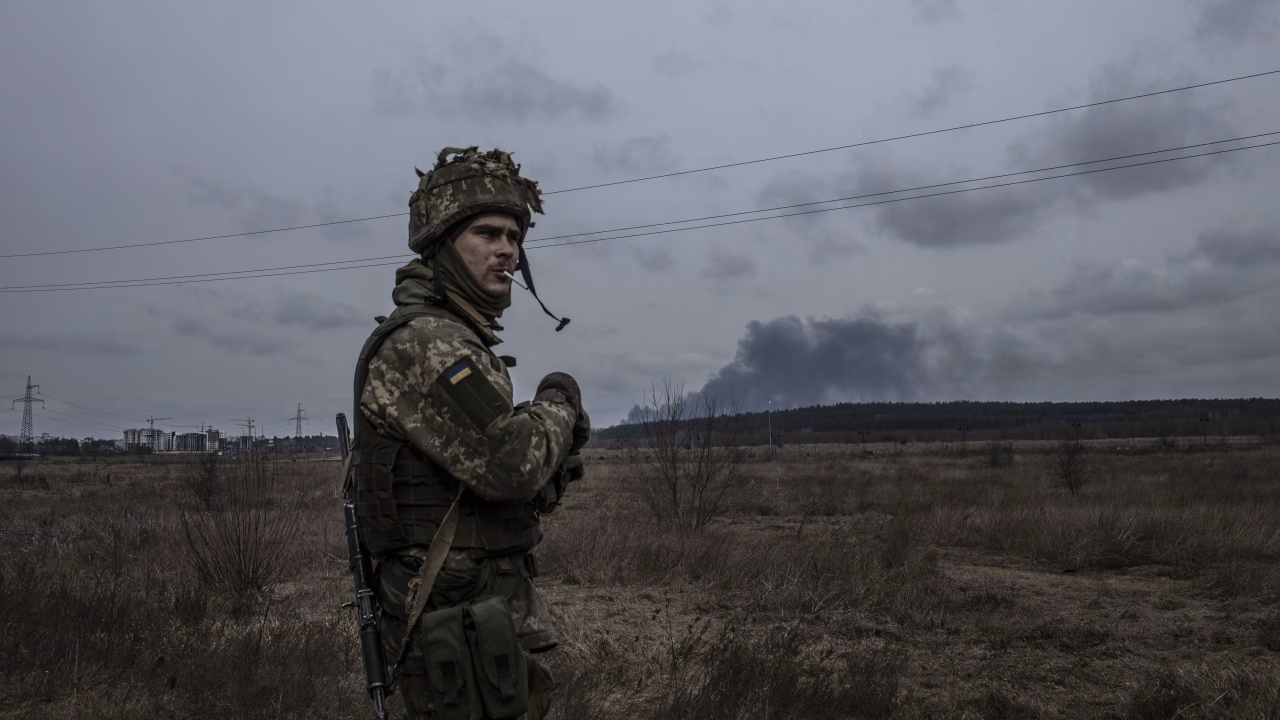

Special operations have long been associated with the ability to generate effects disproportionate to the size of the forces employed. As a result, scholars and practitioners have devoted considerable attention to the strategic value of special operations forces (SOF), their unique capabilities, and their contribution to military and national objectives. While the importance of SOF is widely recognized, less attention has been paid to a more fundamental question: how are strategic effects produced? In other words, what enables a limited-scale operation to generate consequences that extend beyond its immediate tactical outcome?
Answering this question has become increasingly important considering contemporary warfare. Much of the existing literature on special operations was developed before the widespread use of unmanned systems, persistent battlefield surveillance, and highly transparent operational environments. The ongoing war in Ukraine has demonstrated that small units can influence events far beyond their numerical strength, while also highlighting the growing importance of emerging technologies and innovative operational approaches. These developments raise questions regarding the continued applicability of traditional theories and whether additional factors should be considered when explaining how strategic effects occur in modern conflict.
This article argues that strategic effects are most likely to occur when limited-scale operations combine deliberate planning, effective technology integration, and an appropriate form of operational effect. Rather than viewing strategic outcomes as the direct result of tactical success alone, the article suggests that they occur through a combination of factors that shape how an adversary responds to military action. By examining these factors, the article seeks to contribute to a better understanding of how special operations can generate disproportionate outcomes in contemporary warfare.
Strategic Effects Beyond Tactical Success
Military operations are often evaluated through their immediate tactical outcomes. Measures such as enemy casualties, destroyed equipment, seized terrain, or degraded infrastructure provide visible indicators of success and remain important for assessing battlefield performance. While these outcomes are relevant, they do not necessarily explain whether an operation has produced a strategic effect. Tactical success and strategic significance are related, but they are not synonymous.
The distinction between tactical outcomes and strategic effects has long been recognized in military theory. Gray argues that strategy serves as the bridge between military action and political purpose, emphasizing that military success acquires meaning only when it contributes to broader strategic objectives. Similarly, Art contends that the value of military force should be assessed not solely through the destruction it causes but through the political and strategic consequences it generates. Tactical achievements therefore become strategically meaningful only when they influence broader military, political, or organizational outcomes beyond the immediate battlefield.
Despite this general understanding, existing literature provides only limited explanation of how strategic effects occur in practice. Scholars frequently identify successful operations and describe their outcomes, yet the mechanisms that transform tactical actions into broader strategic consequences remain less clearly understood. As a result, strategic effects are often treated as an outcome to be observed rather than a process to be explained.
Recent developments in Ukraine illustrate this challenge. Several operations produced consequences that extended far beyond their immediate physical results. Strikes against Russian military and economic targets, for example, often generated effects that could not be fully explained by the damage inflicted alone. In many instances, the most significant consequences resulted from subsequent Russian decisions, including force redeployments, adjustments to defensive measures, and changes in operational priorities. These reactions frequently imposed costs that exceeded the direct effects of the original operation.
This observation suggests that strategic effects should be understood as more than the destruction of targets or the achievement of local tactical objectives. Rather, they occur when military action influences how an adversary allocates resources, makes decisions, or adapts its behavior. If strategic effects are produced through such processes, it becomes necessary to identify the factors that make them more likely to occur. One of the most important concerns is how operations are conceived and prepared before they are executed.
Premeditation and Operational Design
Strategic effects rarely occur by accident. While battlefield opportunities may arise unexpectedly, operations that generate consequences beyond the tactical level are typically characterized by extensive preparation and deliberate design. This is particularly true for special operations, where limited resources place a premium on thorough preparation and effective operational design. Successful execution is a necessary condition for strategic effects, but it is rarely sufficient on its own. The ability to produce disproportionate outcomes also depends on the planning and design that precedes an operation.
Premeditation involves more than simply selecting a target and developing a plan. It reflects a deliberate intent to generate effects that extend beyond the immediate tactical outcome of an operation. This preparation requires identifying vulnerabilities, anticipating adversary responses, and designing actions that create broader operational pressures rather than merely achieving mission success. In this sense, preparation serves not only to increase the probability of mission accomplishment but also to shape the conditions under which strategic effects may occur. The more complex the intended effect, the more important deliberate operational design becomes.
Historical and contemporary examples demonstrate the importance of this principle. The Ukrainian operation in Kursk, for instance, was preceded by months of preparation, force development, and operational planning. Similarly, successful strikes against high-value targets in Crimea relied on the integration of intelligence, deception, and supporting capabilities long before execution. While the visible action often receives the greatest attention, the broader consequences of these operations were enabled by decisions made well in advance.
Premeditation is particularly important because strategic effects depend not only on what happens during an operation but also on how the adversary responds afterward. Operations intended to generate broader consequences must anticipate likely reactions and create conditions that make certain responses more probable. In this regard, operational design extends beyond the achievement of tactical objectives and incorporates consideration of second- and third-order effects. Strategic effects are therefore more likely to occur when operations are deliberately designed to shape adversary behavior rather than simply achieve immediate battlefield success.
For SOF, this observation carries an important implication. Generating strategic effects requires planners to think beyond the destruction of targets and focus instead on how military action will influence future adversary decisions. Premeditation therefore serves as a critical foundation for strategic success by aligning tactical actions with anticipated operational and strategic consequences. If operational design establishes the framework for strategic effects, technology increasingly provides the means through which such effects can be generated in contemporary warfare.
Technology as an Enabler
Technology can significantly expand the ability of military organizations to generate strategic effects, but it does not produce such effects on its own. In contemporary warfare, unmanned systems, precision-guided munitions, commercial satellites, and digital communication networks have increased the reach, precision, and responsiveness of military operations. For SOF, these developments have created new opportunities to identify targets, gather intelligence, and apply pressure against objectives that were previously inaccessible. As a result, relatively small units can now influence operational environments in ways that would once have required substantially greater resources.
Despite these advances, technology alone does not produce strategic effects. Possessing advanced systems is not synonymous with achieving meaningful outcomes. History offers numerous examples of technologically superior forces failing to translate battlefield advantages into broader strategic success. Technology is most valuable when it is effectively integrated into operational concepts, planning processes, and organizational structures. In other words, strategic effects occur not from technology itself but from how it is employed.
The war in Ukraine provides several examples of this dynamic. Ukrainian forces have demonstrated an ability to combine intelligence, unmanned systems, precision strike capabilities, and innovative operational approaches to reach targets deep within Russian-controlled territory. In many cases, the significance of these operations has not been the physical destruction caused by individual platforms. Rather, it has been the ability to create dilemmas, expose vulnerabilities, and compel adversaries to adapt in ways that generate broader consequences. Technology expanded the range of available options, but successful outcomes depended on how those capabilities were integrated into a broader operational design.
Technology also increases the ability of SOF to influence systems rather than individual targets. Modern sensors and strike capabilities allow operators to affect logistics networks, command structures, critical infrastructure, and other components that support military operations. This shift is significant because strategic effects often occur through the disruption of systems rather than the destruction of individual assets. As technology improves, the ability of small forces to create such disruptions is likely to increase.
The importance of technology therefore lies in its role as an enabler rather than a determinant of success. Emerging capabilities can expand the reach and effectiveness of special operations, but their strategic value depends on how they are integrated into planning and execution. Understanding this distinction helps explain why similar technologies may produce vastly different outcomes in different contexts. Ultimately, the strategic value of technology depends on how it is integrated into operational design and employed to generate a particular type of effect. Different technologies may support different pathways to strategic outcomes, whether through the cumulative imposition of costs or through the disruption and denial of critical functions.
Shaping Adversary Behavior
Not all military operations seek to achieve the same type of effect. Some are primarily designed to destroy enemy personnel, equipment, or infrastructure, while others aim to restrict freedom of action, create operational dilemmas, or deny access to critical capabilities. Although both approaches can contribute to military success, they do not necessarily generate the same strategic consequences. The type of effect an operation seeks to achieve influences how an adversary is likely to respond and, consequently, the probability that strategic effects will occur.
Attrition-based operations focus on reducing an adversary’s combat power through the destruction of physical assets. Such operations can impose high costs and degrade military capabilities, particularly when directed against high-value targets. However, the strategic impact of attrition is often limited when losses can be replaced or absorbed without substantial changes in behavior. Destruction alone does not guarantee strategic significance if the adversary continues to operate according to existing plans and priorities.
In contrast, operations that create denial effects frequently seek to influence how an adversary acts rather than simply what it possesses. By threatening key capabilities, exposing vulnerabilities, or disrupting critical functions, such operations can force opponents to reconsider assumptions and alter decision-making processes. The resulting changes may include force redeployments, modifications to operational plans, increased defensive investments, or the diversion of resources from other priorities. These responses often generate consequences that extend beyond the immediate effects of the operation itself.
Recent Ukrainian operations illustrate this distinction. In several cases, the most important outcome was not the physical damage inflicted on a particular target but the subsequent response it generated. The relocation of naval assets, reinforcement of air defense networks, increased protection of critical infrastructure, and redeployment of military formations all imposed additional costs on Russia. These actions reflected efforts to adapt to emerging threats, demonstrating that the broader significance of an operation often lies in its ability to influence adversary behavior rather than in the damage it directly causes.
This observation suggests that adversary adaptation represents a critical mechanism through which strategic effects are produced. Operations generate disproportionate outcomes not simply because they destroy valuable targets but because they compel opponents to make decisions they would otherwise prefer to avoid. Strategic effects therefore occur through an interactive process in which military action shapes subsequent adversary behavior. Understanding this relationship helps explain why some limited-scale operations produce consequences far beyond their immediate tactical results and highlights the importance of designing operations with anticipated adversary responses in mind.
Implications for Special Operations Forces
The findings presented in this article carry several implications for the employment of SOF in contemporary warfare. First, planners should focus not only on achieving immediate tactical objectives but also on shaping adversary behavior. Operations that generate strategic effects are often successful because they influence subsequent decisions, resource allocations, and operational priorities rather than simply because they destroy valuable targets. Anticipating these responses should therefore become an integral component of operational planning.
Second, technology should be viewed as an enabler of strategic effects rather than a source of such effects in itself. The growing availability of unmanned systems, precision strike capabilities, and advanced intelligence platforms expands the options available to SOF. However, these capabilities create strategic value only when they are integrated into coherent operational concepts designed to achieve broader objectives. Technological superiority alone does not guarantee strategic success.
Third, assessments of operational effectiveness should extend beyond traditional measures of battlefield performance. Metrics such as destroyed targets, enemy casualties, or territory seized provide useful indicators of tactical achievement but may fail to capture broader consequences. Evaluating changes in adversary behavior, resource allocation, force posture, and decision-making can provide a more comprehensive understanding of strategic impact.
Taken together, these observations suggest that the role of SOF may be best understood not as a means of achieving destruction alone but as a tool for creating disruption within larger adversary systems. In an increasingly transparent and technologically enabled battlefield, the ability to influence how opponents think, prioritize, and respond may prove more valuable than the immediate effects of military action itself.
Conclusion
Special operations have long been associated with the ability to generate effects disproportionate to the size of the forces employed. Yet understanding how such effects occur remains an important challenge for both scholars and practitioners. While tactical success is often measured through the destruction of targets, strategic effects frequently result from broader processes that extend beyond the immediate battlefield.
This article argued that strategic effects are most likely to occur when limited-scale operations combine deliberate planning, effective technology integration, and an appropriate form of operational effect. Premeditation creates the conditions necessary for success, technology expands the ability of small forces to influence larger systems, and the nature of the effect shapes how adversaries respond. Together, these factors help explain why some operations generate consequences that far exceed their immediate tactical outcomes.
The experience of contemporary warfare, particularly in Ukraine, suggests that the significance of military action often lies not in what is destroyed but in how an adversary reacts. Force redeployments, changes in operational priorities, increased defensive investments, and other adaptive responses may impose costs that exceed the direct effects of an operation itself. Strategic effects therefore occur through an interactive process between military action and adversary behavior.
As warfare continues to evolve, understanding these mechanisms will become increasingly important. For SOF, success may depend less on the physical destruction they achieve and more on their ability to shape decisions, create dilemmas, and disrupt adversary systems. The strategic value of special operations may not primarily rest in what they destroy, but perhaps in what they compel an adversary to do afterward.


