





Beyond the Grade: Improving Feedback Quality to Build Adaptive Army Leaders
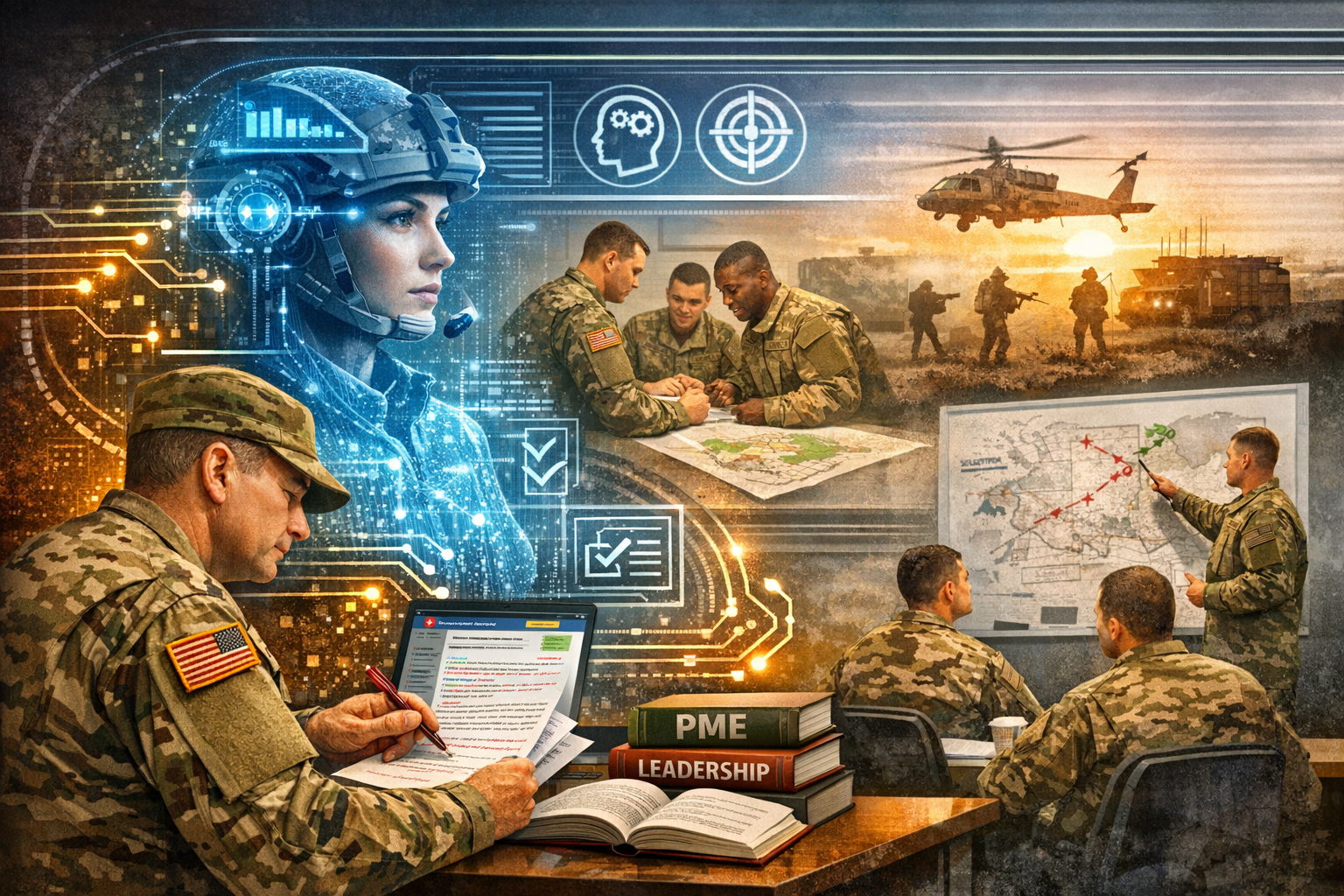

“Feedback is the breakfast of champions.” At Fort Leavenworth, this mantra greeted Soldiers daily on the electronic display board, a reminder from Lieutenant General (RET) Milford Beagle that growth begins with honest assessment. Across the Army, feedback is not optional—it is foundational. Army Doctrine Publication (ADP) 6-22, Army Leadership and the Profession makes performance counseling a core leader responsibility, requiring routine, structured assessments that drive disciplined thinking and accountability. The After Action Review (AAR) process in FM 7‑0 and TC 7‑0.1 reinforces this culture through candid, immediate reflection after training events such as Combat Training Center rotations, where units dissect successes and failures to refine tactics and decisions. Comment cards, end‑of‑course critiques, and 360‑degree mechanisms—including OER support forms—extend this ethos, promoting iterative dialogue and self‑awareness across the force.
These doctrinal imperatives carry directly into Professional Military Education (PME). Here, feedback is not merely evaluative—it is the engine of reflective judgment, ethical reasoning, and operational insight. Yet despite its centrality, feedback in PME often becomes a secondary effort, overshadowed by curriculum demands, administrative requirements, and instructor workload. The result is predictable: delayed, generic, or inconsistent guidance that blunts leader development.
PME aims to produce officers capable of disciplined initiative in volatile, uncertain, complex, and ambiguous environments[1]. Achieving that outcome requires more than exposure to doctrine and discussion—it demands a learning process that actively shapes judgment, adaptability, and ethical reasoning. Grades record performance; targeted feedback builds the adaptive, ethically grounded, and analytically sharp leaders the Army requires. Educational research is unequivocal: timely, specific, developmental feedback significantly improves learning and long‑term performance—an effect magnified in PME, where the goal is operational decision‑making under pressure. When feedback is sparse or superficial, leader growth stalls. When it is structured, frequent, and growth‑oriented, proficiency accelerates.
However, faculty time and resource constraints routinely limit feedback quality and volume across PME institutions. Emerging instructor–AI teaming offers a promising solution, enabling more frequent, personalized, and scalable feedback while preserving human judgment for the nuanced developmental guidance only instructors can provide. This article explores how such partnerships can transform PME feedback processes and better prepare officers for the demands of contemporary and future conflict.
PME Reality: Mission Demands and Instructor Load
Professional Military Education operates within the Army’s broader modernization and leader development framework, which calls for transforming how the Army teaches, educates trains, assesses, and develops leaders for large-scale combat operations (LSCOs) and complex environments. Foundational documents such as Outcomes-Based Military Education Procedures for Officer Professional Military Education and The Army Learning Concept for 2030-2040 emphasize learner-centric, outcomes-based approaches designed to produce adaptive leaders capable of critical thinking and disciplined initiative in uncertain conditions. These concepts prioritize continuous assessment, active engagement, technology-enabled learning environments, and recurring developmental feedback as essential enablers of individual and unit readiness.
In practice, however, PME faculty face significant structural constraints. Instructors must juggle multiple roles: facilitating small-group seminars, providing individualized mentoring and advising, contributing to ongoing curriculum development and revision, managing administrative requirements, and fulfilling additional military duties such as staff rides or operational planning exercises. Compounding this is the high volume of analytical writing assignments—often thousands per academic year across a faculty cohort—each of which requires instructors to read closely, evaluate against standards, and craft individualized feedback that meaningfully develops student thinking.
The Army deliberately emphasizes writing in PME because clear, structured prose directly correlates with disciplined thinking, effective communication of intent, and sound operational decision-making. Analytical papers force officers to articulate complex problems, evaluate evidence, consider ethical implications, and recommend courses of action and skills essential for staff work and command in contested environments.
Yet workload pressures represent well documented barriers to maintain feedback depth and consistency in professional education settings, and PME institutions reflect these same challenges. When instructor capacity and experience is stretched, the minimum grading standards are met, but Soldiers need and deserve more than the minimum. Comments can become abbreviated, less tailored to individual growth needs, and more oriented toward surface level corrections (grammar, format) rather than deeper analysis of reasoning, assumptions, or alternative perspectives. Variability across instructors increases, reducing the overall coherence of developmental guidance.
This degradation has direct implications for leader development. Inconsistent or delayed feedback limits opportunities for reflective practice, hindering progress in core competencies such as intellectual agility, sound judgment, and ethical reasoning. Over time, it risks producing officers who meet minimum academic thresholds but lack the internalized habits of mind required for independent decision-making under pressure.
This challenge transcends simple administrative efficiency. It becomes a fundamental leader development challenge with potential consequences for operational effectiveness and the integrity of PME programs.
The unavoidable conclusion is simple. PME’s persistent constraint is not solely grading volume or throughput. The core challenge lies in sustaining high-quality, individual, scalable and timely feedback.
Doctrinal Imperative: Feedback as a Readiness Function
The Army defines leadership as the process of influencing people by providing purpose, direction, and motivation to accomplish missions and improve the organization. Professional Military Education exists explicitly to cultivate such leaders and officers who can exercise mission command in dynamic, uncertain environments.
In PME, students do not merely receive information; they actively engage in complex operational problems through methods such as case study analysis, seminar discussions, wargaming, and staff ride reflections. They develop evidence-based arguments, evaluate alternatives under ethical constraints, and refine professional judgment amid simulated ambiguity. Quality, effective feedback is indispensable to this process, serving to reinforce standards, cultivate disciplined reasoning, enhance clear communication of intent, and foster reflective, self-aware professional judgment.
This approach aligns with longstanding Army learning concepts that mandate developing adaptive, self-aware leaders capable of creative and critical thinking rather than rote knowledge leaders who learn how to think independently in complex operational contexts.
In this doctrinal framework, high-quality feedback in PME is not an administrative task. It is a core readiness function essential to producing officers prepared for contemporary and future conflicts.
The Standard for Effective Feedback in PME
Educational research consistently demonstrates that feedback achieves maximum impact when it is timely, specific, actionable, and oriented toward improvement and future performance. PME doctrine and scholarship align closely with these principles, emphasizing environments that promote recurring assessment, active learner engagement, continuous self-improvement, and constructive instructional dialogue built on mutual trust.
These evidence-based expectations translate directly into clear standards for PME feedback, which should be:
- timely, delivered within learning cycles to enable immediate application and adjustment
- respectful in tone, preserving trust, professionalism, and the psychological safety essential for reflective growth
- grounded in established standards, rubrics, and learning objectives to ensure transparency and fairness
- actionable and developmentally focused, providing clear guidance on how to advance rather than merely identifying deficits
- centered on higher-order reasoning—such as analysis, synthesis, ethical considerations, and alternative perspectives—rather than surface-level mechanics like grammar or formatting
- consistent across instructors and assignments, minimizing variability that can undermine credibility and equity in evaluation
This standard is unambiguous and well-supported by both general educational evidence and Army-specific guidance. Yet, as faculty workloads intensify and class sizes remain robust, sustaining these qualities at scale across hundreds of analytical submissions per course represents the central challenge.
Meeting this standard is not merely aspirational; it is essential for developing the adaptive, discerning leaders required for complex operational environments.
Instructor–AI Teaming in the Army Learning Enterprise
The Army’s learning concepts call for the responsible integration of emerging technologies to strengthen educational effectiveness, improve learner outcomes, and scale instruction—while preserving human judgment, ethical oversight, and professional accountability. Instructor–AI teaming directly advances this vision by using artificial intelligence as a collaborative tool that expands faculty capacity without diminishing the essential role of human mentorship.
A leading example is the Guided Analytical Recommended Feedback (GARF) system, developed through collaboration between the U.S. Army Command and General Staff College (CGSC), the Army Software Innovation Center (ASIC), and the CGSC Quality Assurance Office (QAO). Originally launched by QAO to analyze large data sets through the Army’s AI Flow, the effort evolved into a joint initiative with ASIC to create GARF specifically for PME writing feedback.
GARF is not a grading tool and does not replace faculty expertise. Instead, it analyzes student essays against lesson objectives, rubrics, doctrinal references, and assignment prompts to generate potential developmental and actionable feedback. Instructors use these insights as a starting point, retaining full authority over evaluation, tone, mentorship emphasis, and final comments—ensuring alignment with PME’s developmental purpose. This model augments, rather than automates, instructional capacity, consistent with Army Learning Enterprise priorities to sustain quality amid increasing demands for adaptive leader development at scale.
How Instructor–AI Teaming Enhances Feedback Quality
- Elevates Substantive Depth – By automating repetitive analytical tasks—such as checking rubric alignment or identifying doctrinal references—GARF frees instructors to focus on higher‑order elements: reasoning quality, operational judgment, ethical considerations, and exploration of alternative courses of action. This shift reinforces the cognitive and professional competencies PME is designed to cultivate.
- Promotes Consistency and Equity – Standardized assessment is essential to PME credibility. Research underscores the importance of uniform rubric application. AI support reduces variability caused by grader fatigue, differing interpretations, or unintentional bias, helping stabilize feedback quality across instructors and large student cohorts.
- Delivers More Actionable, Developmental Guidance – Effective learning requires feedback that diagnoses performance and provides clear improvement pathways. Educational research shows that specific, forward‑looking guidance produces greater gains than purely evaluative remarks. GARF generates structured suggestions tied to standards, enabling instructors to refine and personalize developmental feedback efficiently.
- Sustains Professional Tone and Trust – Trust between instructors and students underpins PME’s reflective learning environment. Heavy workloads can unintentionally shorten or harden feedback tone. AI‑generated recommendations—reviewed and shaped by instructors—help maintain consistent professionalism while preserving the human voice essential to mentorship.
An Additional Benefit: Faculty Professional Development
PME instructors typically bring extensive operational experience but vary in familiarity with academic assessment practices and detailed written feedback. Recent Army University analysis identifies enhancing instructor capability in developmental evaluation as a key objective. Tools like GARF contribute meaningfully by providing commentary grounded in rubrics and doctrine while serving as a modeling resource that accelerates proficiency for newer faculty, reinforces best practices for veterans, and promotes continuous improvement across the teaching corps.
Feedback, Readiness, and the Future Operating Environment
The Army Learning Concept prioritizes cognitive readiness, adaptability, disciplined initiative, and learning agility as indispensable attributes for leaders operating in contested, multi-domain environments characterized by rapid change, information overload, and ethical complexity. High-quality feedback in Professional Military Education directly cultivates competencies by refining creative and critical thinking, precise communication of intent, ethical reasoning, and sound judgment under ambiguity while preparing officers for decision-making where real-world consequences leave no margin for error.
Instructor–AI teaming, exemplified by systems such as the Guided Analytical Recommended Feedback (GARF) tool, fully supports this doctrinal vision. By facilitating learner-centric, outcomes-based assessment and enabling scalable, continuous evaluation, such partnerships preserve instructional depth while addressing resource constraints in expanding PME programs. Early implementations and demonstrations of GARF capabilities have shown measurable gains in quality feedback, relevance, decreased bias, depth, timeliness, rubric consistency, and overall instructional sustainability within PME settings.
Broader Context: AI Integration in Professional Military Education
Recent discourse in outlets such as Small Wars Journal, Army University Press, and Line of Departure publications underscores the evolving integration of artificial intelligence into PME, highlighting both opportunities and persistent challenges. Discussions from the last year emphasize faculty development needs, ethical considerations (including academic integrity, bias, data privacy, and responsible use of AI), and debates over partial versus accelerated adoption. Many authors emphasize the need for clear policies, training in prompt engineering, and stronger skills for evaluating AI-generated outputs, all while maintaining human oversight to protect academic rigor and critical thinking. These concerns reflect broader efforts across military education to balance innovation with ethical safeguards.
The Guided Analytical Recommended Feedback (GARF) system aligns closely with these emerging Army initiatives, particularly at CGSC, where modernization efforts under Army University prioritize AI-enabled tools for decision dominance, data literacy, and human-machine teaming, aligning with directives from the Secretary of War. By augmenting instructor capacity through structured, rubric-aligned feedback while preserving full human judgment, GARF exemplifies practical steps toward a scalable tool that provides recommended feedback to faculty. This contributes to institutional goals of developing and educating Warfighters equipped for AI-augmented environments while improving the core human elements of mentorship and professional development.
Conclusion
These broader institutional experiences and ongoing modernization efforts affirm that responsibly integrated technology can meaningfully alleviate longstanding constraints on PME faculty and resources. More fundamentally, instructors with AI teaming empowers institutions to elevate the most critical to officer growth: the quality, frequency, and developmental focus of feedback that is vital to success.
The central insight is straightforward. Effective PME hinges on prioritizing feedback as the primary mechanism for building adaptive leaders. When harnessed as a human-AI partnership, emerging tools render this priority achievable at scale without eroding the irreplaceable human contributions of mentorship, nuanced judgment, professional tone, and trust-based dialogue.
Better feedback produces better officers. Instructor–AI teaming provides the means to deliver it consistently.


