




August in Ukraine: Despite Drones and Robot Dogs, People Still Matter
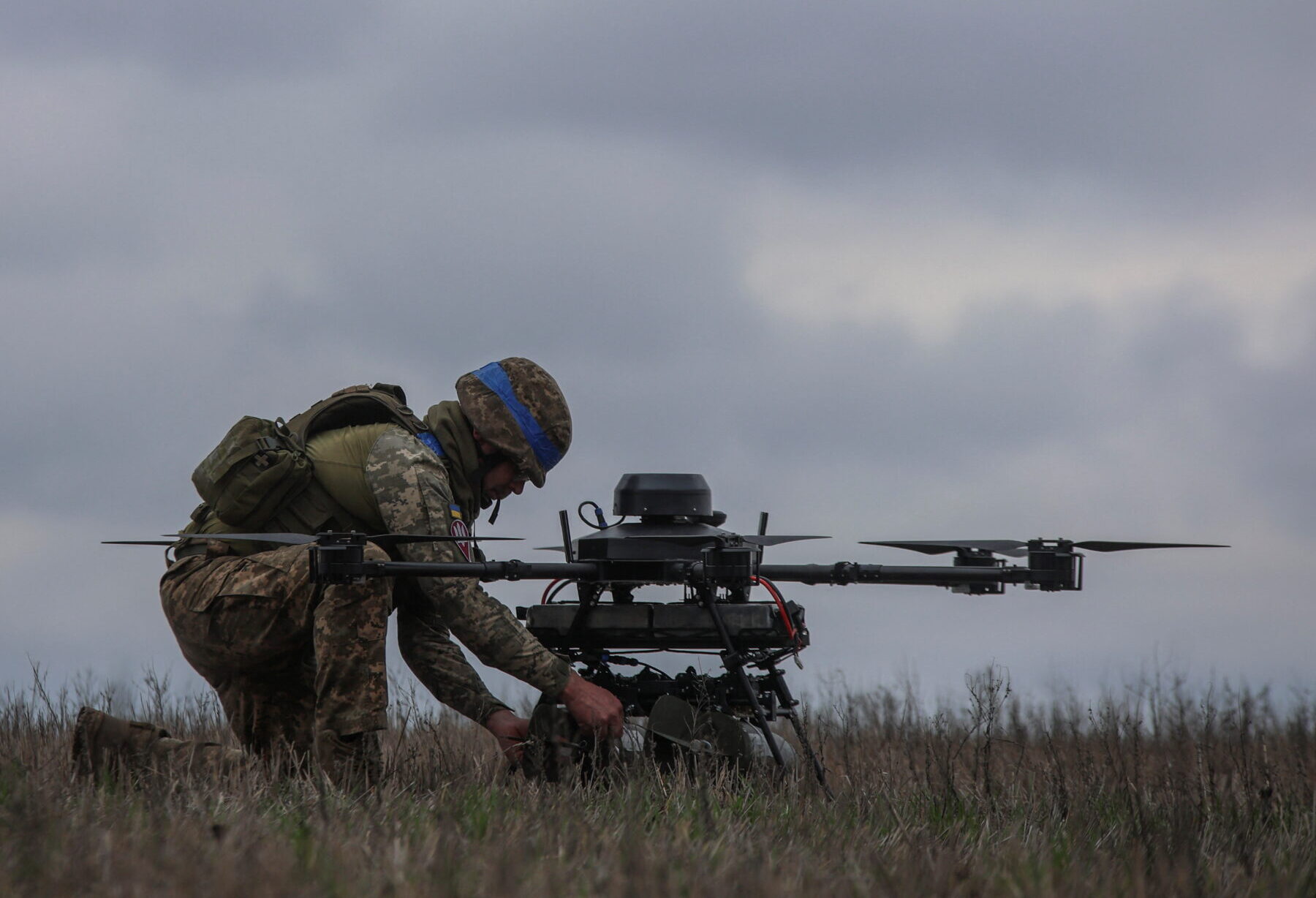

Since February 28, US forces have found themselves under attack from Iranian ballistic missiles, Shahed-136 One Way Attack (OWA) drones, and explosive quadcopter drones. Commercial satellite imagery shows extensive damage to American military bases across the Middle East, with reports of an OWA drone exploding as far away as Cyprus. Faced with this threat, the United States military received help from the nation that has nearly five years of experience combating these threats – Ukraine.
In late August, I accompanied over twenty students and alumni from Harvard University, the Massachusetts Institute of Technology, Columbia University, and Johns Hopkins University on a trip to Kyiv and Lviv, Ukraine, where we met with senior government officials, the defense community, the private sector, and non-governmental organizations. I participated in this trip in my personal capacity.
I took extensive notes on the military situation in Ukraine. For security purposes, many of our briefings, including those from defense officials and Ukrainian soldiers, took place either under the Chatham House rule or similar restrictions. All statements citing these sources have been previously cleared for release. I hope my observations will not only shed light on the current state of affairs, but also help US and allied forces better adapt to the threats they will face on the 21st-century battlefield. Along the way, I became convinced that despite the prevalence of new technologies such as explosive quadcopters and robotic ground vehicles, human beings and legacy systems, such as tanks, still play a central role in combat and likely will continue to do so for the foreseeable future.
Drones, Demystified
“Tanks are largely useless now. A $5,000 drone can destroy a $5 million tank,” former Google chief executive Eric Schmidt claimed during a 2024 conference. More recently, a widely cited Wall Street Journal article describes how a battalion of Ukrainian drone operators nearly wiped out a US Army armored brigade during a training exercise in Hohenfels, Germany, calling the encounter a “drubbing.” Many NATO armies have also had similar experiences during wargames in the Baltics. Drones have had such an impact on the battlefield that one Ukrainian defense source informed me that drones inflict 97.8% of all Russian battlefield casualties. Regarding the number of Russian service members killed or wounded by drones, Ukrainian forces explained their methodology for conducting battle damage assessment and confirming the number of troops killed or wounded by individual weapons systems.
But despite recent reports, most experts in Ukraine I spoke to were hesitant to declare the tank dead in the era of the drone – at least not yet.
For starters, many commentators were sounding the death knell of the tank as far back as the 1973 Yom Kippur War, arguing that cheap anti-tank missiles rendered the behemoths obsolete – only to be quickly repudiated during the 1991 Gulf War. Tanks are remarkably difficult to destroy, especially when equipped with anti-drone systems that can either knock out FPV drones or reduce the damage they inflict. Some experts claimed that modern tanks can withstand between ten and twenty FPV drone strikes – and in one documented instance, over fifty — before becoming combat ineffective. Additionally, both sides have emphasized quantity over quality. As a result, many drones fail to detonate or reach the target in the first place, according to reports from some frontline FPV operators. Darkness, poor weather, and enemy jamming can also limit FPV operations. One Ukrainian officer noted, during a video conference, that drones have not completely replaced all battlefield weapons, remarking that while drones have narrow windows of employment, “artillery works all the time.”
During briefings, civilian analysts and senior officers on the eastern front acknowledged that drones still only play a supporting role for ground troops and armored vehicles, which still form the backbone of offensive operations.
Many sources describe the front lines as a “no-man’s land” stretching several miles deep due to ever-present drones. Nevertheless, Ukrainian forces have still managed to incorporate small numbers of infantry and armored vehicles in offensive attacks – albeit with considerable planning, training, and supporting assets. During the recent Operation Vivaldi, Ukraine’s largest offensive in nearly four years, Ukraine’s Third Army Corps conducted multiple raids against Russian positions, in one instance, nearly three miles behind enemy lines. Although the Third Army Corps’ commander acknowledged the operation’s success, he conceded that “using armored vehicles is effectively a special operation in itself. It requires extremely detailed planning and synchronization of a huge number of assets.”
Elsewhere, there is evidence that headlines of US and NATO forces losing scores of tanks to FPV drones during training exercises might not capture the entire story. Although US and other allied nations may have taken heavy losses during the beginning of the exercise, feedback suggests Western militaries have learned to adapt to the drone threat and adjust their tactics quickly. One American company commander whose unit initially took heavy losses from Ukrainian drones recalled how his unit evaded them by moving his vehicles off open roads and taking advantage of cover and concealment in the rolling hills and thick forests of the Bavarian countryside. Within days, U.S. forces reduced their loss rate from 70% to 30%. Reports from the field suggest many allied militaries are doing the same.
Training exercises also often come with constraints that put visiting units at a disadvantage. Although this may create a challenging training environment, it may not accurately reflect real-world battlefield conditions. The Hohenfels training area measures less than 200 square kilometers, giving a massive armored brigade relatively few places to hide. Opposing forces, who see units rotate through every month, know these hiding spots well. Additionally, observer-controller teams may have unrealistic rules for adjudicating battle damage, such as determining that a single drone sighting means a tank is destroyed. Moreover, the brigade featured in the Wall Street Journal article had not been issued proper anti-drone equipment, which not only puts the unit at a disadvantage but also leaves it without training on the full range of anti-drone systems.
Still, American forces have a long road ahead if they are to effectively employ and defend against drones. After a year-long trial involving an Italy-based U.S. Army battalion, Army leaders have decided to equip every squad with its own drone systems. Leaders in the Marine Corps, however, have already experimented with this option and have some reservations, noting that operating a drone would consume the attention of two people in a nine-person squad. Ukrainian forces, for their part, often incorporate separate specialized drone companies into larger organizations, although these companies often employ specialized drones, such as long-range fixed-wing drones, our briefers stated. Drones also work well when launched from static defensive positions. However, a rifle squad on the march would have to physically carry their drones into combat. Given the already excruciating loads U.S. forces carry into battle, it’s hardly surprising many troops hesitate to carry even more equipment, no matter how valuable.
Unmanned Ground Vehicles
Earlier this year, online video depicted what appeared to be a Ukrainian ground assault consisting entirely of Unmanned Ground Vehicles (UGVs), purportedly the first of its kind in history. However, experts I spoke to cautioned that online commentary was misleading and lacked context – the operation still involved significant numbers of ground troops.
Although much online imagery shows armed ground vehicles, most Ukrainian UGVs perform logistical operations. Sources I spoke to said small UGVs handled nearly 90% of logistical operations near the front lines, as larger trucks risked being more easily spotted and destroyed by enemy drones.
Despite their utility, UGVs have several limitations that prevent them from large-scale use as combat vehicles. For starters, these vehicles tend to be much more expensive than their aerial counterparts, with the average logistical version costing around $8,000, according to experts we spoke to, compared with just a few hundred dollars for an FPV drone. And unlike their disposable aerial counterparts, UGVs are designed to last for a much longer time – in fact, we spoke to Ukrainian soldiers undergoing training on maintaining, repairing, refueling, and recharging these sorts of vehicles.
Finally, experts we spoke to believed that while UGVs have their utility, they cannot replace a well-trained soldier. Humans are still better at traversing obstacles, such as climbing over ditches or navigating dense brush. Armed UGVs also cannot respond to unexpected events, such as clearing a jammed weapon or reloading ammunition. Both sides, however, are still experimenting with these weapons. One source claimed Ukrainian forces may consider using smaller armed UGVs as sentinels, emplacing them in defensive positions where they automatically fire on (hopefully) enemy troops; however, I could not find a documented instance of this occurring yet. Nevertheless, large-scale autonomous ground assaults appear to still be a ways off, at least for the time being.
Battlefield Economics
The United States has become painfully aware of the economics of air defense during recent fighting against Iran and its Houthi proxies. Headlines often proclaim that the US uses multi-million-dollar air defense missiles to destroy drones costing just a fraction of that cost.
Although defense analysts question the value of simple dollar-cost comparisons, there is little question that the United States is failing to keep pace with adversaries capable of rapidly producing large numbers of crude, low-cost, offensive weapons. That said, One-Way Attack (OWA) drones, such as variants of the Iranian Shahed-136, are hardly a wonder-weapon. In fact, these weapons, when used en masse, may be even more cost-prohibitive than high-end missiles such as the American Tomahawk.
Defense experts I spoke to stated that, as of July, Russia had produced 127,000 Shahed-type OWA drones during 2026, putting them on pace to assemble nearly 200,000 by the year’s end. Ukraine, for its part, has responded with several solutions for shooting down OWA drones, including gun kills with F-16s, assault rifles fired from prop planes, and 1970s-era flak cannons. However, beginning around 2025, the most popular option was the interceptor drone, many of which cost between $5,000 and $10,000, depending on the model.
The relative ease with which militaries can deploy large numbers of cost-effective weapons has led some observers to claim that warfare is shifting toward an era of “precise mass.” The U.S. military, attempting to offset the high cost and low stockpiles of exquisite weapons like the Tomahawk missile, has even attempted to emulate Russia and Iran’s example by reverse-engineering a Shahed drone, firing several of the devices during Operation Epic Fury.
However, many experts, including former Army Secretary Dan Driscoll, caution against a total shift toward low-cost weapons, arguing that the US will always need high-end systems. Certain missions, such as the high-visibility raid to capture Venezuelan President Nicolas Maduro or Operation Midnight Hammer in Iran, could have succeeded only with expensive, high-end platforms, including billion-dollar stealth bombers. Shahed drones may have their uses, but they are still slow and easy to shoot down. U.S. commanders in the field, given practical limits on how many missiles they can carry aboard ships or airplanes, will likely prefer the guaranteed success of high-end weapons systems to low-cost ones.
Additionally, the recent trend of countering low-cost offensive weapons, such as Shahed drones, with low-cost defensive weapons has resulted in its own cost dilemma. Ukrainian forces, as of July of this year, managed an intercept rate of around 88% against Russian Shaheds, roughly one in eight, according to our defense source. Given an average estimated cost of $20,000 per Shahed, it takes $160,000 worth of Shaheds to ensure one survives, assuming it even hits the target in the first place. Perhaps it’s no surprise that Russia is moving back up the spectrum toward higher-end systems, such as more expensive jet-powered OWA drones, to offset this effect.
Ballistic missiles, however, present their own challenges. Russia, Iran, and other adversaries have seemingly little difficulty producing large numbers of ballistic missiles. Sources in Ukraine estimated that Russia produced 120 ballistic missiles per month. Unfortunately, as of right now, there are few low-cost options for intercepting ballistic missiles. Russia’s short-range Iskander missile travels at up to Mach 7 and can perform maneuvers up to 30 G. Longer-range ballistic missiles even travel above the Earth’s atmosphere during their flight toward the target. Lockheed Martin’s PAC-3 missile, fired from the Patriot system, is one of the few systems capable of successfully hitting a ballistic missile in flight.
Unfortunately, American defense company Lockheed Martin produces only about 80 PAC-3 missiles per month for domestic and international customers, including South Korea, many NATO countries, and Ukraine, according to our briefings. Additionally, since defenders typically fire two PAC-3s to intercept one ballistic missile, Russia’s production of 120 ballistic missiles per month effectively triples global PAC-3 production. The situation is even further compounded by combat operations against Iran, as well as potential threats from countries such as China and North Korea.
Ukrainian defense sources cited PAC-3s as among the country’s greatest needs, followed by permission to strike ballistic missile systems on Russian soil with NATO-provided weapons. The situation has become even more critical in recent months, as Ukraine’s ballistic missile intercept rate has fallen from 41% before the start of the U.S. war against Iran to 19% just six months later, according to our defense briefing. This shortfall will likely endure, even with current U.S. efforts to boost domestic PAC-3 production and potentially allow Ukraine to produce these systems locally via license.
The Six Week Innovation Cycle
As the old saying goes, “Necessity is the mother of innovation.” Nowhere is that more true than in Ukraine, which lacks the resources of the United States and its NATO allies. Facing an adversary that can field far more equipment and manpower has forced Ukraine to institutionalize adaptation. Experts I spoke to said the battlefield required both sides to follow a six-week adaptation cycle. A new development would arise, prompting the other side to implement a countermeasure six weeks later, followed by another move from the other side just six weeks after that. Some of Ukraine’s methods could serve as a model for the U.S. military, and in some cases, are even being implemented by American forces.
The Ukrainian military relies on the “bottom-up” approach to battlefield innovation: Troops in the field identify a problem and develop a solution. That solution then spreads throughout the entire military. These innovations don’t just help on the battlefield, either. The Ukrainian military has offered financial incentives for winning designs for drones and other weapons, with soldiers receiving a percentage of the profits from the sale of new devices.
New weapons proliferate across the force through a government-built platform known as Brave1, which features an online shopping platform similar to Amazon where organizations can “shop” for drones, jammers, and other technologies. Each item includes reviews from frontline troops who have used the system in combat, allowing organizations to choose what works for them rather than having a massive bureaucracy haphazardly issue equipment that may function poorly or be unnecessary in their area of operations.
Ukrainian forces overwhelmingly prefer Ukrainian-made equipment, especially when it comes to drones. Many Ukrainian troops have reported that US-produced drones are expensive, perform poorly in the field, and are vulnerable to jamming. At least one official described American manufacturers as eager to travel to Ukraine for brief demonstrations in relatively safe areas such as Kyiv and Lviv, but only to advertise that their products were “combat tested”. Ukrainian troops generally prefer domestic products in no small part because these manufacturers respond more quickly to technical problems and can rapidly modify systems if they have design flaws or if new developments render their products obsolete.
The United States Army has attempted to implement this with its own marketplace, drones.mil; however, the system may not function as well as it appears in demonstrations. Although US soldiers I spoke to said the website functioned properly, the money to buy drones and other equipment often comes from funds allocated for other costs and programs, forcing units to make difficult choices about what they want to purchase. Ukraine, for its part, allows units to purchase items in the Brave1 marketplace partly by accumulating “points” for killing Russian soldiers or destroying equipment, incentivizing units to help the Ukrainian military achieve one of its foremost goals for 2026 – killing or incapacitating up to 50,000 Russian troops per month. (Russia lost 54,000 troops during October 2026, according to the Ukrainian General Staff).
Conclusion
It has been over two months since I returned from Ukraine, and my observations are already obsolete. Since I departed, the Ukrainian military successfully deployed a countermeasure to Russia’s jet-powered Shahed drones, which debuted in large numbers just two months earlier, in July. Additionally, Ukrainian forces have seen restrictions on the Starshield communications system, which has affected their drone operations. Many experts also forecast a difficult winter, with likely Russian attacks on electricity infrastructure.
Most briefings from Ukrainian government officials highlighted intermediate war objectives, with the three highest priorities being securing Ukraine’s airspace, destroying Russia’s industrial capacity, and attriting Russian troops faster than they can be replaced (approximately 50,000 per month). Not one official, however, touched upon war termination theory – at what point would Ukraine be willing to cease fighting and negotiate? Without a viable end-state, the war will continue to drag on.


Commenting is available to active SWJ members and staff.