




Book Review: Afghanistan Amid Rival Geopolitics
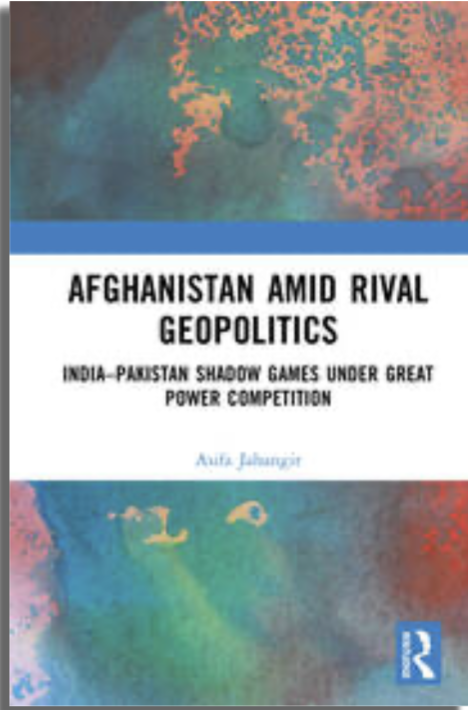

Afghanistan Amid Rival Geopolitics by Dr. Asifa Jahangir. Routledge Publishing, 2029. ISBN: 978-1-032-15280-6. pp. 308. $48.74
Major states, at global and regional levels, are using tactics of indirect wars, humanitarian means, and social-structural base interactions to achieve their grand strategies. The incident of 9/11 changed the dynamics of the world. In this scenario, Dr. Asifa Jahangir’s book Afghanistan Amid Rival Geopolitics India Pakistan Shadow Games Under Great Power Competition is a well-researched and well-written contribution that provides essential inputs to academics. Different chapters provide invaluable analysis of Afghan politics, governance, and Indo-Afghan and Pakistan-Afghanistan relations on the micro- and macro levels. Dr. Jahangir analyzed the trilateral ties through historical, political, economic, cultural, and religious perspectives. Additionally, she shifted the nature of relationships toward the “geo”-security perspective after the 9/11 global order, in which non-state actors and terrorism redefined the states’ policies and actions.
History shows that Pakistan and India have been striving for power in Afghanistan, since their inception in 1947. Pakistan’s losses in Afghanistan are considered India’s victory and vice versa. The hostility between the two rivals has manifested as a competition for political influence in Afghanistan, reminiscent of the rivalry between Tsarist Russia, its successor Communist Russia, and the British Empire during the 19th and 20th centuries. The hostility between Pakistan and India is so intense and entrenched that both countries continuously strive to gain the upper hand within Afghanistan.
In Dr. Jahangir’s book, the Afghanistan problem is contextualized and understood through the lens of Great Game geopolitics by examining the unintended consequences of historical events related to foreign interventions in Afghanistan, spanning from the 19th century to the post-9/11 international system. The Afghan issue, for a long time, has had enormous security impacts on South Asia, especially on Pakistan and India.
The geopolitical landscape of South Asia gained more prominence after the withdrawal of the US military from Afghanistan. On August 30, 2021, US-led NATO military forces withdrew from Afghanistan, and the Taliban became the official political face of the country. The country, once again, has gained importance to regional and extra-regional powers are keen to play their role.
In this book, the author reconceptualizes the Great Game concept as the 3G and its unintended consequences by contextualizing the changing geopolitical dynamics and security patterns of South Asian politics in Afghanistan post-9/11. The author answers the question “what is 3G” logically. In this game, multiple states – especially the US, China, Russia, Pakistan, Iran, and India – are involved in driving their multi-faceted ambitions through different means at different times.
The study is quite comprehensive, almost encyclopedic in its breadth and depth of detail, covering topics from the introduction to the old Great Game of the 1800s, the Cold War (1945-1989), the New Great Game (since 1990), the Global War on Terror (9/11), the Indian role in Afghanistan, its multidimensional implications for Pakistan, and policy recommendations for Pakistan. The author answers the questions: (1) how 9/11 directly hit the geopolitics of the South Asian region; and (2) how the unintended consequences of the 3G started emerging, such as regional Great Game politics starting between India and Pakistan in Afghanistan.
India exploits anarchy in Afghanistan for its designs against Pakistan. Such a reactionary approach by India was balanced by a counter-reactionary approach by Pakistan and paved the way for a full-scale proxy conflict between Pakistan and India in Afghanistan, which has become an additional conflict zone in South Asia between the two traditional rivals instead of Kashmir.
The book clearly explains the interests of each player in Afghanistan, including the reasons why the USA supports India in that region. India has spent millions of dollars in Afghanistan, along with training military personnel. Afghanistan is the extended frontline state between the two arch rivals India and Pakistan in South Asia. However, Pakistan visualizes deep Indian presence in Afghanistan “as part of its strategic encirclemen.”
Chapter 2 discusses the history of Afghanistan based on the orientalists’ “geographical determinism.” She explains that “Orientalism” and “the Orient” are noun forms of the word “Oriental,” meaning “eastern” and commonly referring to Asian countries. The term “Orientalism” is taken from Edward Said’s book by the same name. According to Said, European invaders called themselves Westerners, and they labeled everyone else in the world as “Orientals.” The Great Game made geography an important factor in politics, and Europeans and Americans developed the idea of the Orient as the East. She connects the concept of the Great Game with Said’s idea of Orientalism to elaborate on Afghanistan’s history and how this region was, in many ways, misrepresented and manipulated by major powers pursuing their imperial ambitions with significant geographical interests. The chapter also elaborates on the famous concept of the Great Game in geopolitics and compares historical events based on the concept of unintended consequences, applying a comprehensive approach used in the concept of realism in international relations. The author also discussed the tropes, their meanings, and why the Orientalist uses them. Afghanistan’s perception of India as a potential counterweight to Pakistan in its relationship with Islamabad has long been held, but it is also changing over time. She has extensively explored the history and strategy of different rulers of Afghanistan, starting with Zahir Shah and going up to Ashraf Ghani, covering the pre-Cold War and post-Cold War periods, from 9/11 until 2025.
In Chapter 3, the author critically examined diverse viewpoints about the continuity and transformation of the Great Game in different timeframes. This chapter comprehensively elaborates on theories regarding the Great Game and Pak-Afghan American strategies.
Chapter 4 discussed India’s rising power and indices, which help it formulate an Afghan civil engagement “grand strategy” and India’s soft power policy in Afghanistan. Ms. Asifa put forward the discussions over India’s emerging economic might both inside the country and internationally, making economics the centerpiece of “India’s global engagement.”
Chapter 5 discussed India-Afghanistan strategic relations and their implications for Pakistan. In this chapter, the author first testified to the concept of the Grand Great Game, and she organized and discussed implications taken from the literature and interviews with subject specialists and experts from Pakistan, India, and other countries to fill gaps in the existing information. This chapter’s second part is explanatory in the sense of implications. The author has extensively elucidated the repercussions of Indian involvement in Afghanistan on Pakistan and beautifully interwoven this aspect with terrorism. In this regard, she has detailed Pakistan’s concerns regarding security. Moreover, she examined the implications from multiple dimensions, including strategic, psychological, cultural, political, social, and economic aspects.
In Chapter 6, she skillfully wrapped up the arguments of her book. Dr. Jahangir observes that the game has become more complex due to new techniques and strategies. She asserts that the Pak-Indian rivalry in Afghanistan is a result of competition in the new power dynamics of the 3G at the regional level, which aims to dominate the discourse and balance each other, thereby making the Afghanistan conflict both a regional and an international issue. She accurately analyzed how the U.S. has actively encouraged India to enhance its soft or smart-power involvement in Afghanistan. Consequently, Pakistan’s sense of insecurity is unavoidable. Dr. Jahangir also excellently researched key topics through discussions with research participants. The way forward presents a comprehensive approach and serious regional commitment that can only be achieved if all three countries shed their rivalries and work collectively. After the withdrawal of international forces, Pakistan, India, and Afghanistan must work together to create a bright and prosperous future.
In a nutshell, Dr. Jahangir’s study reconceptualizes the OGG or NGG notion into a new concept known as the Grand Great Game (3G), while also contextualizing the global and regional geopolitical dynamics, geostrategic imperatives, and security patterns.
Dr. Asifa Jahangir is an excellent scholar, and I admire her judicious study of available sources and her care in presenting many sides of contentious and historic arguments that have long divided students, scholars, and leaders of Afghanistan, Pakistan, India, and the West. Dr. Asifa Jahangir’s intellectual prowess and academic excellence serve as a beacon of pride for Pakistan’s young ladies. Here are a few words acknowledging her hard work, inspired by Louisa May Alcott (Little Women). “I am not afraid of storms, for I am learning how to sail my ship.”


Commenting is available to active SWJ members and staff.