





De quoi s’agit-il? The Moral Obligations of the Strategist
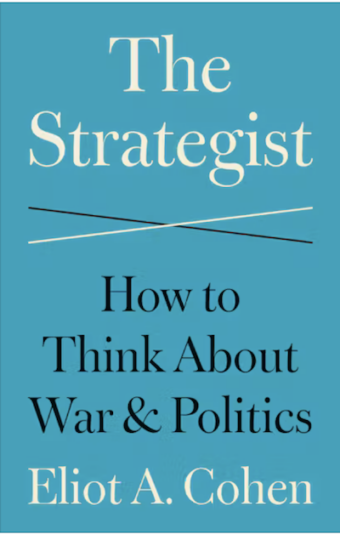

The Strategist by Eliot A. Cohen. Princeton University Press, 2026. ISBN: 9780691269443, pp. 312. $29.95
A Review Essay on The Strategist: How to Think About War and Politics, by Eliot A. Cohen
“You know you never defeated us on the battlefield.”
“That may be so, but it is also irrelevant.”
– Col. Harry G. Summers Jr. and a North Vietnamese colonel, Hanoi, April 1975
“We won all those fights, but that may have been irrelevant.”
These two observations are separated by fifty years. But the paradox they describe – and the pathos they evoke – is the same. Military forces can accomplish their missions, win all their battles, and still fail to produce worthwhile political outcomes.
Connecting military action to political purpose is the business of strategy. Few people are better qualified to explicate that business than Eliot Cohen, longtime professor of strategy and dean at Johns Hopkins SAIS (now at CSIS) who has also practiced the craft in government, most notably as Counselor of the U.S. State Department during the Iraq War.
His new book, The Strategist: How to Think About War and Politics, distills that lifetime of scholarship, teaching, and experience into a remarkably concise guide to the work of strategy. But anyone who has wrestled seriously in the past quarter century with what military force can accomplish, toward what political ends, and at what cost will recognize that what Cohen has actually written is a moral argument disguised as a practical handbook.
There are, of course, other and more expansive definitions of strategy, but Cohen’s is deliberately narrow: “the preparation and the real or threatened use of armed force to achieve the ends of policy.” He is not writing about business strategy or grand strategy – on which, more later – but about war and politics, which, as he demonstrates, is challenge enough. Part of Cohen’s justification for another contribution to the literature is, paradoxically, that we already have too much of it – or at least too much of it to be readily useful. Makers of Modern Strategy, a standard work in the field, grew from 553 pages in its first edition in 1943 to 1,158 in its latest; Lawrence Freedman’s magisterial Strategy: A History runs to 750. These are invaluable works, but not primers. Cohen aims instead for something that can be read in a few sittings: a concise, practical guide to the fundamentals of strategic thought.
The straightforward structure of the book is thus entirely appropriate. Cohen begins with seven questions the strategist must ask, among them: What is going on? Who are we fighting? What are we trying to accomplish? Why should we expect any of this to work? He then turns to the choices strategists must make, the uncertainties and pathologies that lead them astray, and finally the qualities that might help them do better. That progression – from questions, through failure, to judgment – is the essential architecture of the book.
If that sounds simple in summary, the impression is even starker in the reading. Much of this seems like it ought to be filed under N for “no duh.” After all, who would start a war without understanding who they’re fighting, deciding why, and defining what they hope to accomplish? Well, as Cohen illustrates through a dizzying torrent of historical examples, the answer is: states do. All the time. Including the United States. Frequently. The questions of strategy are simple; the answers almost never are.
Indeed, the tension between seemingly simple questions and answers that are anything but simple is central to the book. The value of his framework lies not in making strategy easy, but in making it difficult to evade the simple questions.
Cohen ultimately distills these deceptively simple questions even further, borrowing four words from Ferdinand Foch, Commander-in-Chief of the Allied Armies during the final year of World War I: De quoi s’agit-il? – “What is it all about?” This echoes Clausewitz, who, in On War – which Cohen considers the “one, truly indispensable book” for students of strategy, less for the answers Clausewitz provides than for the questions he teaches them to ask –insists that the “first of all strategic questions and the most comprehensive” is to establish the kind of war on which one is embarking, “neither mistaking it for, nor trying to turn it into, something that is alien to its nature.”
Clausewitz and Foch both demand that strategists see the conflict they have rather than the one they expected, planned for, or would prefer. And not just at the outset – enemies adapt, objectives change, operations produce unexpected effects, and military success itself creates new political circumstances. De quoi s’agit-il? is therefore less a question to be answered than a habit of mind: a continual return to what the conflict is actually about and whether the violence being employed still serves its political purpose.
That discipline is essential because military and political success are not the same thing. Between them lies a causal chain that strategy must continually interrogate: military action produces military effects; military effects produce – or fail to produce – political effects; and only political effects can achieve political ends. A target destroyed cannot by itself be a measure of strategic success. Neither can taking territory or toppling a regime. Each immediately invites the strategist’s next question: And then what?
Every use of force is a wager: a bet that violence, or the credible threat of it, will produce a particular political outcome at an acceptable cost. Recent events have offered spectacular demonstrations of American military competence – and equally vivid reminders that tactical virtuosity and strategic wisdom are different things. Military excellence expands strategic options; it is not a substitute for strategic judgment. Extraordinary capability can make an otherwise impossible course of action possible; it cannot make an incoherent political objective coherent, an unattainable end attainable, or the human and material costs of pursuing it worth bearing. America’s overwhelming military power may secure a seat at the high-stakes table, but it does not make bad bets pay – it only raises the cost of getting them wrong.
If these distinctions are so fundamental – and the questions so obvious – why do strategists so routinely lose sight of them?
Cohen’s answer begins with the ineradicable uncertainty of war but ultimately comes back to the strategist himself. War confronts decision-makers with incomplete information, adaptive enemies, exogenous surprises, and unintended consequences. Those uncertainties are unavoidable – the familiar Clausewitzian problems of fog, friction, and chance. More dangerous, perhaps, are the ways human beings and the organizations they create react to them. Cohen moves from these inherent uncertainties to what he calls the strategist’s “blindnesses”: individual pathologies of personality and cognition, collective pathologies such as groupthink, and analytic habits that create an illusion of understanding where none exists. Uncertainty cannot be eliminated, but blindness can at least be resisted.
And this is where the argument becomes moral. “The problem of strategic blindness is, in the end, one of attitude and disposition, not bureaucratic structure,” Cohen concludes. Because the fundamental problem is human, it cannot be solved by another process, planning framework, bureaucratic reorganization, or technological tool. Instead, Cohen offers four very human strategic virtues: empathy, curiosity, honesty, and courage.
Strategic virtue, he explains, is not synonymous with moral virtue. An empathetic, curious, honest, and courageous strategist can still employ those qualities in the service of evil ends. But strategic judgment carries moral weight because its decisions are ultimately enacted through violence, and the consequences are borne by people other than the strategist. Political leaders may talk about abstract interests, lines on maps, and force tallies on spreadsheets, but their decisions are ultimately carried out by other people, who kill, suffer, and die to achieve the political purposes they define. Cohen’s four virtues aren’t inherently moral. The office of the strategist is, unavoidably.
The strategist’s moral obligation is not to be right. No strategist can guarantee success – war is inherently uncertain, the enemy gets a vote, and actions rarely produce only their intended effects. What the strategist owes those who fight and the public who sends them is something both more modest and more demanding: to ask the right questions, rigorously and repeatedly, before asking other people to bear the consequences of the answers.
When brave and competent troops fight well but the state nevertheless fails to achieve its political purposes, they are left with a painful question: how could we have lost? Frequently, they find solace in a seductive answer: we did not fail; we were failed. The Confederate “Lost Cause” after the American Civil War and the German “stab-in-the-back” myth after World War I offered different versions of that same consolation, preserving martial honor by relocating responsibility for defeat elsewhere. After Vietnam, versions of the same argument took hold in the United States.
But there was another response, as well. The Weinberger Doctrine and later the Powell Doctrine were attempts to impose greater discipline on decisions to use force: vital interests, clear political and military objectives, sufficient means, public support, and an intelligible relationship between the force employed and the ends sought. Whatever their imperfections, they got the moral causal chain right. The lesson of Vietnam was not that political leaders should simply unleash the military to win; it was that those leaders bore a responsibility to be more disciplined about when, why, and toward what attainable political purpose they asked Americans to fight.
The wars in Afghanistan and Iraq leave the United States confronting that choice again. Veterans of those wars are now generals, policymakers, and political leaders deciding how their lessons should inform the next use of force. And those next uses have already arrived, from suspected drug boats in the Caribbean to the Maduro raid in Venezuela to a new war with Iran. The question, then, is whether the hard-earned experience of the last wars will reinforce old virtues or resurrect old blindnesses in those charged with waging the next ones.
Among the blindnesses to resist is the tendency to mistake excellence in the execution of military missions for vindication of the decisions that produced them. Deflecting questions about strategic intent by invoking the courage, lethality, or tactical excellence of American troops is not merely evasive; it reverses the direction of responsibility. There is no disrespect to soldiers in asking whether the missions for which their country risks their lives serve attainable political purposes. Quite the opposite: the troops can never provide political justification for a war through tactical or operational performance, no matter how impressive, and we shouldn’t ask them to; political leaders owe the troops—and the American public—a sound political justification for the missions for which they ask them to kill, suffer, and die.
To be clear, the argument above is not the author’s, at least not explicitly; it is this reviewer’s. But it is difficult to take Cohen’s approach to strategy seriously without confronting its moral implications. A framework that insists on continually interrogating the relationship between violence and political purpose necessarily raises the question of what those who choose the purpose owe those asked to bear the violence. This is why Cohen’s practical handbook ultimately reads as a moral argument.
For all its moral clarity, Cohen’s arguments are not all logically unassailable. His central point in the first chapter is that strategy as he defines it is extremely difficult and rarely wholly successful, but that it is nevertheless possible and, in any case, necessary. Yet only a few pages earlier, he dismisses the broader concept of grand strategy largely because integrating all the instruments of national power into a coherent whole is extraordinarily difficult and rarely achieved in practice. But if uncertainty, complexity, and frequent failure do not absolve statesmen of the need to attempt military strategy, why should those same difficulties absolve them of the need to integrate military power with diplomacy, economics, information, and the other instruments available to the state? Cohen is surely right to reject fantasies of seamless orchestration, but that seems an argument for approaching grand strategy with the same humility, adaptability, and judgment he demands of military strategy – not for dispensing with the concept altogether.
A further inconsistency is stylistic. “The Strategist at Work,” an extended case study built largely around memoranda Churchill dictated while crossing the Atlantic to meet Roosevelt after Pearl Harbor, is intended to show Cohen’s principles operating together in the hands of a master strategist. The purpose is clear, but the chapter feels oddly self-indulgent in a book whose great virtue is economy. After pages of compressed argument and deft historical illustration, the sustained primary-source exercise feels less like the culmination of the primer than an excursion into a different project.
But these criticisms are minor compared with the magnitude of Cohen’s achievement. The Strategist provides both practical and moral clarity at a moment of unusual strategic danger and intense political confusion. Great-power war has returned as a serious possibility, new technologies are changing the means and tempo of violence, and a new generation of American leaders is discovering again how readily extraordinary military capability can create the temptation to use it. At the same time, the political institutions responsible for connecting that violence to public purposes are increasingly polarized and distrusted. A book on How to Think About War and Politics could hardly arrive at a more consequential moment.
Cohen cannot tell strategists whether a war will succeed, or even whether it will prove worth its cost. No handbook can. What he offers instead is the discipline to keep asking the questions on which those judgments depend. Foch’s formulation remains the essential one: De quoi s’agit-il? For those entrusted with sending others to war, the moral obligation is to keep asking.



Commenting is available to active SWJ members and staff.