Operation Readiness Redefined in the Era of the Drone

On September 14, 2019, a swarm of 18 drones and 7 cruise missiles targeted Saudi Arabia’s oil facilities in Abqaiq and Khurais, managing to bypass the sophisticated Patriot batteries intended to defend the sites. The attacks briefly halved the kingdom’s oil output and constituted the single largest disruption in the history of modern oil production. When a handful of low-cost weapons can defeat billions of dollars’ worth of conventional defense equipment, a nation must reconsider whether the strength of its land, air, and maritime forces alone accurately measures the level of operational readiness it requires. The lessons from Saudi Arabia in 2019 and the lessons from the most recent round of conflict in the Gulf have made it clear that only by incorporating a multi-layered counter-drone architecture, one that seamlessly fuses together detection, classification, and response, will the Gulf States be able to protect their conventional forces and defense infrastructures from becoming obsolete. Drawing on historical parallels and Kuwait’s own recent experience, this essay aims to demonstrate that layered protection and cost sustainability should become essential measures of readiness in the region.
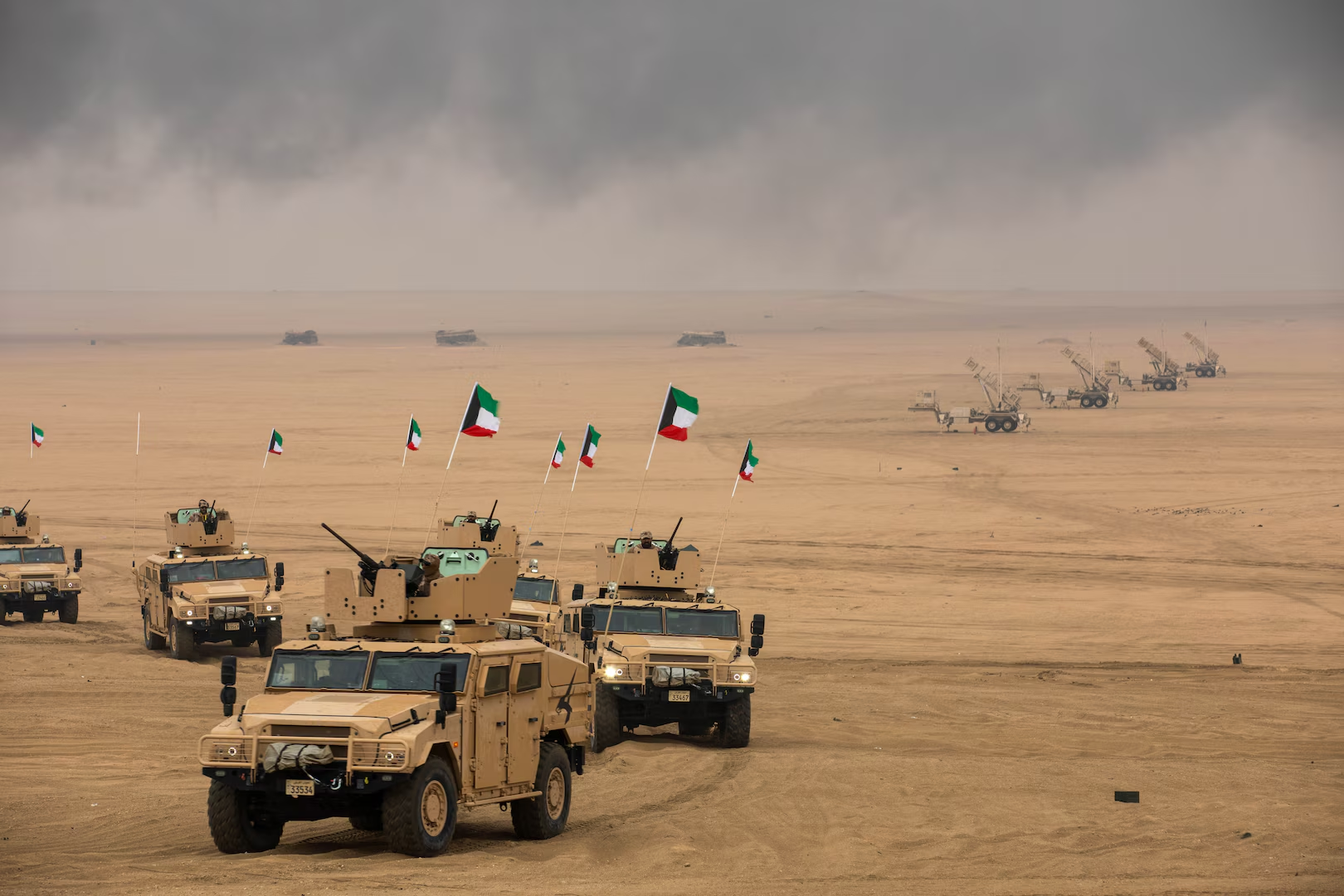
For decades, Gulf states have relied heavily on the strength of their tanks, aircraft, and warships to measure operational readiness. The proliferation of low-cost, one-way attack drones has left these forces vulnerable to destruction. Being restricted by a lack of maneuverability, a Gulf state is consequently limited in its ability to protect and hold its ground. A multi-layered counter-drone architecture both enables and protects a nation’s conventional powers and critical national infrastructure. Such a counter-drone architecture would and must fuse several elements: the detection of incoming drones, the classification of threats, and the ability to rapidly respond to threats that span multiple defense systems. Essentially, it must work in conjunction with land, air, and maritime forces to preserve combat effectiveness, rather than being conceptualized or left to function as a standalone line of defense.
Lessons from History
During World War II, Nazi Germany attempted to invade the United Kingdom over the course of the Battle of Britain. In an effort to seize control of British airspace, Germany deployed the Luftwaffe, a large conventional air force that outnumbered the Royal Air Force (RAF) by roughly five to one. Before the era of radar-driven early warning systems, RAF fighters relied solely on standing patrols to spot German aircraft. Through its aircraft-observation network, the RAF relied on men with binoculars and listening equipment who were tasked with estimating the course and altitude of enemy fighters and relaying that information. Upon detecting a threat, fighter squadrons would be sent to patrol a particular area where the enemy was thought likely to appear, all without knowing the enemy’s precise location. With a success rate of 30% to 50%, many missions returned without encountering the enemy at all. The Dowding system was then introduced, consisting of a combination of the , human observers, and the Filter Room at Bentley Priory. The Chain Home radar, a chain of early warning radar stations positioned along the coast, detected the formations of German aircraft forming over France before they crossed the English Channel. The Observer Corps continued to act as a second layer of human spotters by tracking the aircraft once they moved inland and past the radar’s range. All incoming information would then be combined in the Filter Room at Bentley Priory – an operations center that sent instructions to fighter squadrons. With the Dowding system in place, previously average interception rates of 30% to 50% increased to a staggering 90%. The integrated system was the key component in overcoming the Luftwaffe’s overwhelming force, ultimately increasing the efficiency of interceptions. The integration of early detection and rapid information sharing acted as a force multiplier. The RAF’s limited number of fighters performed as if Britain had three times as many aircraft as it did. The key to the rise in interception rate was not solely the use of radar, but the integration of radar detection into the Dowding system’s full command structure.
The value of integrated systems over standalone systems is further substantiated by other historical military battles and developments. Returning to the Second World War, the Battle of the Somme showcased the successful integration of combined arms tactics, including tanks, to devastating effect. And this lesson has not faded with time, with the weakness of standalone systems prominently displayed during the Gulf War. Standalone Patriot batteries were initially deemed to be highly effective against Iraqi Scud missiles, but later studies proved that interception rates were far lower than officially claimed. When considering modern-day drone threats, an enhanced model that consists of multiple sensors could similarly act as a force multiplier, rather than a standalone asset. The need for such a model can be similarly identified when viewing the matter from an offensive, rather than a defensive, perspective. During the 2020 Nagorno-Karabakh war, Azerbaijani drones rapidly disabled a large number of Armenian tanks, artillery pieces, and air defenses, demonstrating how quickly unmanned systems can neutralize an unprepared conventional force. These historical lessons demonstrate both the value of integration as well as the promise inherent through the implementation of layered counter-drone systems that can serve as an enabling capability for conventional forces in the Gulf, just as the Dowding system did with radar and the British air force during the Battle of Britain.
The Emerging Threat to the Gulf
The Gulf is an interesting region, representing a constellation of states that rely heavily on oil and gas to fund their economies, meaning that their oil and gas infrastructure is an easy and natural target for any bad actor. One attack can ultimately disrupt a nation’s entire economy, something that was on prominent display in 2019 after the attacks at Abqaiq and Khurais in Saudi Arabia. Kuwait acts as a similarly useful case study as it is geographically small and has densely concentrated infrastructure. It is also largely a single commodity state; almost 50% of the Kuwaiti economy relies on oil and gas, and nearly 90% of government revenue and over 95% of export earnings stem from oil exports. Being so reliant, the matter of defense as it relates to oil infrastructure is a national priority and has quickly led to substantial investment in air defense modernization in order to counter the threat of low-cost drones targeting the country’s desalination centers and oil facilities.
However, investment alone isn’t enough. In June of 2026, the risk of a direct drone strike became a reality. Kuwait International Airport was struck by a targeted drone attack that killed one person and injured 63 others. The strike forced Kuwait to suspend commercial flights, and within days, the United States approved a $1.98 billion sale of AI-enabled counter-drone systems to Kuwait. The counter-drone systems were specifically designed to integrate directly with the country’s existing radar and early warning systems rather than operating individually. Because of the layered approach, during Iran’s 2026 saturation attacks – waves of drones and missiles launched simultaneously to overwhelm air defenses – Kuwait’s own defenses and those of the Gulf more broadly proved to be particularly effective, with an aggregate of roughly 93% to 95% of Iranian drones and missiles failing to impact, though interception rates varied by state. Kuwait’s response to the asymmetric Iranian threat demonstrated the need to avoid a single replacement system as an all-in-one solution; it successfully implemented a layered network designed to work alongside its conventional Patriot batteries and existing defenses.
Conventional Power and Layered Protection
Modern layered defense consists of a regular and trusted sequence: detect, classify, and defeat. Multiple sensor types work concurrently to achieve accurate detection, as the first key is to understand whether a threat is present. The theory is simple – if one sensor system misses a threat, another is in place to fill in the gap. Take, for example, the case of small, low flying drones that slip past systems looking at attacks from higher altitudes. The need for additional overlapping sensor systems becomes readily apparent. Classification is closely integrated with detection as it becomes paramount to understand the nature of the threat; electronic jammers have the ability to disable drones that rely on radio signals, but these jammers are not effective against autonomous systems that require no external link or against systems using fiber-optic controls. Once the threat has been identified, the economics of defeating or eliminating the threat come into play. Kinetic hard-kill interceptors, munitions that physically destroy a drone on impact, can become unsustainable if used against every low-value threat, especially a small drone that may not carry a payload or warhead. Only sensors and effectors matched appropriately to each threat, working in combination, provide the protection needed for conventional forces to operate effectively and efficiently. The detect, classify, and defeat sequence relies on the speed of decision-making just as much as the sensors and effectors themselves.
Modern systems use artificial intelligence to fuse sensor data into a single picture used to command and control everything from one place, functioning similarly to the Filter Room during the Battle of Britain. Crucially, these systems do not remove the human operator who ultimately makes decisions and authorizes the final response. AI systems are strictly used as an aid to help humans make accurate decisions at a rapid pace. Kuwait’s newly acquired counter-drone network similarly reflects this human-in-the-loop model.
The Economics of Survivability
The economics of the drone threat matter as much as defense systems themselves. It is the core truth behind why the second step, “classify,” in the three-step process “detect, classify, and defeat,” remains vital. A single Patriot interceptor ranges between $4 and $5 million to make, while Iranian-made Shahed-136 drones cost as little as $20,000. That means 200 Shahed-136s can be made for each Patriot interceptor. This imbalance is not theoretical. The United States fired more than 800 Patriot interceptors in just one three-day period over this most recent Gulf conflict, consuming stockpiles faster than they could be replaced. One could argue that this cost is easily justified: a $5 million missile that saves a $500 million aircraft or a critical oil facility pays for itself. Even if that argument is correct, the same logic also supports an opposing point. If an expensive interceptor is the only way to protect high-value targets, then it is reasonable. However, if that same interceptor is used against every low-value drone, then the practice transforms into an unsustainable form of defense spending. Sustainable protection requires responding to threats with a coherent multi-layered approach that emphasizes detection, classification, and efficient elimination. It is a requirement for the Gulf states and for any state building these systems to avoid the depletion of magazine depth during the “defeat” phase.
Toward a New Framework
From machine guns, to radar, to drones, every major shift in military technology has pushed armed forces to redefine what the term “readiness” means. Today’s shift is no different. Conventional power remains the foundation of military strength in the Gulf, but it can no longer be sustained without an integrated layered counter-drone architecture that works alongside it. Regional defense planning should reflect this reality. Layered protection and cost sustainability must be weighed when conducting readiness assessments and should not be considered an afterthought to conventional strength. While the exact specifications of the relevant systems that states should acquire are decisions that must be made by the relevant policymakers, there is a clear requirement for what is needed to ensure a measure of readiness for the modern era of defense; the Gulf states must incorporate a multi-layered counter-drone architecture into their defense systems. The lesson of Abqaiq and Khurais was never that conventional power had failed, but that conventional forces cannot survive without defense systems that have been updated to fit the requirements of today. These attacks in 2019, as well as the events in the Gulf since February 2026, give military leadership and policy makers in the Gulf the opportunity to understand where the future of defense and warfare is headed. The region, and the world, is moving to a future of warfare that demands the intelligent synchronization of conventional forces with AI-driven and thoroughly integrated multi-layered counter drone architectures. The Gulf states must now adapt and build out the requisite systems and theory of defense to make the preservation of their independence and sovereignty possible.
The author is an active-duty officer in the Kuwait Armed Forces. All information referenced regarding Kuwait’s defense posture is drawn from open sources. The views expressed in this article are the author’s own and do not represent the official position of the Kuwait Armed Forces or the Kuwait Ministry of Defense.