Of Blue and White’s Intelligence Warfare and MENA’s Crisis Profile
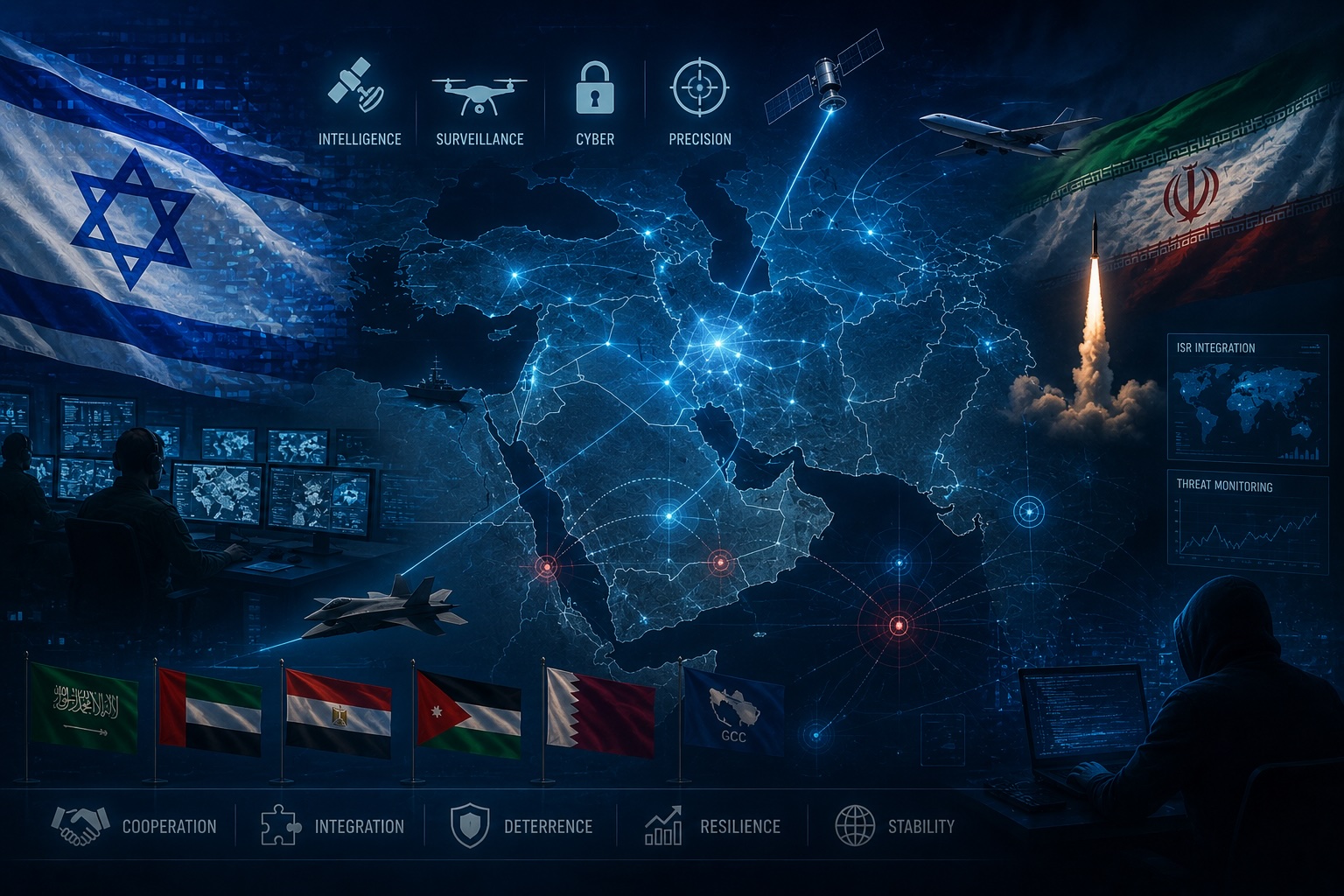

“Hence, to fight and conquer in all your battles is not supreme excellence; supreme excellence consists in breaking the enemy’s resistance without fighting.” Sun Tzu, Art of War
A Not-So-Friendly Neighborhood
As Washington and Tel Aviv pushed Tehran to one of the deadliest interactions, the crisis profile of countries in the Middle East and North Africa (MENA) appeared conventionally sharp but lingered in counter-strategic intelligence. The shared assassination of Iran’s leadership highlighted the necessity to synchronize three domains: intelligence, aerial, and shadow operations. Military interoperability, innovation, intelligence, and integration have become quintessential pillars of combat readiness. For Israel’s neighbors, quick adjustability to these pillars of military modernization is linked to their strategic survival. MENA’s regular security preoccupations have supported Tel Aviv’s intelligence warfare (IW) to consistently mature into intelligence, surveillance, and reconnaissance (ISR). In unison, it continued to divide the high-fliers into prioritizing different traditional elements of geopolitical power.
The Doha attack outlined a call for reform in the diplomatic and doctrinal spaces of the MENA region. Still, preventive measures to face the wobbly strategies of Netanyahu’s administration remained a test of isolated political wills. This similar contestation has always fragmented political choices on the Iranian question and shifted the geography’s focus from collective intelligence upgrades, as it moved without defining a common enemy. Since 1948, persistent standoffs have enabled Tel Aviv to use an avant-garde series of military doctrines. Its sophisticated tradecraft directives became an epicenter of political and strategic anxiety among its neighbors. Decades down the line, how far is the crisis profile of the MENA region from learning the necessity of multi-layered intelligence in traditional alliances? With the walls closing in, is staying mutually vulnerable to modern intelligence operations a mistake worth repeating?
Of Wartime Novelties and Operational Dispositions
Intelligence, Surveillance, Target Acquisition, and Reconnaissance (ISTAR) has emerged as a set of tactical novelties in traditional warfighting. From the Cuban Missile Crisis to the Yom Kippur War, smart performances of ISTAR secured a wide range of crisis reporting through imagery intelligence (IMINT). However, modern warfare demanded more than the integration of targeting methodologies in the intelligence disciplines. For Tel Aviv and Washington, precision striking required cognitive, electronic, and cyber intelligence with periodic conventional engagement. Also, both case studies highlighted the importance of sociological mapping to understand an adversary’s crisis behavior and choices. Conflicts, dominated by algorithmic targeting, need psychological assessments of the leadership to prevent military deception (MILDEC). Such a crucial element in multi-domain integration requires human intelligence (HUMINT) and electronic intelligence (ELINT) to sync together. In military history, clarifying the adversary’s thinking patterns and risk perceptions during spiraling crises became the point of concern. During both standoffs, institutional bargaining remained a common issue of intelligence fragmentation; it led to a tense wartime disjuncture and peacetime blame-shifting. Both case studies underline the precarious limits of intelligence miscalculations, crisis signaling, and operational underestimation.
In 1973, Israel lacked advanced crisis-reconnaissance methods, psychological maneuvers, and intelligence dispatch in its organizational stovepipes. Its modus operandi relied solely on HUMINT and conceptzia (a collective belief of the Israeli intelligence and military command that Egypt would not conduct a regional adventure); thus, the intelligence failures hit great psychological and hierarchical nerves. Hence, the Yom Kippur War became a catalyst for multidimensional retrospection in intelligence layering. From upgrading missile defenses to using electronic warfare (EW), from suppression of enemy air defenses (SEAD) to decentralizing warning systems, and from synchronizing intelligence gathering for accurate movement profiling, Anwar Sadat triggered a wave of reassessments. In conventional setbacks, covert actions persistently provided maneuvering spaces between war and diplomacy. Silent practices enabled situational awareness, pattern-of-life (pol) analysis, consistent surveillance, and battlefield damage assessment (BDA). Anwar Sadat lacked the ability to out-spy Israel, but he never lacked the incentive to conduct deceptive operations, underlining blind spots in Tel Aviv’s intelligence. Egypt’s reactive temptation persisted after the Six-Day War and was displayed in its conventional resentment and deceptive acts, supplemented by the Crying Wolf effect.
Unit 8200 is the intelligence linchpin of Israel’s secret operations. From October 6 (Yom Kippur) to October 7 (Al Aqsa Flood), systematic intelligence setbacks have compelled it to smartly integrate these novelties to reduce the paperwork nightmare. The collaborative targeting of Iran’s leadership used a tracking pattern from the 12-day War. This adventurism displays how intelligence mapping, strategic discipline, and tactical patience were periodically rotated into its conflict behavior. Likewise, it shows Tel Aviv’s motives for changing the character of modern warfare by reading the counterstrategy vulnerability in the MENA region: an inability to form a modern intelligence network. Regular conventional adventurism still requires Israel to continue with hybrid warfare to maintain consistency in time-sensitive targeting (TST). Using hybrid warfare to engage Iran aggressively has put this theory to the test. Previous engagements also explain how Israel used a mixed-method approach to counteract its competitors after facing major intelligence setbacks.
Learned lessons from 1973: synchronize an operational blend of HUMINT and TECHINT with signal intelligence (SIGINT) operations to outsmart counter-deceptive acts and prioritize detailed planning over tactical complacency. These adaptations, preparations, and integrations focus on preventing systematic breakdowns by adding diplomatic normalization and military modernization in its strategic intelligence. However, the disposition to act politically unconcerned and carry psychological misconceptions in its tactical profile persists. Tel Aviv’s episodic misreading of Iran’s ballistic capabilities has left these imprints in numerous regional infighting. From Egypt to Hamas and Iran, Israel’s exaggeration of its own deterrence gives one blind spot to be exposed in regional outbursts: a false sense of security. Surely, with great power comes great complacency and exaggeration, if not only responsibility or insecurity.
Relearning without Unlearning
Traditional battlefield intelligence focuses on attacking one major nerve to destabilize an adversary’s crisis composure: political confidence in military intelligence. Degrading political confidence depends on a combination of external diplomatic factors and internal military conditions. Striking military figures or political leadership through advanced intelligence methods looks deadly, modern, and smart. However, it often pushes states to the ‘rally-around-the-flag’ effect, as witnessed in the current Iran-Israel conflict.
The Netanyahu administration continues to feed its aggression by often retaining political complacency in the face of escalation dominance as a viable tool of deterrence. After the July 2006 conflict, Israel’s administration decision-making setbacks in engaging with Hezbollah triggered a major civil-military episode of buck-passing, with neither side absorbing the failure till the Winograd Commission. The situation of the Trump administration is another example of the current conflict, as the civil-military psychology continues to divide itself. Post-Cold War, the USA relearned modern geopolitics and warfare, but has not unlearned the Cold War pattern of deception in information and intelligence domains as revealed in the Pentagon Papers. Relying on perception management tactics to bridge the precarious gap between public sentiments and achieved war objectives is an old-school political gamble.
Attacking an adversary’s bureaucratic layering creates strategic panic in its command hierarchy, as operational and situational responsibilities become time sensitive. Forcing an adversary to struggle to achieve war objectives depends on operational denial and tactical deception, involving a complex spectrum of silent warfare activities. This compels an adversary to shapeshift its doctrinal posture. It often brings a probability of miscalculating. From miniaturizing communication systems to planting a surveillance web, Israel’s ploys of strategic intelligence have opened multiple countersurveillance series in domestic and foreign affairs. This exact ploy was witnessed in the assassination of Iran’s supreme leader. However, political underestimation of an adversary often resulted in the worst strategic disasters: the United States in Vietnam; the Arab world in 1967; Israel in the Yom Kippur War; and Saddam in Iran. The current case of Iran might result in another weak show for two modern militaries, as the Islamic regime has historically shapeshifted its occasional (military) and causal (political) factors to fill the power vacuums during crises. Not unlearning the methods of historical entanglements will always stop great relearning from integration.
MENA’s Card: Play It By Ear
Arab actors in the MENA region covered this multilayered gap with active defense investments and denial practices. Systematic defense procurements have streamlined their multi-domain operations (MDO) to prevent entanglements. This defensive architecture still requires an additional protective layer over deterrence: a collective intelligence structure as a counterstrategy to Israel and Iran’s evolving warfare doctrines. Not synchronizing against a common enemy has met several reasons: domestic fracturing, doctrinal disparities, outdated weaponry, historical distrust, and interoperability gaps. Investing rapidly in modern war equipment has erased the Arab world’s warfighting inferiority, but the mismatch continues to exist in indigenous productions of air defenses, military intelligence, and technical expertise. Despite inter- and intra-regional strategic connections existing as a starting point, the underlying factors of alliance fragmentation have increased. Till now, MENA has been steadily adding new actors, situations, and plots in the geopolitical arrangement, playing it by ear, to say the least.
Consistent strategic differences are an abject reality of MENA’s geopolitical awareness; such fracturing is suppressing the prospects of political reconciliation and strategic retrospection. Facing multiple power projectors, the shared security architecture has reshaped how this geography collaborates during political flare-ups. MENA’s high-fliers see this geography without one dominating actor. This vacuum is yet to be filled, but complete dominance requires incremental layering, which Egypt, Saudi Arabia, Turkiye, the UAE, and Iran seek. The Gulf’s current idea to combine deterrence with diplomacy has met some historical, geopolitical tests; a satisfactory collaborative performance was displayed. From Kuwait (1990) to Bahrain (2011), this geography has had its fair share of regional adventures.
The fear of exposing warfighting weaknesses has halted political adventures in MENA, as the Arab world lacks all the chess pieces. Aside from weak engagements in Yemen and Syria, and confused performances with Israel and Iran, the strategic nerves provide an occasional silver lining for extensive collaboration. The ongoing crisis demands more than a cohesive bloc from the Gulf Cooperation Council (GCC). Aligning with other MENA actors invites multidimensional risks, gambles, and prospects in managing the evolving theatre of power. A political chance to rearrange the geopolitical chessboard of a volatile geography requires all MENA regional actors to lay it on the line for a new arrangement.
Whole-of-Gulf Approach
Israel’s versatile intelligence ecosystem has refashioned political entanglements for the Gulf. It introduced a hybrid wave of targeted psychological operations (PSYOPS) as a supplemental novelty. The open presence of Israel’s coupled systems of cyber, satellites, spies, wiretapping, tracking, and spyware (Pegasus) has resulted in the Middle East’s doctrinal fatigue. This ‘eye in the sky’ layering impacted the susceptibility, vulnerability, and recoverability of the Arab’s survivable forces. However, the scale of the domestic political confidence and modern warfighting ability of the Persian Gulf faced direct tectonic rifting. It pushed this neighborhood to enhance battlefield management (systems, sensors, shooters) in three settings: Iran’s predictive intelligence, the Gulf’s threat assessment, and integrated weapons systems. Despite modernizing with precision warfare, the absence of collective standardization of military intelligence and interoperability is glaring. To keep a watchful eye on Israel’s pugnacity and Iran’s influence, the Persian Gulf adopted a threefold approach: formalizing passive defense, security clusters, and proactive diplomacy.
With multiple doctrines, neither the Arab world nor the non-Arab states could succeed in collectively preserving power, let alone projecting it. Be it Iran or Israel, a common pattern in the GCC’s strategic behavior was observed; it preferred personalized military innovations and investments in high-end defensive systems while securing inter-regional strategic alliances. From the Levant territory to North Africa, the GCC to Iran, and Turkiye in the broader Middle East, this reality articulated the disconnected objectives. However, the Gulf’s common direction to domestically upgrade remained constant. In such catch-22 situations, limited agreements always come with limited options. As crucial actors in MENA, the Gulf could provide joint, coordinated ventures to bridge multiple choices, roles, and responses of their neighbors.
First, become innovative by forming a layered intelligence coalition with regional military sectors in different geographical quadrants. Starting with inter-regional alliances as a blueprint would give a head start.
Second, continue investing in personalized ambitions through ad-hoc security investments before active defense localization is validated in operational domains. In the current situation, this strategy provided the Gulf with ample psychological and operational confidence to smartly integrate other warfare novelties.
Third, use of the previous geopolitical arrangements of MENA to create a comprehensive counterintelligence structure to deter multi-domain threats.
The Middle East Strategic Alliance (MESA) was the idea of the Trump administration to bring the Arab states together to fight the battles the USA never could. Before unifying MESA against Iran, the Qatar blockade and Egypt’s withdrawal entered the equation. Therefore, the prospects of coordination by cross-regional powers as leading actors remain a toss-up for MENA to decide. Before viewing these options as strategic ‘dreams’ or ‘nightmares,’ a catch arises: the question of who will undertake this, when, where, and how.
Old too Soon, Smart too Late
In the current scenario, the urgency to upgrade counterintelligence structures is neither lacking incentives nor temptations, but doctrinal retrospection, political acceptability, and defense compatibility. This urgency to innovate in multiple spheres of traditional power is a matter of strategic inevitability. The geopolitics and geostrategy of this neighborhood have given two traditional frames of reference: the prisoners of geography and the revenge of geography. In MENA’s case, this political setting has moved from the former and has constructively asserted its geostrategic importance in global politics. MENA has found a cogently balanced geostrategy to maneuver in three geopolitical dimensions. Natural resources, chokepoints, and trade passages give significant bargaining chips to MENA; these have shaped its strategic profile to constructively depend on geostrategic positioning. Using traditional elements of power with natural commonalities and conditionalities grants leverage for alliance building. Notwithstanding, in a not-so-friendly neighborhood, finding a common psychology around alliance-building is an Achilles’ heel, despite the geopolitics demanding it.
Bringing elements of confidence-building from inter-regional lessons for unarmed monitoring, mitigation, and management of collective threats requires a deep consensus. By signing Ukraine as a defense partner, the Gulf states realized the limits of precision defenses in counteracting drone swarming and cluster maneuvering. This development highlights the necessity for change in the Gulf’s security thinking. Egypt, Libya, and Morocco; Cyprus and Jordan; and Turkiye, every geopolitical quadrant of the MENA region has engaged in inter- or intra-regional defense collaborations. With partners stretching from Russia to Pakistan, Greece and the UK, China to South Korea, and now Ukraine, this actor diversification shows a proactive quest for power. MENA has recontextualized strategic alliances; it moved beyond episodic interactions during peacetime and wartime geopolitics.
Using collective quests for geopolitical outreach, these strategic proximities offer space for defense coalitions as a hyper-realistic and multi-narrative setting. Integrating extensive domains of counterintelligence disciplines relies on the available strategic spaces to fuse, forecast, and provide feedback seamlessly. The Iran crisis could invite more defense investments in the region, broadening its actor choices, weapons systems, and political strategies. Surely, with great necessity comes great innovations and adventures. However, a unified sense of direction is a promise rarely made in great multifaceted divisions, despite collectively going through similar experiences.