





Paving the Insurgency: Infrastructure in Papua and the War Jakarta Isn’t Ready to Fight
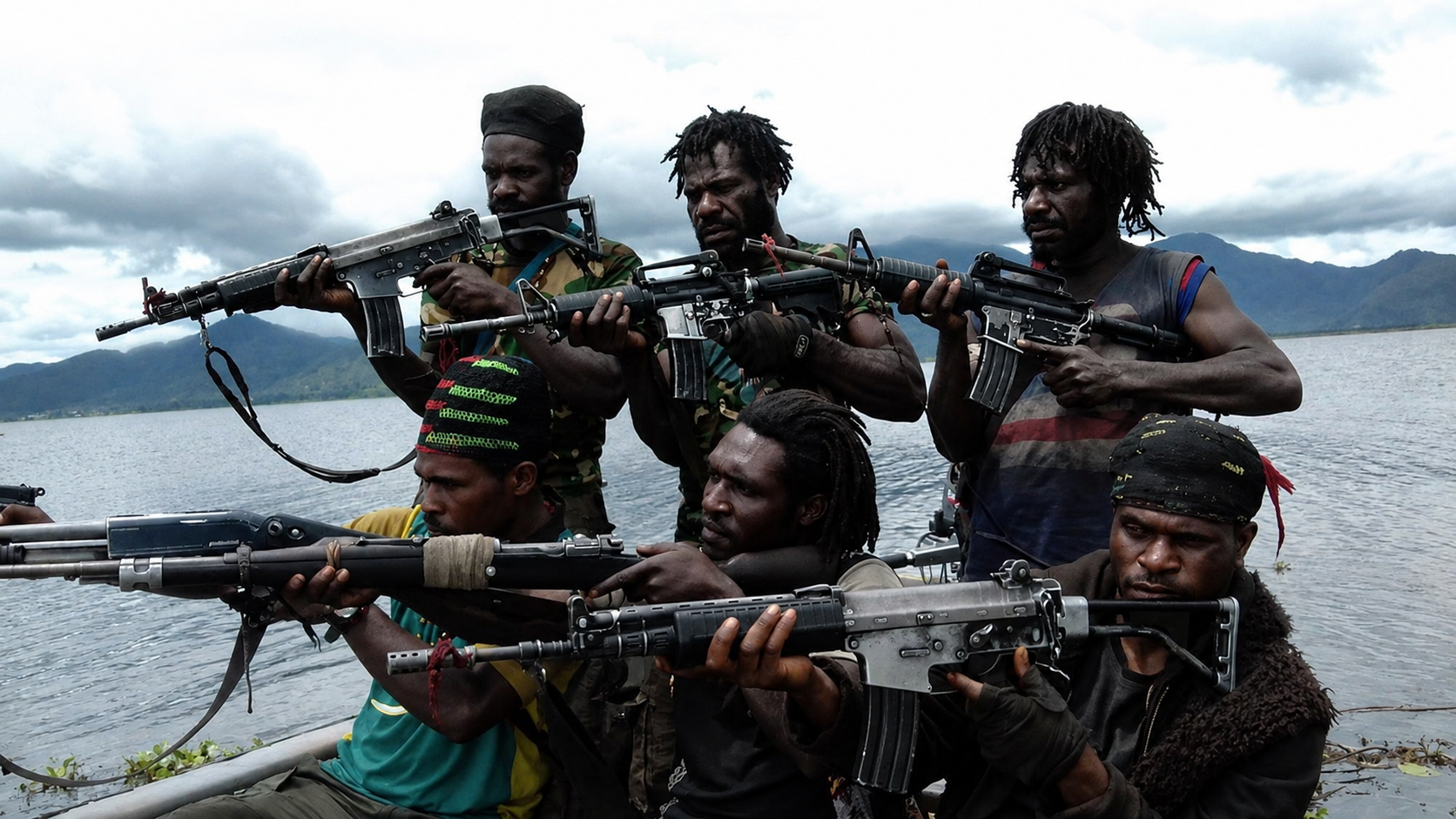

In 2018, the West Papua Liberation Army declared open war on the Indonesian military. Since then, at least 100 Indonesian military and security personnel have died, alongside hundreds of civilian casualties, and hundreds more on the rebel side. The most recent victim was an American pilot flying logistics for a Catholic mission in a remote area, executed on the morning of July 2, 2026.
The Papua rebellion is now the oldest active insurgency in Indonesia, ongoing since the 1970s. But what suddenly transformed this low-level insurgency into a declaration of open war? And why in 2018?
In a vast tropical region like Papua, guerrilla fighters must operate in hard terrain: mountains and rainforest. Control of such terrain gives them three advantages:
Firstly, this control allows the rebellion forces to govern the flow of food, medicine, and other supplies to the wider population, including civilians, thereby binding local communities’ fortunes to those of the insurgency, and incentivizing recruitment.
Secondly, it gives them control over crucial illegal mining activity, a key source of funds.
Thirdly—and most importantly—rebel mastery of roadless terrain allowed hit-and-run attacks, with dense forestation shielding the insurgents from retaliation by the Indonesian military.
As James Scott describes in The Art of Not Being Governed, this highland terrain of Southeast Asia functions as a zone of deliberate statelessness, wherein nonstate armed actors can operate beyond the reach of government control. A massive effort by the administration of President Joko Widodo (2014-2024) saw the construction of roads and small airports for bush planes and commuter aircraft. This far-reaching infrastructural development opened that terrain, throwing all three guerilla advantages into jeopardy.
The 2018 escalation is best understood as a response to that contest. This article traces how Widodo’s roads and airports eroded the terrain advantage the insurgency was built on. It illustrates how—since 2018—the rebels’ new strategy—targeting logistical networks, illegal miners, and suspected collaborators—maps directly onto the three things the new infrastructure threatens. It closes by explaining why Indonesian military doctrine inadvertently favors the rebels, even as the geographic space between them and the military narrows.
To American readers, who may have experience firsthand the mixed outcomes of infrastructure development in Afghanistan, the insurgency in the highlands of Indonesian Papua may seem all too familiar. Papua is another live test of the same assumption: that roads, airstrips, and development extend the state’s reach, pacify contested ground, and win control over the population. But in that contested territory, the opposite happened. The roads and airports the Indonesian government cut through tropical forest and muddy produced two enormous problems. Firstly, the rebels were not pacified, but galvanized. Secondly, those projects went ahead without adapting the military doctrine to the subsequent conflict. Such dysfunction benefited the rebels over the state forces, as this article will show.
The Rebellion Dynamics
The West Papua National Liberation Army, formed on March 26, 1973, is the armed wing of the Free Papua Movement. The rebellion drew global attention in 1996, when fighters kidnapped 26 members of a World Wildlife Fund research mission in Mapenduma, Papua. This incident later became known as the Mapenduma hostage crisis. The hostages included four Brits and two Dutch nationals, with the rest Indonesian.
Papua is about the size of California. Half of the island is mountainous, and nearly 81 percent is rainforest. This terrain isolates many indigenous people from the reach of the state, gives cover to the rebels for attack-and-hide operations, with ample space to run illegal mining enterprises.
The militarization of the area has been constant, but different presidents have taken different approaches to the conflict. Under Susilo Bambang Yudhoyono (2004-2014), the Indonesian government leaned on a policy of special autonomy. This program channeled money to local governments in Papua, letting local leaders decide which projects to fund. This quickly worsened corruption—the Indonesian Financial Transaction Reports and Analysis Center reporting that money was quietly wired to the rebels and the independence movement.
When Joko Widodo took office in 2014, he judged that special autonomy was not working. Widodo launched an ambitious infrastructure program centered on roads, small airports, and other public works. By 2023, his administration had built 3,462 km of road, including 1,098 km along the border with Papua New Guinea. It also constructed at least 10 new small airports and three seaports. Many of these reached remote areas in Papua’s mountainous interior.
Papua is also home to the American firm Freeport-McMoRan, which operates the Grasberg mine, the world’s largest gold mine and one of its largest copper reserves. Given the scale of the operation and the minerals’ importance to both Indonesia and the United States, Grasberg has been a frequent rebel target. The mine lies in the mountains, heavily guarded by the military, yet it remains one of the most attacked assets in the region. Rebels first tried to sabotage it in 1977. Since then, open sources record hundreds of casualties linked to Grasberg. Just this year, the Indonesian military rescued 18 Freeport-McMoRan workers from a rebel siege.
Papua’s natural wealth has sharpened the stakes. Gold in particular is easy to mine illegally and then sell on the black market. The rebels thus fear that any road-building push will open the land to rivals: state-sponsored legitimate mining, or other illegal, unaffiliated miners. Both would move in on the same assets and squeeze out the rebels’ own illicit operations, threatening their primary revenue stream.
The Battle Over Contested Territory
The 2018 declaration of open war was no coincidence. It followed the first roadbuilding in Papua’s interior and mountains, which opened logistics lanes, made it easier for the Indonesian military to operate, and let the state reach remote communities directly with daily necessities like food and medicine. That access threatened the rebels’ survival, pushing them toward more aggressive tactics.
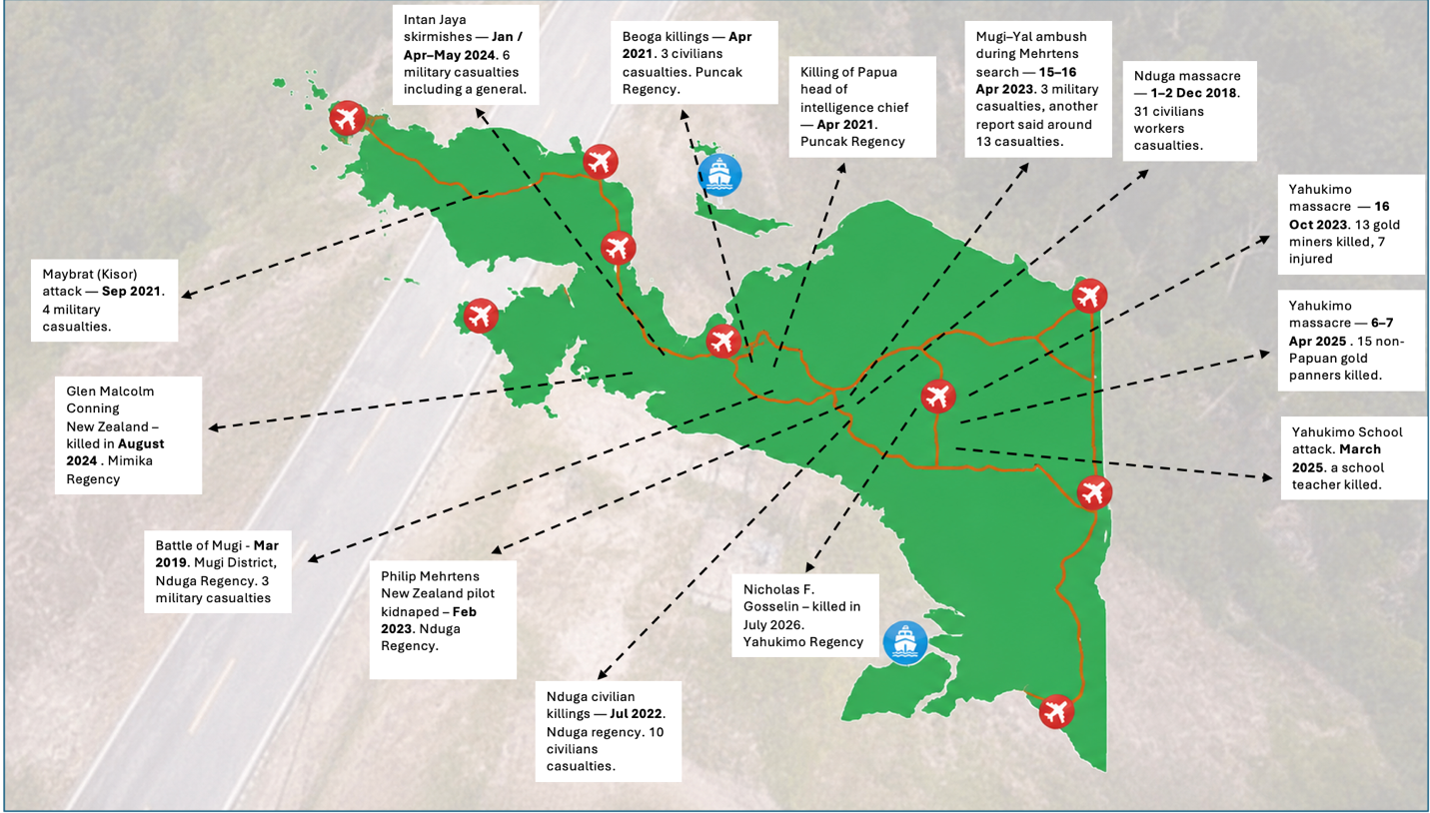
Figure 1: The attacks since 2018. The map is from the Ministry of Public Works.
Figure 1 shows West Papua Liberation Army attacks since 2018. On the map, the orange line marks the new roads built under the Widodo administration. Most attacks cluster in the same districts as or within 50 to 100 kilometers of that line. Several major incidents have signaled insurgent frustration with the infrastructure program. The government continued the projects despite rebel attempts to thwart them, and escalation followed. Since the declaration of war, the rebels have aimed for three main targets.
Logistics and Infrastructure
In December 2018 a rebel leader, Egianus Kogoya, led an attack on contractors paving roads in Nduga, killing 31 workers. Kogoya was 19 at the time. He has led 65 attacks that killed 42 people, making him the key figure in the rebellion. Strikes on the logistics chain itself followed: the 2023 abduction of a New Zealand pilot, the killing of a New Zealand helicopter pilot in 2024, and most recently the killing of Nicholas Goselin, an American logistics pilot, in July 2026. Aircraft are the only supply line into much of the highlands and are thus the extent of state reach.
Unaffiliated Illegal Miners
In July 2022, ten miners were killed on the orders of Kogoya. In the same month, a miner was beheaded. In October 2023, another seven were killed, and the latest attack—ten more illegal miners were executed in May 2026. The rebels have conducted these killings to reassert control over the illegal mining economy.
Alleged Indonesian Government Informants and Collaborators
In July 2026, a husband and wife were executed beside a newly-built road on suspicion of working for the government. In March 2025, a schoolteacher was killed under the same pretense. The aforementioned Nicholas Goselin, who flew for a Catholic mission, was likewise accused of aiding the military.
Contested Territory
This heightened frequency of attacks is the product of contested territory. Before the declaration of war in 2018 the movement carried out fewer, smaller-scale attacks: the 1996 Mapenduma hostage crisis, an ambush near the Freeport mine that killed three teachers (two American, one Indonesian) in 2002, and a series of shootings around the mine in 2009 and 2010 that wounded several workers, among other low-casualty incidents.
However, even with their control contested by the new infrastructure, the insurgents’ capacity to strike back at the Indonesian military and state assets has proven surprisingly broad. The most shocking blow for Jakarta came in April 2021 with the assassination of Papua’s chief of regional intelligence, a one-star army general. This raised a crucial question: if the roads and airports are a government project, why do state forces still seem unprepared for the attacks that follow?
The answer is doctrinal. The Indonesian military remains oriented toward territorial control and a counterterrorism template. It has failed to adapt to a mobile counterinsurgency model that roadless highland terrain demands.
A Doctrine Built for the Wrong War
The West Papua Liberation Army fields no advanced weaponry. Its typical arsenal is modest: AX sniper rifles, SS1-V1, M4s, FN pistols, M16s, revolvers, and homemade firearms. The rebels rarely use rocket launchers or mount the kind of complex, coordinated operations seen among their Southeast Asian peers, such as the Moro Islamic Liberation Front in the southern Philippines or the Karen National Liberation Army in Myanmar. Their tactics are traditional guerilla practice: ambush, then run and hide.
The Indonesian military’s posture is territorial and inward-looking. It rests on a four-tier chain of area commands: the Military Regional Command (Kodam) covers one or more provinces, and beneath it sit the Military Area Command (Korem) over several regencies, the Military District Command (Kodim) at the regency level, and the Military Sub-district Command (Koramil) at the local level. Together these form a net of static territorial presence, where the chain of command and control are designed based on domestic territory.
This system hardened after independence in 1945 into an instrument of internal security against a series of rebellions and conflicts, most consequentially around the alleged communist-led coup of 1965. Under the New Order it fused with the military’s dual-function role in politics and society, extending the command net down to the village level, where it also served as a tool of intelligence, monitoring citizens for dissent, mutiny, or criticism of the regime. The result is a force organized to blanket territory and hold ground, not to outmaneuver and weed out an armed enemy in areas beyond the reach of the Koramil.
This doctrine also shapes procurement and technology adoption. Surveillance and air strikes are the capabilities most essential when dealing with roadless terrain. No official figures for the military’s drone inventory or its other air and surveillance assets in Papua can be readily found. While Indonesia has acquired 12 ANKA drones from Turkey and has since ordered 60 Bayraktar TB3 and 9 AKINCI drones, these are strike platforms. Their effectiveness depends on the surveillance and intelligence systems that enable them, and on the munitions they carry. In Papua, information still primarily flows from ground-level HUMINT sources. Though valuable, intelligence processing is slow. Reports must be escalated from the Military Sub-district Command up to the Military Regional Command, which holds the authority to deploy heavier weapons or special units. Furthermore, human sources are vulnerable to rebel intimidation.
The deeper cost of this territorial doctrine is inertia. This inertia slows military adoption of the air surveillance, intelligence fusion, and rapid-strike capabilities that a roadless guerrilla war requires.
Lessons Learned
Reminiscent of Afghanistan, the southern Philippines, or Colombia, two lessons stand out from the Indonesian government’s struggle against the West Papua Liberation Army’s insurgency.
Firstly, development in a conflict zone is not the same as development in peacetime. Building roads and air strips for the good of the population is essential and the right thing to do, but where it runs into an insurgency whose power rests on terrain and logistics, infrastructure should be seen as contested asset, not a merely development tool. The project cannot be planned in isolation from the security doctrine that has to hold the ground it opens.
The second lesson is the cost of building faster than you adapt. The Indonesian government opened the interior of Papua, but kept a military built for static territorial defense. That discrepancy between doctrine and practice, not the mileage paved, is what gave the rebels ample opportunity for continued strikes.
Neither lesson should stay in Papua. They can be applied to any theater where a state, or its allied security partners, tries to develop its way out of an insurgency without first matching the doctrine to the terrain.


