Mexican Cartel Strategic Note No. 40: South African and Nigerian Meth Labs and Global Expansion

Recent incidents have demonstrated increasing expansion of Mexican cartels into Africa. Specific incidents involving clandestine methamphetamine (meth) in South Africa and Nigeria, as well as Kenya and Mozambique have been documented. This strategic note primarily highlights criminal cartel penetration into South Africa while briefly referencing broader trends, specifically in Nigeria. Both the Cártel Jalisco Nueva Generación (CJNG) and the Sinaloa Cartel (CdS) have been detected in Africa and are believed to be using he region as a base for production as well as trafficking. The fragility of the region and interaction with local gangs—such as the well-entrenched South African and Nigerian gangs presents a strategic challenge for states and a potential competitive advantage for criminal cartels and transnational criminal networks.
Key Information: “Mexican cartels send meth makers to Africa.” African Defense Forum. 25 August 2026, https://adf-magazine.com/2026/08/mexican-cartels-send-meth-makers-to-africa/:
Methamphetamine cooks supplied by Mexican drug cartels have been discovered working at several drug laboratories in Africa over the past two years.
Several arrests, including Nigeria’s largest-ever meth bust in May, have occurred as Mexico’s Sinaloa and Jalisco New Generation cartels expand their operations under a franchise-style business model. The cartels are accused of funding continental terrorists, armed groups and criminal groups that help them produce and move the drugs…
…Mexican meth cooks have operated in Nigeria since 2016, but the recent local arrests and significant meth busts in Kenya and South Africa — areas that historically have been used as transit hubs for drugs — show that the cartels are increasingly sending their own chemists to produce meth…
…In recent years, Mexican cartels have expanded their meth operations into South Africa, which is considered one of the world’s largest consumer markets for crystal meth. This was underscored in July 2024 when two Mexican nationals were arrested at an industrial-scale meth lab on a farm in Groblersdal, a small town in Limpopo Province. Authorities discovered large quantities of precursor chemicals with an estimated street value of 2 billion rand ($122 million)…
…The Sinaloa cartel has tried to expand its South African operations to neighboring countries. In Mozambique, authorities arrested three people, including two Mexican nationals, in April 2026 at Maputo International Airport. Authorities said the cartel wanted to establish itself in Maputo province.
Kenya’s growing role in Mexican meth production was highlighted in September 2024 when authorities arrested six people, including a CGNJ member, in the countryside near Namanga, a community on the border with Tanzania.
Key Information: “Three Meth Labs in Four Months: Are Remote Farms Becoming Drug Factories? eNCA. 4 September 2026, https://www.enca.com/news-top-stories/three-meth-labs-four-months-are-remote-farms-becoming-drug-factories:
A series of crystal meth laboratories uncovered on remote farms in South Africa is raising questions about the country’s growing role in the production and trafficking of synthetic drugs.
Police uncovered the latest suspected lab during an overnight raid on a farm about 200 kilometres north of Johannesburg, after residents reported suspicious activity and a strong, unpleasant smell.
The latest operation is the third suspected crystal meth laboratory police have uncovered in less than four months.
In May, police raided a remote farm northwest of Johannesburg, uncovering what they described as a multi-million-dollar methamphetamine laboratory.
Eleven suspects were arrested, including four Mexican nationals who police suspected of having links to Latin American drug cartels.
Then, in August, another crystal meth laboratory was uncovered near the Zimbabwean border, with several foreign nationals, including two Mexicans, arrested.
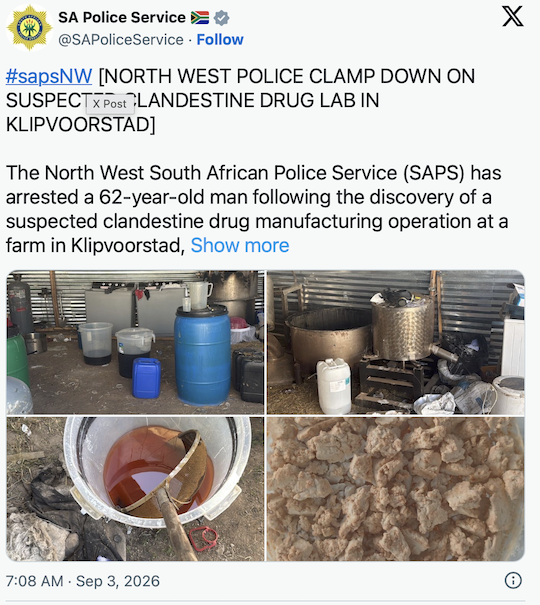
South African Police Service Clandestine Lab Arrest, 2 September 2026. Source: South African Police Service (SAPS), X (Formerly Twitter), 3 September 2026.
Key Information: “SA’s Drug Problem: Why International Cartels Are Moving In.” eNCA. 8 September 2026, https://www.enca.com/news-top-stories-videos/sas-drug-problem-why-international-cartels-are-moving:
South Africa is increasingly becoming an attractive base for international drug syndicates, according to security expert Willem Els of the Institute for Security Studies.
Els says Mexican drug cartels are allegedly sending experienced drug cooks to South Africa to operate industrial-scale laboratories, while working with established local criminal networks to manufacture and distribute drugs…
…Three suspected crystal meth laboratories have been uncovered in less than four months.
In May, police raided a remote farm northwest of Johannesburg, uncovering what they described as a multi-million-dollar methamphetamine laboratory.
Eleven suspects were arrested, including four Mexican nationals who police suspected of having links to Latin American drug cartels.
Then, in August, another crystal meth laboratory was uncovered near the Zimbabwean border, with several foreign nationals, including two Mexicans, arrested.
Earlier this month, a laboratory was uncovered during a raid on a farm about 200 kilometres north of Johannesburg…
…According to Els, there is no clear indication that Mexican cartels have simply transplanted their entire operations to South Africa. Instead, they are allegedly forming links with criminal networks that already operate in the country.
These local connections can provide access to established markets, trafficking routes and distribution networks, making it easier for international syndicates to manufacture drugs locally and move them across borders.
Key Information: Caryn Dolley, “Mexican cartel concerns around SA ‘tik farms’ may connect to Ecuador’s cocaine gangs.” Daily Maverick. 24 August 2026, https://www.dailymaverick.co.za/article/2026-08-24-mexican-cartel-concerns-around-sa-tik-farms-may-connect-to-ecuador-s-cocaine-gangs/:
A crackdown on a suspected R600-million illicit drug facility in South Africa, along with sanctions that the United States (US) has imposed against an Ecuador-based cocaine trafficking network, emphasises the tight grip of Mexican cartels.
In South Africa, five suspects were detained after an alleged crystal methamphetamine (tik) manufacturing facility, worth around R600-million, was uncovered at a Limpopo farm on Thursday, 20 August 2026…
… On the same day as the Limpopo crackdown, the US Treasury Department’s Office of Foreign Assets Control announced sanctions against an Ecuador-based cocaine trafficking network that was working with Mexican cartels – Sinaloa and Cartel de Jalisco Nueva Generación (CJNG).
This [Limpopo] case represents one of at least five illicit drug manufacturing [crystal methamphetamine or ‘tik’]facility crackdowns in South Africa over two years, in which suspects from Mexico have been arrested…
…[O] on the day of the Limpopo farm swoop, the US Treasury Department announced sanctions against various individuals and entities linked to the Ecuador-based cocaine trafficking network which was operating with the Sinaloa Cartel and CJNG…
… “Operating under the guise of legitimate fishing businesses, a fleet of Ecuador-based vessels near Manta, Ecuador, secretly transfers cocaine to small power boats – known as go-fast vessels – that transit north through the Eastern Pacific Ocean […] en route to the United States,” a US Treasury statement on the sanctions said…
… A similar modus operandi, of ships offloading cocaine consignments at sea which traffickers on smaller boats retrieve to bring ashore, has been flagged in South Africa.
Key Information: “Cartel Networks are Establishing a Greater Foothold in Africa.” The Soufan Center. 16 June 2026, https://thesoufancenter.org/intelbrief-2026-june-16/:
Last week, the South African Police Service (SAPS) Directorate for Priority Crime Investigation (DPCI), widely known as the country’s elite ‘Hawks Unit,’ conducted a raid on a rural farm in Swartruggens, discovering an industrial-scale laboratory that contained over 481 kilos of methamphetamine — estimated to be worth around $61 million…
…South African authorities affirmed that the May 2026 raid was one in four total tied to Mexico-based cartel networks in the last two years. Additional discoveries of meth production sites in Nigeria’s Abidagba Forest in May 2026 and Kenya’s Olelep village in September 2024 have also revealed the involvement of Latin American crime groups, specifically the Mexican Sinaloa and Jalisco New Generation Cartel (CJNG) cartels…
…The presence of Latin American criminal organizations in Africa is, by no means, new. As far back as the 1980s, drug trafficking organizations (DTOs) used West and North Africa as a point to transit cocaine flows to European destination markets. Over time, groups like the Brazil-based Primerio Comando da Capital (PCC), Colombian cartels, and Mexico-based groups like Sinaloa, Zetas, and CJNG all established cooperative partnerships with local criminal syndicates, jihadist groups, and even law enforcement in countries like Nigeria, Guinea-Bissau, Mozambique, Mali, South Africa, and Senegal, primarily for cocaine flows. However, this engagement did not translate to a heavy presence of Latin Americans…
…However, the evolution of both drug markets and geopolitics has incentivized cartel groups like the Sinaloa and CJNG to substantially change their strategy and nature of engagement in Africa. Firstly, there has been an explosion in the availability and demand for synthetic substances — particularly amphetamine-type stimulants such as methamphetamine — across global markets, including consumption hubs in Africa. This, combined with the reality that these drugs are easily and cheaply produced — using dual-use chemicals that can evade regulations — create incentives for localized production in African countries.
Key Information: Qaanith Hunter, “How Mexican cartels turned South African farms into meth production hubs,” Al Jazeera. 8 June 2026, https://www.aljazeera.com/news/2026/6/8/how-mexican-cartels-turned-south-african-farms-into-meth-production-hubs:
In the quiet mining town of Swartruggens, a small courthouse is preparing to decide whether five Mexicans accused of a major illegal drug operation will be granted bail or remain in custody.
Their arrests followed a raid on a remote farm in North West province, where police said they uncovered a large methamphetamine laboratory worth about one billion rand ($60m).
The case is one of several pointing to a pattern taking shape in South Africa’s rural interior.
The Swartruggens laboratory was not an isolated discovery.
It was one of four major meth sites linked to Mexican criminals uncovered in South Africa in just two years, a pattern that has unsettled investigators and organised crime experts…
… Mexicans are increasingly being found working alongside local collaborators in rural production sites, suggesting a shift from trafficking meth into Africa to producing it there.
Organised crime researcher Julian Rademeyer told Al Jazeera the model reflects a deliberate strategy…
… The logic is straightforward: produce closer to consumers, cut transport costs and reduce exposure to border and maritime enforcement…
… Mexican-linked networks in Africa did not begin in South Africa.
Researchers trace early activity back to Nigeria, where local groups were producing meth with Mexican involvement by around 2016.
From there, the networks spread through East Africa, then south through Mozambique and Botswana, before reaching South Africa more recently.
Key Information: Stella Horrell, “Mexican Meth Expertise Spreads to African Labs.” InSight Crime. 15 July 2026, https://insightcrime.org/news/mexican-meth-expertise-spreads-to-african-labs/:
On July 10, Nigeria’s Anti-Drug Agency (NDLEA) formally prosecuted African and Mexican actors operating a meth lab uncovered during a raid in Ogun state on May 16. Nigerian authorities dismantled the industrial-scale methamphetamine laboratory, seizing 2.4 tons of crystallized methamphetamine and precursor chemicals. It was reportedly the country’s largest methamphetamine seizure to date. The network, which included three Mexican nationals and seven Nigerian actors, now faces an 11-count charge for the preparation, processing, and production of methamphetamine.
A week earlier, on May 13, police in South Africa had uncovered an industrial-scale methamphetamine laboratory, where four of the 11 suspects arrested were Mexican.
The NDLEA also dismantled a methamphetamine laboratory hidden in a forested area of Oyo State on June 17 and arrested five suspects, including a Mexican national named José Villa Ochoa. NDLEA Chairman Mohamed Buba Marwa called the site “a sophisticated, factory-scale methamphetamine production center run by a highly organized transnational criminal syndicate.”
These cases are part of a broader pattern. Mexican cooks were found at 11 of 12 clandestine drug laboratories seized in Africa over the last two years.
Key Information: Ope Adetayo, “Nigeria’s anti-drug agency shut down large meth laboratory in a raid.” Associated Press. 21 May 2026, https://apnews.com/article/nigeria-drug-bust-meth-lab-ad7bf33330d348c14675ef49d72fb2d8:
Nigeria’s anti-drug agency said it has busted a transnational organized drug syndicate involving Nigerians and Mexicans in the southwestern region of the country.
The National Drug Law Enforcement Agency said late Wednesday that its special operations unit shut down “an industrial-scale clandestine laboratory” in a remote forest in the Ijebu area of Ogun state, which shares a border with Lagos, the country’s economic capital. The agency added that it is the biggest drug bust ever in the country…
… According to the statement, the operation resulted in the seizure of 2.4 tons of chemical materials, including methamphetamine, worth 480 billion naira ($363 million) and two vehicles.
Analysis
There have been several arrests in recent years in Africa that point to an increasing involvement of Mexican organized crime in the expansion of methamphetamine production in the region. Rafaella Lipschitz explains that South Africa, in particular, has shifted from a transit destination to a production hub for organized crime.[1] Recent arrests have also exposed the transnational nature of this shift, as several Mexican nationals have been arrested in these raids. The most powerful criminal organizations in Mexico, the CJNG (Cártel Jalisco Nueva Generación) and the Sinaloa cartel, have both expanded their operations into Africa. Examples of these links span from the arrests of Sinaloa and CdG (Clan del Golfo or Los Urabeños) members who were detained trying to pass 18 suitcases full of cocaine to South Africa in April of 2025 to the creation of a drug lab in Kenya that was raided and resulted in the arrest of a member of the CJNG.[2] Lipschitz’s analysis also reflects these linkages and explains that there is a knowledge transfer in which Mexican meth producers work with local gangs, as they can create high-quality synthetic drugs. South Africa offers several land routes and a weak security system that criminals can exploit.[3] Jason Eligh exposes another reason this region is so valuable: in 2021, he showed that Afghan methamphetamine was starting to appear in Southern and Eastern Africa. He details how South Africa has an embedded meth retail market with a large consumer base, which is also supplying several emerging retail markets in the region.[4]
The production of illicit synthetic drugs like methamphetamines is the perfect tool for overseas expansion for organized criminals. Teun Voeten explores how different forms of methamphetamine have historically been produced and used. In his book, The Devil’s Drug, he unravels the vast ability of meth producers to adapt recipes and circumvent bans on substances by accessing different precursor drugs.[5] This adaptability presents a valuable opportunity to organized criminals who can set up synthetic laboratories in other countries or partner with other criminal groups, providing the knowledge to produce high-potency synthetic drugs. Voeten also explains how many countries across the world are seeing a resurgence in the usage of methamphetamines, whose usage can span from people looking to work long hours to party scenes where it is used as a sexual stimulant.[6] Eligh expands our understanding of this rise in usage, particularly in Africa, by noting how meth has become a form of currency in this region to exchange for other illicit goods, including poached Abalone.[7] As meth continues to rise in popularity across the world, and in these regions in particular, we expect organized crime to continue to develop alliances with other local criminal groups to expand their production and supply lines into these new and emerging markets. As traditional suppliers of methamphetamine like Iran and Afghanistan continue to face local and external pressures on their production and distribution, we can expect organized crime to continue to expand their operations in Africa to profit from these emerging illicit drug markets.
Conclusion
Mexican organized crime and its Latin American affiliates are continuing to expand operations transnationally to exploit economic opportunities and state fragility across the globe. Methamphetamine and other synthetic drugs are highly adaptable in nature. They can be produced in a variety of ways at low to moderate cost, which has led to an explosion of alliances and direct provision of clandestine lab services globally. As they have developed considerable knowledge of producing and distributing these illicit drugs, they can franchise that knowledge into successful enterprise in other countries, notably in Africa and potentially beyond. The rise in demand increases the profitability of setting up production centers worldwide, with new and adaptive supply routes that take advantage of states that may not have sufficient resources or capabilities to combat drug trafficking.
As organized crime continues to expand its foothold in Africa, we can expect similar consequences to what we have seen across Latin America for these countries and their governments. Organized crime exploits these states’ weakness by corrupting security forces, politicians, and the judicial branch to secure new supply lines and run their illicit, power, and reach their ability to contest governance in fragile states. In addition, their ability to diversify into other illicit activities that exploit state limitations, showcases their predatory nature and broad scope of operations, including targeting ability, acting as criminal armed groups (CAGs) that contest state solvency, extracting natural resources, and extortion of legal businesses.[8]
Sources
Ope Adetayo, “Nigeria’s anti-drug agency shut down large meth laboratory in a raid.” Associated Press. 21 May 2026, https://apnews.com/article/nigeria-drug-bust-meth-lab-ad7bf33330d348c14675ef49d72fb2d8.
“Cartel Networks are Establishing a Greater Foothold in Africa.” The Soufan Center. 16 June 2026, https://thesoufancenter.org/intelbrief-2026-june-16/.
Caryn Dolley, “Mexican cartel concerns around SA ‘tik farms’ may connect to Ecuador’s cocaine gangs.” Daily Maverick. 24 August 2026, https://www.dailymaverick.co.za/article/2026-08-24-mexican-cartel-concerns-around-sa-tik-farms-may-connect-to-ecuador-s-cocaine-gangs/.
Stella Horrell, “Mexican Meth Expertise Spreads to African Labs.” InSight Crime. 15 July 2026, https://insightcrime.org/news/mexican-meth-expertise-spreads-to-african-labs/.
Qaanith Hunter, “How Mexican cartels turned South African farms into meth production hubs,” Al Jazeera. 8 June 2026, https://www.aljazeera.com/news/2026/6/8/how-mexican-cartels-turned-south-african-farms-into-meth-production-hubs.
“Mexican cartels send meth makers to Africa.” African Defense Forum. 25 August 2026, https://adf-magazine.com/2026/08/mexican-cartels-send-meth-makers-to-africa/.
“SA’s Drug Problem: Why International Cartels Are Moving In.” eNCA. 8 September 2026, https://www.enca.com/news-top-stories-videos/sas-drug-problem-why-international-cartels-are-moving.
Endnotes
[1] Rafaella Lipschitz, “Mexican Cartels and South Africa’s Shift to Meth Production.” Orion Policy Institute. 5 August 2026, https://orionpolicy.org/mexican-cartels-and-south-africas-shift-to-meth-production/.
[2] “Pentágono advierte sobre cárteles mexicanos en Sudáfrica: ‘va a empeorar con el tiempo’,” Proceso. 5 July 2026, https://www.proceso.com.mx/nacional/2025/7/28/pentagono-advierte-sobre-carteles-mexicanos-en-sudafrica-va-empeorar-con-el-tiempo-353964.html.
[3] Op. Cit., Lipschitz, “Mexican Cartels” at Note 1.
[4] Jason Eligh, A Synthetic Age: The Evolution of Methamphetamine Markets in Eastern and Southern Africa, (Commodity Report). Geneva: Global Initiative Against Transnational Organized Crime, March 2021.
[5] Teun Voeten, The Devil’s Drug: The Global Emergence of Crystal Meth. Lanham: Rowman & Littlefield, 2025.
[6] Ibid.
[7] Op. Cit., Eligh, A Synthetic Age at Note 4.
[8] See Nils Gilman, Jesse Goldhammer, and Steven Weber, Eds., Deviant Globalization: Black Markey Economy in the 21st Century. New York: Continuum, 2011 and John P. Sullivan, “How Illicit Networks Impact Sovereignty” Chapter 10 in Michael Miklaucic and Jacqueline Brewer, Eds, Convergence: Illicit Networks and National Security in the Age of Globalization. Washington, DC: National Defense University Press, pp. 171–188
Additional Readings
Jason Eligh, A Synthetic Age: The Evolution of Methamphetamine Markets in Eastern and Southern Africa, (Commodity Report. Geneva: Global Initiative Against Transnational Organized Crime, March 2021.
John P. Sullivan, “SWJ El Centro Book Review − Clash of the Cartels: Unmasking the global drug kingpins stalking South Africa.” Small Wars Journal, 5 April 2023.
Rafaella Lipschitz, “Mexican Cartels and South Africa’s Shift to Meth Production.” Orion Policy Institute. 5 August 2026.
Vanda Felbab-Brown, “The spiking threat: Mexican cartels in Europe, Canada, Africa, the Asia-Pacific, and Latin America.” Brookings. 24 June 2026.