Whole-of-Government Irregular Warfare May Not Be the Right Goal

Introduction
In July 2026, Retired Special Forces Brigadier General Russell Howard published an article in Small Wars Journal entitled, “China Laughs at the US Approach to Irregular Warfare!” In it, Howard argues that—while the West has been preoccupied with defining irregular warfare—China has successfully practiced it for millennia, even going so far as making it a whole-of-society endeavor. Howard further provided clear strategic recommendations for how America can “shift from a defensive, reactive posture to a proactive, cost-imposing strategy.”
In early September 2026, Chad Machiela, continuing the discussion, wrote that Howard’s approach might work, but only if the United States can get the language and concepts down first. A friend, colleague, and—like Howard—fellow Green Beret, Machiela explained how agreeing on shared vocabulary is the likely first step in bringing the American interagency closer to a whole-of-government model. According to him, agencies need to share terminology, concepts, objectives, and—more importantly than anything else—understanding, before they can integrate scattered knowledge, reconcile competing authorities, coordinate action, and measure whether any of it worked.
Machiela traces, through Sowell, Goodenough, Bechky, and Carlile, why a common lexicon is necessary but not sufficient. After all, agencies can agree on a definition of irregular warfare and still disagree about the political objective it is meant to serve, who owns the authority to pursue it, and what counts as success. That is a careful argument about how to approach the premise of whole-of-government irregular warfare. It is not an argument testing the truth of the premise, nor does Machiela claim that it is.
This piece questions the premise directly. If American government agencies, political entities, and civil organizations cannot act as a single entity—coordinated or otherwise—then a project of building toward that condition through better language is futile. That single entity is something the American constitutional system was not built to produce, or simply cannot produce. The remainder of the argument about how to get there becomes moot, regardless of how well it is constructed.
Before continuing, a note on defining or using the term “irregular warfare,” which is, ironically, an essential part of Howard’s, Machiela’s, and my thesis. I encourage the reader to use whatever term is preferable. Machiela’s paper was very much about the importance of both that definition and common understanding across agencies. It was those dynamics that would hopefully then lead to true whole-of-government irregular warfare.
This essay is not meant to be a rebuttal of either Howard’s or Machiela’s position. It is a further continuation of the discussion. This paper focuses on the idea that the perfect definition might not matter, because whole-of-government cooperation in the American system is not possible in the first place. It is therefore less important to me that the reader use any particular term to describe what some prefer to call hybrid warfare, irregular competition, gray-zone conflict, unrestricted warfare, fifth-generation warfare, or something else.
The Single-Actor Problem
Back to the point of this paper. Start with what China can do that the United States cannot and should not try to replicate. A centralized party-state can remove an official judged insufficiently supportive of a strategic objective. It can compel a ministry, a state enterprise, and a provincial government to act in concert because refusal carries a personal cost. Machiela makes this comparison directly, citing the Center for European Policy Analysis on the PRC’s comparative advantage in coordinating irregular warfare. The American system was built to prevent that kind of concentration. Separation of powers, statutory agency mandates, congressional oversight of appropriations, and the routine turnover of political leadership every two and four years are not defects in an otherwise coordinated system. They are the system itself. Asking State, Defense/War, Treasury, the intelligence community, and USAID’s successor organizations to behave as a single actor asks them to behave in a way contrary to how the Constitution and a century of enabling legislation designed them.
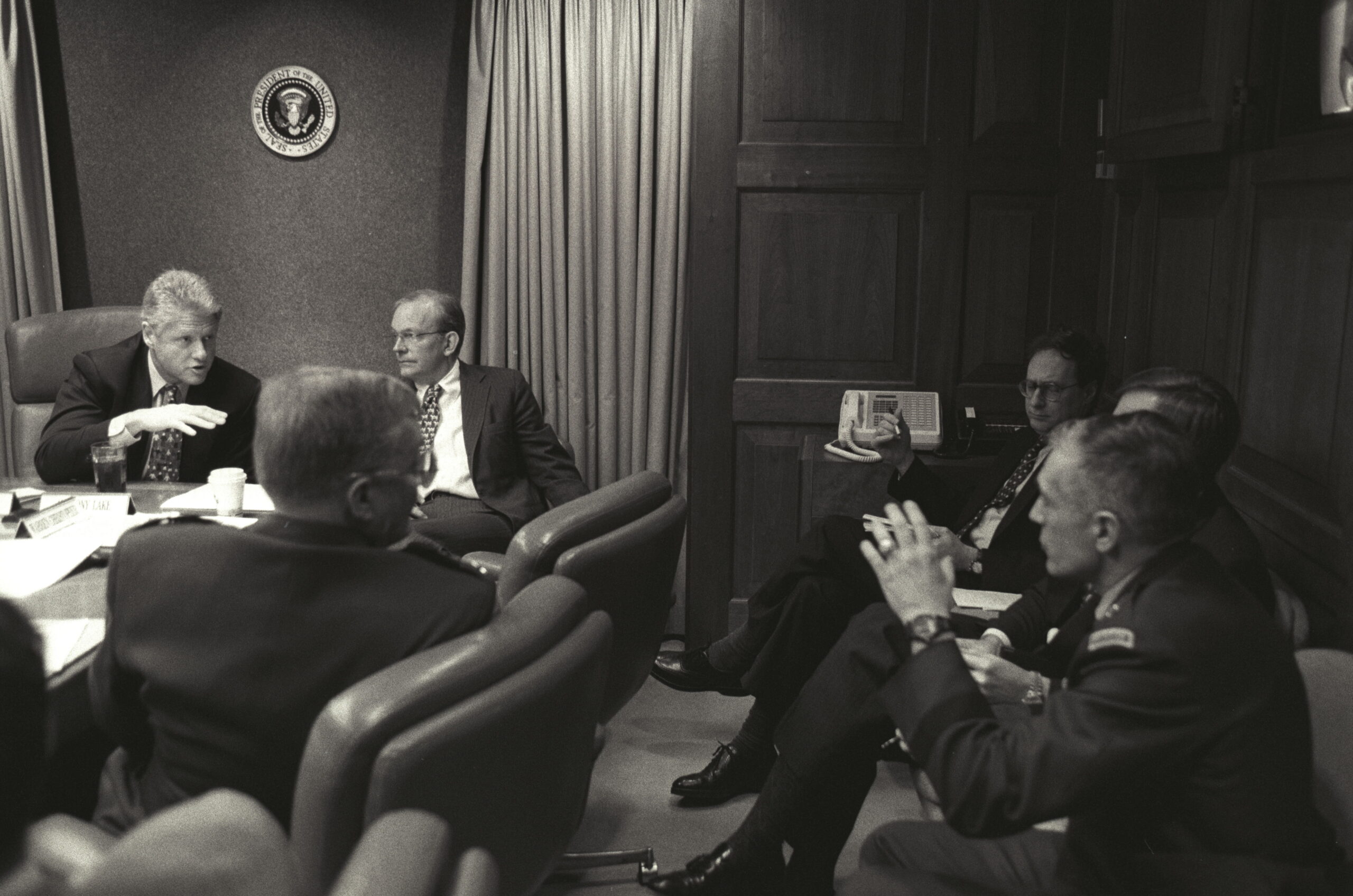
This is not a new observation. President Clinton signed Presidential Decision Directive 56 (PDD-56) in May 1997 after Somalia, Haiti, and Bosnia exposed how badly civilian and military agencies coordinated complex operations. PDD-56 set up interagency working groups, political-military plans, and after-action reviews meant to force agencies toward a shared process. The directive had real effects on operations in Kosovo two years later. It was ultimately rescinded by the next administration.
Later, Bush, Obama, Trump, and Biden would each issue their own version of the same idea under a different name. Reagan’s National Security Council had tried something similar with NSDD-32. Each of these policy directives worked—to the degree that it did work—for the duration of one administration and the tenure of the officials who wrote it. None survived a change in political leadership with its coordinating function intact. If the fix for interagency friction only holds while the people who imposed it remain in office, the fix was never structural. It was personal, and personal fixes expire on a four-year clock against which irregular warfare countering China, Russia, Iran, and North Korea does not hold up.
Shared Language Does Not Equal Shared Understanding
Machiela proposes that shared understanding is achievable through better concepts and more careful language, and he is careful to note that language is a starting point rather than an endpoint. I agree with the sequencing. My question is whether the endpoint he describes—agencies with sufficiently shared objectives producing mutually reinforcing effects—is one that the American system can sustain once the language problem is solved. Shared understanding requires situational awareness of another agency’s structure, activities, and culture, and it requires empathy. These are the same ingredients that make any coalition function. That kind of trust is built through years of proximity and shared risk rather than any directive or memo from the National Security Council.
An officer who has spent a career in special operations, for example, knows that one agency reading an after-action report may reach a different conclusion about what happened than another agency, not because it misunderstood the words but because its institution rewards a different measure of success. A common glossary will not change what American institutions reward. An agency that disagrees with an interagency plan does not have to say so, either. Bureaucratic slow-rolling is a rational response by an agency whose leadership was not consulted on the objective in the first place, and no amount of definitional clarity changes an agency’s incentive to protect its own authorities and its own budget.
None of this means Machiela is wrong about what would help. A shared vocabulary helps with resourcing, authorities, and international engagement while reducing the number of arguments that are really disagreements about definitions dressed up as disagreements about strategy. Measuring effects instead of activity, as Machiela argues, could also catch the difference between a strike that produces fifteen enemy killed and an operation that changes an adversary’s ability to influence an election. Both are worth doing. But these fixes, even if done well, address the symptoms of a structural condition rather than the condition itself. The United States built a government designed to prevent the kind of centralized, sustained, cross-agency unity of effort that a decade-long irregular warfare campaign against a patient, centralized adversary requires.
This is not as simple as a full failure or a complete success, though. State, the Pentagon, and the intelligence community together are not, by themselves, whole-of-government. At its best, the Global War on Terror effort drew on every element of DIMEFIL, plus the United Nations, non-governmental organizations, and foreign partners. That points to the idea that the friction in American interagency irregular warfare may be less about the absence of shared vocabulary and more about which department is holding the pen. The State Department’s convening authority over other agencies is not simply a matter of institutional habit. The chief of mission holds, by statute and by the Foreign Affairs Manual, “full responsibility for the direction, coordination, and supervision of all Government executive branch employees” inside a country, with narrow exceptions for forces under a combatant commander. When State leads on that legal footing, it may generate less friction than when a military organization leads an effort and assumes that—because the mission is irregular warfare—the military should own it.
What is Whole-of-Government Irregular Warfare, Really?
A second distinction is important. Is whole-of-government irregular warfare about attacking or suppressing symptoms, or about understanding and reducing the provocations that produce those symptoms, advancing American interests, deterring gray zone challenges from state competitors, and disrupting violent extremist organizations before they metastasize?
These are different missions with different timelines and different owners. Suppressing a symptom is usually a military and intelligence problem with a clear tactical output. Reducing a provocation or deterring a competitor’s gray zone activity is a diplomatic and economic problem that plays out over years and rarely produces a briefable event. Treating both as instances of a single doctrinal category like irregular warfare obscures the fact that they require different leadership, different measures of success, and different patience.
Task Force 714 in Iraq is a case often cited as proof that American interagency cooperation can function. This case provides real evidence of what the system can do, but it was also episodic. TF714 existed to solve a specific, time-bound problem against a specific enemy network, with a single commander empowered to fuse intelligence and operations in ways that no standing interagency structure permits outside of war. This is not a model for a steady-state campaign that must run for a decade against a patient adversary like the People’s Republic of China. TF714 is an exemplary model of the American system performing well when it forms a tight, ad hoc structure around a defined objective and a deadline. The system performs worse once the stated goal passes and the effort becomes a standing program. The perceived gold standard of synchronized, persistent, whole-of-government irregular warfare may not be the right goal for America to effectively compete, deter, influence, and gain and maintain advantages.
Irregular warfare may not be a project the United States government executes so much as a property that emerges from a complex, adaptive system. Actions taken by the Department of Homeland Security and the Department of Justice inside the United States shape the global irregular warfare environment as much as anything the Department of Defense/War does abroad. Competitors read domestic resilience, law enforcement posture, and information integrity as part of the same contest. If the American objective is a world that stays safe and prosperous for a country governed by its Constitution, the government’s task is perhaps not to command a coordinated campaign, so much as to use its strengths, work around its weaknesses, and set conditions under which useful cooperation self-organizes.
Problem-Specific Adaptation
If cooperation self-organizes best around a defined issue with a clear owner and a deadline, the government should invest less in standing interagency architecture built to run indefinitely and more in the capacity to stand up a TF714-style construct quickly, with the fusion authorities and single accountable leader that made it work. It should be disbanded once the specific problem is solved, rather than institutionalizing it into a program that slowly loses the cohesion that made it effective. If the State Department can coordinate other agencies with less friction than the military does when it leads an irregular effort, the default should stop being a military-led construct, and planners should ask more often whether the problem in front of them is a diplomatic and economic problem in military disguise. Does domestic agency behavior shape the same contest as operations overseas? If so, DHS and DOJ posture toward election security, critical infrastructure, and information integrity, for example, belongs inside the same unit of analysis. It should not be consigned to a separate lane that irregular warfare planners rarely consult.
None of this is whole-of-government irregular warfare in the sense the doctrine describes it. It should not try to be. This architecture looks more like a portfolio of episodic, single-owner efforts, activated and disbanded as specific problems require. It is run by whichever department’s authorities and relationships fit the problem, embedded in a domestic and foreign policy environment that the government shapes without pretending to control. That portfolio will look uncoordinated from the outside. It may also be closer to what this government can actually sustain than the standing, centrally-synchronized campaign that every directive since PDD-56 has tried and failed to build.
One should at least consider that if whole-of-government irregular warfare is not achievable inside the American constitutional system, no amount of careful terminology will make it so. Effort spent chasing it is effort not spent building fewer, well-resourced teams around defined problems and deadlines. U.S. defense doctrine and leaders often profess that the military should not be in the lead in many cases, but they rarely consider making those statements an operational reality. Such a reality would require an honest recognition that most of what shapes this contest may happen inside agencies that never think of themselves as fighting an irregular war at all.
Disclaimer: The views expressed here are the author’s alone and do not reflect the official policy or position of the U.S. Government or the Department of War.