





Whole-of-Government Irregular Warfare Requires a Common Language

Introduction
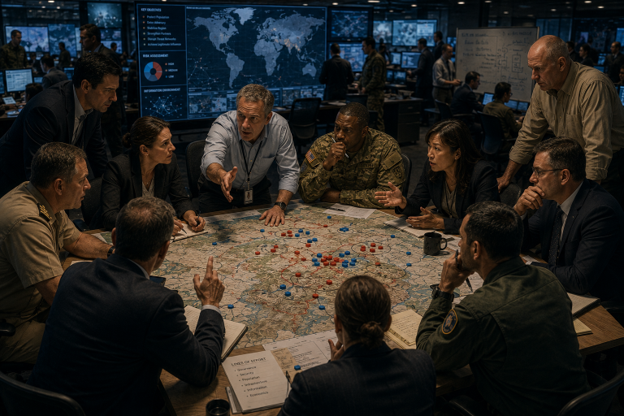
In response to aggressive operations in the gray zone by belligerent states, some authors have proposed ending the debate over doctrinal terms and disparate strategies in favor of immediate, unified action in irregular warfare. While cathartic, these calls to action do not address the recent operational and strategic failures that have resulted when disparate agencies attempted to coordinate major interventions without a shared understanding of goals, objectives, or even the terms used to coordinate authorities and activities. Whole-of-government approaches require, by definition, that multiple (often competing) agencies and organizations, divided by disparate functions and overlapping authorities, organize themselves around clearly understood objectives, ways, and means. This article proposes that a shared understanding of irregular warfare concepts is critical to executing a comprehensive irregular warfare strategy.
Words, whether spoken or written, are icons that represent ideas. Anyone who has traveled abroad knows the friction inherent in simple interactions like giving or receiving directions without a shared language, even when the concepts of right, left, and straight are common. Anyone who has ever worked in an interagency environment knows that communication can be even more difficult when organizations use the same word to describe different concepts, especially when those concepts are associated with different authorities. To coordinate the multiple organizations and agencies required for a whole-of-government approach to irregular warfare, we require a more common language.
A totalitarian state, the People’s Republic of China, owns a comparative advantage in coordinating its irregular warfare efforts beyond its cultural inheritance and literary history. The PRC’s highly centralized leadership can arrest and remove government officials perceived as insufficiently supportive of the party’s strategic objectives. As the United States cannot coerce such whole-of-government unity of effort without constitutional amendments, a shared understanding of strategies, goals, and objectives may address the comparative gap in interagency collaboration.
This article first examines why shared understanding is essential to interagency coordination, drawing on theories of language, knowledge, decision-making, and institutional behavior to examine how disparate organizations identify the meaning of concepts and terms. It then considers how a common conceptual framework would enable agencies to integrate dispersed knowledge, reduce friction created by competing organizational interpretations and jurisdictions, establish functional relationships among actors with different authorities, and communicate feedback across organizational boundaries. Together, these functions demonstrate that a shared language and context for irregular warfare is necessary to translate the specialized knowledge and capabilities of disparate organizations into a coordinated national action.
The Imperative of Shared Understanding in Interagency Coordination
The formulation of a whole-of-society effort is predicated on the assumption that government agencies, political entities, and civil organizations can act as a single, omniscient entity. Thomas Sowell warns against the “Godlike approach” to social policy, since there is no monolithic or executive authority that makes all governance decisions. Rather, authority and governance in a democracy are exercised through an aggregation of disparate decision-making units, each with its own goals and objectives. The U.S. federal government is an overlapping montage of branches and agencies, often in competition with one another for influence and resources. Coordinating activities between these entities requires both a shared vision and language. Organizational research supports this relationship between language and coordination. Beth Bechky found that knowledge-sharing problems between distinct occupational communities resulted in part from differences in language, work context, and conceptualization. At the same time, the creation of common ground allowed these communities to better understand their shared work. Assessments of civil-military coordination in Afghanistan and Liberia identified that, “there is often a strong sense of frustration on both sides with the energy invested in trying to establish good communication and clear understanding of each other’s positions,” noting that communication in whole-of-government efforts is “… even more difficult than other interagency relationships given fundamental differences between international military forces and humanitarian and development agencies in terms of their agendas, operating styles, roles, and the principles and doctrines guiding their work.”
In 1983, Ward H. Goodenough described the critical role that language provides in social organization and conflict management. Combining this literature with Thomas Sowell’s epistemological framework of knowledge transmission and institutional incentives makes clear that the time spent establishing a shared terminology is not a waste of ink. It is the fundamental mechanism required to coordinate scattered fragments of knowledge, manage inherent human conflicts, establish functional jural relationships, and ensure that feedback mechanisms operate effectively during a unified national effort.
Shared terms are critical during interagency coordination. Goodenough emphasized that humans are inherently social animals who rely heavily on symbols and language. Language is a universal human tool that enhances cognitive capacity, facilitates the storage, retrieval, and formulation of information, and enables the imagination of the future and the devising of plans. Language is essential to the development and communication of strategy, intent, and plans. It allows humans to form complex social bonds that enable collaboration—especially among organizations competing within a bureaucracy.
When multiple agencies are brought together for a whole-of-government effort, they bring with them competing priorities, mandates, and values. Social living forces people to make choices and schedule their activities to manage competing priorities. In an interagency context, a shared understanding of terms is the linguistic mechanism by which disparate agencies align their distinct purposes into a recognized set of objectives. Without it, the natural human propensity for divergent purposes leads to systemic friction, precluding a unified effort.
Coordinating Scattered Fragments of Knowledge
One of the most severe constraints facing human institutions is the inadequacy of available knowledge. Knowledge in society does not exist in a single cohesive block. Knowledge is widely scattered in uneven fragments, often too small to be individually usable. The fundamental problem of any complex society—and by extension, a whole-of-government effort or interagency task force—is the communication and coordination of these scattered fragments of knowledge from where the knowledge is held to the decision-making unit authorized to act on it. Organizational research demonstrates that this problem affects more than the transmission of information. Catherine Cramton describes a “mutual knowledge problem” in dispersed collaboration in which participants possess unevenly distributed information, misunderstand the significance of information held by others, or interpret the same information differently. These failures undermine organizational cohesion and learning. A whole-of-government effort requires not only mechanisms for sharing information, but also sufficient shared understanding for agencies to recognize its meaning and significance.
In any national effort, no single agency possesses the totality of knowledge required to address all aspects of a crisis. The military understands the organized application of violence and logistics, health agencies study and apply epidemiology, and local governments strive to understand the needs and interests of their constituents. For these agencies to coordinate effectively, information and ideas must be transformed into knowledge to inform decisions. The challenge is therefore not simply about moving information between organizations, but about providing sufficient context and meaning so that another organization can recognize its relevance and act accordingly. As demonstrated repeatedly during combat operations in Afghanistan, information about an adversary’s activities is useless if it cannot be authenticated and rapidly communicated to a commander with sufficient delegated authority to clear fires. The inability to share information was even more pronounced in Village Stability Operations, where development funds were provided to malign actors, completed civil-military projects frequently destabilized the communities that they were intended to secure, and special operations units designated for rural security advisory missions spent more time training in advanced urban combat than in the language of their partners. A shared understanding of terms—and the ideas they represent—provides the framework necessary to turn information into knowledge. When terminology is standardized across agencies, fragments of specific information can be more rapidly placed into the context of the ideas and concepts driving mission objectives.
Linguistic Misalignment and Territorial Conflict
Term misalignment imposes severe costs on the decision-making process. Sowell observed that when different subcultures or institutional cultures interact, the same words often carry different meanings. If the terminology used in a planning directive is ambiguous, agencies will expend valuable time and resources deciphering the text, shielding themselves from bureaucratic liability, engaging in internal debates, and framing terms in support of their own operational code and organizational objectives. Organizational research suggests that these knowledge boundaries become increasingly difficult to breach as organizations move from differences in terminology to differences in meaning to differences in interests. Paul Carlile distinguishes among syntactic, semantic, and pragmatic knowledge boundaries, requiring the transfer, translation, and transformation of knowledge. A common irregular warfare vocabulary may resolve issues of syntax. Still, effective interagency coordination requires agencies and organizations to reconcile differences in meaning within their institutional contexts and in how the meanings affect their interests and authorities.
Compounding the issues in communication, the structured social environments humans create provide arenas for establishing symbolic “territorial claims,” or the social selves and jurisdictions of groups and individuals. One need look no further than the U.S. Army’s definition of Unconventional Warfare or the Navy’s description of its SEALS for examples of organizational claims to symbolic territory. When terms are ambiguous, they invite what agencies perceive as trespasses on their symbolic or jurisdictional territory. Because human energy is heavily expended on addressing trespass and its socially disruptive consequences, ambiguous terminology in a national response plan can inadvertently trigger antagonistic behavior among agencies. Instead of collaborating, the “warring principalities” will fight over who controls the operation, driven by their differing interpretations of the rules.
Organizational Relationships and Turn-Taking
Effective interagency coordination requires establishing clear rules of engagement. Social mediation is fundamentally grounded in the concept of “taking turns,” which underpins all jural relationships. Turn-taking involves understandings that govern shifts of priority from one entity to another, and when these understandings are formulated in words, they become rules that allocate rights and duties.
In the context of a whole-of-government effort, interagency coordination is essentially a complex system of turn-taking. Different agencies must know when they have priority of access to resources, when they hold the authority to act, and when they must step back and fulfill their duties to support another agency. Because societal and institutional rights are never equally distributed, rules must set priorities among categories. For this framework to function without breeding resentment or ideological conflict, the rules must be explicitly understood by all parties. A shared understanding of terms ensures that the allocation of rights and duties is clearly delineated. When the turns are unambiguously defined, agencies can shift priorities seamlessly, minimize conflict over competing values, and reward cooperation.
While the explicit articulation of terms is crucial, Sowell cautions that we must recognize the inherent limits of articulation itself. Formalized and rigidified decision-making processes cannot exhaustively specify every contingency in advance. Because nothing can be articulated literally and exhaustively, the process of articulation necessarily involves abstraction, in which some characteristics are defined while others are neglected.
If interagency coordination relies strictly on categorical rules—such as defining irregular warfare as asymmetric, indirect, and unattributed—definitions imposed from above without a deeper, shared cultural understanding will fall victim to the law of diminishing returns. Bureaucracies that operate solely on mandated, articulated categorical processes often pursue activities to the point of negative social returns, because they are insulated from the nuanced realities on the ground. Therefore, a “shared understanding” must transcend a mere glossary of terms. It must encompass a shared informal relationship and institutional culture. Bechky’s research suggests that shared meaning emerges through the creation of common ground rather than through vocabulary alone, while Carlile demonstrates that common syntax is not enough when organizations attach different meanings or interests to the knowledge being exchanged. A common irregular warfare lexicon is a necessary starting point for interagency coordination, but not the endpoint. When agencies share an understanding of objectives and goals, they can interpret the spirit of directives, allowing them to adapt to unforeseen variables in a crisis.
Feedback Mechanisms and Systemic Rationality
Weaponizing the whole-of-government requires effective feedback mechanisms. Sowell argues that in a world where no individual or group has sufficient knowledge to be consistently right the first time, feedback mechanisms are vital. These mechanisms must convey both information and the incentives to act upon it. In economic systems, prices transmit this knowledge swiftly and effectively. Political and administrative systems lack universal measurements such as price, allowing distortion in the communication of value and effects. Decision-makers are frequently insulated from the consequences of their actions, either structurally or because those consequences will fall on their replacements in the operational cycle, encouraging choices that prioritize short-term benefits over long-term value.
For interagency coordination to succeed, feedback must flow seamlessly from the tactical operators on the ground to the strategic planners at the top. If the terms used to measure success, failure, costs, and benefits are not uniformly understood, feedback will be rendered useless. Sowell notes that when organizations use different languages or standards, knowledge is distorted in the transmission. If one organization defines an operation as “effective” when a lethal strike results in 15 enemy killed-in-action, while another measures effectiveness by whether it reduced the adversary’s ability to influence an election, the feedback provided to the command may be dangerously contradictory.
An anthropologist, Goodenough, observed that social living inevitably produces frustration and negative emotions. This frustration must be managed for a society—or a task force—to function. If a lack of shared terminology breaks feedback mechanisms, the resulting operational failures will exacerbate the complexities of organizational dependencies, leading to widespread frustration. A shared understanding of terms serves as a conduit for accurate feedback. Shared concepts enable action officers and commanders to make decisions based on measures of effectiveness derived from on-the-ground conditions rather than relying on more readily reported measures of performance, such as the number of lethal strikes completed or tons of aid delivered.
Conclusion
A whole-of-government approach to irregular warfare, featuring the exposure of PRC gray-zone activities, sanctions, hardening assets, and the exploitation of adversary economic and informational vulnerabilities, may counter PRC efforts to create an international order more favorable to the Chinese Communist Party. But organizing U.S. agencies and organizations for unified irregular warfare requires shared language and concepts to enable coordination among them. The results of recent conflicts demonstrate the costs of failing to establish a common language and objectives prior to commencing operations. While painful to achieve, common terminology allows for the authentication and transmission of scattered knowledge, minimizes the costs of miscommunication, and facilitates feedback mechanisms that correct inevitable errors. Shared terminology is therefore the first step to transform the chaotic assembly of “warring principalities” of a functioning democracy into a cohesive whole-of-government effort. Common language provides the foundation upon which agencies and organizations can develop shared meaning, translate specialized information across organizational boundaries, and negotiate how that information becomes knowledge. Recent decades of conflict have demonstrated that it’s worth taking the time to get these concepts right.
The views expressed are his own, and do not represent the U.S. government, Department of War, or the Naval Postgraduate School.


