





No Sea for the Fish: Religion, Violence, and the Failure of the Tibetan Resistance

Abstract
The Tibetan resistance of the late 1950s possessed many of the ingredients associated with successful insurgency: difficult terrain, motivated fighters, popular grievance, religious identity, and covert external support. Yet it failed to produce lasting military or political success. This article argues that the central weakness of the Tibetan resistance was not simply material inferiority to the People’s Liberation Army, but a deeper failure to reconcile Buddhist legitimacy, political authority, and organized violence. Tibetan Buddhism gave the movement its moral force, but it also constrained the Dalai Lama’s ability to endorse sustained armed struggle. The result was a resistance with courage and cause, but without a unified mandate, command structure, or operational approach. For modern military planners, the Tibetan case shows that external support to insurgent movements must account not only for terrain, weapons, and will, but also for whether the movement’s sources of legitimacy can sustain the violence required for irregular war.
Introduction
In July 1957, Gompo Tashi Andrugtsang presented the Dalai Lama with a jewel-encrusted golden throne at a ceremony in Lhasa. The throne was the joint contribution of merchants, lamas, and ordinary Tibetans across the country. It was also a cover. While the fundraising was ostensibly a religious tribute, Gompo Tashi had used the campaign to travel around Tibet, secretly recruiting resistance leaders. Dozens of tribal chiefs had already gathered in his house under the cover of darkness to swear oaths before an image of the Dalai Lama and pledge their lives to fighting the Chinese. When the Dalai Lama accepted the throne, he blessed the men who had organized to take up arms—yet he could not endorse what they were planning. That moment of simultaneous blessing and distance defines the central problem of the Tibetan resistance.
The Tibetan resistance movement of the late 1950s had many ingredients normally associated with guerrilla warfare: mountainous terrain, motivated fighters, a population bound together by deep religious and cultural identity, and covert support from the Central Intelligence Agency (CIA). Yet the resistance failed to produce lasting military or political success. The common explanation is material imbalance. The People’s Liberation Army (PLA) possessed overwhelming manpower, artillery, aircraft, roads, and logistics. Those factors were significant, but material weakness alone does not fully explain the failure. Other insurgencies have survived, and sometimes succeeded, against similar or worse odds.
A deeper problem underlies the Tibetan case. The resistance could not reconcile spiritual legitimacy, armed violence, and political leadership into a unified movement. Tibetan Buddhism gave the struggle its moral force. But that same religious foundation made organized violence spiritually contested, and it rendered the movement’s most important leader—the Dalai Lama—incapable of providing a clear mandate for sustained armed struggle. The result was a movement with courage, terrain, and cause, but no shared religious-political framework needed to sustain an insurgency. For contemporary planners, the case is a cautionary tale: external support cannot compensate for a resistance movement whose sources of legitimacy cannot authorize the kind of violence the campaign requires.
A War Born in the East
The roots of the armed resistance lay in the Chinese consolidation of control after 1950. In October of that year, the PLA defeated the small Tibetan army at Chamdo. The Tibetan government then signed the 1951 Seventeen Point Agreement under coercive conditions. On paper, the agreement promised autonomy and protection for Tibet’s traditional Buddhist political system. In practice, it gave the People’s Republic of China (PRC) time to build roads, move troops, and prepare for full conquest.
By the late 1950s, the PRC had deployed an estimated 150,000 PLA troops into Tibet. A 1955 CIA assessment compared Tibet’s landmass to Texas, New Mexico, and Oklahoma combined, with a population of only about 1.3 million. One CIA officer later concluded that the sparse population and barren plains of Tibet provided no fish for guerrillas to swim with.
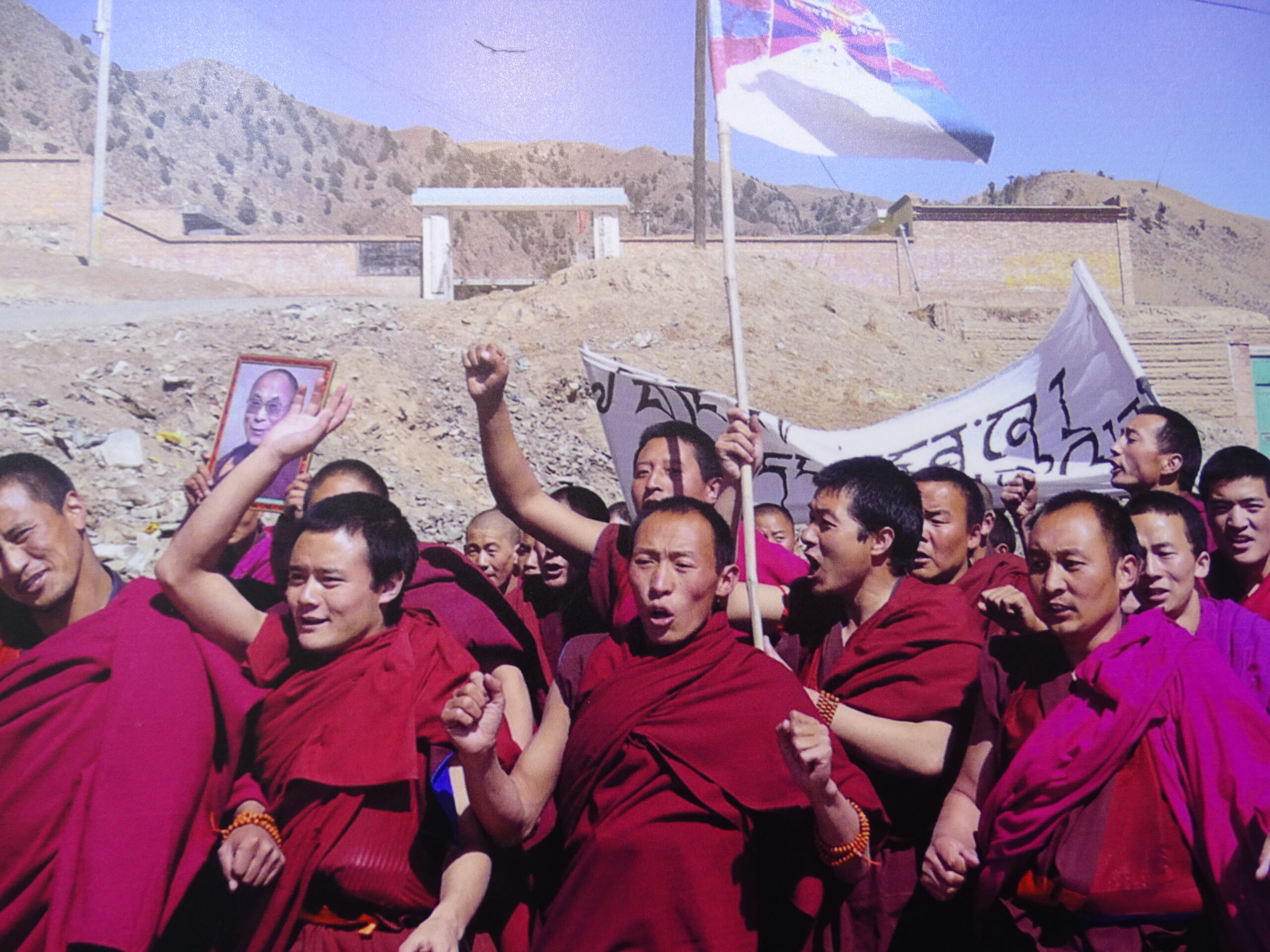
The first major armed resistance emerged in the eastern regions of Kham and Amdo, where Chinese authorities began imposing communist “democratic reforms” in 1956. These reforms included land redistribution, collectivization, and direct attacks on the economic and social power of monasteries. For many Khampas, this was not abstract political reform. It was an assault on religion, local autonomy, and a way of life. CIA intelligence estimated that as many as 50,000 active Khampa guerrillas were eventually involved in these early uprisings.
Khampa resistance was intense but localized. Communities defended their monasteries, their land, and their lamas. The Chushi Gangdruk—”Four Rivers, Six Ranges,” a traditional name for Kham—eventually emerged as the primary organized resistance force, formally proclaimed in June 1958. But even this organization was born of regional loyalty and religious defense, not deliberate national planning. As the PLA responded with artillery and airpower, thousands of fighters and refugees moved westward toward central Tibet, carrying the limitations of a localized uprising into what would become a national struggle. That distinction would prove fatal.
Buddhism as Mobilizing Force and Constraint
Tibetan Buddhism was the strongest source of legitimacy available to the resistance. It was not simply a private faith. It was the organizing framework of Tibetan society. Monasteries were religious centers, schools, landholders, political actors, economic hubs, and symbols of Tibetan civilization. When Chinese reforms targeted monasteries, Tibetans interpreted those attacks as an assault on the social order itself. For many fighters, to defend Tibet was to defend the Dharma—the Buddhist teachings and cosmic order that gave Tibetan civilization its meaning.
Tibetan Buddhism does not impose a simple prohibition on all violence. Tibetan history contains examples of religiously sanctioned force. The ninth-century assassination of the anti-Buddhist King Langdarma by a Buddhist monk provided one historical precedent for violence, framed as defense of the faith. Khampa martial culture allowed fighters to view killing enemies as an act of devotion when the Dharma was under threat. During the 1956 siege of Lithang monastery, the monk Yuri Ponpo reportedly shot and killed a PLA general, before being killed himself. The Chushi Gangdruk named itself the Defenders of the Faith—its very identity was religious before it was political.
Buddhism did not prevent Tibetans from fighting. It did, however, deny the resistance a single, widely accepted framework for turning violence into a liberation strategy. Several Buddhist concepts created persistent tension. Karma imposed consequences for intentional acts, including killing. Compassion (mahakaruna) required concern for all sentient beings, including enemies. Before returning to Tibet, some fighters sought blessed amulets (sungkhor) from high lamas — believed to protect against PLA bullets, but also against the karmic consequences of killing. That detail is crucial: the fighters needed spiritual protection not only from enemy fire, but from the moral weight of what they were about to do.
CIA trainers observed this tension directly during training on the island of Saipan. In one episode, a former monk pushed an instructor away from an anthill because he did not want him to disturb another living entity. In another, a demolition exercise killed fish in a nearby lagoon. The Tibetan trainees collected the dead fish, chanted prayers, and gave them a ritual burial. These men were not cowards. They were willing to fight and die for Tibet. They were fighters operating inside a moral world that treated killing as spiritually dangerous, even when politically necessary.
The Dalai Lama’s Impossible Position
The religious divide had a direct political and operational consequence: it placed Tibet’s most essential leader in an impossible command position.
The Dalai Lama was Tibet’s highest spiritual authority and its central political symbol. His legitimacy was essential to the resistance—without him, there was no unified Tibetan cause. Yet, he consistently stopped short of endorsing sustained armed struggle. In his autobiography “Freedom in Exile,” he acknowledged the fighters’ courage directly: “I admired their courage, but I could not agree with them… violence is contrary to the Buddhadharma.” As Gyalo Thondup—the Dalai Lama’s brother and the CIA’s primary Tibetan liaison—later explained, the Dalai Lama was not directly involved in CIA operations because he could not condone any use of violence when his entire life was committed to nonviolent Buddhist practice.
This was not simply personal reluctance. It was structural. A monk bound by the Dalai Lama’s vows could not sanction killing without damaging the very spiritual authority the resistance needed. And his authority was the only thing that gave the resistance movement its claim to represent the entirety of Tibet rather than simply Kham. A CIA history later described Gyalo Thondup as a kind of spiritual buffer for the Dalai Lama—the man who managed the operational relationship with the CIA precisely because the Dalai Lama could not do so himself without compromising the religious legitimacy upon which the movement depended.
The operational consequences were direct. When the CIA first sought to formalize its support for the Tibetan resistance, it insisted on an official request from the Lhasa government. The Lhasa government did not act. The CIA eventually provided covert support without Lhasa’s formal endorsement—but the absence of that mandate meant the resistance operated without clear political authority. Even after the Chushi Gangdruk was formally proclaimed, the Dalai Lama’s public posture remained deliberately ambiguous. He issued announcements urging the fighters to lay down their arms—messages so transparently written for Chinese consumption that the fighters could see behind the words. They knew His Holiness might not approve of their actions, but they took comfort in knowing he was not against them. That comfort was real, but it was not a mandate. A resistance movement cannot be built on the inference that its spiritual leader secretly approves.
Regional Fracture and the Lhasa Problem
The religious divide compounded a political and regional one. The central government in Lhasa was factionalized and often paralyzed. Aristocratic families viewed the Khampas with—as one account described—a mixture of fear and disdain, even though Khampa fighters formed the backbone of the armed resistance. The Khampas were essential to the war but never fully trusted by the political elite.
This top-down paralysis had operational consequences. In October 1950, as the PLA invasion force bore down on the critical garrison at Chamdo, the ruling Kashag was on a five-day picnic and could not be disturbed, even as their field commander sent frantic radio messages pleading for instructions. That moment does not explain the entire failure of the Tibetan state, but it illustrates the gap between religious-political authority and military command that would persist throughout the resistance.
The CIA ran into the same structural problem. American organizers tried to build guerrilla units along neutral military lines. Tibetan fighters preferred native-place networks, regional loyalties, and monastery-based ties. What looked inefficient to CIA trainers reflected the actual social structure of the resistance—but that social structure was incompatible with centralized insurgent organization. The result was a resistance that achieved localized tactical success but could not produce unified command.
Chinese Strategy Against the Center of Gravity
While the resistance was struggling to reconcile religion and violence, the PLA executed a campaign that attacked the religious infrastructure sustaining Tibetan identity. Chinese strategy combined overwhelming force, political warfare, road construction, and the targeted destruction of monasteries. Mao Zedong made explicit his ideological framework when he told the Dalai Lama directly during a 1955 meeting that religion is poison.
The 1951 Seventeen Point Agreement helped construct Beijing’s political narrative—China could present its occupation as liberation rather than conquest. Operationally, the construction of the Sichuan-Tibet and Qinghai-Tibet highways transformed the battlefield, reducing the protection once provided by distance and altitude. With these new maneuver corridors, the PLA could target the monasteries that controlled large portions of the population and were deeply involved in trade, farms, and herds. Destroying or co-opting these monasteries dismantled the social infrastructure of resistance.
Beijing also exploited divisions within Tibetan Buddhism to fragment the symbolic field. In 1956, China unveiled the Preparatory Committee for the Autonomous Region of Tibet (PCART)—an organization designed in appearance to expand Tibetan self-governance. In reality, PCART was conceived—as Dunham writes—as “a giant wedge to be driven into, and fatally crack, Tibet’s governing system.” Mao assigned the Panchen Lama a commanding position within PCART as a deliberate counterweight to the Dalai Lama’s authority, manufacturing a competing source of religious-political legitimacy. This did not win Tibetan loyalty, but it further fragmented the symbolic field on which the resistance depended.
The PLA understood something the resistance could not overcome: Tibetan religion was the center of gravity. The resistance drew its legitimacy from Buddhism. The Chinese state sought to control, divide, or destroy it. The resistance had no equivalent counter-strategy.
No Shared Theory of Victory
Successful insurgencies connect violence to political organization. They build political, military, and administrative systems in parallel. Maoist revolutionaries and the Viet Minh had ideologies that justified violence, command structures that disciplined fighters, and lines of effort that connected local action to strategic goals. The Tibetan resistance lacked that integration from the beginning.
Tibetan fighters knew why they were resisting: to defend their country, their Dharma, their monasteries, and their way of life. But they did not possess a shared framework for how that resistance should be organized, sustained, or translated into political effect. Fundamental questions went unresolved: should the struggle be violent, nonviolent, or some combination? Was the enemy communism as an ideology, or the Chinese occupation as a political reality? According to interviews with veterans, many fighters did not view themselves as part of a broader Cold War struggle against communism at all. They saw themselves as Tibetans fighting Chinese rule. That framing was authentic and powerful, but it produced no coherent political program—no answer to the question of what victory would look like or how to achieve it.
CIA assistance could not solve this. The agency could provide training, weapons, radios, and limited material support. It could not create Tibetan political unity, resolve the tension between Khampa fighters and Lhasa elites, or make the Dalai Lama endorse sustained armed struggle. The formal end of the organized resistance came in 1974, not through decisive military defeat, but when the Dalai Lama broadcast a message calling for the surrender of the remaining Chushi Gangdruk fighters in Mustang, Nepal, acting—finally and completely—in accordance with his commitment to nonviolence.
Conclusion: What Tibet Teaches Insurgency Studies
The failure of the Tibetan resistance illustrates a problem that material analysis alone cannot capture. The resistance had fighters willing to endure isolation, hardship, and death. It had terrain suited for guerrilla warfare and a cause powerful enough to inspire sacrifice. What it lacked was unified command, political organization, and a shared framework for converting violence into sustained political effect.
For military planners, policymakers, and practitioners working in joint, interagency, and coalition environments, the Tibetan case carries a specific lesson. Standard frameworks like PMESII-PT help planners assess political, military, economic, social, informational, infrastructure, physical, and time variables—but they often fail to capture the internal coherence of a movement’s legitimacy. The Tibet case suggests that before committing external support to an insurgency, planners must map the human terrain of legitimacy: who holds the authority that gives the movement its moral permission to fight? Can that authority provide a sustained mandate for violence? And if it cannot, what does that mean for the movement’s ability to organize, discipline, and sustain itself under pressure?
The CIA could arm and train Tibetan fighters; it could not resolve the contradiction between a resistance that needed religious legitimacy and a religious leader whose authority depended on non-endorsement of violence. That contradiction was not a failure of courage or commitment. It was a structural failure of integration—one that no amount of external assistance could repair.
Mao Zedong argued that guerrillas must move among the people as fish swim in the sea. In Tibet, the resistance found people willing to fight. It never found the political, social, and spiritual sea required to sustain an insurgency.


