





How Great Power Rivalry Is Reshaping UN Peacekeeping

Abstract: The funding shortfalls of the United Nations’ (UN) peace operations are the visible edge of a deeper shift. Great powers now treat peace operations as a stage for their own rivalries with each other. Washington holds back to push for more limited missions while China steps in to take on a bigger role in the gaps left behind. Meanwhile, decisions about peacekeeping mandates get caught up in Security Council deadlocks. The troop-contributing countries like Bangladesh absorb the operational and human costs of these decisions without any say in how they are made.
A Daunting Warning
The United Nations Peace Keeping Operations (UNPKO) have been pivotal in maintaining peace across the world in the last seven decades. However, Jean-Pierre Lacroix’s comments in New Delhi in October 2025 signaled the unravelling of this system, describing the situation as more challenging than ever and asserting that tough cuts are unavoidable. By mid-2026s, the numbers confirmed his warnings: peacekeeping personnel had dropped to its lowest level in 25 years, nearly halving since 2016. His remarks highlight the significance of great power rivalry and its dire implications on global peace operations. Despite this, the troops contributing countries to peacekeeping operations have no say to it at all.
The Consensus that No Longer Holds
The peacekeeping model now under strain was built on the post-cold war assumption that major powers would support a global initiative to establish peace in conflict-ridden areas. The early 1990s Agenda for Peace and the 2000 Brahimi Report reimagined peacekeeping as proactive and multidimensional: protecting civilians, supporting elections, and rebuilding institutions, not merely observing ceasefires. The effort was only possible due to the consensus of the security council’s permanent members – known as the “P5” – who treated peacekeeping as a shared utility worthy of UN funding. South Asian and African countries contributed large numbers of troops on peacekeeping missions all over the world. As that consensus continues to lose relevance, the missions it supports are being closed or cut.
The Underlying Fault Lines
Today, the United States, China, and Russia pull the UNPKO in different directions without formal approval from the United Nations Security Council (UNSC). Great power rivalry degrades UN peacekeeping through four distinct dynamics:
- Ideological Divides Among the P5. Deep ideological and strategic divides among the P5 restrict the UN’s ability to support new or older missions. This disagreement often originates from conflicting interests on economic and political issues. For example, Russia’s military operation in Ukraine and trade war with China has created rifts within the P5. Veto politics stall resolutions and weaken mandates in active war zones, meaning severe conflicts receive inadequate or delayed responses. In Lebanon, US pressure at the Security Council forced the UN mission in Lebanon (UNIFIL) toward its final mandate term. The lack of a common understanding over economic and political support for peacekeeping missions degrades the purpose of these missions.
- Budgetary Constraints. The US has taken an ‘a la carte’ approach to supporting UN operations under the new Trump administration. This approach underprioritizes funding for international organizations that do not immediately align with US foreign policy. In August 2025, President Donald Trump cancelled roughly $800 million in peacekeeping funds, seriously affecting peacekeeping missions in Africa. Moreover, countries like China and Russia often delay payments, citing procedural and sanctions issues as an excuse. The loss of these major financial contributions prompted the UN to announce a sweeping cut of 25% of all uniformed and civilian personnel across nine of the 11 active missions. The financial interests of major powers over the peacekeeping effort degrades the UN’s ability to fund any new or ongoing missions.
- Non-Cooperation of Host Countries. A fundamental principle of UN peacekeeping is that missions deploy only with the consent of the main parties to a conflict, including the host-state. Regardless of this, host countries tend to view the UNPKO through a geopolitical lens. For example, the substantial influence of Russia in Mali supported by deployments of the Wagner Group and Russian instructors prompted the government of Mali to rebuke its consent for the United Nations Multidimensional Integrated Stabilization Mission in Mali (aka MINSUMA), ultimately terminating the entire mission. Russia also extends similar support to the Central African Republic which hosts the 12000 strong United Nations Multidimensional Integrated Stabilization Mission in the Central African Republic (aka MINUSCA). Similarly, as a major contributor of peacekeepers to South Sudan, China frequently advocates for “South Sudanese-led solutions,” and utilizes its diplomatic leverage to block coercive measures against the Juba government. Critics note that such initiatives tend to bypass UN authority and only protect the interests of a major power with the host nation.
- Asymmetric Threats in Peacekeeping Missions. As the major powers vie for control over mineral resources, economic infrastructures, and geopolitical dominance in the African states, many conflict-ridden countries fall within the sphere of influence. This has resulted in rise of asymmetric threats from armed groups, drones, Improvised Explosive Devices, and disinformation campaigns against the peacekeepers. Great power competition has shifted the political focus of such missions to counterterrorism and militarization. When peacekeepers are involved in more kinetic operations, they are sometimes perceived by local populations as taking sides, severely damaging mission legitimacy and increasing casualty risks.
The Burden Falls on the Troop-Contributors (Bangladesh Especially)
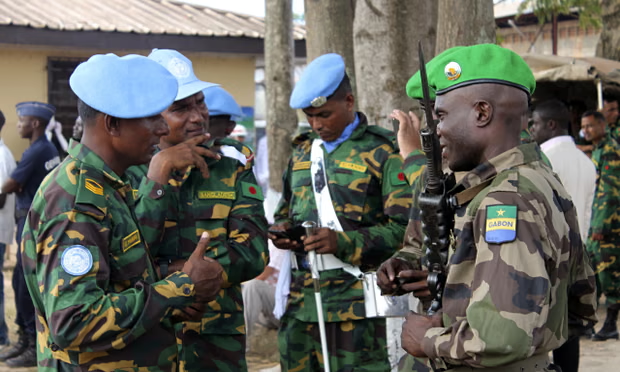
Whereas wealthier states provide the majority of funds for peacekeeping missions, most of the peacekeepers who bear the operational risks come from developing states. Squeezing UNPKO funding may reduce the number of troops deployed, affecting the economy, military development, and diplomatic posture of troop contributing countries (TCC). Bangladesh illustrates the pattern most clearly; it has ranked among the world’s top three troop-contributing countries since 2020, currently fielding 4084 peacekeepers across ten missions. As of May 2026, they have lost 175 peacekeepers in peacekeeping service with hundreds more wounded. Drawdowns in various peacekeeping missions have already resulted in the return of 1300 troops to Bangladesh. These missions generate value for the TCC in the form of reimbursements. Lack of resources in conflict zones also expose the peacekeepers to greater risk, putting the success of the mission at risk.
The Political Economy Behind It
The core problem is not about the politics but the power structure. A small group of wealthy countries and the P5 control funding and make all the key decisions. Meanwhile, most of the TCC are not part of the system. The countries that set the rules and pay the bills are not the same ones risking their people on the ground. This imbalance was manageable when major powers truly supported peacekeeping operations, but as some use the system to push their own agendas it becomes a big problem. The countries facing the real dangers have little ability to protect their interests.
What Continued Erosion Would Mean
This situation is not likely to change on its own. Unless major powers change their posture or the UNSC breaks the deadlock, peacekeeping will continue to shrink by default – not by choice. Meanwhile, the TCCs will keep facing the consequences without any say in decision making. Bangladesh’s four decades of experience in peacekeeping and reputation provide valuable national strength. But now, these strengths are being used in missions shaped by other powers with goals that do not align with the true purpose of peacekeeping. The big question for Dhaka and its neighbors will not be whether peacekeeping is still important—it clearly is—but whether staying deeply involved in a system dominated by rivalries they cannot influence still benefits the goals they care about.


