The Blue Helmet’s New Battlefield: Drones, Proxies, and Weak Intelligence

Abstract
In December 2025, six Bangladeshi United Nations (UN) peacekeepers were killed in a drone strike on a UN facility in Kadugli, Sudan, amid the country’s ongoing civil war. The attack was not an isolated battlefield tragedy. It exposed how the spread of inexpensive drones, proxy forces, inadequate intelligence sharing, and declining mission resources has rendered traditional UN peacekeeping force-protection assumptions increasingly obsolete. Drawing on interviews with peacekeeping-intelligence officers, this article argues that Bangladesh and other major troop-contributing countries must press for stronger early-warning systems, counter-unmanned aerial vehicle (UAV) capabilities, revised training and rules of engagement, and greater influence over how peacekeeping missions assess and respond to emerging threats.
Introduction: What Happened
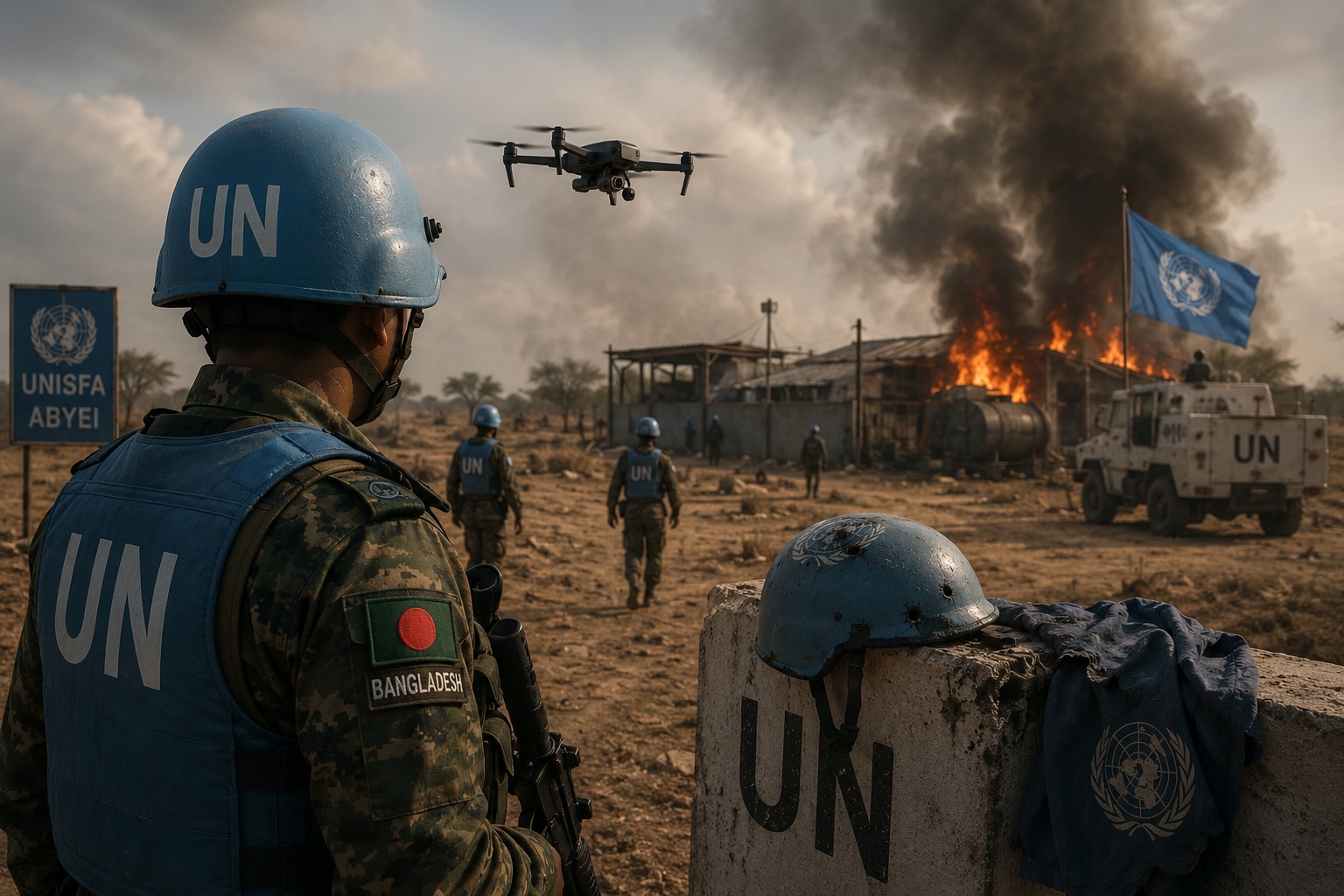
On December 15, 2025, six Bangladeshi peacekeepers were laid to rest in a ceremony at the headquarters of the UN Interim Security Force for Abiyei (UNISFA). The peacekeepers were slain in a drone strike at the mission’s logistics base two days prior. The strike, lasting only about ten minutes in the afternoon, hit a fuel depot inside the camp and killed six Bangladeshi peacekeepers while wounding eight others. All the victims were serving with the UN Interim Security Force for Abyei (UNISFA), a mission monitoring the tense border between Sudan and South Sudan. The Sudanese army blamed the Rapid Support forces (RSF), the main rebel side in Sudan’s currently raging civil war, which used relatively unsophisticated one-way attack UAV strikes elsewhere during the conflict. The conflict has seen both sides acquire increasingly sophisticated equipment, including the Chinese-made FK-2000 air defense system by the RSF.
It was a warning that the traditional assumptions underlying UN peacekeeper protection have become dangerously outdated. Peacekeepers designed to monitor ceasefires and separate armed groups are now operating in conflicts shaped by cheap attack drones, proxy forces, long-range strikes, and rapidly shifting front lines, often without the intelligence, equipment, or authority required to defend themselves. For Bangladesh (one of the world’s leading troop-contributing nations and other troop-contributing countries (TCCs), adapting to this environment will require more than additional training or isolated equipment purchases. Peacekeeping nations must press for institutional reforms in peacekeeping intelligence, counter-drone defenses, mission doctrine, and rules of engagement, while working with other troop contributors to demand that future deployments receive adequate surveillance, logistics, and force-protection resources.
Bangladesh has long been one of the world’s top contributors of peacekeepers to UN peacekeeping missions. For Dhaka and other countries that similarly contribute large contingents of soldiers and police, the benefits of peacekeeping usually outweigh the risks. Those benefits include financial compensation, equipment reimbursements, prestige, as well as the opportunity for military training or operational and organizational experience that would normally come from a country’s own defense budget.
However, the risks to peacekeepers themselves are growing. Few incidents illustrate this trend more than the most recent slaying of a peacekeeper in Lebanon on June 4, 2026. The Trump administration has made a sharp reduction in funding contributions to UN peacekeeping operations, directly leading to the downsizing and under-resourcing of missions across the Middle East and Africa. An estimated 1,400 Bangladeshi peacekeepers are expected to return home prematurely by mid-2026 as a result of these cuts. Under-resourcing is not just a matter of raw numbers of blue-helmeted troops. It also bites into support capabilities, logistics, and morale. Yet the demand for peacekeeping missions isn’t diminishing. On the contrary, the proliferation of territorial conflicts from Thailand to the eastern Democratic Republic of the Congo (D.R.C.) and everywhere in between actually portends a greater need for peacekeeping and ceasefire monitoring in the future.
Bangladesh’s Foreign Minister and newly elected President of the UN General Assembly, in his previous capacity as National Security Advisor, reportedly expressed interest in joining as peacekeepers for a future Gaza stabilization force. This was likely motivated by the very mundane monetary benefits for its soldiers, just as much as the diplomatic capital such a move would earn with Washington. In the near future, this portends the increasingly transactional nature of peacekeeping. However, there should be some caution in committing to a new stabilization mission after the December 2025 strikes in Sudan.
While Bangladesh has had growing pains in earlier, particularly challenging missions such as Rwanda, the country has since built decades of credibility as a disciplined and reliable troop-contributing country. However, Dhaka may now find itself on the hook to assure a greater level of security for its peacekeepers than previously necessary. There is, as of now, no single country or player willing to step in to substitute the United States’ previous role. Instead, troop-contributing countries may need to adapt with the tools they have available, and collectively agitate for more resources for peacekeeping operations (PKOs), within or outside the UN structure.
A New, Dangerous Era
The bombing of Bangladeshi peacekeepers in Sudan is shocking, but not unprecedented. Since the beginning in 1989, the recent casualty has brought the total number of Bangladeshi soldiers slain in PKO missions to 174. This recent incident is the second-deadliest battlefield loss; the deadliest single battlefield incident involving Bangladeshi UN peacekeepers occurred on February 25, 2005, when nine soldiers were ambushed and killed by militants in the Ituri district of the Democratic Republic of Congo during the MONUC stabilization mission.
As one of the largest troop contributors, Bangladeshi peacekeepers serve as prominent canaries in increasingly dangerous coal mines. Starting with the attack on an ASEAN observer mission in Myanmar in 2023 and ending with this most recent attack on the UN mission, United Nations Interim Security Force for Abyei (UNISFA), the past two years have seen a steady normalization of violence against any and all organizations normally tasked with peacekeeping, ceasefire monitoring, or other aspects of peacebuilding.
This situation is largely due to global factors outside of any peacekeeping mission’s control. Localized wars are increasingly deadly as cheap, innovative military technology (e.g., in the most recent case, a drone attack) diffuses outward into ever-more hands. Territorial conflicts in particular are widening in scope as opportunistic states seek to change the status quo on the ground as fast as possible in the absence of concerted international pressure. In many cases, a common factor is the use of non-state actors or militia groups that have plausibly deniable links to actual countries. This can be seen, for instance, in the M23 militant group’s seizure of Goma in the DRC, which directly led to the deaths of 17 UN peacekeepers.
The use of ‘proxies’ in this manner makes for a more permissive environment for attacks on peacekeepers, as states can argue these groups are outside their military’s control while backing their operations with funds and weaponry. The Rapid Support Forces (RSF) has known links to the United Arab Emirates, and enjoys a certain degree of diplomatic cover as a result. The proliferation of combat drones allows any military to strike from far outside the intelligence, surveillance, and reconnaissance (ISR) range of a target, and peacekeepers, across the board, are not equipped nor meant to be equipped with counter-UAV defenses.
Training curricula at peacekeeping training centers (including Bangladesh’s own Institute of Peace Support Operations Training) should be revised to incorporate lessons on operating in high-tech conflict environments. Bangladeshi instructors can incorporate case studies like the Sudan attack to educate future peacekeepers on situational awareness and bunker drills under air attack, including by high-end attack drones and loitering munitions.
Similar to how peacekeeping operations experienced profound growth and challenges during a distinct period in the 1990s, the start of 2025 may need to be contextualized as an epoch in which peacekeeping began to come under a prolonged period of special stress.
What To Do
In this most recent case, it is worth noting that the PKO logistics base for the Abiyei mission is not actually in the Abiyei area itself, but rather is in Sudan’s South Kordofan State. The peacekeepers that were struck appear to have been caught up in a much wider offensive that the Rapid Support Forces have launched across South Kordofan since capturing and massacring the key town of El-Fasher in Darfur. One-way UAV strikes have been reported elsewhere in the area, including the towns of Kalogi and Dilling.
The UN Security Council was aware of increased RSF attacks and presence in the northern sector of the peacekeeping mission in Abiyei as recently as October. More alarmingly, UNISFA had repeatedly come into tension with the RSF over the latter’s creation of illegal checkpoints on key logistics routes that run through Abiyei into South Kordofan, and regularly had to confront the RSF to tear them down. At the beginning of 2025, the RSF had confiscated UNISFA-contracted fuel trucks and begun harassing ground convoys moving between the PKO logistics base in Kadugli and UNISFA Headquarters. In hindsight, this may have been an omen of the strike in December, as the RSF perceived UNISFA as an obstacle to its upcoming offensive.
The RSF may also have believed that UNISFA was aligned with the rival Sudanese Armed Forces. In May, the RSF demanded that Sudanese monitors leave the area covered by UNISFA’s mandate and later abducted SAF-appointed members of the local government that same month.
There is a lingering question about whether these incidents were appropriately understood by all sides to be indicators of a future crisis. The Security Council briefly discussed RSF agitation in Abiyei at their meeting in November, but it was not the focus of their discussion. UNISFA attempted to carry on logistics via air route from Kadugli to Abiyei even after the RSF seized El-Fasher and turned their attention to South Kordofan.
How could the December strike have been prevented? One area to consider is in the realm of peacekeeping-intelligence (PKI). Intelligence is an extremely thorny subject for the UN, but the Kadugli incident was a clear example where successful strategic-level analysis of the direction of Sudan’s civil war would have yielded indicators that the RSF was priming to attack peacekeepers in the region indiscriminately.
Each UN peacekeeping mission, including UNISFA, has a Joint Mission Analysis Centre (JMAC) that is the bedrock all-source analysis cell for a peacekeeping mission, comprising law enforcement, military, and civilian personnel contributing to tactical, operational, and strategic-level intelligence assessments. However, these centers do not always have the mandate or resources to effectively assess their security environment. UNISFA’s JMAC was still seeking analysts to fill critical gaps this year. More importantly, there are limitations on the kinds of mission-oriented intelligence that JMACs perform.
In our interviews with peacekeeping-intelligence officers, we discovered three main issues that undermined the ability of UNISFA to warn its peacekeepers of growing danger. First, peacekeeping contingents can only receive official intelligence bulletins from the JMAC – and these assessments can be slow or not forthcoming at all. Open-source intelligence (OSINT) or even observations by peacekeepers themselves are rarely used as the basis for decisions to be made on the threat environment around a contingent. Rather, often, contingent commanders and deputy contingent commanders will require an official intelligence bulletin from a JMAC before considering anything like a withdrawal or a reordering of a mission.
Second, OSINT can also be used to slow-roll changes in a deployment, which is related to a separate issue officers identified. Often, for political reasons, contingent commanders are extremely reluctant to pull a contingent out of an area, even when there is ample warning of an imminent threat. The financial incentives peacekeepers bring to their home militaries and governments are a strong motivator to ignore deteriorating threat environments, especially because where peacekeepers withdraw, they are usually not replaced when a mission is up for renewal. In the case of the Abiyei strike, contingent leadership was made aware of a number of alarming RSF activities, all of which showed up later in UN Security Council reports, but refused to consider withdrawing from Kadugli.
The final issue concerns the limitations that intelligence-gathering peacekeepers have themselves. No human intelligence gathering is permitted by contingents, due to the controversy it would cause among UN member states. However, this extends to willing volunteers around a contingent. Even if a member of the local community wanted to share information with a contingent, it would not be accepted and would not be subsumed into a JMAC assessment. Beyond human intelligence, the absolute most crucial tools for peacekeepers in central Africa, as explained to the authors, were intelligence, surveillance, and reconnaissance (ISR) flights. These are the premier source of information that peacekeeping-intelligence officers can use without controversy, and there is a strong preference for unmanned flights with drones due to their ability to scope a surrounding area and identify two key things: possible conflict zones and ceasefire violations. However, the U.S. withdrawal from UN peacekeeping is having an adverse effect on these flights. Because all peacekeeping equipment is loaned – nothing from a home country can be brought into a mission by a peacekeeping officer – the withdrawal of the U.S. has led to rationing of ISR drone flights across all contingents. Whereas before a peacekeeping-intelligence officer based in Africa may be able to do one unmanned ISR flight a week, they are now forced to do one every three months – or every six months, as one person familiar with peacekeeping-intelligence informed us. The alternative to unmanned ISR flights is manned ones, usually with helicopters, which are both risky and too noisy to covertly surveil an area for possible ceasefire violations and checkpoints.
The last major update to peacekeeping-intelligence was published in 2019, after much debate among UN member states. Early warning is a key principle of that policy framework, yet early warning clearly failed UNISFA in this scenario. For countries like Bangladesh, it may be worth revisiting the topic and seeing whether the current structure and capabilities are suitable for a world where dangers to peacekeepers are only growing. In collaboration with locally recruited staff familiar with the language and terrain, Bangladesh could consider equipping peacekeepers with greater intelligence analysis training pre-deployment, ensuring that officers and non-commissioned officers headed to missions are trained in basic analysis, open-source intelligence gathering, and identifying early indicators of danger, or work with other troop contributors to demand peacekeepers receive better sensitization and training at the point of their contact with a JMAC.
A simpler solution could be more PKI courses with more robust funding. If enough troop-contributing countries demand it, this would probably be the preferred method for the ‘big hitters’ and Permanent Five (P5) members in the UN.
The doctrines guiding UN peacekeepers have traditionally focused on principles such as neutrality, the use of force in self-defense, and the consent of the parties. These principles remain valid, but doctrine must evolve to address emerging scenarios in which peacekeepers are targeted by sophisticated asymmetric attacks. Bangladesh can advocate within the UN for updated guidelines or rules of engagement that explicitly cover threats such as drones, improvised explosive devices (IEDs), and cyber or electronic warfare. For example, missions may need clearer authority to actively neutralize an imminent drone threat within their airspace. Under the status quo, many contingents may hesitate, uncertain whether shooting down a drone would violate the mandate; this requires clarification.
It is neither feasible nor desirable for UN peacekeepers to transform into heavily armed warfighters, but they must be equipped to defend against emergent, sophisticated, and fatal threats. After the Sudan incident, given the low price of UAVs, it is evident that counter-UAV systems should become part of the standard peacekeeping toolkit in most missions. Bangladesh can take the lead by working with the UN Department of Peace Operations to field practical counter-drone measures. These could include radio-frequency jammers to disrupt drone control links, radar or acoustic sensors to provide early warning of incoming UAVs, and trained response teams equipped to neutralize small drones when necessary, including through precision small-arms fire or directed-energy systems. Some of this technology is commercially available and has been used to protect diplomatic compounds and airports. There is no reason UN PKOs should remain defenseless against a buzzing drone carrying a bomb. Additionally, improving surveillance (ISR) coverage around bases and along patrol routes is vital. Missions should expand their use of reconnaissance drones (unarmed) to monitor approaches to their positions. A few UN missions have started doing this. For instance, the UN mission in the DR Congo employed unarmed UAVs for patrol overwatch. Bangladesh could request some commercial quadcopter drones for all or most of its contingents, filling critical ISR gaps. The UN’s 2021 Digital Transformation Strategy for peacekeeping already calls for leveraging technology to enhance safety.
The budget crunch facing the UN PKO missions requires proactive political action. Bangladesh, as a leading contributor, should lead a coalition of troop-contributing countries to demand adequate mission resourcing through bilateral engagement with donor countries that have high stakes in conflict-prone regions. Bangladesh might work closely with other major contributors, such as Rwanda, Nepal, India, and Pakistan, many of whom share its concerns, to present a united front. Bangladesh should also use bilateral channels with Washington to argue that cutting peacekeeping is counterproductive. It creates security vacuums that extremists fill and could ultimately cost more—even in terms of hard security interests—down the line.