





The Inversion of Soft Power: America’s Reversal at 250
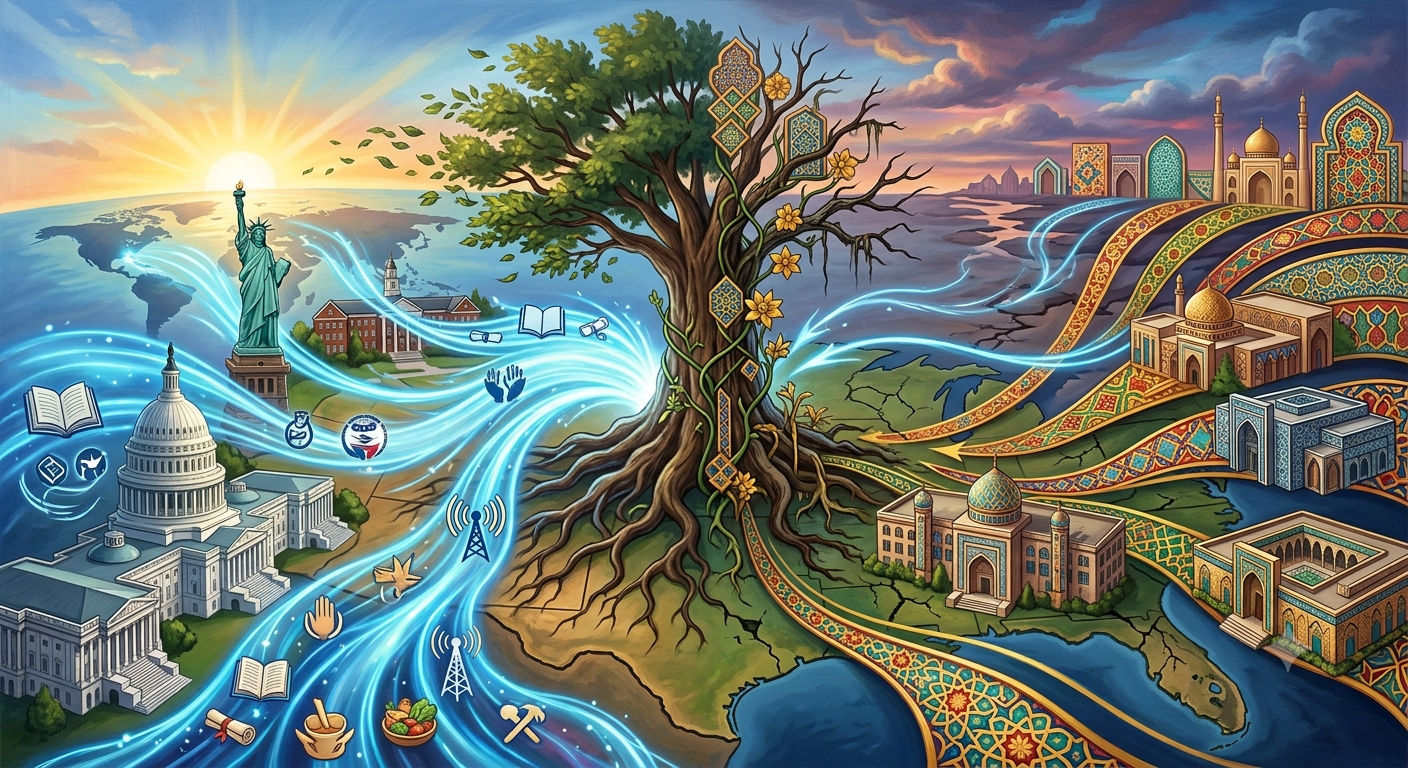

For eight decades, the United States was the world’s foremost entrepreneur of soft power: the country that built the institutions, vocabulary, and infrastructure of attraction-based influence that Joseph Nye would later conceptualize. In the span of roughly a year, it has become something radically different: a target market where wealthy foreign states, chiefly in the Gulf, now cultivate American elites, universities, and policymakers the way Washington once cultivated theirs.
That system is now beginning to run in reverse.
The United States is no longer exporting influence alone; it is increasingly importing it. Wealthy foreign states, particularly in the Gulf, are increasingly investing in American universities, research ecosystems, policy communities, and technology networks with a strategic clarity that Washington once applied abroad.
This reversal is not simply a story of American decline or rising multipolarity. It reflects something more specific: a quiet erosion of the infrastructure of influence that once generated US soft power, even as other states have begun to treat influence not as an accessory to power but as a form of strategic infrastructure in its own right.
The Infrastructure of Influence
At its height, US soft power was not reducible to culture or values. It was built on a dense web of institutions that shaped how other societies understood the United States—and their relationship to it.
Scholarships like the Fulbright Program brought generations of foreign students and researchers into American academic life. Broadcasting networks under the US Agency for Global Media projected narratives of openness and credibility across contested information environments. Development efforts led by the United States Agency for International Development (USAID) embedded an American presence in local governance, infrastructure, and civil society. Even more targeted tools, such as the Global Engagement Center, sought to counter disinformation and shape the information domain, offering the US a competitive edge against its rivals.
The strategic value of these institutions was not theoretical. Over 40 current and former heads of state and government have participated in the Fulbright Program, including leaders from allied and partner nations across Europe, Asia, and Latin America. The International Visitor Leadership Program (IVLP) counts thousands of senior foreign officials among its alumni, including presidents, prime ministers, cabinet ministers, and diplomats who would later shape their countries’ relationships with Washington.
During the Cold War, Radio Free Europe and Radio Liberty provided millions of listeners behind the Iron Curtain with access to uncensored information and alternative political narratives. Vaclav Havel later described the station as a vital source of independent information for dissidents in Czechoslovakia. In Poland, Hungary, and across Eastern Europe, American broadcasting became synonymous not simply with news, but with the possibility of political alternatives. These programs succeeded because they embedded American influence within the formation of future leaders and political movements rather than relying solely on government-to-government diplomacy.
Taken together, these were not standalone programs. They formed an ecosystem of influence—one that operated on long-time horizons and shaped how future decision-makers, researchers, and public servants thought, collaborated, and aligned with US foreign policy goals.
Erosion Without Replacement
Budgetary pressures, shifting political priorities, and institutional fragmentation have reduced the coherence of US soft power efforts. Programs have been scaled back, deprioritized, or reframed in ways that limit their long-term strategic impact. The result is not the disappearance of American influence—far from it—but the gradual thinning of the infrastructure that once sustained it.
USAID was effectively dismantled after the administration terminated 5,342 projects worth $75 billion. Voice of America, which had broadcast in 49 languages to 420 million people across more than 100 countries, was limited to four languages. Due to funding cuts to the National Endowment for Democracy, both the National Democratic Institute and the International Republican Institute were forced to close overseas offices. The administration denied Fulbright awards to a substantial number of scholars it had selected for the 2025-2026 academic year and subjected foreign Fulbright recipients to “an unauthorized review process”, which led to almost the entire oversight board resigning. New international student enrollment in US institutions declined by 17% in Fall 2025, the largest non-pandemic decline in the last 11 years. The frozen visa pipeline is the proximate cause, but it’s not the only one. According to NASFA’s Association of International Educators CEO, “the US is no longer the central place that students aspire to come to”. The US adversaries recognized this vacuum: Kremlin and Beijing officials were quick to welcome the demise of Radio Free Europe / Radio Liberty.
At the same time, the nature of influence itself has evolved. In a world shaped by digital platforms, cross-border capital flows, and globally networked research communities, influence no longer depends solely on broadcasting outward. It can be embedded directly into the institutions and ecosystems of other states.
This is where the shift becomes most visible.
The Inversion
Influence is no longer flowing primarily from the United States to the rest of the world. Increasingly, it is flowing into the United States itself.
Foreign governments and state-linked entities are investing in American universities, funding research partnerships, supporting policy programs, and building long-term relationships within professional and academic networks. These investments are not incidental. They are structured, sustained, and often aligned with broader national strategies.
What was once a US export model of bringing foreign students to American campuses, engaging future policymakers through exchange programs, and shaping narratives through media and institutional presence is now being mirrored in reverse. The difference is that these efforts are unfolding inside the United States.
This is not influenced by malicious propaganda or coercion. It is slower, subtler, and more durable. It operates through access to, collaboration within, and participation in the very systems that generate knowledge and policy ideas.
What is emerging instead is a deeper layer: Influence has become infrastructure, through research pipelines, funding streams, institutional partnerships, and professional networks. These are harder to detect, harder to regulate, and far more consequential over time.
Influence as Infrastructure
Few countries illustrate this transformation more clearly than the United Arab Emirates (UAE). Long before many Western governments began rethinking soft power, Abu Dhabi had already reconceived it – not as public diplomacy or national branding, but as strategic infrastructure.
Over the past decade, the UAE has moved beyond traditional public diplomacy and invested heavily in building influence through education, technology, and global partnerships. Institutions such as the Mohamed bin Zayed University of Artificial Intelligence (AI) are designed not only to advance research but to position the country at the center of emerging technology networks. The university has recruited leading researchers from top Western institutions and established partnerships with global technology firms, reflecting the UAE’s broader ambition to become a hub for AI talent, research, and governance. These investments are concentrated in sectors that generate long-term strategic advantage: artificial intelligence, advanced manufacturing, higher education, and space. Each reinforces the others, positioning the UAE not only as an innovation hub but as a convening power capable of attracting researchers, entrepreneurs, investors, and policymakers.
Yet the true significance of the UAE’s strategy lies not only in what it has built at home, but in how those capabilities have become platforms for international influence. Through partnerships with American universities, think tanks, technology firms, and policy communities, the UAE has embedded itself within the networks where ideas are developed, talent is cultivated, and strategic priorities are debated.
Other Gulf states are pursuing similar, though distinct, approaches. Qatar has long leveraged media and education—through institutions like Al Jazeera Media Network and the Qatar Foundation—to shape narratives and build global connections. Saudi Arabia, meanwhile, is combining large-scale investment initiatives with cultural and technological projects to expand its global footprint.
Qatar has become the largest foreign funder of US higher education, surpassing even China, as a recent comprehensive report from the Foundations for Defense of Democracies (FDD) by Natalie Ecanow shows. The UAE has expanded partnerships with American universities, AI laboratories, and technology firms while cultivating relationships with policy institutions in Washington. Saudi Arabia’s Vision 2030 has increasingly relied on American venture capital, research collaborations, and cultural partnerships to integrate the Kingdom into the ecosystems that shape the next generation of innovation.
These efforts differ fundamentally from lobbying. Lobbying seeks to influence decisions already being made. This strategy seeks to shape the institutions that determine how future decisions will be made.
What makes this shift unusual is that it is occurring inside the world’s most influential knowledge ecosystem. For decades, the United States sought to attract foreign talent and integrate future leaders into American institutions. Today, foreign governments increasingly recognize that shaping the institutions themselves may be even more consequential than shaping individual participants. The result is a subtle but important shift: influence no longer flows primarily through the movement of people into American systems, but increasingly through the integration of foreign interests into those systems themselves.
The evidence of this shift is increasingly visible across American institutions. Qatar has spent more than two decades treating higher education as a tool of statecraft. Through the Qatar Foundation, it established Education City – bringing branch campuses of Georgetown University, Carnegie Mellon University, Northwestern University, and other leading Western institutions to Doha – while simultaneously becoming one of the largest foreign funders of American higher education. According to the US Department of Education’s Section 117 disclosures, American universities have reported $67.6 billion in foreign gifts and contracts since 1986. In 2025 alone, Qatar accounted for more than $1.1 billion in reportable gifts and contracts, making it the largest single foreign source of funding for US universities that year.
The UAE has pursued a complementary strategy centered on the technologies that will define the next generation of geopolitical competition. Rather than simply investing in artificial intelligence, Abu Dhabi has sought to position itself inside the ecosystems that produce it. Mohamed bin Zayed University of Artificial Intelligence has recruited leading researchers from top global institutions while building partnerships with major technology companies. In 2024, Microsoft deepened this strategy with a $1.5 billion investment in G42, establishing a long-term partnership in artificial intelligence infrastructure, research, and governance that links Emirati institutions directly to one of America’s most influential technology companies. These relationships are reinforced through collaborations with US universities, research laboratories, venture capital firms, and policy organizations, positioning the UAE as an increasingly indispensable participant in emerging technology networks.
Saudi Arabia has complemented this approach through Vision 2030, deploying the Public Investment Fund, venture capital, biotechnology initiatives, cultural partnerships, and investments in advanced technology to integrate the Kingdom into American innovation ecosystems. Its objective is not simply to purchase technology, but to participate in the networks through which technology, talent, and expertise are produced.
Viewed individually, these initiatives appear commercially rational, academically beneficial, or strategically pragmatic. Collectively, however, they reveal a coherent model of statecraft. Rather than seeking influence primarily through diplomacy, media campaigns, or lobbying, Gulf governments are investing in the institutions that generate expertise, shape research agendas, cultivate future leaders, and define the technologies that will underpin geopolitical competition for decades to come. This is not influenced through coercion, propaganda, or disinformation. It is influenced through participation. Rather than persuading the United States from the outside, these states are embedding themselves within the ecosystems through which American knowledge, technological leadership, and ultimately foreign policy are produced.
The competition is no longer simply over people. It is increasingly the institutions that shape them.
The Risks of Asymmetry
The United States remains a formidable source of soft power. Its universities, technology sector, and cultural industries continue to attract talent and attention from around the world. But these strengths are increasingly operating in a more open and contested environment, one in which other states are actively participating in and shaping the same ecosystems.
This creates a growing asymmetry.
While foreign governments invest strategically to build influence in the United States, Washington’s own efforts to cultivate long-term relationships abroad have become less coherent and less prioritized. The result is not a simple loss of influence, but a shift in where and how influence is generated.
Over time, this has several implications.
First, while it would be an exaggeration to say this will cause American power to decay overnight, it does narrow Washington’s room for maneuver. As foreign states embed themselves in the policy networks that shape US decision-making, they acquire quiet leverage over the debates that precede policy. The Gulf example is instructive: as Gulf capitals become woven into the institutions that generate US policy, it becomes harder for Washington to take positions in the region without weighing the preferences of the very states funding those institutions – a subtle but real constraint on policy autonomy.
Second, it risks eroding institutions and creating security breaches. Influence has become infrastructure, often quietly expanding into research pipelines and funding streams, making it harder to spot that the same partnerships that bring talent and capital into American labs can also create channels for sensitive knowledge to flow outward. Over time, the blurring of collaboration and dependency can create national security vulnerabilities that are difficult to detect until they have already been exploited.
Third, it accelerates the drift toward multipolarity, with consequences that extend well beyond the United States. When the world’s foremost exporter of soft power becomes a net importer, the gravitational pull that once organized alliances and aligned partners weakens, and other states move to fill the vacuum on their own terms. The result would be a more fragmented international order in which influence is contested rather than anchored, reshaping the environment for allies and adversaries alike.
Rebuilding the Infrastructure of Influence
The challenge for the United States is not to withdraw from global collaboration or restrict foreign engagement. Openness remains one of its greatest strengths. But openness without strategy risks ceding ground in domains that are increasingly central to geopolitical competition.
Rebuilding US soft power does not require recreating the institutions of the twentieth century exactly as they were. It requires recognizing that influence today operates through different channels and treating those channels with the same level of attention that competitors already do. Educational exchange, international broadcasting, research partnerships, and knowledge networks should not be viewed as peripheral instruments of statecraft. They are part of the infrastructure through which power is translated into lasting influence.
Most of all, it requires abandoning the assumption that American influence is self-sustaining. For much of the postwar era, the United States invested heavily in the institutions that attracted talent, shaped ideas, and cultivated future leaders around the world. Those investments generated returns measured not only in goodwill but in geopolitical advantage.
The United States invented the modern architecture of soft power. The question at its 250th anniversary is not whether that architecture still matters. It is whether Washington still recognizes it as its own.



