Beyond Technology: Ukraine’s Innovation Advantage

Abstract
The war in Ukraine provides a unique opportunity to examine the conditions that drive innovation and adaptation. This article explores how organizational leadership, cross-sector collaboration, and frontline empowerment have accelerated Ukraine’s ability to manage functional challenges and quickly develop technical solutions to adapt on the battlefield. While Ukraine continues to modernize its command structure based on NATO and U.S. noncommissioned officer practices, many units already apply these principles. Ukraine’s decentralized, front-line-oriented modifications to the tactical technological requirements of combat have demonstrated the value of squad-level, real-time improvisation and innovation. Using the evolution of emerging technology and civil-military innovation ecosystem as an analytical lens, this essay argues that Ukraine’s collaborative and decentralized ecosystem offers broader lessons for military organizations seeking to achieve a combat advantage.
Introduction
Since February 2022, after a lengthy conflict in the Donbas in eastern Ukraine, President Vladimir Putin directed Russian forces to invade Ukraine, capture Kyiv, and topple the Ukrainian government, thereby delivering the Kremlin a decisive victory. Instead—almost four and a half years later—the Russian-Ukrainian conflict has lasted longer than World War I. Already, there has been significant analysis and research into the convergence of factors—geopolitical, military, commercial, and collective resolve—transforming the conflict and influencing its possible outcomes.
As the war’s character continues to evolve, the variables that produce each side’s respective advantages are also shifting. Summer signals a critical period for both Russia and Ukraine. Recent commentary has increasingly focused on changes in functional capabilities, political friction, defense-industrial capacity, and military personnel, all of which may have significant implications for the war effort.
Many factors will influence success on the battlefield and the resolution of this war. A comprehensive aggregate analysis of Russia’s invasion of Ukraine may develop in the future, likely as a retrospective. Today, however, Matthew N. Slusher reports that the “battlefield is a real-world laboratory for testing new military technologies, doctrines, and operating adaptations.” Ukraine’s ability to shorten the time to adapt, innovate, and integrate platforms and operations is transforming the war effort. As Sir Lawrence Freedman explains, this ability has kept Ukraine going—compensating for its strategic weaknesses in military scale and weapons capacity.
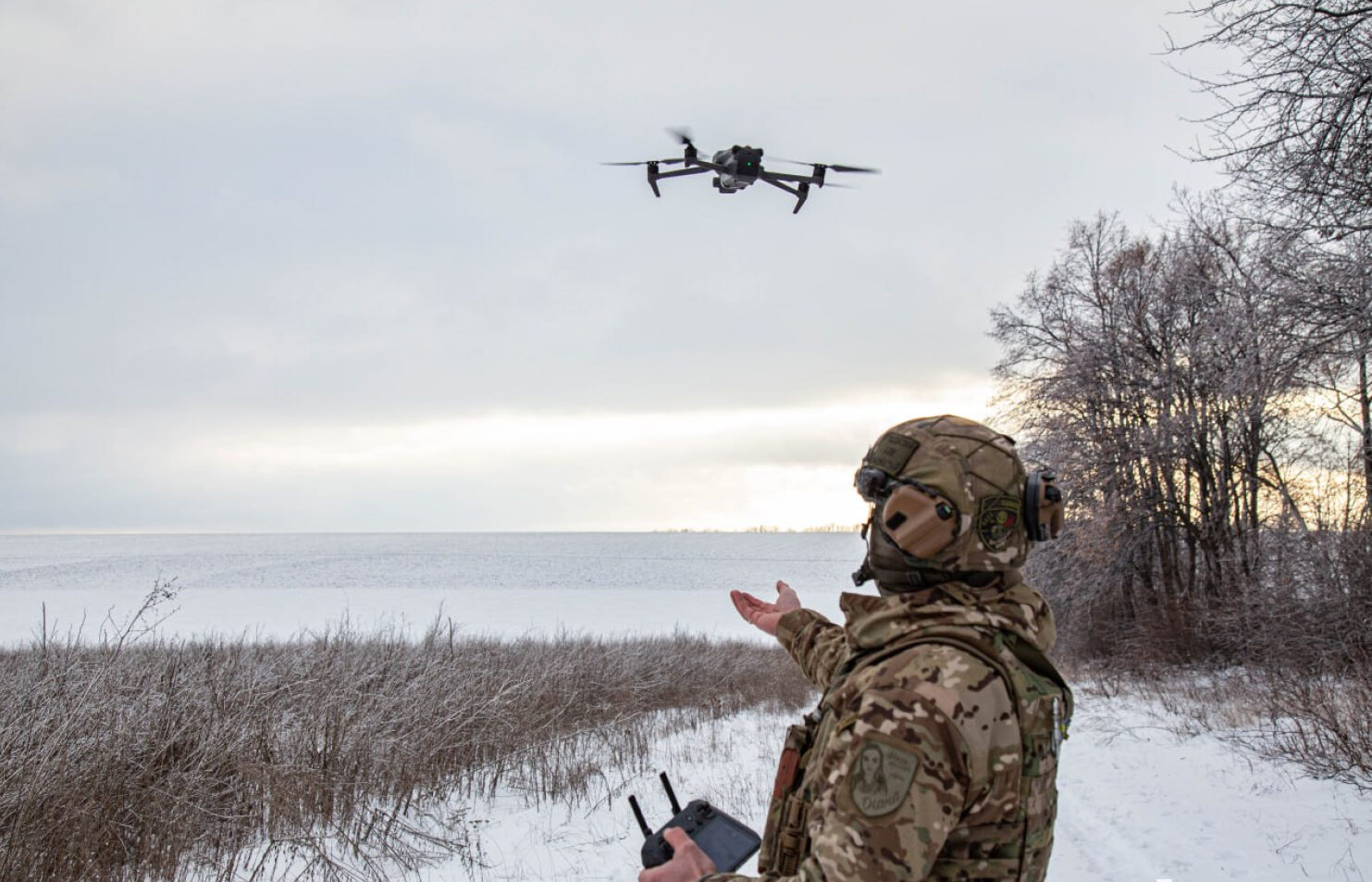
Drone, autonomous, and artificial intelligence (AI)-enabled systems remain observable and increasingly measurable examples of innovation and operational responsiveness. But Ukraine’s broader advantage stems from its ability to decentralize decision-making authority, expand participation in the war by incorporating resources and solutions from a variety of sources (e.g., frontline operators, institutions, agencies, technology firms, citizens, and international partners), and adapt tactics and capabilities faster.
These relationships and this command philosophy together streamline the delivery of new capabilities, enabling Ukraine to center technology as a driver of its military strategy. This essay acknowledges the role and impact of emerging technologies unto themselves, whether advanced software, digital solutions, artificial intelligence, or satellite networks. However, it argues that Ukraine’s primary instrument for augmenting military responsiveness and adaptation is the unprecedented, combined effect of its technological capabilities and organizational agility. This essay focuses on the evolution of drones and autonomous systems in the Russia-Ukraine War and provides a view into how institutional reform, operational agility, and technological advancement have supported Ukraine’s battlespace outcomes and are even transforming modern warfare.
Building Organizational Agility
To achieve military technological improvement, Ukraine needed to reform its Soviet-era command practices. Ukraine accelerated reforms after Russia annexed Crimea. The goal was to transition from a rigid, officer-centered Soviet command structure by developing a professional noncommissioned officer (NCO) force and to encourage decentralized action. Since 2014, Ukraine has partnered with the United States military and NATO training to develop an NCO program with this capability. Central to the U.S. Army’s mission command approach is 6-0 Mission Command, a doctrine described by Master Sgt. Fred N. Tolman as a command-and-control structure that “empowers subordinate decision-making and decentralized execution appropriate to the situation.” The mission command approach is creating a foundation for a collaborative operational ecosystem.
Essential to this approach is an established relationship between leaders and subordinates built on trust and a shared understanding, risk acceptance, disciplined action, and mission intent. According to Tolman, when fully implemented, this mission command structure provides an advantage in combat tempo and battlefield responsiveness. Progressing toward mission command is an organizational enabler for the effective empowerment and coordination of forces across air, ground, and maritime domains. A previous analysis in Small Wars Journal by Daine van de Wall suggested that the war in Ukraine has exposed the shift to a distributed, tactical-level model that is generating combat power. In contrast, Russia’s military organization remains compartmentalized and lacks trust between units, which has contributed to Russia’s overall underperformance in the war.
While Ukrainian organizational reform is continuing, and the tenets of mission command are established, a fully decentralized decision-making model has not yet been achieved. According to Kateryna Bondar, “Ukraine is changing its tactics, its doctrine, and adapting its technology and everything else almost in real time.” Sustaining command philosophy and organizational transformation presents both challenges and opportunities as the Ukrainian military expands. For example, at the start of the Russian invasion in February 2022, President Volodymyr Zelenskyy mobilized hundreds of thousands of Ukrainians—increasing Ukraine’s military to roughly 700,000 personnel. This surge of reservists and civilians brought diverse skill sets and created a larger, more agile force with greater capacity for responsive wartime innovation. Today, these forces bring multiple perspectives and experiences. They reinforce a culture of continuous change that generates advantages during wartime. Viktoriia Honcharuk, a Ukrainian combat medic and the director of defense tech at the Snake Island Institute, reaffirms the opportunity this innovative environment represents for Ukraine:
“We didn’t come in with a box that usually people are being put in when they do either basic training or when they do general military education, and we could think out of the box. That enables so much, like enthusiasm and initiative, because if you don’t know where the edges of the box are, you don’t think in it.”
Ukraine continues to refine the balance between institutional tradition, rigidity, and continuous improvement. There remains significant pressure to respond faster. Max Maslii, a captain in the Ukrainian Air Force, noted that “the most important thing right now is the speed of adaptation. You just need to change or die—that’s how it works.” Accelerating warfighters’ input of frontline fighters to improvise and innovate is crucial. Developing new tactics, drone capabilities, AI, electronic warfare, and rapid response capabilities are decisive factors in countering Russian threats.
Entrepreneurial culture is empowering brigade crews to implement new techniques without delay, and the accompanying transparency has brought about faster, more effective troubleshooting of battlefield failures. According to Andris Sprūds, Latvia’s former defense minister, a key lesson from Ukraine is the importance of “the mindset of a startup, the mindset of innovation, and the mindset of ambition.” For Ukraine, evolving threats may require an agile, localized approach rather than a traditional, monolithic program. Otherwise, accelerating and implementing capability changes creates enormous friction for rigid institutions. Freedman argues that Russia’s highly centralized command structure has reduced its organizational adaptability and precludes the creativity needed to change rapidly.
From Battlefield Feedback to Technical Solution
On the Ukrainian battlefield, AI-enabled systems, autonomous vehicles, and electronic warfare have proven essential to fight in a rapidly changing combat environment. Combat units participate in translating problems and requirements into new software, hardware, and tactical innovations. Communicating combat lessons in response to Russian threats and evolving at speed have been decisive factors in Ukraine’s sustained defense. Success has depended on continuously updating software, changing theater tactics, and implementing solutions faster than the adversary. “Better never stops,” as deputy commander of NATO’s Allied Air Command, Air Marshal Johnny Stringer observes.
In Ukraine, battlefield technology is considered a “service of the infantry” and is expected to keep pace with an ecosystem that evolves in real time. Compressing the time from identifying issues to technical solutions will be essential to maintain operational advantage. Achieving this requires field operators to identify gaps, refine requirements, and rapidly test and implement new solutions.
Distributed decision-making provides crews with the flexibility to act quickly once a problem is identified. Crews can immediately adopt tested processes or conduct system modifications. These unit-level feedback loops compress the time from gap identification to delivery. This imperative—to adapt at speed—requires current information flow directly from the operators. Frontline soldiers are active participants in developing systems and process changes. This immediacy of feedback empowers land forces and drone crews to improvise solutions and experiment through trial and error. For example, when air defense teams were working to protect ground forces in the kill zone from Russian drone attacks, Ukrainian teams proposed attempting to intercept drones with their own drones. Although its practicality was initially questioned, air defense teams have, after several iterations, demonstrated results. Agility has been a necessity, and urgency—combined with frontline feedback and a decentralized organizational approach—is driving practical operational improvements.
Ukrainian fighters operate in an environment where threats evolve continuously. With combat-tested systems, operators understand that an important consideration is to identify which capabilities can be modified and implemented quickly. For example, software adjustments can typically be developed, tested, and deployed much faster than hardware changes. Also, due to fluid theater conditions, additional AI development or training time may be required to train AI-enabled autonomous systems. Crews may initially implement a hybrid approach with human assistance or the “human-in-the-loop” method until a more strategic solution is available.
Expanding the Innovation Ecosystem
In Ukraine’s organizational hierarchy, bottom-up innovation is possible. Beyond combat, Ukraine’s reforms are extending to create decentralized procurement, digital marketplaces, and crowdsourcing networks of volunteers. These volunteers produce 3-dimensional-printed components and engage directly with brigades to reduce delivery timelines from months to weeks or days. In this model, brigades identify the mission requirements and select equipment from an approved government marketplace. Modifications may be made in the field, eliminating lengthy approval processes and refactoring delays.
In this decentralized model, Ukraine’s ministry retains governance functions like contracting, compliance, and payments. In 2025, over 100,000 first-person view (FPV) drones were delivered through this system. In addition, crowdsourcing—which Ukraine has used throughout the conflict for cyber activities and monitoring adversary operations—is connecting volunteers to warfighters. Without direct government funding, volunteers receive requests, manufacture the parts with 3-D printers, and deliver them to frontline troops. Logistics and communications efficiency become prerequisites for continuous innovation and integrating teams, platforms, and military assets. The federated procurement model, strategic partnerships, and the corps of volunteer manufacturers improve supply chain efficiency and maximize Ukraine’s limited manpower and help scale the industrial base to meet the evolving demands of conflict conditions.
Hedgehog: Proof of Model
In May 2025, Ukraine’s battle-tested drone innovations were demonstrated. During this NATO Hedgehog exercise, a Ukrainian drone crew simulated over 30 strikes and the destruction of armored vehicles. Initial analysis suggested Ukraine’s success stemmed from superior drone systems and software. However, the decisive Ukrainian advantage may have stemmed from the crews’ ability to quickly assess conditions, apply their dynamic combat mindset, and make rapid tactical decisions and adjustments to address imperfect conditions. The success of the Hedgehog exercise underscores the need for combat units to deliver rapid, actionable adaptations and accelerate the iterative refinement of systems and tactics.
Conclusion
The war in Ukraine suggests that the pursuit of military advantage and the capability to offset superiority in manpower and conventional weapons may rely on building and sustaining organizations with cohesive teams that evolve faster than their adversaries. To do this, establishing decentralized decision making and collaborative feedback loops with cross-functional organizations is essential for solving difficult combat challenges and compressing the time-to-invention cycle. Relying on institutional principles and leadership culture is necessary to effectively manage conflict surrounding strategic vision and execution to accelerate the adoption of new capabilities. Alone, technology is an enabler. Organizational agility that transforms technology into combat power.
Advanced weapons, artificial intelligence, autonomous systems, and electronic warfare will continue to change the character of war. Ukraine’s experience demonstrates that technological superiority alone is insufficient. The central lesson for NATO and the U.S. is not merely to acquire similar technical capabilities. It is also to build a culture of innovation in which empowered military personnel directly influence, shape, test, and field solutions at the speed of combat.
History will reflect the impact of technological changes on conflict. Still, the decisive advantage may no longer belong to the force with the largest or most expensive arsenal, but to the force that applies battlefield experience, initiative, technological superiority, and leadership. As the war continues, maintaining Ukraine’s civilians’ commitment and the nimble, entrepreneurial approach of the military remains a strategic imperative. Ukraine is redefining how military organizations generate innovation. Its greatest innovation is an organizational model and set of principles that embrace continuous learning, accept failure as a part of innovation, and adapt faster than its adversary.