





Algorithmic Giants, Ethical Infants: How Autonomous Mass Is Breaking the Clausewitzian Contract

Abstract
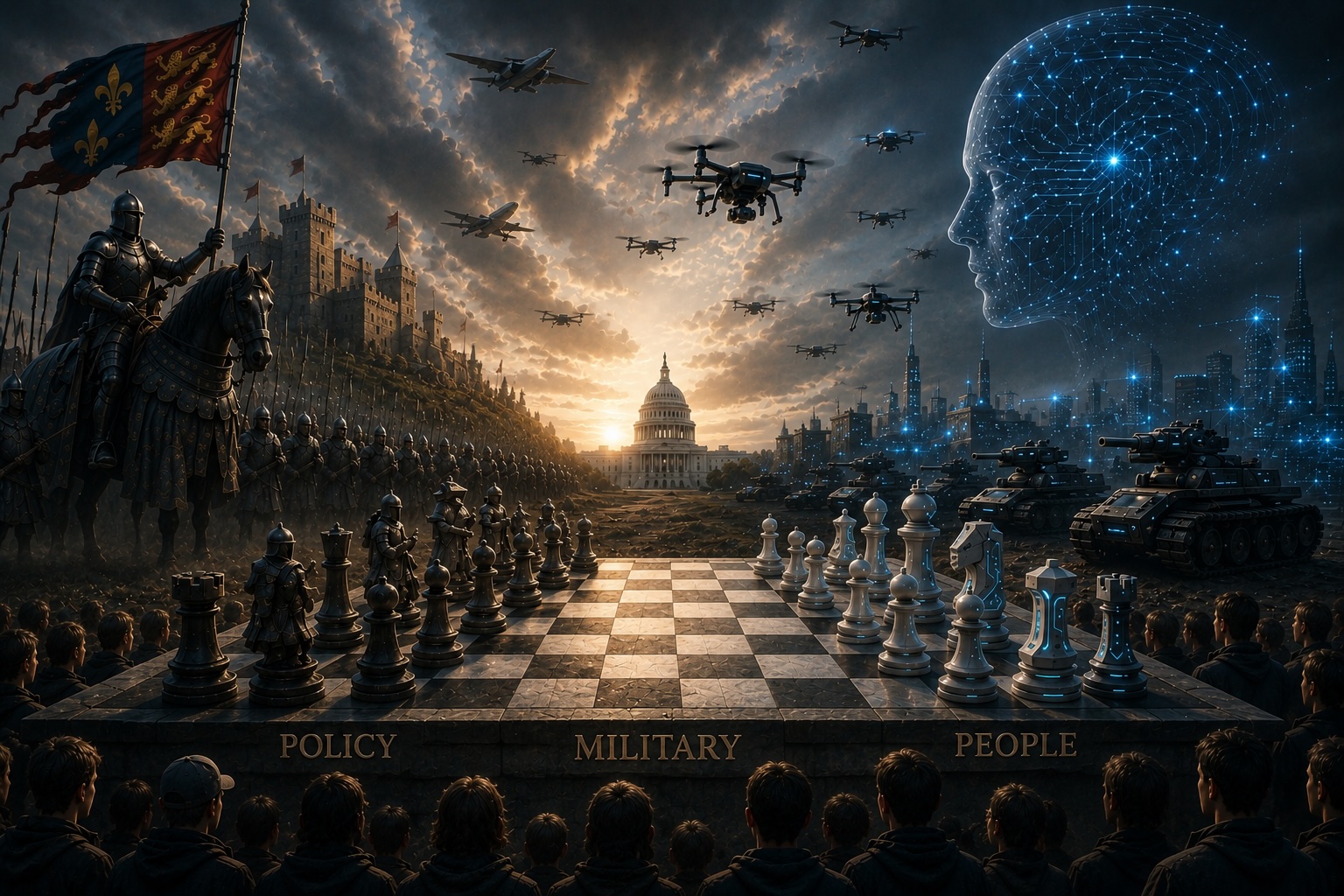
As the Western defense establishment grapples with the crippling costs and prolonged production timelines of exquisite legacy platforms, attention has shifted toward replicating affordable mass production through autonomous systems and artificial intelligence. However, this military revolution mirrors a deeper socio-political shift from centuries past, when the decline of the feudal knight gave rise to the mass conscript army and the modern state. By automating the tactical edge out of sheer operational necessity, modern militaries are inadvertently severing the people from Clausewitz’s Paradoxical Trinity. This creates a dangerous political moral hazard where states can wage perpetual, frictionless warfare, completely decoupled from public accountability or democratic friction.
Introduction
In 1415, the French nobility rode onto the mud-soaked field of Agincourt as the absolute pinnacle of military capability. The medieval knight was an exquisite, low-density weapon system. These elites wore custom-tailored plate armor, rode specialized warhorses, and spent fourteen years training from childhood to master the art of shock cavalry. Yet they were systematically decimated by English commoners wielding the longbow—in face-to-face tactical encounters that proved a comparatively cheap, mass-produced tool could dismantle a lifetime of elite martial training. The defeat at Agincourt was a tactical disaster, but the economic and political shock was structural. The entire business model of feudal warfare had broken. Kings quickly realized that relying on a small, hyper-elite, irreplaceable class of fighters was a losing strategy in a world shifting toward mass overmatch and rapid replacement.
Today, the United States military faces its own Agincourt moment. The West remains heavily invested in multi-billion-dollar aircraft carriers, hundred-million-dollar stealth jets, and an artisan-style defense supply chain that takes years to deliver single platforms to the battlefield. In an era when a $3,000 commercial drone carrying a 3D-printed explosive can blind a multimillion-dollar radar or disable a main battle tank, reliance on a small number of exquisite, irreplaceable systems leaves the force strategically fragile.
The Pentagon’s rush to solve this through automated mass, uncrewed swarms, and artificial intelligence is a logical tactical evolution. Militaries must field tools that can handle the brutal reality of modern attrition. But this technological pivot triggers a profound, unexamined political paradox. When the late medieval military revolution forced nations to abandon knights for mass armies of musket-wielding peasants, it forged a blood-equity contract that required public buy-in to wage war. By contrast, the modern transition to autonomous mass does the exact opposite: it isolates the population from the human cost of conflict, severing the vital connection between a democracy and its wars.
The Feudal Business Model vs. The Modern Gilded Force
To understand how deep this trap goes, one must look at the knight not just as a combatant, but as an economic ecosystem. Funding a single knight required the tax revenue of an entire fief or manor. Because they were so ruinously expensive and took half a lifetime to train, a king could rarely risk losing his entire force in a single afternoon. A tactical blunder was not just a lost battle; it was a generational economic catastrophe.
The modern defense establishment has built a remarkably similar gilded force. In their analysis of defense procurement flaws, security analysts frequently warn of a survivability paradox where adding endless, expensive layers of protection to ensure a platform’s survival makes the overall platform so costly that the military can only afford them in tiny numbers. By packing platforms with so much bleeding-edge capability, they become too expensive to buy in volume and too slow to replace. If the United States loses a few stealth bombers or an aircraft carrier in a peer conflict, production lines cannot simply scale up to replace them in time to affect the outcome. The West is playing a fewer-but-better game on a global chessboard that is tilting rapidly back toward cheap and many.
The global market has essentially decentralized precision. Software, commercial off-the-shelf electronics, and distributed manufacturing have leveled the playing field, allowing middle powers and non-state proxies to buy asymmetric denial on the cheap. The military edge is shifting away from who has the largest defense budget and toward who can sustain a continuous, automated war of attrition.
Breaking the Trinity: Squeezing the People Out of War
When Carl von Clausewitz laid out his famous Paradoxical Trinity, he described the raw chemistry that makes a state capable of sustaining a conflict. For war to function as an extension of politics, it requires three forces pulling in unison: the rational policy of the government, the tactical skill and chance managed by the military, and the blind passion and willpower of the people.
Before the longbow and the musket, the average peasant was just background scenery. But when technology made a cheap firearm in the hands of a commoner deadlier than a lifetime of knightly chivalry, monarchies were forced to drag the populace into the equation. To field a massive infantry force, the state had to offer a trade. They needed the people’s bodies, so they had to give them political buy-in, rights, and a shared national identity. The mass army essentially created modern citizenship. It meant that if a government wanted to go to war, it had to absorb the massive friction of public debate, societal grief, and domestic political risk. The passion of the people became the ultimate speed bump against reckless conflict.
The push toward autonomous mass and uncrewed swarms completely snaps that link. By replacing citizen-soldiers with silicon and carbon fiber, defense planners are solving a tactical problem but creating a massive political blind spot. When a nation can project lethal power into a conflict zone without putting flag-draped coffins on the evening news, the threshold for violence plummets.
This trend is not entirely new. The transition to an all-volunteer force and the reliance on localized standoff strikes over the last few decades have already begun to distance the voter from the realities of combat. But those operations still required human skin in the game—pilots in cockpits, teams on the ground, and family deployments. The shift to fully autonomous mass finishes what the volunteer force started. We are effectively cutting the people out of the triangle. War shifts from a shared national endeavor that requires collective sacrifice to a quiet, bureaucratic utility managed by tech executives and military managers. The public is entirely insulated from the immediate costs of foreign policy.
Our Servant as Our Executioner
This is exactly what General Omar Bradley was terrified of when he gave his Armistice Day address in 1948. Looking out at the dawn of the atomic age, he warned:
We have grasped the mystery of the atom and rejected the Sermon on the Mount. Man is stumbling blindly through a spiritual darkness while toying with the precarious secrets of life and death. The world has achieved brilliance without wisdom, power without conscience. Ours is a world of nuclear giants and ethical infants. We know more about war than we know about peace, more about killing than we know about living.
If he were looking at today’s defense landscape, he would likely call the nation a collection of algorithmic giants. Bradley’s ultimate warning was simple: “If we continue to develop our technology without wisdom or prudence, our servant may prove to be our executioner.”
The danger of an automated, risk-free military machine is not a science-fiction scenario of rogue artificial intelligence. The pivot to affordable mass is a brutal operational necessity if a military wants to survive a modern peer conflict. The tragedy is that the West is adopting the tools of algorithmic warfare without answering the structural political question they leave behind. The executioner is the strategic complacency built into the system.
Conclusion
When war becomes invisible and cost-free to the domestic voter, politicians can wage low-intensity, grey-zone conflicts with total impunity. But in doing so, the muscles of societal resilience and democratic accountability completely atrophy. Just as medieval kingdoms discovered that relying on an elite, irreplaceable class of knights left them fragile and bankrupt when the wind shifted toward mass attrition, the West may find that its algorithmic brilliance has insulated it into a corner of strategic overmatch.
Ultimately, this technological evolution threatens to permanently break the Clausewitzian contract. A state can build the perfect robotic servant, only to realize too late that it has stripped away the very component that gives a republic its deep, long-term strength: the active, agonizing buy-in of its people. If the West does not find a way to re-anchor public accountability to its automated projection of power, it will field a military capable of winning attrition games on the tactical edge, while losing the democratic foundation required to sustain a long-term strategic vision.
(Disclaimer: The views expressed in this article are those of the author and do not reflect the official policy or position of the Department of the Army, the Department of War, or the U.S. Government.)


