Why Military Theory Still Matters

Abstract
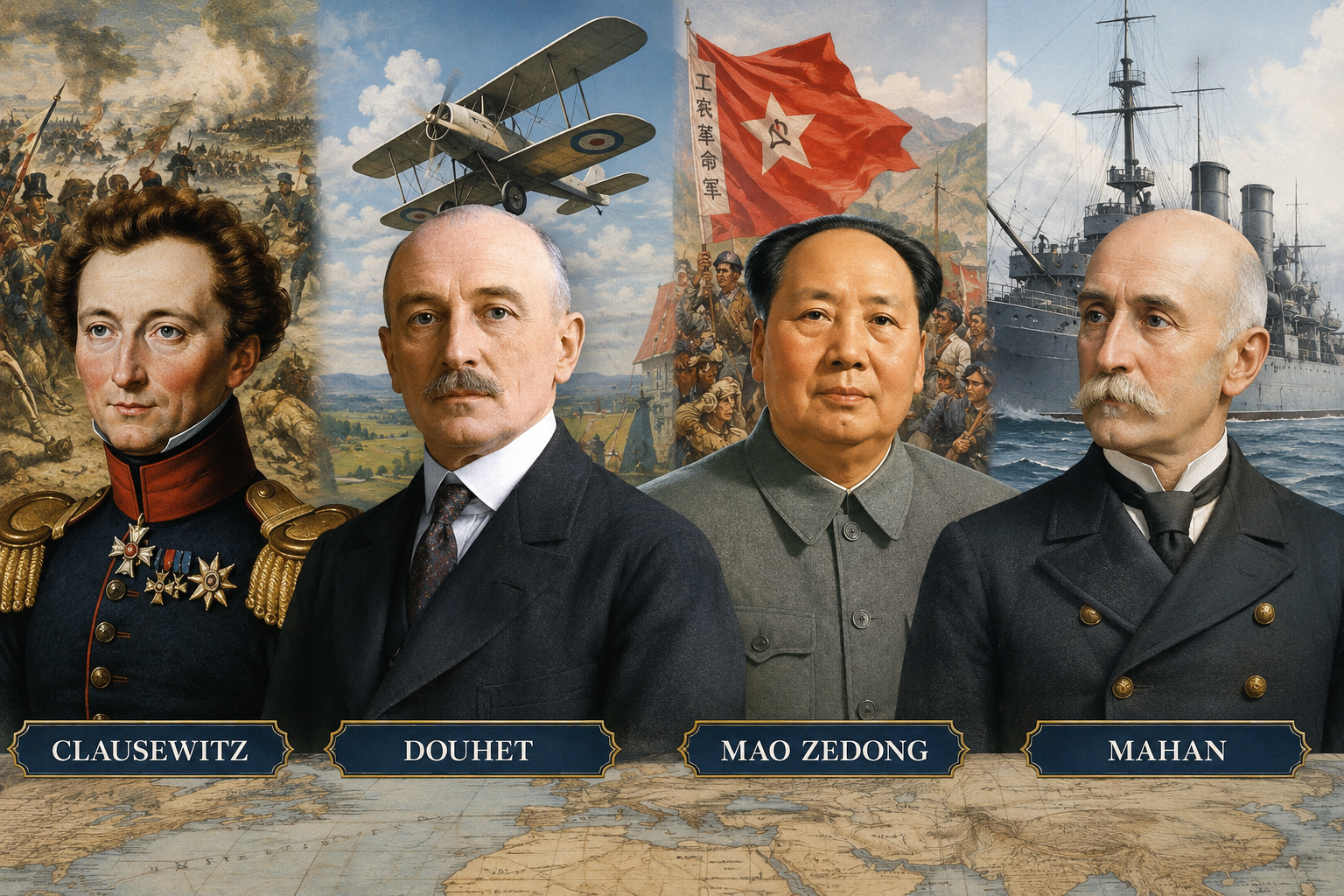
This article argues that four military theorists—Clausewitz, Douhet, Mao Zedong, and Mahan—provide the essential and complementary intellectual framework for understanding modern warfare and the strategic competition now taking shape. Each addresses a distinct dimension: war’s unchanging political nature, the revolutionary impact of airpower, the capacity of politically mobilized populations to sustain protracted resistance, and the role of sea power in underpinning national power and enabling force projection. Each theorist is necessary; none is individually sufficient; and for Western military professionals, mastering all four is a professional obligation, not an academic exercise.
Introduction
Every war produces its own lessons. The conflict in Ukraine has delivered them at an unprecedented pace: drone swarms disrupting armored advances, cyber operations targeting critical infrastructure, space assets enabling precision fires, and artificial intelligence accelerating decisions at every echelon. Yet history offers a sobering warning—armies that chase innovation without theoretical grounding risk becoming experts in the last war while entering the next one without a compass. Warfare observed without theory is data without meaning. Mastering the latest technology is necessary; understanding the enduring nature of war is indispensable. As commercial technology diffuses to weaker hands, the material edge that once separated great powers from everyone else is narrowing—making a grounding in enduring theory more decisive, not less.
Many theorists have attempted to distill warfare’s essential dynamics, yet most failed to remain relevant as circumstances evolved in unforeseen ways. Only a few endure in major military institutions today, distinguished by their capacity to illuminate not just the conflicts of their own era but those of every era since. Understanding the last one hundred years of warfare requires addressing three essential questions: why do nations fight? How did they fight? Who fought and who could endure? Answering these questions rigorously demands engagement with three theorists whose frameworks capture different yet essential aspects of warfare. Carl von Clausewitz provides the foundation by explaining war’s unchanging political nature. Giulio Douhet examines how warfare’s conduct fundamentally changed with airpower, demonstrating technology’s revolutionary impact across all conflicts. Mao Zedong explains how politically mobilized populations transformed who could fight and win, making irregular warfare central to the post-1945 era. A fourth framework, however, is now required for the strategic competition underway in the Western Pacific: Alfred Thayer Mahan and the theory of sea power.
Carl von Clausewitz (1780–1831)
Of all the theorists who have attempted to explain the nature of war, none has proven more enduring than Carl von Clausewitz. Born in Prussia in 1780, he witnessed the Napoleonic wars firsthand as both enemy and reluctant admirer of the Emperor’s operational genius, and brought to his theoretical work the hard-won authority of a soldier who had experienced war’s realities from multiple vantages. His magnum opus, Vom Kriege—On War—remains the most studied work of military theory in Western professional military education (PME). Yet its presence in curricula raises a practical question: why does Clausewitz still require close engagement when every officer believes they already know him? The answer is that Clausewitz is more frequently cited than read, and more often simplified than understood. His three fundamental contributions—to war’s political nature, the paradoxical trinity, and friction—remain essential precisely because they reward careful reading rather than casual summary.
Clausewitz defines war as a political act and, famously, as “a continuation of policy by other means”—emphasizing that war employs unique means unavailable to diplomacy or economics: organized violence. War is never autonomous but operates as one instrument among others available to the state in pursuit of its interests. This insight remains valid today: most Western joint doctrines define the National Instruments of Power using the acronym DIME—Diplomatic, Informational, Military, and Economic. His “Paradoxical Trinity” describes war as composed of three interrelated forces: primordial violence driven by passion, the play of chance where creative genius must operate amid uncertainty, and rational policy calculation. Associated respectively with the people, the commander and army, and the government, these forces exist in dynamic tension. “Friction”—the countless impediments distinguishing real war from war on paper—completes the picture. The institutional response proved as consequential as the concept: Gerhard von Scharnhorst’s post-Jena reforms produced the Prussian General Staff, a means of mitigating friction through skilled, systematically trained staff officers—the model for every modern staff system since.
Clausewitz’s framework remains the essential starting point for understanding war’s fundamental nature. The consequences of ignoring it are visible in two contemporary theaters. In Ukraine, Russia’s catastrophic miscalculation was not primarily logistical or technological—it was a failure to account for the passion element of Clausewitz’s trinity: the will of the Ukrainian people to resist. Moscow assumed the government would collapse under a fait accompli and that the population would acquiesce. It did not. Clausewitz predicted exactly this outcome when he warned that neglecting any element of the trinity invites defeat. Simultaneously, the People’s Republic of China (PRC) is conducting a textbook Clausewitzian campaign against Taiwan and the broader Indo-Pacific order—deploying all instruments of power in the DIME framework, using economic coercion, diplomatic isolation, and gray zone military pressure, with direct military force held in reserve as the final instrument. A Western military professional who reads Clausewitz only as a theorist of battle will miss that the war for the South China Sea is already underway—it is simply being fought, for now, without bullets.
Clausewitz’s focus on war’s political and psychological dimensions, however, leaves technology virtually unaddressed—a gap Western military professionals have paradoxically failed to notice even as they invoked his name in support of technology-centric doctrines.
Giulio Douhet (1869–1930)
Born in Caserta in 1869, Giulio Douhet served as an officer in the Italian Army and became an early and vocal advocate of military aviation when most general officers regarded aircraft as auxiliaries to ground forces. His outspoken criticism of Italy’s inadequate preparation for air warfare led to a court-martial and imprisonment—a persecution that only amplified his later prominence when events vindicated his warnings. In 1921, building on the lessons of the first air campaigns over Libya and the trenches of the Western Front, Douhet published his theory of air warfare, establishing airpower as an independent domain and the first coherent framework for its strategic use.
In The Command of the Air, Douhet argued that aircraft’s unique advantages—flexibility, speed, and freedom from terrain constraints—made them capable of penetrating deep into enemy territory to destroy vital centers and undermine national will. He identified five target systems: industry, transportation, communications, government, and popular morale. The campaign sequence required first achieving command of the air, then mass bombing of vital centers. His claim that civilians under bombardment would pressure governments to surrender proved incorrect—Allied strategic bombing campaigns against Germany and Japan demonstrated that populations under attack exhibited far greater resilience than anticipated, and ground forces remained necessary for final victory.
Nevertheless, Douhet’s emphasis on air superiority as a prerequisite for military success has proven enduring. The Korean War, Vietnam, the Gulf War, and Operation Iraqi Freedom all demonstrated that air supremacy enabled ground forces to maneuver effectively and forced adversaries toward negotiations. In the nuclear age, the United States integrated strategic bombing concepts into deterrence theory, threatening unacceptable destruction to prevent war entirely. The thread connecting Douhet’s theory to the present remains visible: Operation Midnight Hammer, the June 2025 US air and naval strikes against Iran’s nuclear facilities, and Operation Epic Fury, the February 2026 major combat operation directed against Iran’s missile arsenal, navy, and proxy networks, both reflect the enduring logic of targeting an adversary’s vital centers from the air—the foundational premise Douhet articulated a century ago.
The recurring temptation to believe that airpower alone can be decisive—that the next generation of precision weapons, stealth aircraft, or autonomous/unmanned systems will finally fulfill Douhet’s original promise—remains a live institutional tendency. Each decade produces its own version: the Revolution in Military Affairs of the 1990s promised near-perfect situational awareness and precision fires that would lift the fog of war; the drone campaigns of recent years suggested that persistent surveillance and strike could substitute for ground presence. Both proved partially correct and fundamentally insufficient. Douhet’s framework is essential not because it was right in every particular, but because it forces Western military professionals to ask the correct question: what combination of air power and other means is required to break an adversary’s will, not merely to destroy its assets? The recent strikes on Iran illustrate the point: precision air and naval strikes degraded the regime’s nuclear, missile, and naval assets, yet did not break the will of the Islamic Revolutionary Guard Corps (IRGC) or its proxy network—destroying an adversary’s capabilities is not the same as compelling its decision.
Douhet’s lasting contribution lies in recognizing the revolutionary potential of new technologies and establishing a framework for integrating emerging capabilities into national strategy. His miscalculation regarding civilian resilience, however, reveals a critical shared gap in Western military theory: the failure to account for the population as an active instrument of war.
Mao Zedong (1893–1976)
If Douhet explains how technology transformed the conduct of war, Mao Zedong explains why technology alone could never be sufficient to win it. Born in Hunan Province in 1893, Mao developed his theories not in an academy but across two decades of civil war and foreign invasion—a theorist forged entirely by practice. His inclusion raises an inevitable question: why study a Communist revolutionary? Because understanding how one’s adversary thinks—and how adversaries of the United States have thought—is a professional obligation, not an ideological concession. Mao’s theoretical contributions transcend his political context and have outlived his ideology. In On Guerrilla Warfare (1937) and On Protracted War (1938), Mao conceptualizes the population as the central element sustaining prolonged resistance against technologically superior forces—a revolutionary understanding that shaped much of the military conflict of the last one hundred years.
Mao’s theory of Protracted Revolutionary War divides conflict into three phases: strategic defense, during which the weaker side trades space for time; strategic stalemate, during which base areas expand and guerrilla operations intensify; and strategic counter-offensive, during which the balance of forces shifts sufficiently to enable offensive operations. Central to the entire framework is popular support. Guerrillas are like fish, and the people are the water in which they swim—without food, intelligence, recruits, and sanctuary from the population, guerrilla forces cannot survive. Political mobilization must therefore precede military action: winning the people remains the primary task.
During the Vietnam War, North Vietnamese forces sustained nearly a million deaths and devastating air raids yet persevered through ten years of conflict, demonstrating the resilience that politically mobilized populations could achieve. While Communist ideology faded after 1991, the centrality of population support to insurgent warfare remained: ethnic and religious identity became the new vehicle for popular resistance, demonstrated repeatedly across Afghanistan, Iraq, Syria, and beyond. Mao’s core insight—that mobilizing civilians through shared identity is a decisive factor—applies beyond Communist ideology. For Western military professionals, his theory clarifies why insurgencies and revolutionary wars often outlast conventional expectations, and why modern conflict requires addressing political and social dimensions alongside military operations—a lesson painfully learned in Vietnam, Iraq, and Afghanistan.
The persistence of this dynamic into the present is most visible in Iran’s proxy network. The Houthi movement’s capacity to contest Red Sea shipping lanes despite an overwhelming firepower disadvantage reflects Maoist fundamentals: political mobilization preceding military action, popular support providing the base for sustained resistance, and the exploitation of time against a technologically superior opponent. What is new is the narrowing of the material gap itself. The diffusion of commercial technology—high-resolution satellite imagery available by subscription, inexpensive one-way attack drones, and increasingly capable anti-ship systems—has handed materially inferior actors a measure of the precision and situational awareness once reserved for advanced states. This does not displace Mao’s logic so much as extend it: the mobilized population still supplies the will, the intelligence, and the sanctuary, while diffused commercial technology now grants a reach and precision that popular support alone never could. The result was on display against the Houthis and the IRGC, where perceived US technological overmatch did not translate into decisive effect: despite hundreds of precision strikes, forces operating from conventional inferiority absorbed the punishment and continued to contest the theater. The operational implication is direct: any future conflict involving a politically mobilized population—whether on the Korean Peninsula, in a renewed confrontation with Iran and its proxies, or in a future conflict with the PRC—will require the same analytical framework Mao developed in 1937. Technology does not dissolve the people’s role in war. It may intensify it.
Alfred Thayer Mahan (1840–1914)
The three theorists analyzed above provide the essential intellectual foundation for understanding the last one hundred years of war. Yet as the strategic environment shifts decisively toward maritime competition in the Western Pacific, a fourth framework is no longer optional—it is indispensable. Alfred Thayer Mahan, born in West Point, New York, in 1840, was a US Navy officer whose lectures at the Naval War College were transformed into the most influential works of naval theory in the English language: The Influence of Sea Power upon History, 1660–1783 (1890) and The Influence of Sea Power upon the French Revolution and Empire (1892). Mahan argues that command of the sea enables control of global trade and thereby national power. While the Pacific War against Japan demonstrated this argument’s enduring validity—control of maritime lines of communication across the Western Pacific proved decisive, and naval forces remained an essential instrument through which the United States projected power—the role of the maritime domain until the present day has been more supporting than decisive in conventional military operations.
The PRC’s military expansion has reactivated the problem set Mahan originally identified. The People’s Liberation Army Navy (PLAN) has become the largest naval force in Asia, with a growing fleet of aircraft carriers, submarines, and surface combatants supported by an integrated anti-access/area-denial (A2/AD) envelope designed explicitly to deny US naval access within the first and second island chains. Beijing’s nine-dash line claims encompass the critical sea lines of communication (SLOCs) through the South China Sea, and the PRC’s Southern Theater Command has been configured specifically to enforce these claims and contest maritime access. The Taiwan Strait and Malacca Strait represent maritime chokepoints whose control would determine whether US forces could project power into the theater at all. Xi Jinping’s directive for PLA readiness to invade Taiwan by 2027 presents US military planners with a compressed timeline in a theater defined by maritime geography, extended logistics, and contested sea control. These are precisely the conditions Mahan’s theory was designed to analyze. His argument that command of the sea underpins national power and enables force projection is no longer preparation for a hypothetical future—it is the strategic logic required to understand both the threat and the appropriate response to the competition already underway.
Conclusion
The last one hundred years witnessed profound evolution in the waging and character of war, yet certain fundamentals remained constant. War as an instrument of policy and its paradoxical trinity persist regardless of technological or tactical changes. Within this unchanging framework, two dimensions underwent dramatic transformation: technology expanded the geographic scope and operational means available to military forces through integrated air operations, space systems, and cyber capabilities; and populations evolved from passive witnesses to active participants in revolutionary movements and guerrilla conflicts. These dynamics remain fully alive today, from the drone-contested skies of Ukraine to the insurgencies that continue to defy conventional military resolution across multiple theaters. Military professionals must therefore master four interconnected frameworks. Clausewitz provides the foundation for understanding war’s political nature. Douhet captures how technological change reshaped the conduct of conflicts. Mao demonstrates how politically mobilized populations could overcome material disadvantages through protracted revolutionary warfare. Mahan completes the framework by explaining how command of the sea underpins national power—a dimension that defined the Pacific War and now defines the strategic competition in the Western Pacific. No single theorist suffices: Clausewitz without Douhet cannot explain how wars are fought; Clausewitz without Mao cannot explain irregular warfare’s dominance post-1945; Douhet and Mao without Clausewitz lack the political framework explaining why wars occurred. All three, without Mahan, leave military professionals unprepared for the defining strategic challenge of the coming decade.
US and Western PME institutions already teach these theorists, and their inclusion in curricula reflects a serious intellectual tradition. The risk is not absence but drift: as warfare grows more technologically complex, staff officers face relentless pressure to become hyper-specialized technicians at the expense of the broader theoretical view that best equips them to understand the full dynamics of armed conflict. A staff officer who can optimize a targeting cycle but has lost sight of Clausewitz’s trinity, or who can plan an air campaign but has forgotten Douhet’s miscalculation about civilian resilience, is professionally incomplete. This matters more, not less, as technology proliferates. The three theaters that recur throughout this analysis present three distinct relationships to technological overmatch. Against Iran and its proxies, American overmatch was blunted by adversaries wielding diffused commercial capability. In Ukraine, cheap commercial technology has repeatedly offset Russian mass, denying either side a decisive material edge. And in the Western Pacific, the PRC is assembling an overmatch of its own. In none of these cases does the technological balance alone determine the outcome; in each, the decisive variable is the strategic judgment brought to bear on it. That judgment is precisely what theory cultivates, which makes a grounding in enduring frameworks equal to—if not more important than—any material advantage. Overmatch that an adversary can acquire off the shelf is a fragile foundation for strategy; a sound theoretical compass is not. The recommendation is not to change what is taught but to guard against what is gradually lost: the habit of returning to first principles, of reading theory not as a historical exercise but as a living framework for understanding the wars being fought today. Recommended reading programs, professional seminars, and self-study guides that explicitly connect these theorists to current operations are the means by which PME institutions can sustain that habit beyond the schoolhouse.