Military Science and the Intellectual Foundations of War

Every profession rests on a body of accumulated knowledge. Doctors study medicine. Engineers study engineering. Yet, military expertise is often treated as little more than opinion. Politicians routinely dismiss military judgment as institutional bias. Commentators with no military education confidently pronounce what armies should or should not do. Even some within the profession treat military theory as something reserved for schoolhouses rather than the foundation of military effectiveness.
Military science is not guesswork. It is the accumulated study of war built by soldiers, historians, statesmen, and theorists over centuries of conflict.
Such an attitude would be strange in any other profession. Nobody could expect to practice medicine without understanding anatomy or surgery without studying generations of medical research. The profession of arms is no different. Military science is not guesswork. It is the accumulated study of war built by soldiers, historians, statesmen, and theorists over centuries of conflict.
War will never be a hard science like physics or chemistry; it is too multidisciplinary. It includes everything from psychology, politics, and sociology clashing with violence, fear, chance, and leadership. Still, soldiers, historians, and strategists have built foundational theories and principles drawn from battlefield historical analysis, experimentation, and experience over centuries. Some of these principles are concerned with the technical realities of warfare: weapons, logistics, maneuvering, communications, engineering, and the organization of military forces. Others are concerned with strategy, political objectives, leadership, and human behavior under extreme conditions. Together, they form the intellectual foundation of the profession of arms: how wars are fought and won.
War is both a science and an art. The scientific side – the principles, theories, and accumulated knowledge that shape how force is organized, applied, and connected to political purpose – is not simply a matter of opinion. It has been tested in battle, debated by generations of military thinkers, and carried forward across centuries of war. The art comes later, when plans collide with reality, intelligence proves incomplete, and circumstances force commanders to adapt in real time against a thinking enemy. One cannot master the art without understanding the science beneath it.
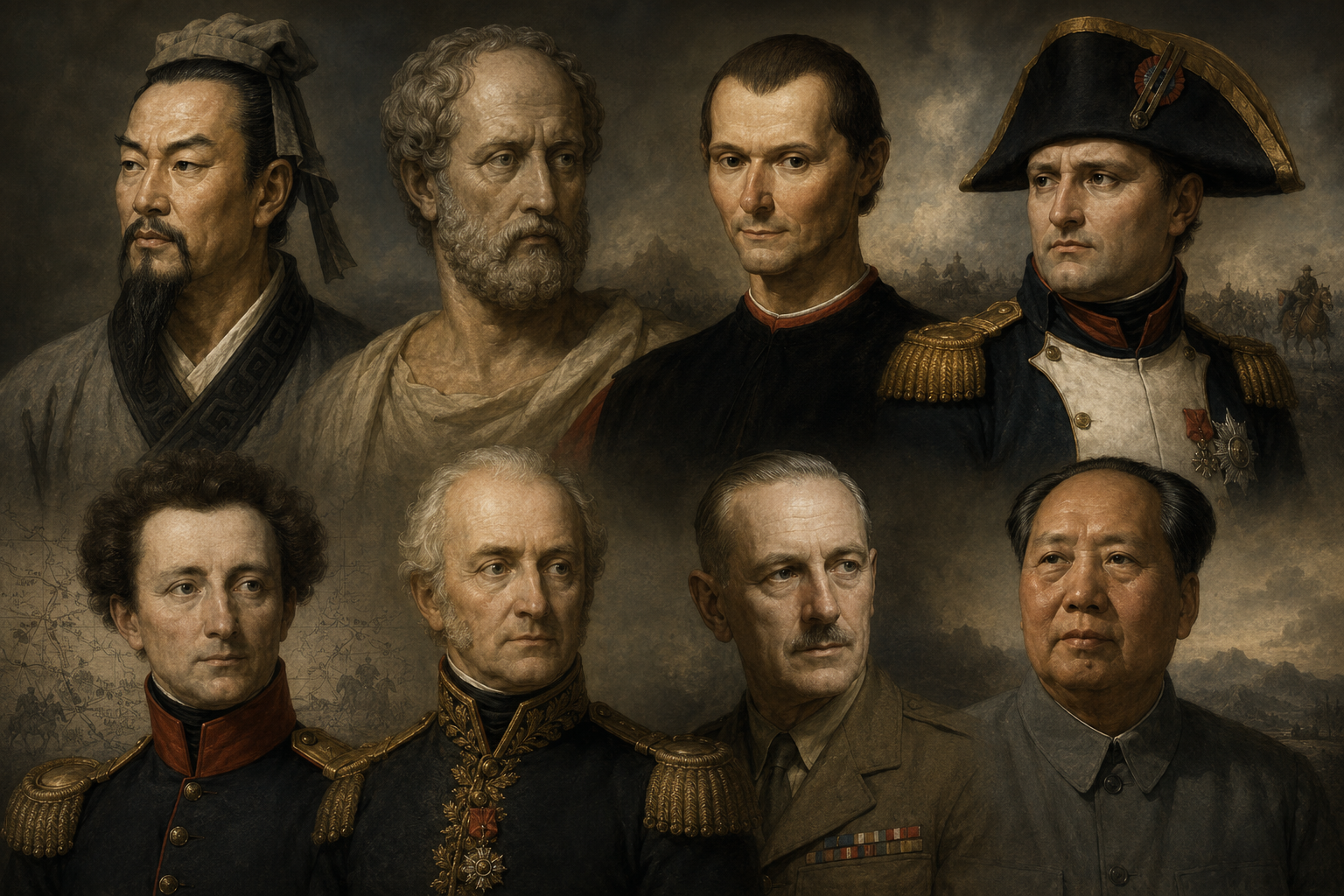
There is a relatively small group of thinkers whose ideas still underpin how soldiers should study, discuss, and wage war. Some wrote from direct experience in command. Others approached war as historians, theorists, or politicians. Some searched for enduring principles. Others believed war could never be reduced to formulas at all. Together, they form the intellectual foundation of military science.
Sun Tzu (5th century BCE, China) is one of the earliest major voices in military theory, even though his existence is contested. Some scholars argue that The Art of War may be less of a single work than a compilation that took shape over time. Either way, the ideas have endured for more than two thousand years.
Sun Tzu may be the most quoted and least carefully read military theorist of all time; everyone remembers his line about subduing the enemy without fighting. Most people take this as a call to avoid war. It is not. It is about shaping conditions so thoroughly that victory becomes likely before battle even begins.
Sun Tzu also stressed deception, famously stating that all warfare is based on it. He placed immense weight on intelligence and knowledge of both self and enemy. In his view, victory came from creating advantages before armies ever met on the battlefield. Military force remained important, but the commander who shaped the environment, disrupted an opponent’s plans, and understood the situation better than his enemy entered battle with the outcome already tilted in his favor. More than two thousand years later, those ideas still show up in everything from strategic deception and intelligence operations to cyber campaigns and competition between states that unfolds below the threshold of open war.
Read: The Art of War, Sun Tzu, translated by Samuel B. Griffith
Thucydides (c. 460–400 BCE, Athens) Almost any discussion of great-power competition today comes back to Thucydides. Writing about the Peloponnesian War nearly twenty-five centuries ago, he examined questions that are still central to strategy. Why do rising powers frighten established powers? Why do leaders make disastrous decisions? Why do wars routinely produce outcomes nobody expected?
An Athenian general and historian of the Peloponnesian War, Thucydides wanted to understand why great powers go to war, why leaders make bad decisions, and why outcomes often differ from expectations. He argued that the rise of Athenian power and the fear it created in Sparta drove the conflict more than the immediate disputes that preceded it. His observation that nations go to war out of fear, honor, and interest is still a part of strategic discussions more than two thousand years later.
Thucydides examined the forces that push states towards war and the choices leaders make once war begins. His history is filled with miscalculations, shifting alliances, domestic politics, competing interests, and strategic overreach. Readers today will recognize many of the same patterns: countries still worry about rising rivals, leaders still make decisions based on incomplete information, and military power alone can still fail to deliver the political outcomes expected of it.
Read: The History of the Peloponnesian War, Thucydides, translated by Martin Hammond
Julius Caesar (100–44 BCE, Rome) stands as one of history’s most influential practitioner-authors. His campaigns and writings continue to shape the study of war. Through his Commentaries on the Gallic War and Civil War, Caesar produced detailed accounts of military operations that, while written with clear political intent, offer enduring insights into leadership, operational art, and the integration of military action with political objectives. His campaigns demonstrate the effective use of speed, engineering, and intelligence to overcome larger or more dispersed forces, as well as the ability to sustain operations across extended distances and complex terrain. At the same time, Caesar’s writings illustrate how narrative and perception are inseparable from military success, as he framed his actions for audiences in Rome to justify decisions and consolidate power. Though not a theorist in the formal sense, his work is essential reading for anyone serious about campaigning, command, and the relationship between battlefield success and political purpose.
Read: The Gallic War, Julius Caesar, translated by Carolyn Hammond
Niccolò Machiavelli (1469–1527, Florence) is often remembered for The Prince, but his most important contributions to the study of war come from The Art of War and Discourses on Livy. Writing during the chaos of Renaissance Italy, Machiavelli saw that political weakness was a product of military weakness. States that relied on mercenaries forfeited both their security and their independence. His central argument was that a strong state requires its own army, composed of its own citizens, and tied directly to its political system. Looking to Republican Rome, he argued that military power, political institutions, and civic identity must function as one system.
Living in the brutal politics of Renaissance Italy taught Machiavelli a hard truth: weakness invites attack. He believed leaders must adapt quickly when conditions change. To him, military force was simply a political tool that had to deliver real results for the state.
Read: The Art of War, Niccolò Machiavelli, translated by Christopher Lynch; and Discourses on Livy, Niccolò Machiavelli, translated by Julia Conaway Bondanella and Peter Bondanella
Frederick the Great (1712–1786, Prussia) occupies an important place in military history because he demonstrated how a relatively small state could survive and often prevail against stronger rivals. Prussia lacked the population and resources of many of its opponents. Frederick understood that a prolonged war fought on his enemies’ terms would eventually exhaust his kingdom. His campaigns included rapid movement, concentrated attacks, battlefield initiative, and striking enemies before allied armies could fully coordinate against him.
The army Frederick built became one of the most studied military systems in Europe. Training, discipline, operational mobility, and battlefield cohesion allowed his forces to move and fight faster than many opponents thought possible for eighteenth-century armies. His practice of concentrating combat power against a portion of the enemy line rather than attacking evenly across the full front, became one of the defining tactical innovations associated with Frederick’s campaigns. Later commanders, especially Napoleon, studied Frederick closely.
Frederick’s influence reached well beyond tactics. His campaigns helped shape a style of command that values initiative, operational mobility, battlefield discipline, and exploiting enemy mistakes before opponents could recover. Carl Von Clausewitz admired him deeply, and much of the later Prussian military tradition grew out of the system Frederick helped build.
Read: Frederick the Great on the Art of War, edited and translated by Jay Luvaas
Napoleon Bonaparte (1769–1821) was not a formal theorist, but his campaigns changed the study of war so much that military institutions spent the next century trying to understand what he had done. The French Revolution had already transformed war by turning it from the business of kings and professional armies into the business of the nation. Mass conscription – known as the levée en masse -, nationalism, and revolutionary politics created armies larger and harder to break than Europe had seen before. Napoleon took that system and made it operationally viable.
His Grande Armée moved faster than its opponents thought possible. The corps system allowed formations to maneuver independently across wide areas, then concentrate quickly at decisive points. That gave Napoleon a degree of flexibility most European armies could not match. The army itself reflected the political changes unleashed by the Revolution. The military personnel and promotion system increasingly was based on battlefield performance rather than social class or family status, creating a generation of commanders who operated faster, took more initiative, and could sustain campaigns at a pace older military systems struggled to handle.
Napoleon also exposed a recurring weakness in coalition warfare. He repeatedly defeated larger alliances by exploiting poor coordination between allies whose political goals, military cultures, and command systems rarely aligned with their doctrine. His campaigns showed how speed, concentration, and operational clarity could break apart stronger coalitions before they could fully combine their power. Victories such as Jena and Auerstadt demonstrated how quickly an entire military system could collapse once its command structure and morale gave way.
Napoleon’s influence still runs through modern military thought. Operational art, maneuver warfare, corps organization, mass mobilization, and the link between battlefield success and political objectives all emerged from the wars of the Napoleonic era. Napoleon’s victories transformed warfare. He demonstrated what operational brilliance could accomplish. Russia demonstrated its limits. Even the greatest battlefield commander cannot escape political reality, geography, economics, and time.
Read: The Campaigns of Napoleon, David G. Chandler
Carl von Clausewitz (1780–1831, Prussia) If a military professional reads only one theorist, it should be Clausewitz. Nearly every serious discussion of strategy eventually returns to concepts he developed.
A Prussian officer who came of age during the wars against Revolutionary and Napoleonic France, he experienced firsthand the catastrophic defeat of Prussia in 1806 and the reforms that followed. Clausewitz did not attempt to create a system of fixed rules for victory. Instead, he sought to understand the nature of war itself. Drawing on history, experience, and critical analysis, he built a framework for thinking about war as a dynamic and evolving phenomenon rather than a problem to be solved by formula.
His most famous idea that war is a continuation of politics by other means is widely quoted but often misunderstood. For Clausewitz, war is not separate from politics. It is an instrument of it. The political objective defines the purpose of the war, and military action must remain subordinate to that purpose. He rejected the idea that war could be reduced to scientific certainty, emphasizing instead uncertainty, chance, and interaction. His “remarkable trinity” explains war as a relationship between the people, the military, and the government, influenced by passion, probability, and reason. His concepts of friction and the fog of war explain why even simple actions become difficult and why perfect knowledge is never possible.
Clausewitz is the master of masters because he provides both a foundation for understanding war and a method for studying it. War, he argued, cannot be reduced to rules, only understood through critical analysis, history, and experience. His work offers enduring analytical tools – from concepts such as center of gravity and culminating point to the relationship between ends, ways, and means – that allow leaders to understand war on its own terms. He does not simplify war. He forces the reader to confront it as it is: uncertain, political, and deeply human. That is why his work is still foundational.
Read: On War, Carl von Clausewitz, translated by Michael Howard and Peter Paret
Antoine-Henri Jomini (1779–1869, Swiss/French), a veteran of the Napoleonic Wars, made one of the earliest and most influential attempts to identify the enduring principles that shape success in war. Where Clausewitz focused on the uncertainty and political nature of war, Jomini concentrated on the patterns commanders could study, learn, and apply. He believed that while war would always contain friction and complexity, history still revealed recurring principles that could guide military decision-making. His work detailed the importance of decisive points, lines of operation, interior lines, and concentrating combat power against enemy weaknesses at the right place and time.
Jomini’s influence on professional armies was enormous. His ideas left marks on military academies, staff systems, campaign planning, and later many of the formal principles of war taught to officers for generations. Part of his appeal was simple: after the upheaval of the Napoleonic Wars, armies wanted frameworks that made war more understandable and teachable. Jomini gave them one. Officers could study campaigns, identify recurring features, and apply those lessons to future wars in a way that felt practical and systematic.
Jomini gave officers something practical they could teach and study. That was valuable after the chaos of the Napoleonic Wars. War rarely stays inside clean geometric lines, however. His framework works best when balanced with Clausewitz, who never lets readers forget friction, politics, and chance.
Read: The Summary of the Art of War, Antoine-Henri Jomini, translated by W.P. Craighill and G.H. Mendell
Alfred Thayer Mahan (1840–1914, United States) focused on the maritime domain. A naval officer and historian, Mahan argued that sea power determines global power. He stressed the importance of controlling sea lines of communication, the critical arteries of trade and military movement. For Mahan, decisive naval battles were essential to achieving that control, and maritime commerce formed the foundation of national strength. His ideas influenced the rise of naval powers in the late 19th and early 20th centuries and continue to shape strategic thinking in regions like the Indo-Pacific, where control of key maritime chokepoints remains central to global competition.
Read: The Influence of Sea Power upon History, 1660-1783, Alfred Thayer Mahan
J.F.C. Fuller (1878–1966, Britain) was both a military theorist and historian who focused on how technology could change the character of war. A British officer, veteran of the First World War, and early advocate for mechanized warfare, Fuller believed industrial-age armies could no longer rely on the attritional methods that had dominated the trenches of World War I. He argued that tanks, motorized forces, airpower, and communications technology created the possibility for faster and more decisive forms of warfare.
Fuller argued for speed, mobility, shock, and disrupting the enemy’s ability to function as a coherent system rather than simply destroying forces through prolonged attrition. He studied military history constantly, looking for recurring patterns in command, battlefield adaptation, and how armies responded to technological change. Fuller also introduced systems thinking into military theory, viewing the enemy as an integrated organism whose critical components could be targeted to produce systemic collapse. His ideas influenced the development of armored warfare and later operational concepts associated with Blitzkrieg.
Fuller helped push military thought toward the realities of industrialized and mechanized war. His work drove debates about armored warfare, operational mobility, and the relationship between technology and military doctrine throughout the twentieth century.
Read: The Foundations of the Science of War, J.F.C. Fuller
B.H. Liddell Hart (1895–1970, Britain) was a military historian and strategist best known for developing the concept of the indirect approach. He believed many commanders had learned the wrong lessons from industrialized warfare and had become too willing to accept attritional bloodshed as unavoidable. His concept of the indirect approach argued that successful strategy often comes from upsetting an enemy’s balance before the main blow ever lands, forcing confusion, hesitation, and collapse rather than relying on frontal destruction alone.
Liddell Hart stressed maneuver, surprise, deception, and attacking weaknesses instead of prepared strength whenever possible. His ideas echoed elements of Sun Tzu and later influenced modern maneuver warfare thinking, especially concepts centered on dislocation, tempo, and breaking an opponent’s cohesion faster than it can recover.
Read: Strategy, B.H. Liddell Hart
Mao Zedong (1893–1976, China) brought theory into the realm of revolutionary and insurgent warfare. As a political and military leader, Mao argued that war is fundamentally political and often protracted. He developed the concept of people’s war, in which the population is central to the conflict, providing support, legitimacy, and manpower. Mao outlined a three-phase approach: strategic defensive, stalemate, and counteroffensive. He integrated guerrilla warfare with conventional operations, demonstrating how weaker forces can defeat stronger ones over time. His ideas continue to inform insurgency, counterinsurgency, and hybrid warfare in the modern era.
Read: On Protracted War, Mao Zedong and On Guerrilla Warfare, Mao Zedong, translated by Samuel Griffith
Giulio Douhet (1869–1930, Italy) extended strategic thought into the air domain. As one of the earliest airpower theorists, he argued that airpower could decisively win wars independently of ground or naval forces. Douhet believed that achieving air superiority would allow for strategic bombing campaigns against cities and industrial centers, breaking civilian morale and forcing governments to capitulate. His vision was controversial and is still debated, but it laid the intellectual groundwork for strategic bombing campaigns in the 20th century and continues to inform discussions about coercion, deterrence, and the role of airpower in modern war.
Read: The Command of the Air, Giulio Douhet, translated by Dino Ferrari
John Warden (1943–, United States) represents a more mature and structured airpower theory. A US Air Force colonel and key planner in Operation Desert Storm, Warden developed the Five Rings model, one of the most influential frameworks for understanding how to target an enemy as a system. In his model, the enemy is composed of five concentric rings: leadership, system essentials such as infrastructure, energy, and industry, infrastructure such as transportation and communications, population, and fielded military forces. Warden’s central argument was that war should focus on the inner rings, especially leadership and critical systems, rather than primarily engaging fielded forces. His model has been widely applied in modern campaign design, with the core insight being that targeting an enemy’s ability to function produces strategic paralysis faster and at lower cost than grinding through fielded forces. This marked a shift away from attrition and from earlier airpower theories that focused primarily on morale. Warden focused heavily on precision, parallel attacks, and systemic disruption. His ideas shaped the Desert Storm air campaign and continue to influence modern concepts of strategic targeting and campaign design.
Read: The Air Campaign, John Warden
Conclusion
A soldier, commander, or political leader who has never seriously engaged with military theory is making decisions influenced by assumptions they have never examined. They are inheriting concepts they may not recognize and applying ideas they do not fully understand.
No single theorist explains every war we fight today or the one coming next. Technology, politics, and societies keep changing how wars look on the surface. The core nature of war stays the same, however. These old voices are not only worthy of study but form the foundation of military science.
This list is not exhaustive. Entire bodies of knowledge critical to war sit outside it. Just war theory, from Cicero and Augustine to the modern law of armed conflict, carries its own intellectual tradition. Naval theory extends far beyond Mahan. Counterinsurgency, revolutionary warfare, nuclear strategy, terrorism, and emerging technologies all have their own histories, debates, and foundational thinkers. The study of war never ends, but everyone must begin somewhere.
A soldier, commander, or political leader who has never seriously engaged with military theory is making decisions influenced by assumptions they have never examined. They are inheriting concepts they may not recognize and applying ideas they do not fully understand.
Medicine has its foundations. Engineering has its foundations. The profession of arms does too. The study of war has produced generations of accumulated knowledge about strategy, logistics, maneuver, technology, leadership, organization, and the political purpose of force. Ignoring that body of thought does not make war simpler or more moral. It only leaves those responsible for fighting and leading wars less prepared for the reality of them.