





Welcome To the Party, Pal: Die Hard as an Allegory of Unconventional Warfare

Introduction – This Was Never About Christmas
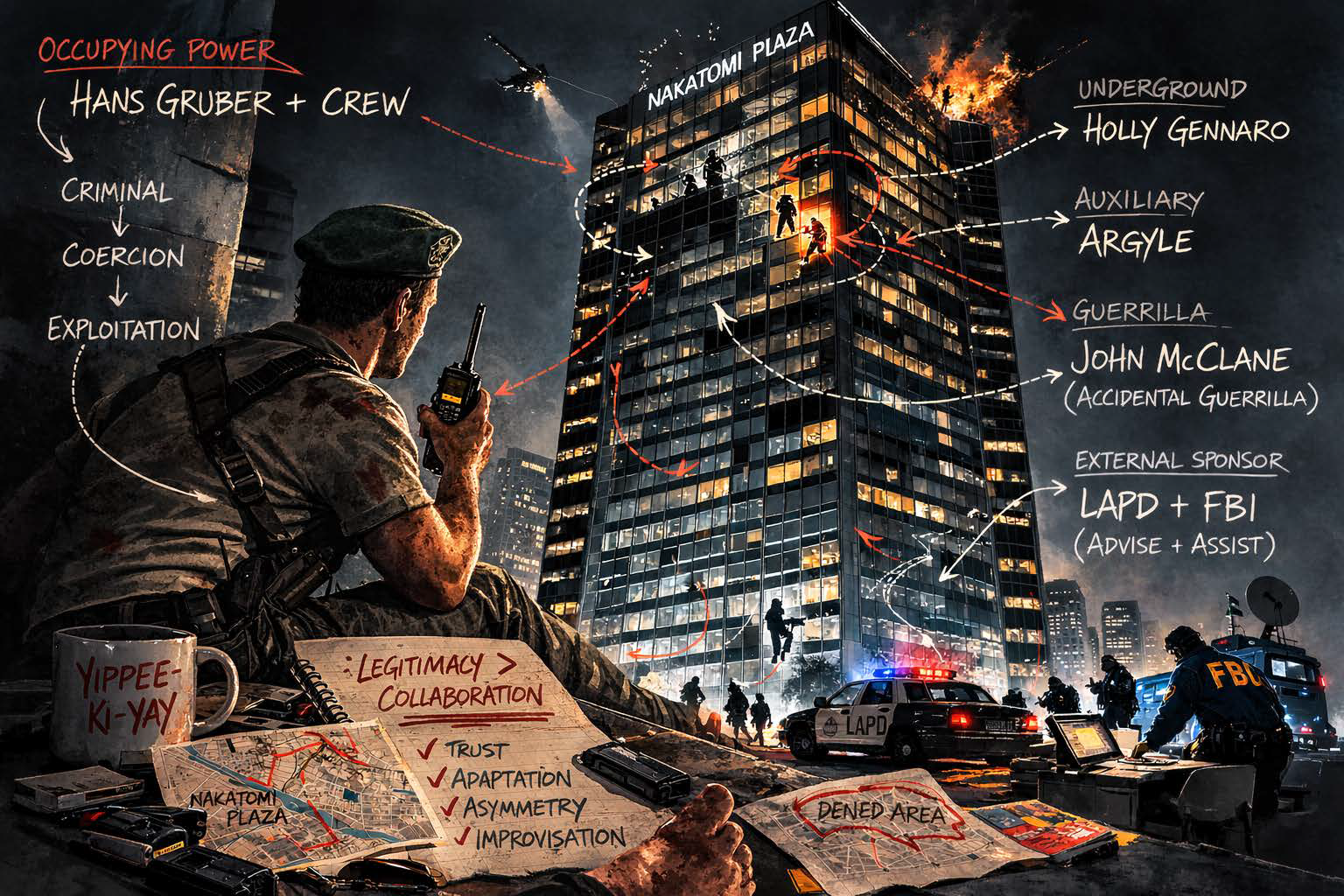
Die Hard (1988) has become so culturally overdetermined that it now functions as a seasonal ritual. Every December, the same argument flares up: is it a Christmas movie? The debate is half-serious, half-seasonal sport, though its persistence demonstrates just how thoroughly the film has embedded itself in the American popular zeitgeist. However, the Christmas question is the wrong one. What gets lost in that annual exchange is that the film’s internal logic—its structure of conflict, its moral stakes, its distributed agency—maps far more cleanly onto the grammar of Unconventional Warfare (UW) than onto holiday cinema.
Most viewers see an action film. Some see a plucky underdog narrative. A few see tinsel and reconciliation. But if you watch carefully, if you watch as a practitioner or student of UW, you see something else: a denied area, a hostile occupying power, a fragmented population, an emergent resistance ecosystem, and eventual external sponsorship marked by friction, mistrust, and offset coordination.
This is not a war film. Yet structurally, it mirrors the architecture of UW more faithfully than many films that explicitly depict combat. Die Hard condenses the essential components of resistance: guerrilla, underground, auxiliary, and sponsor into the vertical battlespace of a Los Angeles high-rise. That compression makes it analytically useful. It dramatizes legitimacy, narrative control, sponsor friction, and asymmetric adaptation without ever using explicitly doctrinal language.
For UW practitioners, this film is more than mere nostalgia. It is a conceptual teaching aid. This picture should not only occupy a place on every UW practitioner’s watchlist but also serves as a conceptual example for understanding the fundamentals, pitfalls, and obstacles inherent in this method of warfare. Die Hard has long been considered a pseudo-guerrilla warfare film. In reality, however, the analogy can be taken even further.
It is also worth clarifying terms. Guerrilla warfare and UW are often treated as synonyms. They are not. As CPT Nelson J. Anderson observed in 1941, “guerrilla warfare” describes military activity conducted by comparatively small, irregular forces in connection with a larger war. UW, by contrast, is not merely the use of guerrilla tactics. It is the enabling of a resistance—by, with, and through indigenous components—typically with external sponsorship.
Current doctrine (FM 3-05) defines UW as “activities conducted to enable a resistance movement or insurgency to coerce, disrupt, or overthrow a government or occupying power by operating through or with an underground, auxiliary, and guerrilla force in a denied area.” Die Hard aligns remarkably well with this structure. More interestingly, it anticipates the evolution of UW: offset sponsorship, remote advise-and-assist, sponsor-resistance friction, and the centrality of legitimacy and narrative.
The Occupying Power — Hans Gruber’s Seizure of Sovereignty
To recognize John McClane as a guerrilla, we must first recognize Hans Gruber as an occupier. Gruber’s crew executes a textbook seizure of sovereignty: surprise, violence, communications dominance, and rapid isolation of the population. They displace legitimate authority (Nakatomi corporate leadership), sever external contact, and impose coercive order. Functionally, they become an occupying power.
Historically, UW emerged from contexts such as SOE and OSS Operation Jedburgh support to resistance movements in occupied Europe. But occupation is not limited to state actors. Increasingly, non-state entities such as criminal cartels, insurgent movements, and militias seize territory or institutions without developing governance capacity. Their authority is coercive rather than legitimate. That legitimacy gap is precisely what creates fertile ground for resistance.
The Revolutionary United Front (RUF) in Sierra Leone offers a useful analogue. The RUF’s rapid seizure of territory and control of diamond resources mirrors Gruber’s exploitation of bearer bonds in Nakatomi’s vault. In both cases, coercion creates the conditions for resistance. Occupation need not involve flags, banners, and uniforms. It requires only the displacement of legitimate authority and the imposition of coercive control. And Hans Gruber governs the building. Poorly.
The Guerrilla – John McClane as the Accidental Insurgent
John McClane does not arrive intending to launch a resistance. He is, in David Kilcullen’s terms, an “accidental guerrilla.” He is drawn into conflict by immediate circumstances rather than ideology. He is not there to liberate Nakatomi. He is there to see his estranged wife. He is there for a Christmas party.
Then the occupier arrives. Accordingly, McClane’s resistance is reactive, local, and necessity-driven. He is literally caught shoe-less. That detail matters. Guerrilla warfare is improvisational It is shaped by constraints. McClane scavenges weapons, exploits terrain, conducts hit-and-run attacks, and weaponizes surprise. Mao Tse-Tung’s principles, as highlighted in On Guerrilla Warfare—mobility, deception, asymmetrical warfare—are present in cinematic form.
McClane is also an outsider. He does not belong to the corporate population he defends. This too has historical precedent. T.E Lawrence operated as an embedded outsider in the Arab Revolt. Che Guevara inserted himself into revolutionary movements beyond his homeland. Outsiders can catalyze resistance, provided they can establish legitimacy. Legitimacy after all, is not automatic. McClane earns it through action, risk assumption, and shared danger. He bears the cost of violence on behalf of the captive population. That sacrifice here acts to substitute preexisting social embeddedness.
Equally important is his use of narrative. From the taunting war cry “Yippee Ki Yay…” to the “Ho, Ho, Ho” message scrawled across his fallen adversary to his deliberate signaling outward to attract external attention, McClane understands that resistance is communicative. Information operations are not merely adjunct to kinetic action; they are constitutive of it. In this way, McClane shapes perception to destabilize the occupier and to signal the legitimacy of resistance. The guerrilla fights physically. The guerrilla also fights symbolically.
The Auxiliary – Argyle and Invisible Support
No guerrilla operates alone. Even when cinema reduces resistance into a single protagonist, the ecosystem remains. UW practitioners recognize that resistance movements rely on background support networks. These support functions are performed by the auxiliary, which Argyle, the limousine driver, metaphorically represents. The auxiliary performs support functions that “enables the guerrilla force—and often the underground—to survive and function.” In this way, Argyle embodies the auxiliary: the support network that enables resiliency and continuity. Doctrine describes the auxiliary as performing functions that allow the guerrilla and underground to operate—logistics, mobility, communication, and protection.
He provides mobility (infiltration and exfiltration), communication relay, situational awareness, and critically, opportunistic sabotage. His final ramming of the escape vehicle is not grand strategy. It is simple, timely disruption. That is often what auxiliary action looks like. What makes Argyle particularly instructive is his invisibility. He blends into the civilian environment. He is not tactically formidable or dominant. But, he is contextually essential. Guerrillas do not win because they are individually heroic. They win because ecosystems support them. Without indigenous support, they cannot operate.
The Underground – Holly Gennaro and Legitimacy
If McClane is the kinetic arm of the resistance here, then Holly Gennaro is the film’s political and social infrastructure. She is the estranged wife of John McClane, a career-driven executive at Nakatomi Corporation, and as it turns out, a resilient leader. The underground component sustains cohesion, preserves morale, controls information, and maintains legitimacy under occupation. Following the murder of Nakatomi president, Joseph “Joe” Yoshinobu Takagi, Gennaro emerges as the connective tissue between population and resistance. Her composure stabilizes the hostages. Her discretion protects McClane’s identity. Her negotiations with Gruber preserve time and space for resistance to function. Legitimacy resides here.
Sleazy Nakatomi employee Harry Ellis provides a useful counterpoint. Ellis attempts to posture as an intermediary but lacks relational credibility. His failure underscores a central truth of UW: the underground must be authentically connected to both population and guerrilla. Legitimacy cannot be improvised under pressure. Gennaro does not carry a weapon. She carries coherence. And that is often more decisive.
The External Sponsor – LAPD & FBI and Offset Friction
The arrival of the LAPD and FBI introduces the sponsor dynamic—the most analytically rich dimension of the allegory. For much of the film, the resistance operates without external support. When support arrives, it does not arrive seamlessly. It arrives with ego, incomplete situational awareness, and procedural rigidity. This is sponsor–resistance friction.
Historically, external sponsorship has been decisive in resistance success—from French support to the American Revolution to OSS and SOE support in World War II. But sponsorship introduces tension: mismatched tactics, uneven trust, uncertain command and control. Benjamin Franklin’s diplomatic messaging led to the signature of Treaty of Alliance with France (1778) – effectively bringing France into the American Revolution. He then wrote to Samuel Cooper stating, “the King has acted a noble and magnanimous part, as well as a wise one,” which roughly translates to “welcome to the party, pal.” It is essential to note that McClane’s signaling for external support follows a classical UW model. McClane’s outward signals shaped perception to express the need for assistance and the legitimacy of the cause.
The modern dimension emerges in the offset nature of support. The sponsor is physically outside the denied area. Coordination occurs without co-location. David Kilcullen’s analysis, in The Evolution of Unconventional Warfare, of Remote Advise and Assist (RAA) and offset UW—enabled by technology, constrained by trust—finds an unexpected precursor here. Current examples of such assistance methods can be seen in Ukraine.
The police and FBI lack granular situational awareness. They misinterpret signals. They default to conventional solutions for unconventional problems. “If all you have is a hammer…”—we know how that ends. Only off-duty police officer SGT Al Powell establishes rapport grounded in humility and listening. Trust, not technology, becomes the decisive variable. Shared hardship accelerates trust-building; offset environments complicate it. That tension remains central to contemporary RAA models. The film dramatizes a lesson practitioners know well: enabling without suffocating; advising without assuming; supporting without displacing.
Conclusion – The High-Rise as Classroom
Die Hard is not a perfect UW allegory. It simplifies population dynamics. It condenses strategic complexity into tactical immediacy. It does not fully explore the wicked political problems that define long-term resistance movements. But that compression is pedagogically powerful. The film visualizes the resistance ecosystem in a way that doctrine alone cannot. Guerrilla, auxiliary, underground, sponsor—each appears in distilled form. Legitimacy is contested. Occupation is coercive. Friction is inevitable. Trust is decisive.
For practitioners, this is not about romanticizing resistance. It is about understanding its moral and operational grammar. UW, as a discipline, is not simply about tactics. It is about relationships, legitimacy, narrative, and restraint under uncertainty. Die Hard endures not because it is a Christmas movie. It endures because, inside a glass tower high-rise in Los Angeles, it accidentally staged a seminar on Unconventional Warfare.
Welcome to the party, pal.




I love this out of the box thinking!
A good analogy can teach doctrine without sounding like doctrine. That is its strength. But it can also seduce students into mistaking compressed drama for the full political and human mess of UW.
Using Die Hard to teach UW may work best not because it is perfect, but because its flaws are visible. The gaps force the teacher to explain what real resistance movements suffer that films leave out.
But, … if Die Hard is used to teach UW through guerrilla, underground, auxiliary, and sponsor roles, how should instructors prevent students from carrying the analogy too far and underestimating the long-term political complexity, legitimacy struggles, and population dynamics that actual UW campaigns must confront?
But is it a Christmas movie or not?