





Patraeus: Taiwan’s Ukraine Problem Isn’t Procurement
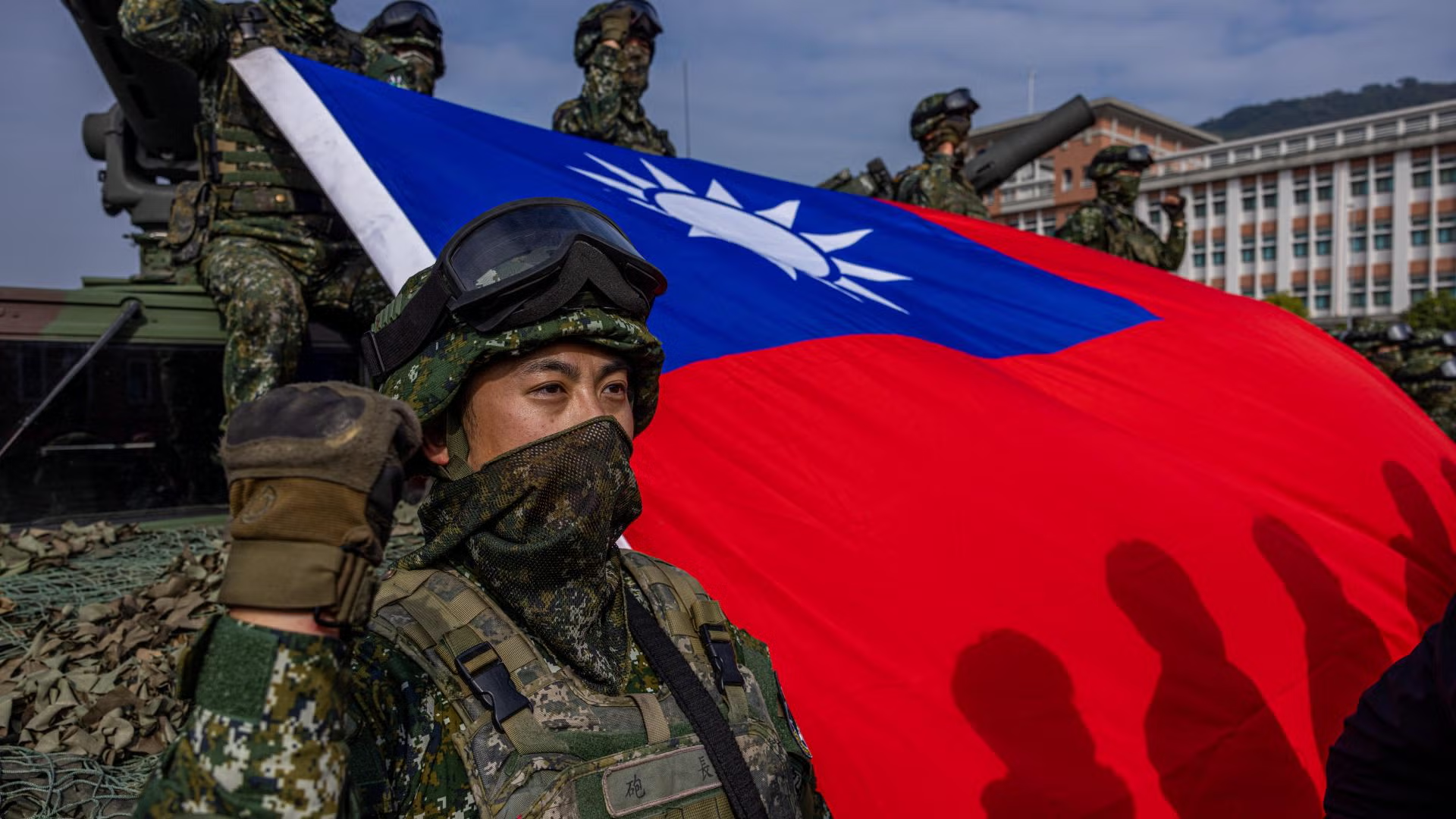

In a Foreign Affairs piece published July 8th titled “The Ukraine Lesson Taiwan Keeps Missing,” David Petraeus and Clara Kaluderovic write how Taiwan needs to replicate Ukraine’s domestic innovation ecosystem in order to truly deter Chinese aggression. Until it can build and sustain its own layered defense architecture, it will remain dependent on imported, expensive weapons systems (not to mention energy). This dependency, Petraeus and Kaluderovic claim, is Taiwan’s greatest weakness.
While Ukraine’s achievements are admired in Taiwan, that admiration has not yet produced the enormous, fundamental changes that enabled Ukraine’s success.
The biggest lesson from Ukraine
The biggest lesson Taiwan needs to take from Ukraine is that you need not only aerial and ground drones of all types, but also an overall architecture that links sensors, engineers, leaders, and shooters. That’s what enables these weapons systems to work at scale. The problem is that Taiwan seems to be falling back on procurement. “There is a danger,” the authors write, “that military strategists will look at the battlefield in Ukraine and see little more than a catalog of weapons to buy.”
In other words, you need drones like Ukraine’s– but you also need the architecture. Ukraine’s Delta system is just that. Taiwan needs its own.
The Geographic problem
As an island, Taiwan is dependent on maritime imports. Once a conflict begins, what is has is all it has. A defense establishment that buys things but “does not know how to develop systems and is unable to articulate its own beliefs about strategy” is a defense establishment without a clear path to island defense.
The task before Taipei is therefore not imitation but translation: the recasting of Ukrainian innovation for a theater more maritime and more exposed to the air.
What to do?
Patraeus and Kaluderovic don’t offer clear, solid prescriptions for Taiwan’s establishment. But there’s still time, they conclude, to build the architecture that can deter Chinese aggression. There’s no time, however, to procure their way to safety.
Themes
The key words that continue to come up in conversations about the future of war– particularly around drones– are architecture, doctrine, organizational adaption, and command structure. Petraeus himself, in a piece for The Hill in late April, wrote how The Pentagon’s $54.6 billion investment in the Defense Autonomous Warfare Group is to be applauded– but risks going to waste without the right doctrine, organizational training pipelines, and continuous adaptation.
Taking this to the next step: Increasingly, drones are viewed less as the focal point but more the lethal end product of a whole human-technology stack. That is because the system that supports them, adapts them, connects them, and commands them is the crucial factor in modern layered defense. Ukraine learned this years ago. Taiwan’s– indeed any allied– defense establishment needs to understand and operationalize this phenomenon.
One question that analysts will ask, on the other hand, is how applicable that architecture is to an island that would need to defend against the world’s largest missile stockpile with no room to retreat. How different should Taiwan’s architecture look compared to Ukraine’s? Will the difference be in the hardware or the software? Somewhere in between? Patraeus and Kaluderovic are confident that the architecture needs to be replicated. But they stay away from claiming to what extent.

