





Why Peacebuilding, Not Peacemaking Alone, Is Sudan’s Only Viable Path Forward

Why Peacebuilding, Not Peacemaking Alone, Is Sudan’s Only Viable Path Forward
As Sudan’s civil war enters its third year, international diplomacy remains overwhelmingly focused on securing a ceasefire between the Sudanese Armed Forces (SAF) and the Rapid Support Forces (RSF). Regional mediators, Gulf states, and international organizations continue to pursue negotiated pauses in fighting in the hope that violence can be contained before the country collapses further. Yet Sudan’s history demonstrates that ceasefires and elite political agreements alone do not produce durable peace. Since independence, Sudan has experienced repeated cycles of war, negotiated settlements, partial stabilization, and renewed violence. The 2005 Comprehensive Peace Agreement ended one civil war but failed to resolve structural marginalization, weak governance, and militarized politics. The 2019 revolution removed Omar al-Bashir but did not dismantle the underlying security structures or political economy that sustained authoritarian rule. The result was the catastrophic SAF-RSF war that erupted in April 2023. Today, Sudan faces one of the world’s worst humanitarian crises. Millions have been displaced, state institutions have fractured, and essential infrastructure has collapsed.
According to UNESCO’s Sudan: One Year of Conflict – Key Facts and Figures (2026), nearly 90 percent of Sudan’s media infrastructure has been destroyed, while approximately 1,000 journalists have been displaced. At the same time, the United Nations Fact-Finding Mission has warned that RSF operations in El Fasher exhibit the “hallmarks of genocide,” including systematic ethnic targeting and mass atrocities against non-Arab communities.
These realities illustrate a fundamental point: Sudan’s conflict is not simply a military confrontation between rival armed factions. It reflects the collapse of governance, the militarization of politics, deep regional inequalities, and the erosion of social cohesion. A ceasefire may reduce violence temporarily, but without a broader peacebuilding strategy, Sudan is likely to remain trapped in recurring conflict.
This article argues that peacebuilding, rather than peacemaking alone, represents Sudan’s only realistic path toward sustainable stability. More specifically, durable peace will require long-term investment in reconciliation, inclusive governance, security sector reform, accountability, and economic recovery.
At the same time, international peacebuilding capacity has also declined. Reductions in development assistance and the weakening of institutions such as USAID have limited the United States and its partners’ ability to sustain long-term civilian engagement in Sudan. While humanitarian assistance remains essential, effective peacebuilding also depends on consistent investment in governance programs, civil society support, conflict mediation, education, and institutional reform. The erosion of these investments and tools risks rendering international engagement overly militarized, reactive, and crisis-driven rather than preventive and transformative.
To guide this effort, the article will outline five key, actionable recommendations: strengthening reconciliation and social cohesion at the community level; building inclusive governance and supporting a broad-based political transition; undertaking comprehensive security-sector reform and demobilization; ensuring transitional justice and accountability for atrocity crimes; and prioritizing economic recovery and livelihoods. These priorities can form the roadmap for moving beyond temporary ceasefires to lasting peace in Sudan.
The Limits of Conventional Peacemaking
The international community’s default response to civil conflict typically centers on peacemaking: ceasefires, elite negotiations, and power-sharing agreements aimed at halting violence. While these measures remain necessary, Sudan’s experience shows that they are insufficient on their own.
Previous agreements in Sudan often reduced violence temporarily without addressing the root causes and drivers of instability head-on. The Comprehensive Peace Agreement created a unity government but preserved the Islamist security apparatus and failed to resolve land disputes, political exclusion, and uneven development. Similarly, the 2020 Juba Peace Agreement incorporated armed factions into government structures but reinforced the perception that political power is achieved through violence. These agreements focused primarily on managing armed actors rather than transforming the system that produced conflict in the first place. Wealth, political authority, and state resources remained heavily concentrated in Khartoum, while peripheral regions such as Darfur, Blue Nile, South Kordofan, and eastern Sudan continued to experience marginalization.
The current war has also intensified ethnic polarization in ways that ceasefires alone cannot resolve. In Darfur, the RSF and allied militias have been accused of systematically targeting non-Arab communities. The United Nations has documented ethnic hate speech, selective violence, and rhetoric directed against Zaghawa and Fur populations.
At the societal level, the conflict has further fractured communal trust. Research conducted by the Youth Citizens Observers Network found that the majority of tribal discourse on Sudanese social media platforms contained hostile or dehumanizing rhetoric. Communities increasingly view one another through the lens of political or ethnic suspicion, thus deepening fragmentation across the country. This environment cannot be stabilized through elite negotiations alone. Sustainable peace requires rebuilding relationships between communities, restoring confidence in institutions, and creating political arrangements that are viewed as legitimate by more than just military elites.
Building a Sustainable Peace
A viable peacebuilding strategy for Sudan must address the structural causes of conflict, not merely its immediate military dimensions. Drawing on international peacebuilding frameworks and lessons from other post-conflict states, five areas of focus emerge as especially important.
Reconciliation and Social Cohesion
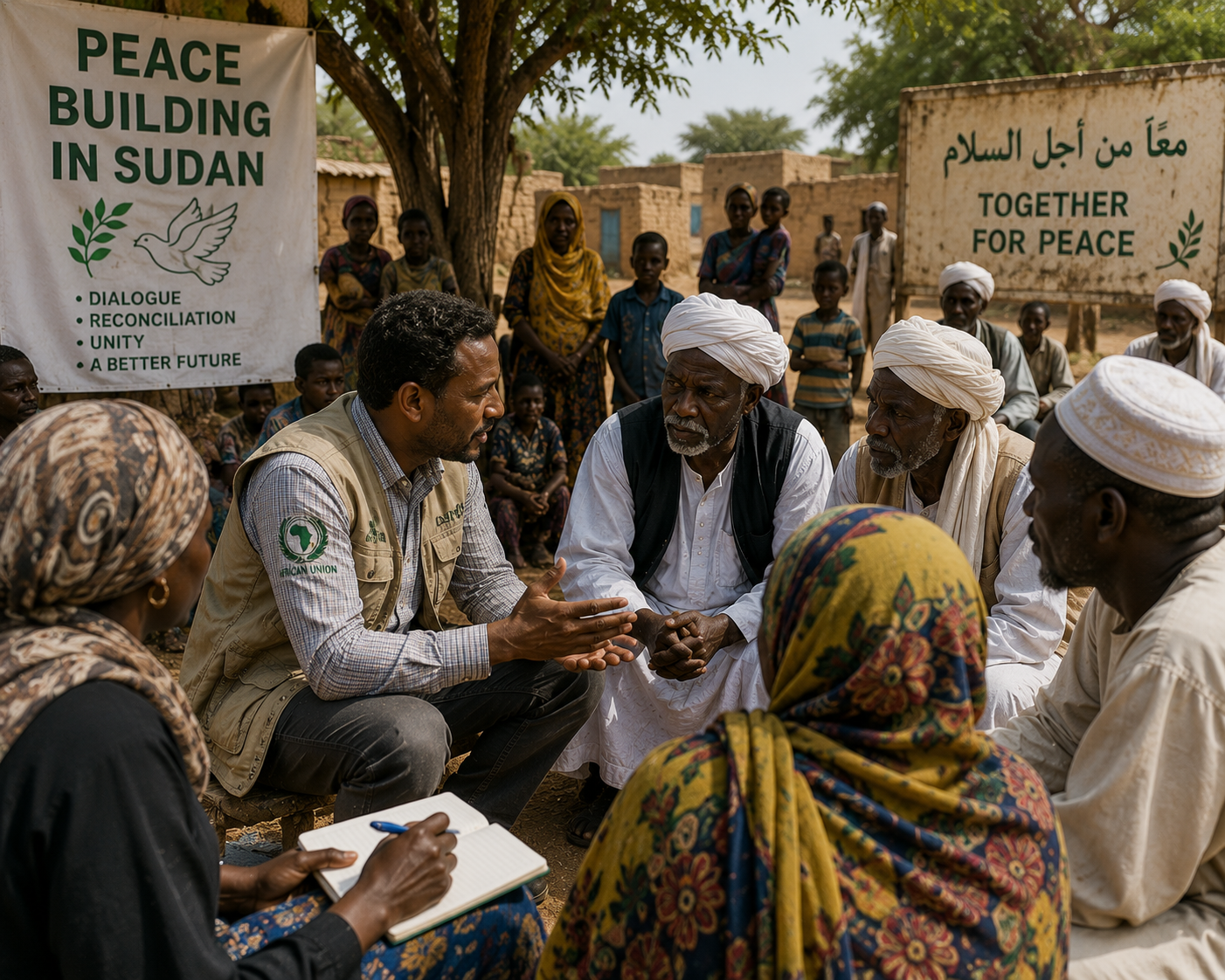
Peacebuilding in Sudan must begin at the community level. Local reconciliation initiatives are essential for rebuilding trust after years of violence, displacement, and ethnic polarization.
Across Sudan, local actors have already begun this work. Community organizations in Darfur have supported intercommunal dialogue, educational initiatives, and media campaigns designed to counter hate speech and reduce tensions. Organizations such as the SalaaMedia Center have launched platforms to strengthen community resilience and promote peace-oriented narratives. These efforts demonstrate that Sudanese civil society retains significant capacity even amid extreme pressure. International actors should therefore prioritize supporting local peacebuilders rather than imposing externally designed reconciliation models. This support can take concrete forms, such as providing flexible, sustained funding to grassroots organizations, delivering training in peacebuilding and mediation techniques, and offering protection measures for local mediators and journalists facing threats. International actors can also provide technical assistance, create safe spaces for dialogue, and ensure local peacebuilders have access to regional and global networks for knowledge exchange. By engaging directly with Sudanese organizations and tailoring assistance to local needs, external partners can help empower community-driven peace initiatives, particularly because reconciliation efforts will inevitably differ across regions and communities, making local ownership essential.
Inclusive Governance and Political Transition
A sustainable political settlement cannot be negotiated exclusively between the SAF and RSF leadership. Sudan’s future political order must include resistance committees, women’s groups, professional associations, youth movements, trade unions, and civil society actors that were central during the 2019 revolution. Research consistently demonstrates that peace agreements involving civil society and women are more durable than elite-only settlements. Yet Sudanese negotiations have repeatedly marginalized these groups.
Future governance arrangements must also address the longstanding imbalance between Sudan’s center and peripheral regions. Darfur, Blue Nile, eastern Sudan, and the Nuba Mountains have experienced decades of economic exclusion and political neglect. Without meaningful decentralization, equitable resource distribution, and representation for marginalized regions, any post-war government risks reproducing the same conditions that fueled previous conflicts. International mediators should therefore condition diplomatic support and reconstruction assistance on meaningful political inclusion and credible institutional reform. To enforce these conditions effectively, international actors could establish independent monitoring mechanisms that include local civil society and external observers. These mechanisms could require regular public reporting on benchmarks related to the representation of marginalized groups, the implementation of decentralization measures, and the protection of civic space. Furthermore, incremental release of financial assistance could be tied to the verified satisfaction of certain pre-agreed reforms, such as the formation of inclusive transitional bodies or the passage of legislation safeguarding human rights. These mechanisms would help ensure that compliance can be measured and that aid can be redirected or suspended in a timely manner if benchmarks are not met, thereby strengthening both accountability and the likelihood of genuine reform.
Security Sector Reform and Demobilization
Sudan cannot achieve stability while multiple armed organizations retain separate command structures, economic networks, and territorial influence. The RSF has developed extensive economic interests through gold mining, cross-border trade, and commercial activity, while the SAF continues to maintain substantial influence over state institutions and economic assets. Both actors possess incentives to preserve militarized power structures.
Comprehensive security sector reform (SSR) will therefore be essential. This includes:
- disarmament, demobilization, and reintegration (DDR) programs;
- gradual unification of armed groups under civilian authority;
- restructuring of security institutions;
- and the establishment of professional oversight mechanisms.
Experience from Liberia and Sierra Leone demonstrates that DDR programs are unlikely to succeed unless ex-combatants receive viable economic alternatives. Former fighters who lack employment opportunities or security guarantees often return to violence or criminal networks.
In Sudan, SSR must therefore be gradual and carefully sequenced. Immediate disarmament without political guarantees or opportunities for reintegration could create security vacuums and strengthen spoilers. A possible sequencing for the reform process could begin with establishing a comprehensive ceasefire and a mutually agreed political framework among all major stakeholders. The next step should focus on joint security assessments and the establishment of transitional oversight bodies that involve civilians and representatives from both the SAF and the RSF to ensure transparency and buy-in. Demobilization efforts should then prioritize low-risk armed elements while parallel initiatives provide targeted vocational training and reintegration packages. Security institutions could be restructured incrementally: command structures would first be unified under a civilian-led transitional authority, followed by the gradual downsizing or integration of paramilitary units into the national forces. Throughout this process, continuous international monitoring and technical support would be crucial to mitigate risks of spoilers or renewed violence.
Transitional Justice and Accountability
The scale of atrocities committed during the current conflict makes accountability unavoidable.
Sudan has a long history of impunity for political and military elites accused of serious abuses. Omar al-Bashir remained in power for years after being indicted by the International Criminal Court, reinforcing the perception that political and military elites operate beyond the reach of justice.
The current war has involved allegations of genocide, ethnic cleansing, systematic sexual violence, mass displacement, and deliberate attacks on civilians. Failing to address these crimes would deepen grievances and undermine future reconciliation efforts. Sudan will therefore require a comprehensive transitional justice framework combining judicial and non-judicial mechanisms. This should include:
- prosecutions for major atrocity crimes;
- truth-seeking initiatives;
- reparations for victims and affected communities;
- and institutional reforms designed to prevent future abuses.
Hybrid courts involving both Sudanese and international participation may offer one realistic pathway for accountability while maintaining domestic legitimacy.
Economic Recovery and Livelihoods
Conflict in Sudan is sustained not only by political rivalries but also by war economies.
Armed actors profit from control over gold mining, smuggling networks, border trade, and state resources. At the same time, widespread unemployment and economic collapse have created strong incentives for recruitment into armed groups.
Economic recovery must therefore become a central pillar of peacebuilding rather than a secondary post-conflict objective. Reconstruction efforts should prioritize community-driven development, agricultural recovery, youth employment programs, and equitable resource distribution. International financial support should be tied to transparency mechanisms designed to prevent elite capture and corruption. Sudan’s international partners must also address the country’s debt burden and fiscal crisis. Without meaningful economic stabilization, political reforms alone are unlikely to hold.
Obstacles to Peacebuilding
Despite the urgency of peacebuilding, the obstacles to implementation remain severe.
First, neither the SAF nor the RSF currently appears to believe that continued fighting is unsustainable. Both sides continue to benefit from wartime economic structures and maintain support from external backers. Regional and international actors, including the United Arab Emirates, Egypt, and Russia, have contributed to the conflict’s continuation through political backing, arms flows, or strategic competition. These dynamics reduce incentives for compromise. Second, Sudan’s territorial fragmentation complicates national negotiations. Large areas of the country remain divided between competing authorities and armed groups, making centralized implementation difficult. Third, Sudanese civil society has been systematically weakened. Activists, journalists, and local organizers have been detained, displaced, or killed. Restrictions on digital freedoms and civic space further undermine independent organizing.
Nevertheless, the cost of failing to invest in peacebuilding will likely be far greater than the cost of pursuing it. Continued instability risks regional spillover, further humanitarian collapse, and the entrenchment of armed economies that will become increasingly difficult to dismantle.
International policymakers should therefore prioritize several immediate actions:
- Securing humanitarian access;
- Expanding sanctions against actors fueling violence;
- Increasing support for local peace initiatives; and
- Strengthening diplomatic coordination around accountability mechanisms.
These measures alone will not resolve Sudan’s crisis, but they can create space for broader political and institutional transformation.
Conclusion
Sudan’s conflict cannot be resolved through ceasefires alone.
Sudan’s repeated cycles of violence demonstrate that elite agreements without structural reform may reduce immediate violence while leaving the underlying conditions for future war unresolved. The SAF-RSF conflict reflects deeper failures of governance, accountability, political inclusion, and economic development that have accumulated over decades. Peacebuilding is therefore not a secondary post-conflict exercise. It is the central requirement for Sudan’s survival as a functioning state. A sustainable path forward will require long-term investment in reconciliation, inclusive governance, security sector reform, transitional justice, and economic recovery. None of these reforms will be easy, particularly given ongoing violence and regional competition. Yet the alternative is continued fragmentation, recurring atrocities, and permanent instability. Sudanese civil society organizations, local communities, journalists, and grassroots activists continue to articulate a vision for a more democratic and inclusive Sudan despite extraordinary conditions. International actors should support these efforts with consistent diplomatic engagement, targeted economic assistance, and meaningful accountability measures. The central lesson from Sudan’s history is clear: peace agreements may temporarily end battles, but only peacebuilding can end the cycle of war.
For the United States, supporting peacebuilding in Sudan is not simply a humanitarian responsibility. Sudan sits at the center of a strategically important region bordering the Red Sea, a vital corridor for global trade, energy shipments, and international security operations. Continued instability risks intensifying regional displacement, expanding transnational smuggling networks, disrupting Red Sea security, and creating opportunities for extremist movements and external powers to exploit state collapse. The conflict also indicates rising geopolitical competition involving regional and international actors seeking influence across the Horn of Africa and the Red Sea basin. Investing in long-term peacebuilding, civilian governance, and institutional recovery is therefore not solely a moral imperative but also a strategic investment in regional stability and in preventing crises that could ultimately demand more costly international intervention. To translate this strategic vision into actionable policy, the United States should intensify diplomatic engagement with regional stakeholders to support inclusive peace talks, provide targeted humanitarian and development aid to rebuild vital institutions and services, and work with international partners to coordinate sanctions and incentives that encourage a return to civilian rule. Additionally, supporting multilateral cooperation through groups such as the African Union and the Intergovernmental Authority on Development can increase the impact of U.S. efforts and reinforce collective security over the region.


