The Designation Boomerang: How Terror Status for Brazil’s Factions Exposes US Gun Suppliers
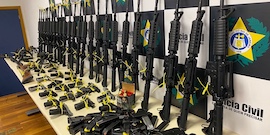

In November 2024, a man was gunned down in daylight outside São Paulo’s international airport. The victim, Antônio Vinícius Lopes Gritzbach, was a cooperating witness who had agreed to testify about his dealings with the Primeiro Comando da Capital (PCC). Among the three restricted-use rifles police recovered at the scene was a Smith & Wesson, left in a backpack near the terminal, that a US citizen had bought 15 years earlier from a gun shop in Winchester, Virginia, according to police records reviewed by the Associated Press.[1] The other two were Romanian-made, and they too had been purchased in the United States. How any of the three crossed into Brazil, the authorities have not established. Investigators were able to trace only one of the three, and that trail ended at a lawful over-the-counter sale in Virginia.
For decades, Brazilian law enforcement focused on traffic that moved in one direction. The outbound flow was the one that drew attention and resources: cocaine bound for the interior highways, the Port of Santos, the transatlantic corridors into Europe. What came back the other way drew far less institutional attention. That blind spot has now become a legal problem for both countries. Washington’s designation of the PCC and the Comando Vermelho (CV) as terrorist organizations, effective June 5, 2026, does more than tighten the financial noose around Brazil’s factions.[2] It opens a second avenue of liability, criminal and civil, that the Supreme Court left untouched when it shielded gun manufacturers in 2025, because the case before it had nothing to do with terrorism. The same designation Washington aimed at Brazil now turns part of that risk back onto the American suppliers who feed that flow.
A measurable flow
Neither faction manufactures its own rifles. The firepower that lets them out-gun the police in a given neighborhood is largely American.
The most rigorous numbers come from “Blind Fire,” a study published in September 2025 by Brazil’s Instituto Sou da Paz in a London School of Economics journal.[3] It draws on roughly 7,000 restricted-use weapons seized between 2019 and 2023 in Brazil’s Southeast, the region where both factions were born. Over those years, seizures of military-style weapons climbed 11.4 percent, from 1,494 to 1,665. Most of the seized firearms were made in Brazil. The United States was a consistent second, ahead of Germany and Belgium.
At the state level the pattern is even sharper. Of the 638 rifles that Rio de Janeiro’s military police seized in 2024, the force’s intelligence division traced 604, roughly 95 percent, to foreign factories.[4] The United States was the largest single source by a wide margin: 295 rifles, nearly half the foreign-made total, all built on one US platform. Across the wider Southeast, three of every four seized military-style rifles were chambered in 5.56×45mm and 7.62×51mm, the same rounds that flooded Brazil’s legal market once civilian access to previously restricted calibers was loosened between 2019 and 2022.
And it is not only finished rifles. Much of the trade runs through parts. An AR-pattern parts kit bought in the United States for around $1,000 is assembled by gunsmiths on a faction’s payroll and resold for close to eight times that price, by the Rio police’s own estimate. Brazilian officers have a word for the weapons that come out of mixed-origin components: “Frankenstein” rifles. In 2023, the Federal Police seized 47 of these ghost rifles in 5.56 caliber in an affluent corner of Rio.[5] Bloomberg traced one smuggling operation, code-named Florida Heat and running from 2017 to 2022, back to parts shipments from at least seven US-based manufacturers, all bought from ordinary online retailers that had broken no law.[6]
None of this requires anything illegal to happen inside the United States. The sale can be perfectly lawful at that counter in Virginia, and no border controls what happens to the weapon next.
The PLCAA shield
It is tempting to assume the law has already settled this question. It has not.
On 5 June 2025, a unanimous Supreme Court decided Smith & Wesson Brands, Inc. v. Estados Unidos Mexicanos.[7] Mexico had sued seven American gun manufacturers for $10 billion, on the theory that they fueled cartel violence by making trafficking easier. The justices rejected the suit and reaffirmed the Protection of Lawful Commerce in Arms Act (PLCAA), the 2005 statute that shields manufacturers from liability when third parties put their products to criminal use.[8] Writing for the Court, Justice Elena Kagan found that the complaint never showed the manufacturers had taken affirmative steps to facilitate unlawful sales, or that they intended to promote crime, which is the threshold for aiding-and-abetting liability.
The easy reading of that ruling is that the matter is closed: an American manufacturer does not answer for what a faction later does with its rifle. For the kind of claim Mexico brought, product negligence, that reading holds. A major manufacturer whose weapon turns up in PCC hands is generally protected by PLCAA.
The claim here is not that a Smith & Wesson rifle in PCC hands should punish Smith & Wesson. That argument would not survive a unanimous Court, and it should not. The question is a different one: whether the terrorist designation opens a door the ruling left shut only because terrorism was never before it.
A second avenue
On 28 May 2026, the State Department named the PCC and the CV as Specially Designated Global Terrorists, with the Foreign Terrorist Organization listing taking effect on 5 June 2026, under Section 219 of the Immigration and Nationality Act and Executive Order 13224. For the first time, this designation campaign reached Brazil directly. It had begun in February 2025 against Mexican cartels and other Latin American groups, among them the Sinaloa Cartel, the CJNG, and Tren de Aragua. By 2026, the PCC’s own operations had spread across South America, reaching as far as Chile.[9]
None of this came out of nowhere. The PCC had already been placed on the Treasury’s sanctions list under Executive Order 14059 in 2021, and in 2024 the Office of Foreign Assets Control sanctioned a financier who had washed roughly $240 million for the organization.[10] Then, in August 2025, Operation Carbono Oculto,[11] which Brazilian authorities called the largest search-and-seizure operation in the country’s history, exposed a multibillion-dollar laundering scheme running through the fuel sector, part of an asset network that investigators trace across fuel, logistics, fintechs, agribusiness, and real estate.[12] The danger is not only financial. Research by Uribe, Lessing, and colleagues finds that criminal governance is pervasive across Latin America, a phenomenon their data put at 77 to 101 million people,[13] and the depth of that governance in faction-held territory is widely documented.[14] Guns are what hold that control in place.
PLCAA guards against liability for the “criminal misuse” of a firearm “by a third party.” That is the logic of negligence. The terrorist designation does not remove that protection. It runs a separate body of law alongside it, one that turns on what a party knew and did, not on negligence or strict liability. This second regime has a criminal side and a civil one.
On the criminal side, the material-support statute is 18 U.S.C. §2339B,[15] and its threshold is lower than most people assume. To incur criminal liability, an actor need only know two things: that he is providing material support, and that the recipient is a designated organization or one that engages in terrorism. There is no requirement to intend the group’s violence, a point the Supreme Court settled in Holder v. Humanitarian Law Project.[16] Penalties run to 20 years in prison, with fines of up to $250,000 for individuals and $500,000 for organizations, and the statute reaches conduct committed abroad.
The civil side is the Anti-Terrorism Act, 18 U.S.C. §2333, widened in 2016 by JASTA to reach anyone who knowingly provides substantial assistance to an act of terrorism committed by an FTO. The bar here is higher. In Twitter, Inc. v. Taamneh (2023),[17] the Court read “knowing and substantial assistance” to demand “conscious, voluntary, and culpable” participation in the act itself, the same idea of complicity the Court would return to two years later in Smith & Wesson. A plaintiff who prevails collects treble damages and attorney’s fees.
The timing is hard to ignore. The Court appeared to close one path to liability in June 2025. A year later, the terrorist designation created a different one, grounded in terrorism law rather than negligence.
Who is actually exposed
Who, then, actually carries new risk? The answer has to be narrow. An inflated version of it would not hold up before a competent defense lawyer.
The large institutional manufacturer is not the one whose position changes. It stays protected by PLCAA and by the steep bar for aiding-and-abetting. The risk falls instead on those closer to the knowledge the statute requires: the exporter who ships components while looking past clear signs of where they are headed; the straw purchaser who buys in his own name to move weapons down the chain; the broker who would rather not confirm the cargo’s final destination. None of this requires any intent to cause harm. What matters is what a party knew, or deliberately avoided knowing, about a recipient that is now a designated terrorist organization, because §2339B hinges on knowledge of the group, not on any intent to further its violence.
It reaches further than that, to any company whose supply chain, commercial counterparty, or ownership structure touches the PCC or the CV, however indirectly. Firms including Jones Day, Hogan Lovells, and Freshfields put out alerts to exactly this effect once the listing came down, warning clients that third-party risk and opaque ownership were no longer just a question for the anti-money-laundering desk but live exposure under a sanctions-and-terrorism regime.[18]
There is precedent for exactly this. In October 2022, the Justice Department won its first corporate guilty plea under §2339B against the building-materials giant Lafarge, whose Syrian subsidiary had paid ISIS and the al-Nusrah Front to keep a cement plant running.[19] Lafarge agreed to roughly $778 million in penalties. Prosecutors never claimed the company shared the militants’ goals; they showed only that it paid them for commercial advantage, and the statute reached that conduct anyway. Corporate liability under §2339B is established practice, not theory. The Department has since signaled that it will treat corporate material support to FTOs, including the newly designated cartels, as an enforcement priority. That risk is no longer hypothetical. In March 2026, federal prosecutors in Arizona indicted the owner of a licensed firearms store under § 2339B for attempting and conspiring to supply weapons to the CJNG and the Sinaloa Cartel after both had been designated terrorist organizations.[20] It is the same liability theory, now applied to an American gun seller.
In the Brazilian context, the case that makes this concrete is Iron Tire.[21] In 2021, Homeland Security Investigations (HSI) and Brazil’s Federal Police, working together, took apart a network that was shipping hundreds of firearm accessories out of the United States to supply the PCC, the first documented instance of faction members sourcing components directly on American soil. One of them was arrested in Orlando, Florida. After 5 June 2026, conduct of that kind falls squarely inside the material-support regime, civil exposure and all. Florida adds a further wrinkle for anyone operating there: beyond the federal statute, the state criminalizes material support to a designated FTO (Fla. Stat. §775.33)[22] and provides its own civil cause of action, modeled on the federal Anti-Terrorism Act and carrying treble damages (Fla. Stat. §772.13)[23], so the forums in which such an actor can be sued multiply.
Iron Tire was not the only case of its kind. An earlier HSI investigation in South Florida, backed by Argentine and Brazilian authorities, charged two former Broward County residents with illegally exporting hundreds of AR-15 parts, without the State Department license the law requires, to a weapons-trafficking organization operating across South America.[24] The parts were assembled abroad and sold on to transnational criminal groups. At the time, this read as an export-control violation, and that is how it was charged. The same pattern today, parts that leave the United States and end up in PCC or CV hands, carries a heavier charge behind it: material support to a designated terrorist organization. None of these statutes is new. The designation brought those regimes together, and the new exposure sits in that overlap.
The boomerang
The designation was aimed at the two factions in Brazil, meant to cut their revenue, freeze their transactions, and disrupt their logistics. The same measure also creates exposure for American actors.
Drugs move north. Guns move south. The designation now sends legal exposure north as well. This was never a one-way measure aimed only at Brazil; both countries are exposed. Brazil absorbs the firepower that arms its factions. The United States carries the liability for whoever supplies that firepower once the recipient is a designated terrorist organization.
For more than two decades, the security debate in Brazil, and to a large extent in the United States, organized itself around one question: how the drugs reach the street. The flow in the opposite direction was always there, but it drew almost no notice. The export, cocaine, was studied in exhaustive detail. The import, the rifles, was barely tracked at all.
The terrorist designation places both directions of that flow under the same legal regime. And for the Comando Vermelho in particular, the inbound weapons flow may be its most concrete documented tie to the United States, firmer than the drug nexus itself.
For investigators, exporters, compliance officers, and policymakers, the question is no longer only how the drugs reach the street. It is also how the rifles reach the factions, and who, on both sides of the border, answers for putting them there.
Endnotes
[1] Gabriela Sá Pessoa, “Lax Gun Laws in Brazil and US Help Arm Brazil’s Organized Crime, Study Finds.” Associated Press. 23 September 2025, https://apnews.com/article/brazil-gun-policy-gun-trafficking-us-7c34c4e84b438084393c30db28b649e2.
[2] “Terrorist Designation of Comando Vermelho and Primeiro Comando da Capital.” U.S. Department of State, Office of the Spokesperson. 28 May 2026, https://www.state.gov/releases/office-of-the-spokesperson/2026/05/terrorist-designation-of-comando-vermelho-and-primeiro-comando-da-capital.
[3] Bruno Langeani and Natalia Pollachi, “Blind Fire: The Rise of Military-Style Firearms amid Regulatory Failures and Data Deficiency in Brazil.” Journal of Illicit Economies and Development. Vol. 7, no. 1, 2025: pp. 72-89, https://doi.org/10.31389/jied.300.
[4] Douglas Corrêa, “Maioria de fuzis apreendidos em 2024 no Rio foi fabricada no exterior.” Agência Brasil. 23 May 2025, https://agenciabrasil.ebc.com.br/geral/noticia/2025-05/maioria-de-fuzis-apreendidos-em-2024-no-rio-foi-fabricada-no-exterior.
[5] Renato Souza, “Ação da PF apreende 47 fuzis em condomínio de luxo no Rio de Janeiro.” Correio Braziliense. 11 October 2023, https://www.correiobraziliense.com.br/brasil/2023/10/5133128-acao-da-pf-apreende-47-fuzis-em-condominio-de-luxo-no-rio-de-janeiro.html.
[6] Bloomberg News, “Deadly New Trade in ‘Frankenstein’ Guns Enabled by a Gap in US Law.” Bloomberg. 14 December 2023, https://www.bloomberg.com/graphics/2023-us-made-gun-exports-frankenstein-gun-parts/.
[7] Smith & Wesson Brands, Inc. v. Estados Unidos Mexicanos, No. 23-1141, 605 U.S. 280 (2025),https://supreme.justia.com/cases/federal/us/605/23-1141/.
[8] “15 U.S. Code § 7903 – Definitions.” Legal Information Institute, Cornell Law School, https://www.law.cornell.edu/uscode/text/15/7903.
[9] John P. Sullivan and Diego Ramírez Sánchez, “Third Generation Gangs Strategic Note No. 55: Primeiro Comando da Capital (PCC) Expanding its Reach to Chile.” Small Wars Journal. 26 March 2024, https://smallwarsjournal.com/2024/03/26/third-generation-gangs-strategic-note-no-55-primeiro-comando-da-capital-pcc-expanding-its/.
[10] “Treasury Sanctions Primeiro Comando da Capital (PCC) Operative.” US Department of the Treasury, Office of Foreign Assets Control. 14 March 2024, https://home.treasury.gov/news/press-releases/jy2180.
[11] Marina Cavalari, “Historic PCC Bust Spurs Brazil Crackdown on Digital Money Laundering.” InSight Crime. 11 September 2025, https://insightcrime.org/news/historic-pcc-bust-spurs-brazil-crackdown-on-digital-money-laundering/.
[12] Roberto Uchôa, “From Drug Trafficking to Faria Lima: The PCC’s Metamorphosis into a Corporate Conglomerate and the Threat to the Economy.” Small Wars Journal. 30 August 2025, https://smallwarsjournal.com/2025/08/30/from-drug-trafficking-to-faria-lima-the-pccs-metamorphosis-into-a-corporate-conglomerate-and-the-threat-to-the-economy/.
[13] Andres Uribe, Benjamin Lessing, Noah Schouela, and Elayne Stecher, “Criminal Governance in Latin America: Prevalence and Correlates.” Perspectives on Politics. Vol. 24, no. 1, 2026: pp. 124-142, https://www.cambridge.org/core/journals/perspectives-on-politics/article/criminal-governance-in-latin-america-prevalence-and-correlates/A9B2D491806C26DB0F42869B2D81AB19.
[14] John P. Sullivan and Robert J. Bunker, Eds., Competition in Order and Progress: Criminal Insurgencies and Governance in Brazil (A Small Wars Journal–El Centro Anthology). Bloomington: Xlibris, 2022, https://smallwarsjournal.com/blog/competition-order-and-progress-criminal-insurgencies-and-governance-brazil; and, by the same editors, Third Generation Gangs and Transnational Cartels (A Small Wars Journal–El Centro Anthology). Bloomington: Xlibris, 2025, https://smallwarsjournal.com/2025/05/27/new-swj-el-centro-anthology-released-third-generation-gangs-and-transnational-cartels/.
[15] “18 U.S. Code §2339B – Providing Material Support or Resources to Designated Foreign Terrorist Organizations.” Legal Information Institute, Cornell Law School, https://www.law.cornell.edu/uscode/text/18/2339B.
[16] Holder v. Humanitarian Law Project, 561 U.S. 1 (2010), https://supreme.justia.com/cases/federal/us/561/1/.
[17] Twitter, Inc. v. Taamneh, 598 U.S. 471 (2023), https://supreme.justia.com/cases/federal/us/598/21-1496/.
[18] “Brazilian Criminal Factions Designated as Terrorist Groups by U.S. State Department.” Jones Day. 30 May 2026, https://www.jonesday.com/en/insights/2026/05/brazilian-criminal-factions-designated-as-terrorist-groups-by-us-state-department; “U.S. Government Designates Brazil’s Primeiro Comando da Capital (PCC) and Comando Vermelho (CV) as Terrorist Organizations.” Hogan Lovells. 29 May 2026, https://www.hoganlovells.com/en/publications/us-government-designates-brazils-primeiro-comando-da-capital-pcc-and-comando-vermelho; “U.S. Terrorist Designations of Brazilian Crime Groups.” Freshfields. 5 June 2026, https://www.freshfields.com/en/our-thinking/blogs/a-fresh-take/u-s-terrorist-designations-of-brazilian-crime-groups-102n188.
[19] “Lafarge Pleads Guilty to Conspiring to Provide Material Support to Foreign Terrorist Organizations.” US Department of Justice, Eastern District of New York. 18 October 2022, https://www.justice.gov/usao-edny/pr/lafarge-pleads-guilty-conspiring-provide-material-support-foreign-terrorist.
[20] “Gun Store Owner Indicted for Conspiracy and Attempting to Provide Material Support to Designated Foreign Terrorist Organizations.” US Department of Justice, District of Arizona. 25 March 2026, https://www.justice.gov/usao-az/pr/gun-store-owner-indicted-conspiracy-and-attempting-provide-material-support-designated.
[21] “HSI, Brazil Federal Police Execute Large-Scale Disruption of International Arms Trafficking Organization.”US Immigration and Customs Enforcement. 2 June 2021, https://www.ice.gov/news/releases/hsi-brazil-federal-police-execute-large-scale-disruption-international-arms.
[22] “The 2025 Florida Statutes, §775.33 — Providing Material Support or Resources for Terrorism or to Designated Foreign Terrorist Organizations.” The Florida Senate, https://www.flsenate.gov/Laws/Statutes/2025/775.33.
[23] “The 2024 Florida Statutes, §772.13 — Civil Remedy for Material Support of Terrorism.” The Florida Senate, https://www.flsenate.gov/laws/statutes/2024/772.13.
[24] “Former Broward County Residents Charged with Export Control Violations for Illegally Exporting Hundreds of Parts for AR-15 Assault Rifles.” US Department of Justice, Southern District of Florida. 28 June 2019, https://www.justice.gov/usao-sdfl/pr/former-broward-county-residents-charged-export-control-violations-illegally-exporting.