





Cognitive Warfare at the Crossroads: Defining and Developing Capabilities


Introduction: The Biopsychosocial Complementarity of Cognitive Warfare
To date, there continues to be some discussion, including essays that have appeared in this forum, as to whether and to what extent cognitive warfare represents anything other than psychological operations (PSYOPS) with more sophisticated tools and methods, or if it actually is a unique and evolving domain of combat. To be sure, given that (1) a formal definition of cognition describes mental processes of assimilating information, comprehending and gaining knowledge; (2) mental processing is defined as those operations that mediate sensory input and behavioral output; and (3) the psychologic realm is defined as the unconscious and conscious events and mechanisms that affect behavior; it is axiomatic that any engagement(s) in the cognitive domain will entail psychological factors. But cognitive warfare is not limited to the psychologic realm. Rather, we posit that it entails complementary, interdependent operations in and across the spectrum of biological, psychological and social dimensions (See figure 1), and in this way, (2) can influence operations in all other domains of warfare.
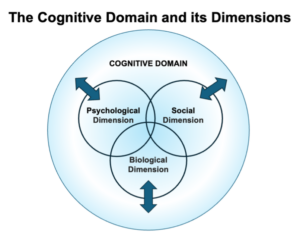
Figure 1 Caption: Diagrammatic representation of the multidimensionality of the cognitive domain battlespace (details in text).
Yet, despite growing recognition of the cognitive domain as a viable and valuable operational arena, a recent Senate Armed Services Committee (SASC) assessment soberingly concluded that the Pentagon currently lacks both the strategic clarity and the operational capability required to conduct an effective cognitive warfare campaign. Such capability includes the means and methods to both change an adversary’s beliefs, attitudes, values and behavior, and to deter and counter an adversary’s cognitive warfare initiatives. The SASC’s critique affirms our longstanding view that neurocognitive targeting is no longer science fiction but instead has rapidly emerged as scientific fact that should foster profound operational concerns about threat(s) to the United States (US)’ security.
To adequately prepare for and respond to such threats, we believe that U.S. military planners must conceptualize cognitive warfare not as a discrete set of techniques but as a campaign. They should view cognitive warfare as a palette of capabilities that are leverageable across the entire cognitive battlespace, as depicted in figure 1. Understanding these interdependences is crucial for effective operational planning over time.
The Biopsychosocial Battlespace of Cognitive Warfare
The biological dimension entails the neurophysiological substrates of cognition; namely, the structural and functional integrity of the brain, including neurochemical systems, sensory mechanisms, and processes of thought, perception, emotion, and decision-making. In this area, cognitive warfare capabilities include pharmacological agents that influence neurotransmitter systems affecting alertness, mood, or judgment. In addition, various forms of directable energies can be used to disrupt neural processing, and novel gene-editing and synthetic biologic technologies can be employed to enhance or degrade cognitive capabilities over time. Given that altered neurophysiologic alterations can directly influence individual experience and behavior, interventions in the biological arena will incur effects in the psychological and social areas as well. In light of this, the interactive bio-psychological domains also include stress responses that accompany sustained cognitive load, sleep deprivation, or exposure to perceived threat(s), all of which can be exploited or induced.
In the biological realm, adversaries are pursuing novel pharmacological agents, electromagnetic neuromodulation, brain-machine interfaces, and directed energy systems, all of which can be weaponized. Regulating the neurodata that can be exploited for assessing and affecting neurocognitive systems, evaluating and mitigating cyberbiosecurity risks is even more critical. Without active surveillance and regulation, adversaries will develop capabilities that emerge unchecked, bypassing the oversight and control mechanisms of extant weapons control treaties like the Biological Weapons Convention and Chemical Weapons Convention.
The psychological dimension represents individuals’ subjective experience, cognitive processing, emotional regulation, and decision-making. This includes perception, attention, memory, reasoning, belief formation, motivation, and the psychological resilience or vulnerability that determines how individuals respond to familiarity, uncertainty, and stress. Cognitive warfare in the psychological dimension targets vulnerabilities in human cognition such as confirmation bias, heuristics, emotional reasoning, cognitive consonance and dissonance, and the need for narrative coherence. Operations in this area employ targeted messaging, and use symbols, semiotics, memes and tropes that exploit individuals’ sentiments, aspirations, and/or worldviews. They are used to cause information overload inducing decision paralysis and eroding confidence. Importantly, psychological effects are shaped by both biological and social factors, and can reciprocally affect them, thereby creating a dynamic system in which individuals’ cognition is never truly isolated.
In the psychological arena, adversaries’ cognitive warfare operations leverage neuroscientific insights, targeted misinformation, and manipulation of emotionally resonant narrative and trope platforms to alter perceptions and thereby affect targets’ attitudes and behavior. Current advancements by peer-competitor and adversarial nations (and their proxies) should further compel U.S. development of an integrated system of deterrence of, and defense against mis/disinformation and psychological exploitation. Such a deterrent posture begins with a granular understanding of adversaries’ strategic culture and the operating logic that evolves from it. Of note in this regard is that Chinese Shih strategic culture provides a conceptual framework for their cognitive engagement narratives and informs the temporal horizon for China to become the preeminent global superpower.
The social dimension encompasses the collective space of cognition (i.e. – group identity and cultural narratives) and the shared beliefs that bind or fracture communities. It is important to recognize that humans are fundamentally social organisms whose individual cognition is dependent on and profoundly shaped by group membership, social comparison, conformity pressures, and needs for belonging and status. Cognitive warfare in the social dimension operates by manipulating group identities, amplifying inter-group dissonance and tension, undermining trust in institutions and leaders, and disrupting social cohesion. This is primarily where narrative engagements, disinformation campaigns, and polarization tactics are directed, using all of the information ecosystems (e.g.- personal and social media platforms, etc.) to reshape collective perception at scale. Thus, social-domain effects concomitantly depend upon and produce changes in individual psychology, and group-level phenomena. These changes can normalize or stigmatize particular individual and collective beliefs and behaviors. They also create feedback loops, which amplify the effects of these engagement(s).
In the social arena, misinformation ecosystems manipulated by neurocognitively directed digital targeting technologies can prompt and/or exacerbate polarization, weaken societal resilience and disrupt democratic cohesion. For example, current peer-competitors and adversaries are seizing advantage of the open, diverse culture of the U.S. to fortify divisive narratives and foment animosity between opposing groups. Hence, the U.S. and its allies should seek to mitigate existing gaps and vulnerabilities in these domains and amplify and accelerate efforts to counter adversaries’ use of these tools. Absent current signatory treaties or multinational guidelines addressing the scope and conduct of cognitive engagements, the development of nefarious capabilities will continue unchecked.
These dimensions constitute the inter-functional hierarchy of systems that defines cognitive warfare. Cognitive targeting encompasses the entirety of this interconnected system and can be directed at biological (‘bottom-up’), psychological (middle-out’) and/or social (‘top-down’) levels to exert maximum effects (see figure 2)
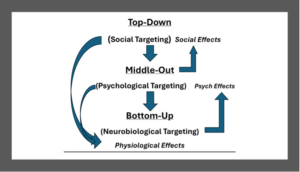
Figure 2: Schematic representation of “bottom-up” (neurobiologic), “middle-out” (psychologic) and “top-down” (social) foci of cognitive targeting, illustrating the interactive effects of such targeting approaches.
For example, a biological intervention (such as exposure to a pharmacological agent or some form of directed energy) can affect psychological processing, which in turn influences behaviors to influence social interactions and group dynamics. Conversely, social variables will incur individual and collective psychological responses that manifest in measurable biological changes and behavioral outcomes. Effective cognitive warfare campaigns are designed to impact and cascade across all three parts of the system in the cognitive domain. Thus, cognitive warfare, by targeting decision-making could undermine the very foundations of just war theory and international humanitarian law. These frameworks assume that combatants are capable of moral agency, if not rational choice. Operations designed to eliminate or fundamentally compromise such agency represent a categorical transformation in the character of war. They render regnant ethical and legal frameworks dated, if not obsolete, and should prompt revising these treaties and signatory conventions or establishing others anew.
Operational Classification: Covert, Clandestine, and Overt
Cognitive warfare operations can be classified as covert, clandestine or overt according to their visibility and attribution profile, with each offering distinct operational advantages and challenges.
Covert operations are those where both the activity and the engaging entity remain obscure. The targeted individual(s) or collective(s) are unaware that an operation against them is being conducted. Covert cognitive engagements include subliminal messaging, unattributable social media manipulation using sophisticated bot networks and artificial personas, or neurocognitive (e.g.- pharmacological or technological) interventions being delivered without the target’s knowledge. The tactical value of such operations is inherent to their opacity, while their strategic value is derived from their ability to influence cognition and behavior while avoiding defensive responses or attribution that could trigger retaliation. However, covert operations are often difficult to sustain, as discovery typically occurs following repeated occurrences, thereby undermining the future viability (and value) of such engagements in a given target space.
Clandestine operations are those where the activity may be visible, but the offending actor remains unrecognized or plausibly deniable. Currently, most cognitive operations are executed in this space, consider for example disinformation dissemination through proxy media outlets, influence operations conducted through front organizations, and/or ambiguous neurocognitive engagements and effects, whereby both mechanism and perpetrator may remain difficult to identify. Clandestine operations can afford sustainable effects while managing retributive risk through attribution ambiguity. The challenge for defenders is that clandestine operations exploit uncertainty, making decisive response difficult and allowing adversaries to probe vulnerabilities while maintaining strategic deniability.
Overt operations are those conducted openly, with clear attribution to the engaging entity. This might include acknowledged psychological operations during declared conflicts, open influence campaigns designed to shape international opinion, or declared research and use of cognitive enhancement or disruption in warfighting. Overt operations have significant deterrent signaling value and benefit from legitimacy within applicable legal frameworks. They can also be instrumental for building coalitions around defined, shared objectives. However, they are also likely to evoke defensive countermeasures, and retaliatory actions that can be disproportionate, and not limited to the cognitive domain.
As illustrated in figure 3, modern cognitive warfare campaigns typically employ covert, clandestine and overt approaches simultaneously and with orchestrated synergy to engage biological, psychological and/or social domains of effect.
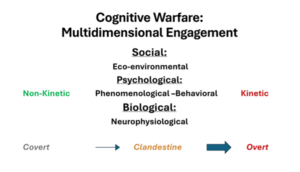
Figure 3: Schematic representation of possible distribution and exercise of non-kinetic and/or kinetic, and covert, clandestine, or overt operations in and across the multidimensional spectrum of cognitive warfare (details in text).
For instance, an adversary might conduct overt diplomatic messaging to establish a narrative framework while executing clandestine influence operations exploiting media and amplifying and legitimizing a selected narrative. That narrative targets select elements of a collective and employs covert interventions targeting key decision-makers to surreptitiously bias their attitudes, judgment and behaviors. Such synergy creates compound effects that can be far greater than the simple summed outcomes of unitary-domain operations.
The Non-Kinetic/Kinetic Continuum
The spectrum of cognitive warfare capabilities is executed across a range of non-kinetic to kinetic applications. “Pure” non-kinetic cognitive engagements employ informational, psychological, and social means to affect cognition without physical force or material destruction. This includes disinformation campaigns, targeted propaganda, social media manipulation, influence operations, and psychological operations designed to alter beliefs, perceptions, and ultimately behaviors. These approaches leverage the vulnerabilities inherent in information processing and social dynamics, requiring no physical access to targets and often operating below the generally accepted threshold of armed conflict. The strategic advantage of non-kinetic cognitive warfare lies in its deniability, its ability to operate continuously during peacetime, and its potential for mass effect across entire populations through networked information systems.
Hybrid approaches combine non-kinetic cognitive effects with limited kinetic enablers. For example, a directed-energy weapon that produces temporary disorientation or a pharmacological agent that induces confusion represents a kinetic delivery mechanism for a primarily cognitive effect. Similarly, cyber-attacks that disable communications infrastructure can serve kinetic purposes but generate end-effects through the psychological and social consequences of isolation and uncertainty. These hybrid capabilities blur traditional boundaries between information operations and direct action, affording tactical flexibility and strategically latent impacts; all the while offering a veil of ambiguity regarding attribution.
Kinetic-cognitive integration represents the incorporation of cognitive warfare methods and principles into conventional kinetic operations. This includes using neuroscientific approaches to optimize psychological operations during combat; employing precision targeting to maximize psychological impact through tactical strikes that yield more durable strategically influential cognitive effects; and coordinating kinetic actions with information operations to influence adversary decision-making. This integration enables engagement in the cognitive domain to become a force multiplier for traditional military capabilities, fortifying kinetic effects to achieve maximum (psychologically and socio-behaviorally) disruptive outcomes, rather than merely physically destruction.
Recognizing the effects and implications of these interactive effects of cognitive engagement and non-kinetic through kinetic applications enables insight to their relative value. Indeed, a devastating non-kinetic cognitive attack could be more strategically consequential than limited kinetic action yet may not trigger conventional deterrence or response mechanisms.
At present, non-kinetic cognitive warfare tends to be the purview of the intelligence community while kinetic applications are more frequently conducted by conventional military forces. We believe that these distinctions and mission separations are not realistic, especially in today’s security environment. The current environment demands the development of more effective and efficient capabilities and the need for dedicated resources to meet, address and respond to threats in the cognitive domain. Simply put, engagements along the cognitive (bio-psychosocial dimensions and non-kinetic through kinetic) spectrum represent an emergent domain of warfare. Prevailing in this domain necessitates intelligence and defense community collaboration and coordination, along with a whole-of-nation response.
“Individual to Group” and “Group to Individual” Targeting
Cognitive warfare engages two complementary approaches, “Individual to Group” and “Group to Individual” targeting. This enables comprehensive effects across an adversary’s decision-making hierarchies and societal foundations. Individual targeting focuses on high-priority individuals, such as senior military leaders, political decision-makers, key technical personnel, and others who have strategic impact. Operations against these targets employ highly personalized approaches based on detailed psychological profiles that exploit individual cognitive vulnerabilities, belief systems, and decision-making heuristics. For example, a senior commander’s perception of battlefield conditions, confidence in intelligence assessments, or amenability to accept risk can be subtly influenced through carefully crafted information environments, targeted disinformation that exploits existing biases, or even direct neurobiological interventions in certain contexts and scenarios. The strategic logic of “Individual to Group” targeting is grounded in the leverage of affecting select decision-makers that can redirect entire military operations, shift policy decisions, and/or affect the stability and conduct of organizational hierarchies.
Such approaches require sophisticated intelligence preparation, reliable access to and assessment of the target’s information environment, and calibrated articulation to avoid detection while achieving effect. They are particularly effective during times of crisis when key leaders may experience cognitive overload while needing to make high-stakes decisions with incomplete information. Additionally, an adversary may induce such situational variables to “position” influential targets to be more vulnerable to cognitive manipulation. Individual targeting is most effective against targets and target organizations that lack redundancy in decision-making structures.
Group targeting seeks to affect broader groups of individuals, creating mass disruptions that incur ripple effects to influence leadership, degrade societal resilience, and undermine collective will. These campaigns operate at scale, leveraging information technology and social media to achieve wide reach with tailored messaging designed to polarize, confuse, demoralize, or radicalize targeted groups. Such cognitive engagements exploit group dynamics, social identity, and communal emotions to fracture cohesion, exacerbate division, and foster an environment of suspicion and volatility. The strategic power of these approaches is in manipulating the cognitive processes of policy and military decisions.
When facts about reality become disparate, trust in intelligence analysis erodes, and intragroup cohesion fractures. The capability for leadership to ‘lead’ becomes strained as doubts about intended courses of action threaten decision makers’ authority. Group cognitive engagement is used by adversaries to create conditions where even optimal decisions by capable leaders cannot be effectively implemented due to informational chaos, collective discord and resistance, and institutional paralysis. The challenges of group targeting are maintaining narrative coherence across diverse target populations, sustaining effects over time as media/messaging and managing the risk that group disruption becomes uncontrollable and produces unintended consequences. The most sophisticated cognitive warfare campaigns integrate both forms of targeting in mutually reinforcing ways. For example, group polarization and confusion can create an information environment where individual targeting of key leaders is facilitated and fortified to become more effective, as individual leaders find their mandate to lead in question
Deterrence Effect(s) of Cognitive Engagement
The SASC report reinforces the need for a comprehensive cognitive warfare deterrence posture spanning neurobiological, psychological, and social areas of interest. Effective deterrence in the contemporary cognitive engagement environment requires a dual approach: leveraging technologies for offensive effects, while developing defensive capabilities against adversaries’ technological innovations; keeping in mind that cognitive warfare is about human perceptions, not just the technologies that may be used to affect them. Any effective deterrence posture in the cognitive domain is founded upon a population’s ability to think critically about the veracity and implications of the information that is available to them in myriad forms. The disruptive impacts of cognitive engagements are raising the stakes of warfare and are introducing new levels of unpredictability to the threat landscape. In particular, the possibilities for novel and enhanced weapons systems created by integrative scientific and technologic convergence blurs the line between military and civilian uses and thus complicates traditional nonproliferation and arms control methods and regimes.
According to the Department of Defense Joint Publication 5-0: Joint Planning (July 2025), deterrence is defined as “discouraging an actor from taking unwanted action by signaling and demonstrating the existence of a credible threat of unacceptable counteraction or the adversary’s belief that the costs of a future action outweigh the perceived benefits.” Characteristically, deterrence goals are achieved by shaping an adversary’s perception of the costs and benefits of their actions and of the viability of restraint as an acceptable course of action. Importantly, the ultimate measure of effectiveness of a deterrence strategy is in the eyes of the adversary. Without an in-depth understanding of the adversary’s culture and belief systems, including their political incentive structure, any deterrence strategy runs the risk of mirror imaging, and is destined to fail.
Operational Implications and Strategic Integration
At this juncture, we feel that several foundational points are worth noting. First, that the embodied, socially-embedded human brain and its constituent functions (i.e.- the “mind”) is the fundamental nexus of cognitive warfare. As Hoffmann has noted , this battlespace is targetable, and dual use neuroscience and technology (neuroS/T), cognitive/psychological techniques, and social influence methods contribute to the development of weaponizable approaches with applications ranging from affecting neurocognitive functions in key individuals, to incurring destabilizing and dependency effects in groups. The SASC’s finding that the Pentagon is not apace with rivals’ enterprises in this space further validates that cognitive warfare tools and techniques, when coupled with a considered understanding of the social and cultural contexts of an adversary, have sufficiently matured to achieve operational relevance, and in this way pose a clear and present threat.
Second, the noted lag in the SASC language in research and operational readiness underscores an inadequacy of cohesive and actionable doctrine for cognitive warfare. Indubitably, research must be undergirded and directed by technical, as well as ethical, legal and policy frameworks that guide responsible development and deployment of tools and techniques. Absent such doctrine, vital capabilities risk being overlooked by the U.S. They are not, however, being overlooked by adversaries such as China and Russia who understand the power of cognitive warfare. Furthermore, the paucity of clear definitions, classification, and governance of cognitive domain capabilities poses risks for unchecked proliferation, misuse and strategic miscalculation.
Third, prior and current efforts aimed at improving warfighter cognition and affecting adversaries’ neurocognitive performance should be prioritized and fortified. This includes arming U.S. forces with the critical thinking skills to question and disregard attempts by adversaries to instill cognitive dissonance in personnel, including senior decision-makers. To this latter point, the SASC’s warning counsels that the disruptive capacity of U.S. and allied neurocognitive capabilities remains underdeveloped. Given that China and other states are rapidly developing cognitive warfare capabilities, we believe that a balanced emphasis on both warfighter enhancement (viz.- neurocognitive health, operational protection, and enablement) and disruption of adversaries’ capabilities remains crucial for operational readiness as well as deterrence.
These imperatives, however, do not imply that the ethical issues generated by neurocognitive operations’ research and engagement be ignored. Nor should we ignore differences in adversary nations’ cultures, philosophies, and politics that support practices that are fundamentally different from our own. This cultural and social distinction is an enduring parallax in the cognitive battlespace. Understanding and accepting this parallax is key to the development and employment of effective offensive and defensive measures in a cognitive war campaign.
Conceptualizing cognitive warfare as a spectrum across multiple dimensions enables several critical operational capabilities. First, it allows tailored campaign designs that match specific operational objectives with appropriate combinations of domain focus, non-kinetic/kinetic engagements, operational (i.e.- covert, clandestine, overt) classification, and targeting. Second, it facilitates multi-echelon coordination where operational, tactical and strategic goals and elements can be aligned to synthesize and synchronize effects in the cognitive battlespace. Third, it enables dynamic adaptation as operations shift in response to adversary countermeasures, changing operational conditions, and evolving strategic objectives.
This spectrum framework necessitates the development of integrated capabilities that conjoin neurocognitive research laboratories, psychological operations units, information warfare commands, cyber operations, intelligence agencies, and conventional force structures. It will require evolving (1) doctrine that explicitly addresses how cognitive effects integrate with traditional domains of warfare; (2) training to prepare personnel to recognize and respond to cognitive attacks, and (3) institutional and organizational authorities to enable rapid, well-informed decision-making across the full spectrum of operations in the cognitive domain.
Most importantly, we assert that cognitive warfare should not be regarded as supplementary to traditional military operations, but rather is central to prevailing in strategic competition and conflict. Adversaries who become adept at operating across this full spectrum (i.e.- biological through social domains, non-kinetic through kinetic applications, covert through overt classifications, top-down and bottom-up targeting) will achieve strategic objectives. The findings of the recent SASC report caution that competitors are already progressing to operational capability across this full spectrum, while U.S. capabilities remain fragmented and underdeveloped.
Recommendations
In light of the SASC findings, we offer the following recommendations toward fortifying U.S capabilities in the cognitive domain:
1. Establish doctrine and strategic clarity by defining the cognitive battlespace. Doctrine should recognize, define and formally establish the entirety of cognitive processes as the preeminent domain of warfare. It is important to integrate cognitive engagement constructs into modeling exercises, wargames, operational intelligence, tactical mission planning and strategic goals. These approaches will be crucial to mapping adversary threats across neurobiological, psychological, and social areas and establishing appropriate defensive and offensive operational activities.
2. Enhance awareness and training. Joint force-wide education should entail cognitive warfare content into extant professional military education, war colleges’, and combatant command curricula. Critical thinking skills should be taught to recognize cognitive attacks from every dimension and direction. Early warning and investigative/intelligence capacities should be fortified by improved detection and attribution protocols for neuroweapon incidents and streamlined mechanisms for reporting – and validating – such incidents. It is also imperative to deal with an adversary cognitive war campaign in ways that negate its effect on U.S. strategic / operational decision-making and subsequent behaviors.
3. Advance dual-use neuroS/T research. Priority should be given to research that enhances joint warfighter cognitive performance; while equal emphasis should be placed on developing technologies and countermeasures aimed at modulating adversaries’ cognitive function. We have emphasized previously, and reiterate here, the importance of, and need to sustain ethical and legal probity in these pursuits.
4. Integrate cognitive deterrence and defense systems. Layered defenses combining technical tools and methods (e.g.- neurodata resilience and resistance to purloinment; neurotechnological safeguards that ensure all neurocognitive devices employed for military undergo rigorous auditing; access controls, and tamper-resistance to prevent unauthorized exploitation or data exfiltration), and policy mechanisms should be developed and deployed to counter disinformation and manipulation. Even more important is the need to develop the capability for individuals and groups to recognize and counter cognitive attacks.
5. Engage international collaboration and governance; since coalitions are always stronger than any individual country. Coalitions with allies that establish partnerships with allied academic, defense, and policy institutions can coordinate research, develop shared norms, and facilitate cooperative surveillance of neuroweapon developments worldwide. Additionally, such collaborations should address gaps in existing guidelines and policy guardrails relevant and applicable to cognitive warfare, and work to close gaps in current treaty mechanisms and their enforcement, as previously discussed (see above).
Conclusions: The Broader Security Imperative
The SASC’s report materially validates our ongoing warnings that the human mind is now a contested battlespace, and adversaries are gaining capabilities in cognitive warfare that pose a clear threat to U.S. national security. Ignoring these developments or failing to act swiftly cedes strategic advantage in this domain. We believe that the cognitive domain is even more consequential than the other domains of war: sea, air, cyber, or space. The SASC report serves as an urgent reminder that neurocognitive warfare is advancing, and adversaries are deploying ever more sophisticated techniques and technologies affecting individual and collective cognition, decision-making and behavior.
We believe that the U.S. must maintain both capability development and ethical discipline, ensuring that research serves both national security and global norms. From this, a multi-domain deterrence strategy must be developed that spans neurobiological, psychological, and social domains and integrates technical, doctrinal, and policy solutions. This is a measured recommendation that U.S. and allied dual-use neurocognitive research and capability development must remain ahead of the threats from Russia and China that are a current reality. Additionally, deep and measured discourse should focus upon the role of the U.S. in the entire spectrum of cognitive warfare. Lessons learned from the Cold War about geo-political stances and postures could provide insights to options for navigating the current realities of cognitive warfare, and the possible scenarios and exigencies that lie ahead.
The challenge is not merely technical but rather is one that must be understood within the neurobiological, psychological and social framework we presented. We are facing threats that seek to alter our perceptions about factual or empirical data, to influence our decision making and consequently change our group and individual behaviors. Adversaries do that by attacking the cognitive process of groups and individuals with an eye towards changing how they act upon those thoughts, feelings and beliefs. To meet this challenge, we advocate arming U.S. forces with the tools and methods needed to understand the actualities and potential of cognitive warfare, and effectively deter, and defend against this threat.
Disclaimer: The views and opinions expressed in this essay are those of the authors and do not necessarily represent those of the United States government, Department of War, or the National Defense University.




A concise and timely analysis that rightly frames cognition as the central battlespace in modern competition. Its warning about U.S. strategic gaps in cognitive warfare is well‑argued and deserves urgent policy attention.