





Gillibrand Bill Puts a Human in the Loop
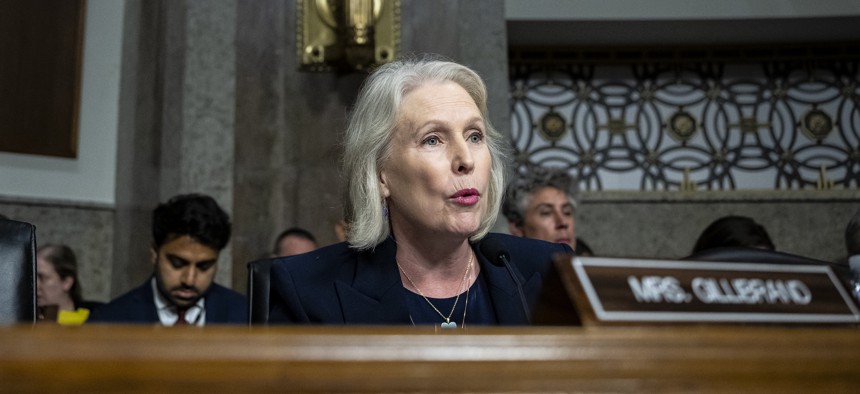

Senator Kirsten Gillibrand, D-N.Y., has introduced the Secure and Accountable Military AI Act of 2026. This bill would establish the first comprehensive statutory framework for how the Department of Defense governs artificial intelligence in military operations.
The Bottom Line
The bill’s architecture rests on the single organizing principle that AI can support human judgment, but cannot replace it in high-consequence decisions. “High-consequence decisions” are defined broadly to mean nuclear targeting, lethal targeting support, autonomous weapon systems, cyber operations with external effects, and domestic surveillance of U.S. persons. Per the bill, all require designated human decision-makers with documented authority and the practical ability to override or terminate the system.
Autonomous Weapons
The most operationally significant provisions govern autonomous weapons. The bill effectively prohibits fully autonomous weapon systems except in four narrow circumstances:
- Semi-autonomous systems with operator target selection
- Supervised autonomous systems for local point and platform defense against saturation attacks
- Surface-to-air missile interception
- Non-lethal non-kinetic applications
Anything outside those categories requires the Secretary of Defense to petition Congress directly. A joint resolution of approval naming the specific system would be required before fielding.
Contractor Provisions
Companies providing frontier AI models to DoD must report covered incidents. These include:
- model weight theft
- training data poisoning
- supply chain compromise
- materially concerning model behaviors like unexpected cyber offense capability or deceptive behavior
Per the bill, contractors would be required to report these incidents within 72 hours for security breaches and 7 days for behavioral anomalies.
Tensions
The bill is laudable, but there are tensions between operational demand and well-intentioned safeguards. Take an example from The Economist’s cover story on the evolution of modern war, discussed recently in our discourse titled “The Dangerous Delusion of the Knock-Out Blow | The Economist,” which observed that American engineers are expecting targeting systems to move from 400 to 5,000 targets in the near future. That rate is admitted to be “beyond human scope.” One of the two sides will need to budge. You can’t have your operational capability and eat it too. Expect this bill to garner some intense debate as we progress through the NDAA process.
You can access the full text of the bill here.
While you’re here…
Check out Captain Scott Pleasants’ article on the importance of preparing a workforce to be capable of critically evaluating and securely using AI technologies in the National Security arena: “The AI Battlespace: Artificial Intelligence, Civil Stability, and the Weaponization of Trust.”

