





Ukrainian Veterans Bring Lessons of War to Arizona
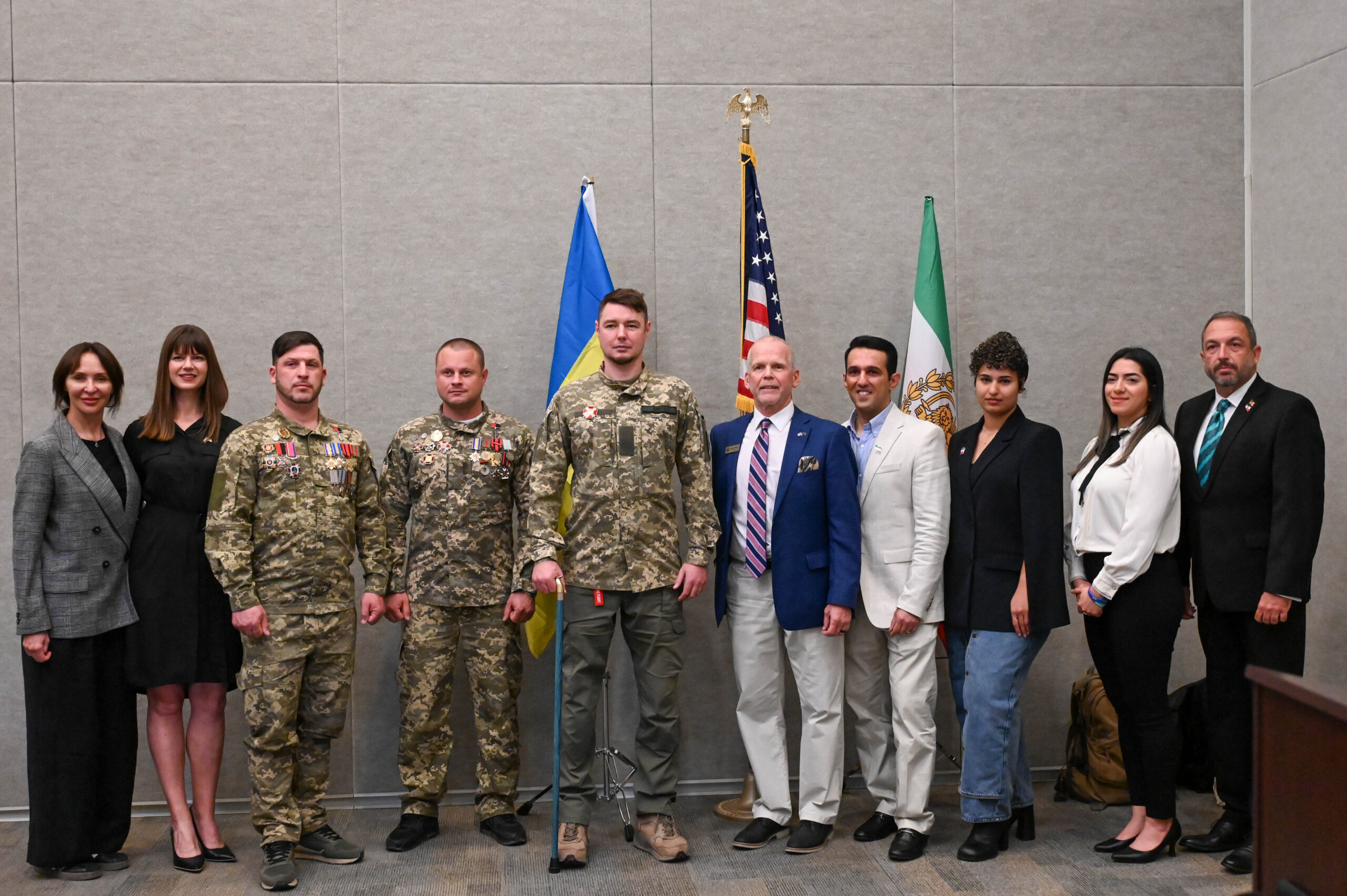

A group of Ukrainian veterans is in the Southwest, telling Americans that today’s wars advance faster than news cycles and institutions.
Denys Haida carries himself with the precision of a career soldier: shoulders aligned, spine straight, eye contact steady. Mykola Melnyk has a close-cropped military haircut and moves between three languages, often translating for Haida and Oleh Bonchynskyi. Bonchynskyi keeps his chin set, his uniform adorned with medals and ribbons that say what he does not.
The three spoke about warfare, technology, life and death with civilians, officials, students, defense stakeholders and diaspora communities, in rooms quiet for the most part, the silence interrupted only by an occasional gasp, another question or brief laughter.
“When the war started in 2014 it was the war between the soldiers, between the platoons, between the checkpoints,” said Melnyk, a retired senior lieutenant in the Armed Forces of Ukraine, during the panel hosted by the Phoenix Committee on Foreign Relations on April 30. “In 2022 it was a classical war, like World War II with air defense. What you’d see in movies. But now we have a war of the future. You have tactical drones, reconnaissance drones, ground drones. Drones, drones, drones.”
For these veterans, as for many Ukrainians, the war did not begin with Russia’s full-scale invasion in 2022. It began in 2014, after the Revolution of Dignity, also known as Maidan, ousted pro-Russian President Viktor Yanukovych and Russia seized Crimea and backed separatist forces in eastern Ukraine.
The three joined the Ukrainian army as volunteers.
“In 2014 we didn’t have anything, no bulletproof vests, no helmets, no military boots. If you wanted to have a rifle you had to kill a Russian. Then the situation changed because the war progressed and Ukrainian forces progressed, too,” said Haida, a retired senior soldier-operator.
With the progression came a rapid change in the role of a soldier, Melnyk added: “Ten years ago soldiers only had to know how to shoot. Now he must operate the drone, he must understand medicine and other things.”
Building a Defense Ecosystem at Battlefield Speed
Lynndy Smith, who leads the Arizona Defense and Industry Coalition, or AZDIC, told Small Wars Journal the war evolves on a daily basis. “Ukraine would come out with a drone with some unique GPS capabilities. Within two weeks, Russia will learn how to counter it. Ukraine will come out with another phase of that technology and they will operate for two weeks and then Russia will figure out how to jam it.”
AZDIC, a chapter of the Global Defense and Industry Coalition, works as a regional convening body that brings together military, government, defense industry and manufacturers in Arizona and beyond. Smith, who travels to Ukraine frequently, said the organization’s work is about helping defense supply chains and innovation move at the speed battlefields now require.
“The best way to get input on the defense industry is to talk to those on the ground,” she said. “The enemy is learning very quickly. The key advantage that Russia has is the number of people they have access to. Ukraine’s advantage is they move even quicker and, in my opinion, they are more innovative.”
Smith said Ukraine’s advantage is often not a new technology, but a more cost-effective way to use tools and tactics under resource constraints. One of her roles is to identify Ukrainian supply gaps that the US could help fill.
Although needs on the ground are massive, Ukrainians have one central request, Smith said, and it is not more munitions or more drones.
“Ukraine was asking for companies that would be interested in setting up operations within the borders of Ukraine to either localize production, participate in R&D, do tech transfers and licensing agreements to help build up the defense ecosystem in Ukraine.”
Multiple reports this year suggest Ukraine now produced the vast majority of drones it uses on the battlefield, a milestone toward the kind of defense ecosystem and self-sufficiency that Smith said could deter Russia in the long run.
“We believe they needed solutions … whether that was counter-drone technologies, bunker technology or, in some cases, agricultural exchanges. Anyone we met that could have an application in Ukraine we would introduce to the necessary government stakeholders as well as potential industry partners in the country,” Smith said.
Smith, who was appointed as the sole American on the supervisory board at Ukroboronprom, Ukraine’s state-owned defense holding, navigates a saturated US technology industry. She pointed to a recent letter of intent signed with LeVanta Tech, a company that builds hybrid unmanned aerial vehicles, or UAVs, capable of transitioning from water into flight “with the goal of operating in a multi-domain environment.”
“One of my favorite partnerships is with D&M,” Smith said, referring to a company that provides ammunition and other supplies. “We have multiple projects with them ranging from investments into the United States as well as investment and training happening in Ukraine on the production of raw materials needed for energetics for munitions, which is a fancy way of saying TNT.”
TNT, or trinitrotoluene, is an explosive used in artillery shells, bombs and grenades. The Russia-Ukraine war has intensified demand for TNT, which the US has not produced since the 1980s. This prompted security partnerships with foreign suppliers, as well as efforts to rebuild domestic production.
Smith said the work goes beyond matching existing products to immediate needs. It also means identifying what manufacturers could build in the future: “How could they develop solutions that would be relevant for Ukraine, even if they didn’t already exist?”
Arizona-based Crow Industries, a ground-drone company that originally developed mining technology, gained attention for Fenris, its unmanned ground vehicle. CEO James Crowell said he traveled to Ukraine and received frontline feedback, which the company used to refine Fenris prototypes. Crow is planning a demonstration of Fenris in Ukraine to gather additional direct operational feedback.
That kind of feedback is critical if defense stakeholders want to keep pace with how quickly warfare is changing, Smith said: “We have drone companies from the United States that say they’re going to come to Ukraine and they can’t wait to show their solution and it’s going to blow Ukraine out of the water. And they get to Ukraine and their drone gets jammed or there’s some piece of feedback that the company has not yet thought about.”
“We pay for our mistakes with our own blood. It is very important for you to take our on-the-ground experiences,” Melnyk said during the event at PCFR, which was moderated by Smith.
Haida, who survived a gunshot wound to the head and multiple wounds to the chest, arms and legs, said the metal left in his body sets off airport security alarms. He asked attendees to counter the myth that Russian soldiers are weak, scared and poorly equipped.
“There are basic truths about the war. Those who underestimate their enemy lose,” he said.
Melnyk echoed his friend: “If they are so weak, why are they taking our positions every day? Because they have more people. Because they have more tanks. Because they have the same technology. Because they have great experience, just like Ukrainian forces. Because their officers have many talented people. They have a strong economy. They have strong allies. They have North Korean infantry. They have Chinese technology. They have Iranian Shahed drones.”
Bread, Salt and the Lion and Sun
A few days later, on May 5, the three veterans sat at a table with Iranian human rights activists in the picturesque town of Fountain Hills, speaking to an audience that included Iranian Americans. Mayor Gerry Friedel expressed the community’s support for Iranians and Ukrainians: “The citizens of Fountain Hills are 100% behind you,” he said.
The veterans change into their uniforms before each speaking engagement, returning to civilian attire immediately afterward. Melnyk’s movements reveal the cost of war. He has a prosthetic leg and needs a few extra seconds to stand up and sit down.
“We do not have separate wars against Russia and the Islamic Republic. We have one war: freedom against dictators,” said Melnyk, who intercepted Shaheds, Iranian-designed drones that Russia now produces domestically.
“We in Ukraine call them Iranian Shaheds,” Melnyk clarified as Hessam Rahimian, the founder of the Iranian Liberty Foundation and moderator of the Fountain Hills event, drew a clear line between Iranian citizens and their government. Another panelist, Iranian American activist Farzan Faramarzi, added that “Iran is a country. The Islamic Republic is the occupying force. The Islamic Republic has nothing to do with Iranians or Iran.”
For Faramarzi, countering disinformation is one battle; making distant repressive regimes relevant to Americans is another.
“Four years ago we had a Phoenix Rock ‘n’ Roll Half Marathon,” Faramarzi recalled. He ran in honor of Mahsa Amini, a young Iranian woman who died on Sept. 16, 2022, after being detained by police for allegedly wearing hijab improperly.
Faramarzi carried Iran’s pre-revolutionary flag – a green, white and red tricolor with a lion, sword and sun at its center.
“As I was running, there was a group of folks cheering me on, saying, ‘Go Mexico!’” Faramarzi said.
For the Ukrainian veterans, the war carries a different kind of bitter complexity: the Ukrainian army also has to fight Ukrainians forced into combat by Russia.
“If we return to the year of 2014, the children that were in the occupied territories are now standing with weapons against us. This is a very large problem,” said Bonchynskyi, a retired senior soldier-operator who sustained a head injury and lost one eye in 2014. He continued to fight for another decade.
An occasional joke lightened the atmosphere, as when Haida answered a question about what brought Ukraine to today’s situation with two words: “Bad neighbor.”
“I love how positive you all are,” Donya Ziraksari, an Iranian American human rights activist from Texas, told the Ukrainian veterans. “Some people become very bitter and y’all are not.”
When Rahimian asked what freedom meant to Ziraksari, she said she misses Iran’s contributions to the world before the revolution: “Iran was a country that exported poetry from Rumi to Ferdowsi. Iran was a country that exported their saffrons, their pistachios, their beautiful rugs. … In 1979 came a man named Khomeini and he said, ‘I’m going to export the ideology of the Islamic Republic.’”
Attendees of multiple gatherings asked a range of questions, from where to get the best Kyiv cake in Ukraine to detailed battlefield tactical observations.
“We are used to it,” Melnyk told Small Wars Journal.
During their meeting with Arizona State University students and faculty, the three were asked what they did before the Revolution of Dignity. Bonchynskyi was a migrant worker who did road construction in Russia and later worked at construction sites in Prague, Czech Republic. Melnyk was a legal expert working with members of Ukraine’s parliament. He recently wrote a book, My Maidan. Haida was a bartender.
“Everyone loves bartenders!” Melnyk said as attendees clapped.
“We like roads too!” someone called out.
The local Ukrainian Community Center looked festive on Sunday, May 3, its interior punctuated by bright blue and yellow colors. Children, dressed for the occasion, greeted the veterans with karavai, a traditional sweet bread offered with salt – a Ukrainian gesture of welcome.
It was a short detour from the grim reality of the war that keeps grinding, even as Russia’s frontline advances have slowed significantly over the past months.
At the Phoenix Committee on Foreign Relations someone asked about life in the trenches.
“It is mud. It is blood. It’s death. Now we remember good things more, but every day you lose your friends,” Melnyk responded. “Every day you see death. Every day you see guys losing legs, eyes, hands. It’s terrible. Unfortunately this becomes your normal. There are times when you don’t feel anything. You live like a machine that must protect your country and kill enemies.”
Photo courtesy of Cactus and Tryzub.
Editor’s Note: This story has been updated to clarify Crow Industries interactions with Ukraine.


