Mind the Gap: Zelenskyy and Ukraine’s Middle East Gamble

Introduction
Ukrainian President Volodymyr Zelenskyy’s Gulf tour spanning Saudi Arabia, the United Arab Emirates, Qatar, and Jordan has generated considerable international attention. The headline offer is straightforward: Ukraine will share its hard-won expertise in countering Iranian-origin drones with Gulf states currently absorbing waves of Shahed strikes. Yet the strategic logic underpinning this initiative is more complex and more contested than the diplomatic optics suggest. At a time when Ukraine continues to fight for its territorial survival, questions of credibility, coordination, and motivation demand serious scrutiny.
The Technical Proposition
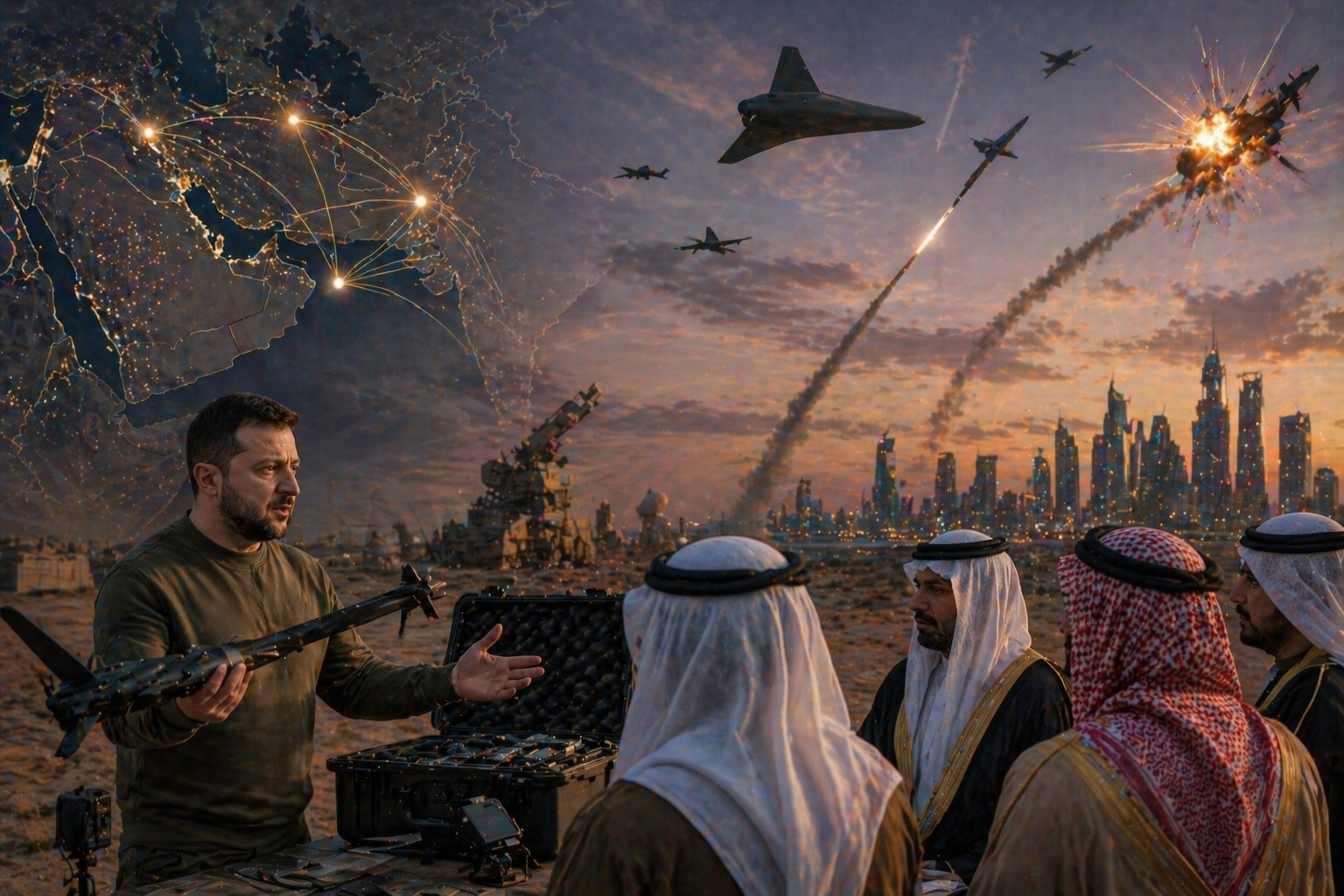
The core of Zelenskyy’s pitch rests on a genuine military-industrial development. Denied sufficient quantities of high-end Western air defense systems such as the US Patriot missile battery, Ukraine was forced to innovate at scale. The result has been the rapid emergence of a domestic counter-drone industry producing what have been termed “Shahed Killers”, low-cost, mass-producible interceptor drones designed to engage the Shahed-136 loitering munition and its Russian-produced derivative, the Geran-2.
Each Ukrainian interceptor drone costs roughly $1,000 and $2,000 to produce, a fraction of the several million dollars required to manufacture, transport, and fire a high-end US interceptor missile. Operators guide them using first-person-view (FPV) goggles or ground control stations, and Ukrainian manufacturers are producing thousands per month. Among Ukraine’s most effective systems are the General Cherry Bullet, the Sting, and the Octopus, ranging from low-cost FPV models to more autonomous platforms which together have transformed how Ukraine defends its airspace against large-volume Russian UAV attacks.
The recently fielded Shvidun, a fixed-wing interceptor, weighs approximately 8 kg, features a wingspan of nearly two meters, operates at altitudes up to 6 km, reaches speeds exceeding 250 km/h, and has a stated operational range of more than 70 km with an endurance of over two hours. Ukraine is simultaneously developing next-generation autonomous systems: the Zerov-8, a vertical take-off and landing interceptor featuring an AI-based detection and tracking module that autonomously identifies, tracks, and homes in on Shaheds, reaching maximum speeds of up to 326 km/h. The JEDI Shahed Hunter is a vertically launched multirotor interceptor weighing just over 4 kg, equipped with daylight and thermal imaging cameras for day-and-night operations, capable of protecting airspace within a 40 km radius. The P1-SUN by SkyFall reaches speeds of between 300 and 450 km/h and can operate at up to 5 km altitude, with optional AI-assisted targeting.
Crucially, Ukraine has also built the Sky Fortress, a nationwide sensor network comprising more than 10,000 nodes that detect low-flying Shahed drones when they evade traditional radar. This has been integrated into a layered air defense concept combining mobile fire groups with MANPADS, helicopter interception teams, electronic warfare, fighter aircraft, and surface-to-air missile systems. This integrated approach is, in many respects, Ukraine’s most exportable asset. As analysis by the Foreign Policy Research Institute notes, Russian strike campaigns combine cruise missiles, ballistic missiles, Shahed drones, and decoy platforms in coordinated waves designed to exhaust air-defense systems at a level of operational complexity that provides instructive lessons for what Gulf states may eventually face.
The operational results are significant. In February 2026, Ukrainian interceptor drones flew roughly 6,300 missions and destroyed more than 1,500 Russian drones; domestically produced interceptors now account for nearly one-third of all Russian aerial threats successfully neutralized.
A New York Times analysis found that Russia sent approximately 5,000 drones into Ukraine in February alone, and Ukraine downed 87% of them.
These figures represent a genuinely compelling performance record — one that explains why Gulf states are paying close attention.
However, a critical technical caveat applies: interceptor drones are effective against low-and-slow Shahed-136 variants (cruising at approximately 185 km/h), but the newer jet-powered Shahed-238, capable of 550–600 km/h, presents a qualitatively harder interception problem. Equally, examination of downed drones in Ukraine has revealed that Shahed variants in the Russian inventory contain Western components, including Nvidia Jetson Orin processors and Texas Instruments chips sourced partly through UAE-based intermediaries in violation of export controls, illustrating the depth and complexity of the Russia–Iran–Russia supply chain.
The Strategic Calculus
Zelenskyy has signed ten-year security agreements with Saudi Arabia and Qatar and expects to finalize a similar arrangement with the UAE, covering joint defense industry projects, co-production facilities, and the exchange of battlefield expertise. In the UAE, discussions focused on providing counter-drone technology in exchange for ballistic missile support and financial aid. Kyiv has proposed swapping its cheap interceptors for the vastly more expensive Patriot and THAAD missiles that Gulf states have been using to counter Iranian strikes, arguing that Ukraine urgently needs high-end air defense for its own near-daily Russian attacks. The UAE has inquired about 5,000 interceptor drones and Qatar about 2,000.
Zelenskyy has been candid about the transactional dimension. “For us today, both the technology and the funding are important,” he told reporters. He separately sought a $35–50 billion drone agreement with the United States, which Washington has not pursued. The Gulf tour is partly an attempt to secure an alternative path to resources as Western support grows more uncertain. The Pentagon was reportedly weighing redirecting equipment intended for Ukraine to the Middle East, with the Iran conflict straining existing American munitions stockpiles.
There is also a diplomatic dimension. Zelenskyy has framed the offer as a direct exchange: Ukraine’s drone expertise in return for Gulf pressure on Moscow to agree to a ceasefire. By positioning Ukraine as an active security contributor rather than a passive recipient of Western aid, Kyiv is attempting to resist strategic marginalization at a moment when US attention has shifted decisively towards the Iranian theater. “Simple sales do not interest us,” Zelenskyy told reporters in Doha. His goal, he said, is long-term strategic ties, including joint production, investment, and energy cooperation.
The Russia–Iran Nexus: Zelenskyy’s Core Argument
Central to Zelenskyy’s diplomatic pitch is the argument that Russia and Iran constitute a single threat architecture and that Ukraine’s war is therefore directly relevant to Gulf security. Ukraine has stated it holds “irrefutable evidence” that Moscow is sharing signals intelligence and electronic warfare capabilities with Tehran to prolong the conflict and deepen global instability. In a post on X, Zelenskyy disclosed that Russian satellites had photographed US military facilities across the Gulf “in the interests of Iran”, including the Diego Garcia joint base, Kuwait International Airport, Prince Sultan Air Base in Saudi Arabia, and installations in Turkey and Qatar.
These allegations have been corroborated at senior levels. EU foreign policy chief Kaja Kallas told G7 leaders that Russia is providing support to Iran in ways that may contribute to actions that endanger American personnel. UK Defense Secretary John Healey described the “hidden hand of Putin” behind Iran’s war effort, and France’s foreign minister characterized the Russia–Iran relationship as “two-way cooperation”. The Financial Times, citing Western intelligence assessments, reported that Russia had begun a phased shipment of drones, medicine, and food to Iran, with deliveries expected by the end of March 2026. Meanwhile, CIA Director John Ratcliffe told Congress that Iran has sought intelligence support from Russia and China. The Kremlin’s spokesman dismissed the Wall Street Journal’s reporting as “fake news”, though the denials have carried diminishing credibility as multiple independent intelligence assessments converged.
By framing Russia and Iran as a single adversarial network, Zelenskyy attempts to align Ukraine’s struggle with the security anxieties of Gulf states and to present his regional outreach as a matter of shared strategic interest rather than Ukrainian opportunism.
The argument has genuine evidentiary support and constitutes the most strategically coherent element of his Gulf initiative.
The European Fault Line
Zelenskyy’s independent Gulf diplomacy acquires additional significance when set against the backdrop of European strategic paralysis. The US launched its military operation against Iran on 28 February 2026 with little to no consultation with its transatlantic allies, leaving European governments deeply divided. France’s President Macron warned that military action outside international law risks undermining global stability and called for emergency UN discussions. Germany’s Foreign Minister stated Berlin had no intention of joining military operations, while Chancellor Merz’s spokesman said the conflict has “nothing to do with NATO”. The UK’s Prime Minister Starmer stated the UK would “not be drawn into the wider war,” restricting British military involvement to a defensive role. Spain went furthest, evicting US military aircraft from its bases, prompting a sharp rebuke from President Trump.
As an LSE analysis observed, Europe has become a strategic spectator in the Iran war, unable to shape outcomes despite having strong interests in the region. Several European governments have indicated they will not participate in military operations to secure the Strait of Hormuz while hostilities continue, and there has been little appetite in Brussels to expand existing EU naval missions into the Gulf.
Whether Zelenskyy consulted EU leadership before embarking on his Gulf tour remains publicly unclear. There is no visible evidence of coordination. Ukraine’s survival depends critically on sustained European support, whether military, financial, and political. Independent diplomatic initiatives in a theater where Europe has staked out careful positions of restraint risk creating friction with the very alliance that has kept Kyiv in the war. The Council on Foreign Relations has noted that for most European governments the central geopolitical priority remains Ukraine itself, meaning Kyiv’s unilateral Gulf activism could be perceived in Brussels as a complicating distraction.
The Legitimacy Question
There is an inescapable domestic dimension to Zelenskyy’s foreign activism. His presidential term, for which he was elected in 2019, has formally expired. Ukraine’s constitution prohibits elections while martial law remains in force, and martial law has been extended in 90-day intervals, most recently until May 2026. Russia has weaponized this fact, though the charge does not withstand legal scrutiny. The Atlantic Council has noted that the Ukrainian Constitution specifically forbids elections during martial law as a foundational safeguard for governance continuity, not a legal loophole. The Journal of Democracy has observed that opposition leaders within Ukraine have publicly acknowledged that Zelenskyy’s legitimacy is not in genuine question domestically.
A Kyiv International Institute of Sociology survey found that 69% of Ukrainians oppose holding elections while the war continues. Ukraine has formally ruled out elections in 2026, with the Central Election Commission stating that a vote could only realistically be held six months after the cessation of hostilities. The Wilson Center has argued that the winner of any wartime election would have less legitimacy than Zelenskyy does now. Nevertheless, Zelenskyy governs in a compressed political environment in which projecting statesmanlike global engagement serves a compensating domestic function, particularly when battlefield progress remains uneven and post-war reconstruction remains a distant prospect.
The Critical Gap
The fundamental problem with Zelenskyy’s Middle East initiative is the mismatch between the narrative and the underlying reality.
Ukraine has genuinely developed world-leading expertise in a domain that is reshaping conflicts from Kyiv to the Gulf. According to the CEPA analysis, Ukraine’s most valuable export is arguably not hardware but operational experience how to build an entire layered system capable of stopping drone swarms night after night, how to position interceptor teams across large territories, and how to coordinate sensors, electronic warfare, and kinetic platforms under live-fire conditions. That is a genuinely transferable capability.
But the claim of defensive success sits uneasily against the daily reality of Russian missiles degrading Ukrainian infrastructure, continued territorial losses in Donetsk, and persistent dependence on Western systems for the highest-tier threats. According to Zelenskyy’s own figures, Russia launched over 14,670 guided aerial bombs, 738 missiles, and nearly 19,000 attack drones during the winter months of 2025–2026 alone. Ukraine’s energy infrastructure remains chronically degraded. Offering counter-drone expertise abroad while unable to halt sustained strategic strikes at home invites the charge of overreach.
Gulf states are acutely pragmatic in their security partnerships and will assess Ukraine’s offer through observable results rather than political narratives. The cost arbitrage is real: Ukrainian interceptors priced at $800–3,000 represent a far cheaper alternative to Patriot interceptors for countering mass-produced Shahed threats. But the Gulf has historically maintained multi-directional relationships with both Russia and Iran and is unlikely to be drawn into an explicitly anti-Moscow posture regardless of what Kyiv offers in exchange.
Moreover, there is a systemic limitation to Ukraine’s offer that is rarely acknowledged publicly. The War on the Rocks analysis notes that effective defense against Shahed-type threats requires sensors and military equipment operating across wide territories, linked through coordinated command structures, a capability that takes years to build and cannot be transferred through advisory missions alone. The UAE has already imitated some Ukrainian tactical innovations, such as helicopter interception teams, but the institutional depth of Ukraine’s integrated air defense architecture is not replicable in months.
Conclusion
Zelenskyy’s Middle East initiative reflects both genuine capability and undeniable necessity. Ukraine has developed technically significant, combat-proven expertise in drone interception that is now in global demand. The Russia–Iran nexus gives Zelenskyy a coherent strategic argument for why Ukraine’s war is relevant to Gulf security, and his desire to secure alternative sources of funding, technology, and political leverage is entirely rational given the uncertainties surrounding Western support.
However, the initiative also highlights the gap that defines Ukraine’s strategic position: between external projection as a security contributor and internal reality as a state still fighting for its survival; between the narrative of defensive success and the evidence of continued Russian penetration of Ukrainian airspace and territory; between independent diplomatic activism and the need to maintain the cohesion of the Western coalition on which Ukraine depends. Until that gap closes on the battlefield, in governance, and in the coherence of its alliances, the question remains: is this a strategic expansion or a costly overextension at a time when Ukraine can least afford it?