Delegated Violence: Jihadist Organizations and the Strategic Logic of Small Wars
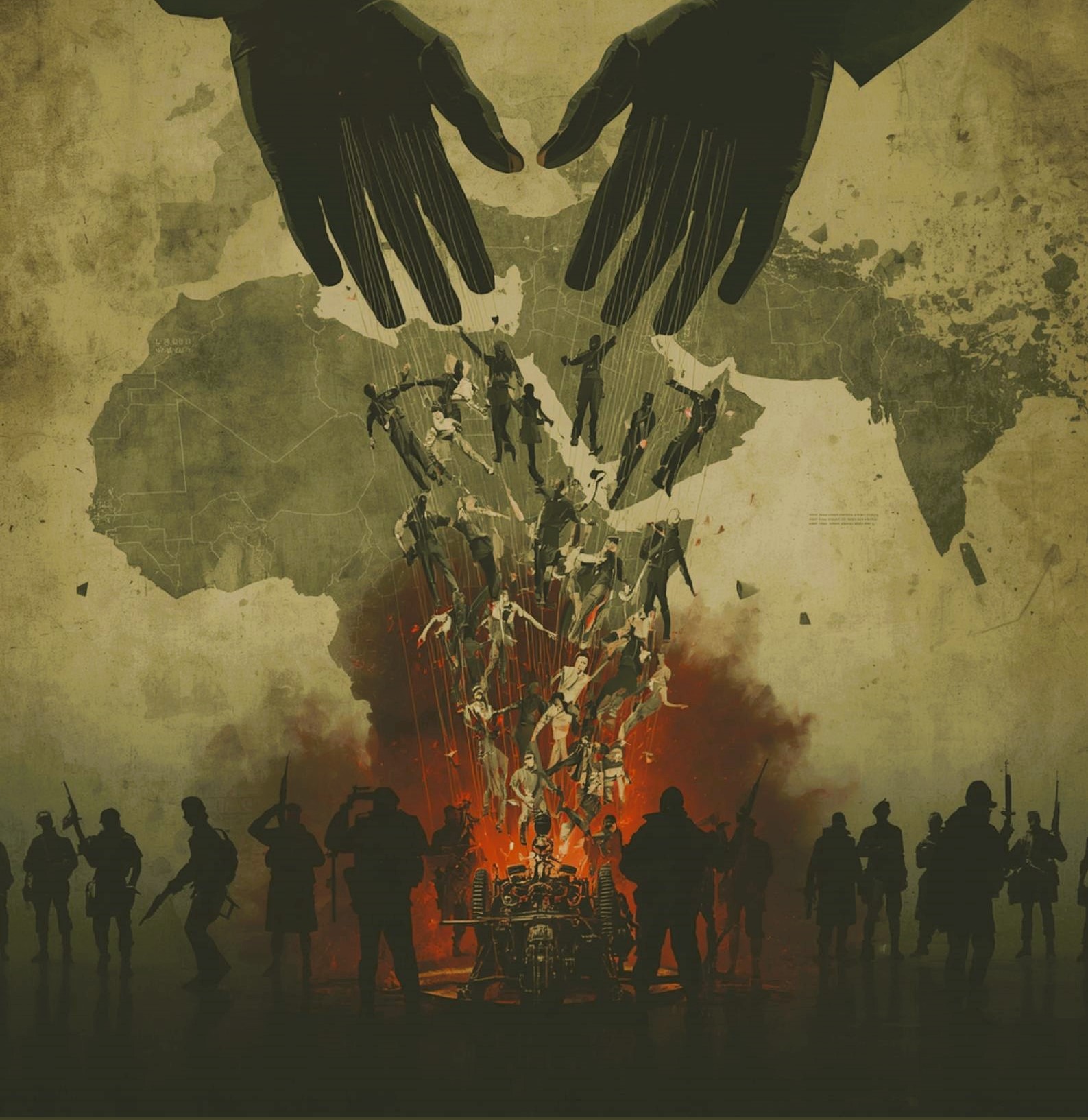

Contemporary warfare increasingly operates through the delegation of violence to non-state proxies, transforming insurgent networks into functional extensions of state strategy. In this configuration, “small wars” function as technologies of indirect confrontation through which major powers manage geopolitical competition via expendable intermediaries. From a Foucauldian biopolitical perspective, this dynamic reflects a shift in state rationality: governance no longer centers solely on the administration of life but increasingly on the strategic management of death. Violence thus emerges as a political resource, while human bodies become sites of geopolitical inscription—converted into mobilizable and negotiable capital within the political economy of proxy warfare.
Far from disappearing, the state retains control over the narrative, outsourcing violence while legitimizing it through symbolic registers—religious, national, or moral—that convert crime into collective necessity. “Small wars” emerge as a political technology for the deferred management of major confrontations. They rely on “disposable” human mediators: lives transformed into added value within the global economy of deterrence. In this logic, extremist groups are not anomalies but functional instruments embedded in transregional security architectures, serving both to exhaust external enemies and to legitimize internal control. These actors move from tribal or sectarian margins to the frontlines, propelled by financial networks, religious platforms, and charitable NGOs often linked to regional or international intelligence services, skillfully deploying religion as a political mask. Over the past two decades, Turkey and Qatar have assumed central roles in this armed politico-religious economy, orchestrating flexible infrastructures combining funding, media amplification, and sanctuary.
Religion operates less as faith than as a governmental technique. In a Foucauldian biopolitical logic, the task is no longer merely to administer life but to organize death. Power becomes spectral: it delegates violence, publicly denies it, yet retains its political consequences. Whoever controls the narrative sets the thresholds of the acceptable, transforming ignorance into virtue and obedience into truth. According to Kansas State University data on international military interventions, the United States supported, on average, at least one “small war” per year between 1975 and 2005, with civilian casualties approaching 90%.
Tracing the political instrumentalization of jihadist groups reveals three pivotal moments in the reshaping of the relationship between the state and sacred violence. Juhayman al-‘Utaybi’s uprising in Mecca in 1979 constituted a major symbolic rupture, directly challenging Saudi politico-religious authority and inaugurating a durable link between religion and security apparatuses. The fall of the Shah and the rise of Khomeini subsequently reconfigured the regional space around transnational sectarian conflict. Finally, the Soviet war in Afghanistan transformed jihad into a transnational armed project, embedded in a U.S.-sponsored containment strategy, supporting the Arab Afghans and establishing logistical corridors from the Middle East to South Asia. The evolution of U.S. engagement with jihadist figures illustrates selective delegation in practice. While Osama bin Laden became the fixed symbol of absolute enmity after 9/11, figures like Abu Mohammad al-Joulani, the now President of Syria, were presented in some Western media as a “negotiable” jihadist. This shift must be understood within the broader politics of instrumentalizing jihadist groups: it reveals the enemy’s classificatory plasticity, reshaped according to geopolitical contingencies. Delegated violence relies on blurring the boundaries between legal and illegal, state and non-state, sacred and political.
The Terrorism of Virtue
The Soviet war in Afghanistan was framed in United States strategy as a campaign of geopolitical attrition. Under the guidance of Zbigniew Brzeziński, the Central Intelligence Agency launched Operation Cyclone, designed to turn Afghanistan into a “Soviet Vietnam” by massively arming Afghan and Arab mujahideen. This clandestine infrastructure empowered actors who would later shape the trajectory of global jihadism, including Osama bin Laden and Mullah Omar. Brzeziński later acknowledged the logic of this policy openly. Such practices belong to a longer genealogy in which terrorism functions as a technology of governance. Echoing the revolutionary violence examined by Eric Hobsbawm in his analysis of the Reign of Terror, violence appears not as a deviation from political order but as a form of moralized necessity—a “terrorism of virtue.”
Yet, the trajectory of bin Laden quickly exposed the limits of strategic instrumentalization. By transforming al-Qaeda into a transnational network connected to multiple jihadist movements, he pushed violence beyond the sphere of state control. The 1998 United States embassy bombings and, above all, the September 11 attacks revealed the autonomy of an instrument initially mobilized within Cold War strategy. Historical irony runs deeper. Mohammed bin Laden—Osama’s father—built the first residential complex for Americans in eastern Saudi Arabia after the discovery of oil in 1938. To secure the oil fields, United States and Saudi Arabia established a security partnership that enabled the first permanent American military presence in the Gulf. By 1950 Washington had opened an airbase in Dhahran near the headquarters of Saudi Aramco—then jointly controlled by American interests before its nationalization in 1980.
After the September 11 attacks, this configuration collapsed. The former tactical convergence between the United States, al-Qaeda–linked networks, and the Taliban during the Soviet war turned into direct confrontation. The ensuing War in Afghanistan—the longest war in U.S. history—imposed immense human and financial costs without producing durable stabilization. The Doha Agreement marked another strategic inflection: the Taliban were gradually reframed as necessary interlocutors, a shift that ultimately facilitated their return to power after two decades of Western military intervention.
The “Light Footprint” Strategy
According to the SIGAR report, American failure in Afghanistan stems from a structural illusion: the belief that a rapid military victory would suffice to end the conflict. This conviction justified the adoption of a “light footprint” strategy and the redeployment of priorities to Iraq, despite lessons from the Balkans emphasizing the need for immediate institutional investment during the post-conflict “golden hour.” In the absence of civil administration and transitional justice mechanisms, Washington favored transactional arrangements with tribal leaders and local militias, recycling violence rather than containing it. As in Somalia or Bosnia, prioritizing military tools over civil policing and institutions contributed to the erosion of state legitimacy. Development programs, spatially concentrated and culturally disconnected, ultimately fueled the very dynamics of conflict they were meant to resolve.
“No Boots on the Ground”
The American doctrine of small wars reached explicit formulation under the Obama administration around the principle of “no boots on the ground.” In Syria, this approach relied on indirect support to opposition groups intended to represent a moderate alternative to the Assad regime. Yet, the line between armed opposition and jihadism quickly proved porous. Despite warnings about the risks of arms diversion to extremist groups—previously observed in Libya—the US and its regional allies reinforced organizations such as Jabhat al-Nusra. Joe Biden acknowledged that the primary beneficiaries of these financial and military flows were groups affiliated with al-Qaeda. This policy, oscillating between rhetorical caution and indirect engagement, failed to produce a credible political alternative. It further fragmented the Syrian arena, strengthened radical actors, and fostered the emergence of hybrid authorities dependent on external powers.
The Recycling of Terrorism
The history of Syrian jihadism reveals a continuous process of strategic recycling rather than a series of ruptures. The trajectory of Abu Musab al-Suri—moving from U.S. “extraordinary rendition” to re-emerging in the Islamic State and al-Nusra orbits—exemplifies the controlled circulation of jihadist cadres between state security apparatuses and non-state armed organizations. This logic was institutionalized in 2011–2012 when the Damascus regime’s release of prisoners from Saidnaya catalyzed the militarization of the uprising, transforming a civil protest into a sectarian conflict that served the regime’s counter-terrorism narrative. Prisons like Bucca and Saidnaya functioned as ideological incubators, producing an elite capable of navigating detention and armed reintegration. Abu Mohammad al-Joulani’s evolution follows this dialectic: from a Bucca detainee to the founder of Jabhat al-Nusra. His subsequent “rebranding” efforts—from Fath al-Sham to Hay’at Tahrir al-Sham (HTS)—were tactical reconfigurations designed to adapt to shifting geopolitical demands. While officially designated as a terrorist organization, HTS was often treated with “pragmatic” ambiguity by Western and regional actors who valued its military efficacy against the Syrian state, mirroring the 1980s mobilization of “Arab Afghans” against the Soviet Union.
The involvement of Turkey marked a decisive turning point, as documented by UN reports and journalistic investigations. Ankara orchestrated a flexible infrastructure—the “Syrian National Army”—utilizing these criminals groups as instruments of regional power projection from Libya to the Caucasus. Despite international sanctions and documented human rights violations, these actors were gradually integrated into new political architectures.
The 2025 accession of HTS to power, facilitated by international negotiations, echoes the 2020 Doha Agreement with the Taliban. In both instances, organizations once classified as terrorist were recycled into legitimate political authorities through geopolitical bargaining. This cyclic re-calibration of violence, which blurs the boundaries between sacred militancy and state-like administration, is crystallized in the lives of Osama bin Laden and Abu Mohammad al-Joulani—icons whose trajectories reveal the shifting plasticity of the “terrorist” label within the global economy of small wars.
Functional Icons of Violence
Inventing the Legend: Bin Laden
Osama bin Laden was acutely aware of the role of cruelty in constructing his own legend within the jihadist imagination, and of the power of imagery in manipulating the unmoored emotions of audiences lulled by the sermons of ignorant clerics. He first waged a semantic battle—using Gramschi’s term—before ever engaging in the military campaigns of jihad and organized international terrorism under his leadership. Relying on a carefully crafted discourse—tone of voice, austere clothing, measured harshness in expression—paired with an ascetic lifestyle despite immense wealth, bin Laden distinguished himself from the sadistic bluster of many political officials. Michael Scheuer nicknamed him the “Master of Silence.”
Bin Laden thus transformed his body into a symbolic equivalent of a terrorism rooted in doctrinal rigidity—a historical feature shared by only a few criminal figures operating in structures openly hostile to the state, such as Hassan-i Sabbah, leader of the Assassins, or, in a parallel frame, Pol Pot, leader of the Khmer Rouge. This radical, destructive logic, aimed at overturning the world order in the name of a reductive creed, elevated him to the status of a model of barbarity, allowing him to construct a narrative of inevitable confrontation between two worlds presented as irreconcilable.
Born in 1957, bin Laden grew up alongside his Syrian mother, Alia Ghanem. Like Hitler, bin Laden maintained a deep attachment to his mother and knew his father only briefly, as Muhammad bin Laden died when Osama was ten. In an interview with The Guardian, Alia Ghanem appeared next to a photograph of her son, insisting he be described only positively, while acknowledging the decisive influence of al-Qaeda’s spiritual guide, the Palestinian Abdullah Azzam.
Bin Laden’s father, a figure surrounded by mythic aura in a world steeped in symbols, had married at least eleven women and fathered fifty-four children. Osama was not prominent within this vast family, but he inherited a fortune estimated at $300 million, sourced from a real estate empire specializing in Islam’s holy sites. Among its projects was the architectural infrastructure of the Kaaba, for which the family company held complete plans. When Juhayman al-‘Utaybi and two hundred jihadists seized the Grand Mosque in Mecca in 1979, Saudi and French authorities turned to the bin Laden company for the full architectural plans of the sanctuary.
From this architectural symbolism associated with the Kaaba to the deployment of suicide attackers in 2001, bin Laden transformed the concept of architecture into an organizational matrix for the largest terrorist project in contemporary history. Many analyses consider Abdullah Azzam a father figure to bin Laden, having instilled in him the conception of jihad as a universal doctrinal matrix. This vision opened the door for “recycling” jihadists and redirecting them to other theaters. To emphasize a symbolic rupture with his homeland, bin Laden deliberately selected fifteen Saudis among the nineteen hijackers, embodying a worldview in which total destruction served as a tool for world reordering.
Following his 2011 death, al-Qaeda’s doctrine underwent a profound strategic shift toward decentralized resistance, largely influenced by the theories of Abu Musab al-Suri (Mustafa Setmariam Nasar). Al-Suri, a pivotal figure in the global jihadist movement, pioneered the concept of “Individual Jihad” to bypass the rigid hierarchical structures that characterized the early iterations of al-Qaeda. His intellectual legacy is defined by his masterwork, “The Call for a Global Islamic Resistance,” which reimagined the world as a fluid battlefield of attrition.
Al-Suri’s own trajectory epitomizes the “recycling” of jihadist assets; after his 2005 arrest in Pakistan, he was subjected to the U.S. policy of “Extraordinary Rendition”—effectively “torture by proxy”—before his obscure release from Syrian prisons in 2012 . His subsequent integration into the orbits of ISIS and later Jabhat al-Nusra in Idlib demonstrates how these doctrinal legacies are repurposed within new regional conflicts. It is precisely this synthesis of al-Suri’s tactical decentralization and the pragmatic pursuit of localized power that defines the political rebirth of his successor in the Syrian arena: Abu Mohammad al-Joulani.
Al-Joulani: Power Through Sacrifice
There is no true biography of Ahmad al-Shara‘, only that of “Abu Mohammad al-Joulani,” a public figure shaped by combat, secrecy, and calculation. This absence is deliberate: it contributes to the construction of power not rooted in a personal trajectory, but in a functional role within organized violence. His ideological framework was forged in 2003 in Iraq, nourished by figures like Marwan Haddad and Abu Musab al-Suri, and by canonical texts such as Fiqh al-Dam and Management of Savagery. These writings were an operational manual for power through terror. His return to Syria in 2011 marked not continuity, but a genuine political rebirth. Sent to Syria with a small cadre on direct mandate from the Islamic State in Iraq, al-Joulani was tasked with expanding the organization. Yet Abu Bakr al-Baghdadi’s trust in him remained limited: an Iraqi supervisor was dispatched to monitor him, signaling a structural tension between local autonomy and jihadist centralism. The proclamation of the “caliphate” accelerated the rupture. Al-Joulani chose al-Qaeda’s more patient strategy, making Syria the new regional center for al-Qaeda. From 2015 onward, al-Joulani embarked on a strategic transformation. The official split from al-Qaeda in 2016 did not signify abandonment of the ideology but rather its concealment, transforming jihadist Salafism into a presentable political force. This transformation relied on a solid material base: kidnappings for ransom, funds from Gulf charitable associations, control of border crossings with Turkey, and systematic taxation of local populations. Since 2015, HTS has exercised near-exclusive control over the “Idlib Emirate.” What fundamentally distinguishes al-Joulani is his relationship to power. Unlike others bound by doctrine, al-Joulani treats ideology as an interchangeable instrument. The case of his Iraqi deputy, Abu Mariya al-Qahtani, illustrates this logic: he was eliminated when his popularity became a threat. Purges often coincide with targeted strikes by the international coalition against rival jihadist leaders, fueling suspicions of indirect cooperation. Al-Joulani’s power also rests on a dense repressive apparatus where international human rights organizations have documented systematic torture and arbitrary detention. Religious minorities have been targeted through campaigns of violence and ideological imposition. Comparing al-Joulani to Osama bin Laden would be a misreading. Bin Laden embodied ideological terrorism; al-Joulani pursues no transcendence: his horizon is power itself.
Conclusion
The functional role of HTS signals a shift in contemporary conflict: the transformation of terrorism into an instrument of indirect governance. Here, violence does not seek a political solution but serves to manage perpetual conflict through the “ordinary” production of death. Syrian lives are thus reduced to administrable units within a system where destruction requires neither accountability nor memory. Ultimately, Washington’s strategy—supported by regional actors—has not facilitated state reconstruction but has instead stabilized governable violence. In this framework, the armed organization transcends its tactical utility to become a form of proxy sovereignty.