The Perfect Swarm: Taiwan’s T-Dome in the Era of Drone Warfare
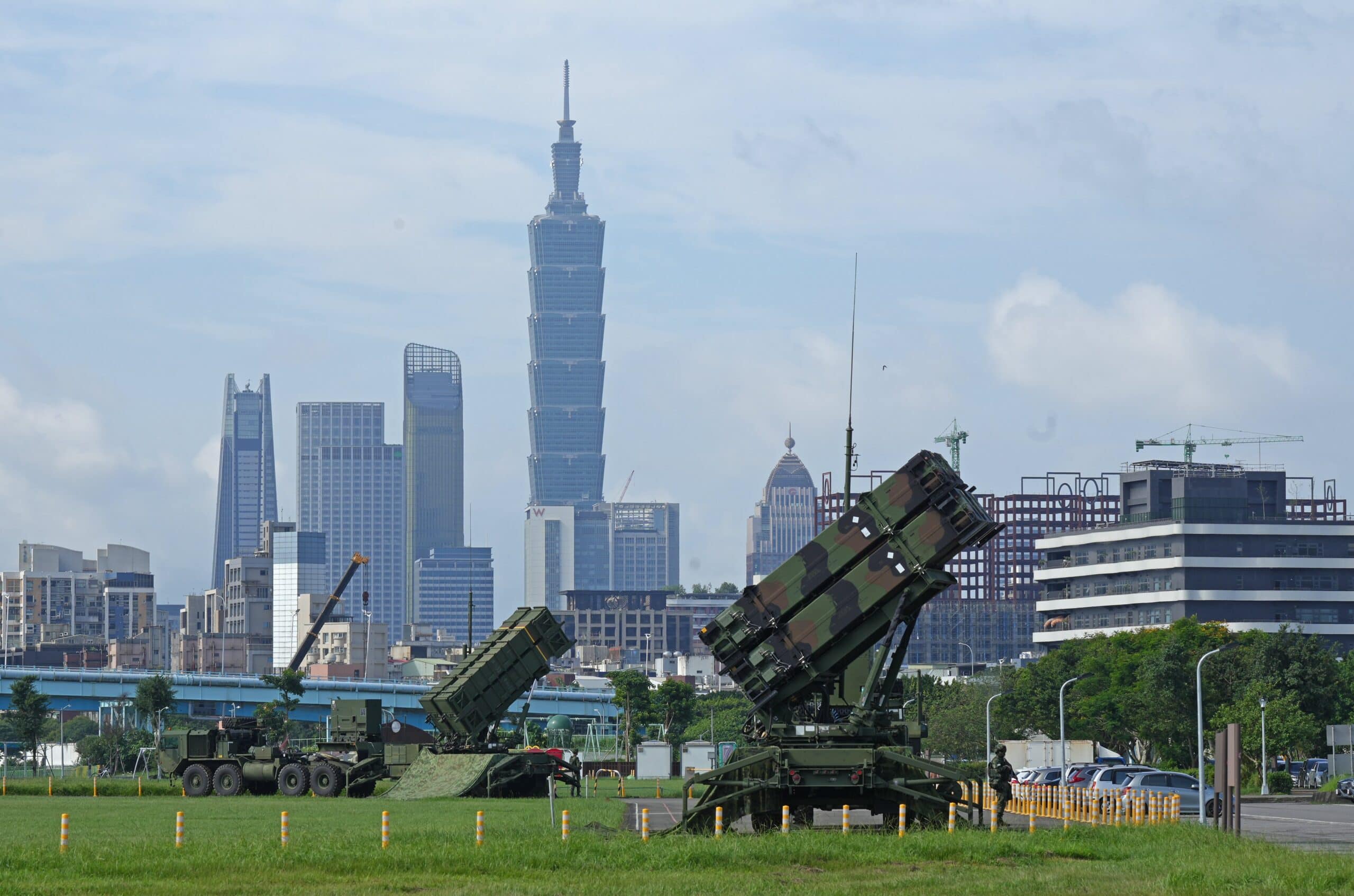

Abstract: In October 2025, Republic of China President Lai Ching-te announced Taiwan would invest in a multi-layered air defense system known as “T-Dome” to defend against possible People’s Liberation Army (PLA) air attacks. The success of Israel’s Iron Dome against Iranian attacks last summer and the United States’ (U.S.) Golden Dome provided inspiration for this decision. However, further reporting from the 12 Day War may provide a roadmap for the PLA; their massive drone production capacity could overwhelm the T-Dome with millions of low-cost drones and clear a path for deadly PLA Rocket Force (PLARF) rocket attacks.
Introduction
Taiwan is betting big on the air defense “dome” craze. Inspired by the success of Israel’s Iron Dome against Iranian attacks last summer and the proposed U.S. Golden Dome for America, President Lai Ching-te announced in October 2025 that Taiwan would build its own multi-layered air defense “T-Dome” system. This move signals the island’s commitment to enhancing its ability to defend against an air and missile attack from the People’s Republic of China (PRC). But is Taiwan learning the wrong lesson from Israel’s Twelve-Day War with Iran?
While there are many open questions in President Lai’s proposed $32 billion project, it appears that the T-Dome would supplement Taiwan’s existing air defense infrastructure with assets purchased from the U.S. and integrate them into a single unified command platform. The T-Dome would detect and engage multiple incoming projectiles from various altitudes and provide targeting recommendations, matching incoming projectiles with appropriate air defense responses, and ignoring harmless decoys.
The Porcupine Strategy
Historically, a state-of-the-art air defense system would fit well into the porcupine strategy long preferred by defense analysts. As Taiwan’s most plausible strategy for surviving an assault from the PLA, such an approach calls for asymmetric capabilities and concepts of operations to deny the PRC decisive victory and impose significant losses on the PLA. As described by former Taiwan Chief of the General Staff Admiral Lee Hsi-min – who crafted Taiwan’s Overall Defense Concept – such an approach conceives of victory not through the defeat of the adversary on the field of battle but through survival. It seeks to deter the PRC by enhancing Taiwan’s ability to deny the PLA victory at an acceptable speed and cost while preserving Taiwan’s forces long enough for U.S. support to arrive.
While Israel invested in expensive air defense systems, Iran built a vast inventory of cheap ballistic missiles and drones to soak up Israeli interceptors. This experience demonstrates the benefits of quantity over quality in attrition warfare.
A critical element of a porcupine strategy is that it demands a low-cost/high-benefit ratio for any fielded capability. President Lai may have been inspired by Israel’s Iron Dome, but a deeper understanding of Israel’s Twelve-Day War provides reasons to be cautious as the PLA may flip the cost-benefit ratio in its favor, a risk decision-makers in Taiwan need to be alert to. For example, Israel boasted an impressive interception rate of nearly 90% during the conflict but depleted it’s stockpile of interceptors to critically low levels by the end of the Twelve-Day War, leading the U.S. to scramble to deliver more aid. While Israel invested in expensive air defense systems, Iran built a vast inventory of cheap ballistic missiles and drones to soak up Israeli interceptors. This experience demonstrates the benefits of quantity over quality in attrition warfare.
For Taiwan, the interceptors for its PAC-3 and Tien Kung III (TK-III) missile defense systems, both integral to its current air defense network, are extremely costly and difficult to produce. PAC-3 missiles cost an estimated $3.7 million per missile and Lockheed Martin only produces about 500 per year. The domestically produced TK-III is far cheaper, but still costs over an estimated $600,000 per missile with less than 100 produced per year.
Across the Strait
Furthermore, it is estimated that, if ordered to do so, Chinese manufacturers could retool civilian drone factories to produce almost one billion weaponized drones per year.
Across the Taiwan Strait, the PLA Rocket Force has an arsenal of thousands of ballistic missiles, cruise missiles, and glide bombs. Chinese firms account for nearly 90% of the commercial drone market; Da-Jiang Innovations (DJI) alone controls nearly 70% of the global market and manufactures most of the key hardware in commercial and military drones. Furthermore, it is estimated that, if ordered to do so, Chinese manufacturers could retool civilian drone factories to produce almost one billion weaponized drones per year. DJI drones like the MAVIC are used to great effect in Ukraine and can be weaponized for one-way attack missions for a few thousand dollars. Considering that it is standard practice to fire multiple interceptors against one drone or ballistic missile, the cost-benefit ratio of advanced missile defense systems is clearly in the PLA’s favor.
Given this comparative advantage, the PLA could employ a figurative “offense in depth,” swarming thousands of cheap drones for the same cost as a single PAC-3 missile. This would easily overwhelm Taiwan’s air defenses, deplete interceptor stockpiles, drive up the cost of resistance, and clear a path for PLARF missiles. Indeed, Iran successfully employed this tactic during the Twelve-Day War by sending swarms of Shahed drones to overwhelm Israel’s air defenses and create gaps for its ballistic missiles to slip through.
Recent breakthroughs in PLA Navy (PLAN) carrier and drone technology indicate the PRC may be preparing to employ similar tactics in Taiwan. In 2024, the PLAN launched its Type 076 amphibious assault carrier equipped with electromagnetic catapults capable of launching heavy unmanned aerial vehicles (UAVs). One of the most concerning of these heavy UAVs is the newly developed Jiu Tian, often referred to as the PLA’s “drone mothership”. It has a range of 7,000 km and can release swarms of up to 100 kamikaze drones or loitering munitions.
Keeping the Porcupine Strategy Alive
Air defense systems still have an integral role in Taiwan’s defense but Israel’s experience and the ongoing conflict in Ukraine should serve as a warning of their vulnerability. The PLA is increasing its drone capabilities and expanding the PLARF’s magazine depth. To ensure that an invasion of Taiwan remains a costly gamble for the PRC, Taiwan should consider three steps that would help rebalance the cost-benefit ratio in its favor.
First, Taiwan needs to expand its electronic warfare and counter-UAS capabilities. Though much of this technology is in its early stages, so too is the PLA’s; there are potential windows for exploitation. The war in Ukraine is a testing ground for many novel counter-UAS capabilities and tactics; Ukrainian defense companies are pioneering new technologies for drone detection and jamming. The U.S. has also made major strides in directed energy weapons like the Navy’s HELIOS laser and rapid-fire gun systems. These may provide cost efficient options to shoot down enemy drones and save interceptor missiles.
Even worse, Taiwan’s officer corps maintains an outdated, top-heavy hierarchy incapable of implementing the strategic changes necessary for modern combat. During Operation Absolute Resolve, Venezuela’s inexperienced and untrained troops failed to down a single U.S. aircraft despite their advanced Russian air defense systems.
Second, Taiwan needs professional and experienced air defense operators and an officer corps capable of employing a porcupine strategy. This will mean targeted recruiting and retention initiatives for key air defense billets and a military culture that emphasizes tough, realistic training. Taiwan has already extended mandatory military service, but key front-line billets remain understaffed. Even worse, Taiwan’s officer corps maintains an outdated, top-heavy hierarchy incapable of implementing the strategic changes necessary for modern combat. During Operation Absolute Resolve, Venezuela’s inexperienced and untrained troops failed to down a single U.S. aircraft despite their advanced Russian air defense systems. This operation has certainly provided U.S. forces with key insights on how (or how not) to implement an effective air defense. An effective defense of Taiwan will depend upon competent officers and operators learning from their U.S. counterparts and implementing strategic changes to Taiwan’s military doctrine.
Finally, Taiwan must find ways to harden critical infrastructure to withstand the initial Chinese air-delivered munitions onslaught and maintain its offensive and defensive capabilities. Any T-Dome system would likely be vulnerable to blinding attacks on radar and command and control systems. Prior to Operation Absolute Resolve, Venezuela’s radar and air defenses were undisguised and out in the open, making them easy targets for U.S. airpower, namely one-way attack drones. Hardening and concealment of these assets, both physically and in the cyber domain, may help keep Taiwan in the fight. Dispersing mobile radar systems and missile batteries and deploying decoys will also complicate targeting for the PLA, providing much-needed longevity for the island’s radars and weapons assets.
Conclusion
Developing an integrated air and missile defense system like the T-Dome is by no means a mistake. The unified command platform proposed for the T-Dome would likely increase the longevity of Taiwan’s missile defenses and preserve costly interceptors. However, in the era of modern drone warfare, integrated air and missile defense systems are not the impenetrable sanctuary they are sometimes imagined to be. When employing a porcupine strategy, Taiwan cannot afford to employ thousands of PAC-3 and TK-III missiles against thousands, millions, or even billions of one-way attack drones. Taiwan must preserve these resources for intercepting incoming ballistic and cruise missiles. Taiwan must learn from the experiences of Israel and Ukraine by adopting viable counter-UAS capabilities, prioritizing training and readiness for its air defense units, and hardening critical infrastructure to withstand the PLA’s air and missile threat to the island’s security.