





The Singular Threat of Lone Actors in the European Union

Abstract
This paper analyzes terrorism perpetrated by lone actors, assessing its impact on internal European Union security. The research focuses on cases recorded in France and Germany between 2015 and 2025, examining the operational and ideological characteristics of the perpetrators.
The analysis confirms the acceleration of non-linear radicalization processes, largely driven by online propaganda, as well as persistent challenges in the detection of this type of threat.
The findings highlight the need for coordinated responses that ensure a balance between security measures and the safeguarding of fundamental rights, while recognizing the impact of this phenomenon on the amplification of populist and nationalist narratives, which pose additional challenges to European integration.
Introduction
This research examines terrorist attacks in the European Union (EU), focusing on those perpetrated by lone actors. Terrorism constitutes a distinctive threat due to its psychological and social impact, contributing to the erosion of public trust in institutions.
The main objective is to analyze the security challenges faced by the EU in relation to contemporary terrorism. Two specific objectives are pursued: (i) to examine the operational and ideological characteristics of terrorist attacks; and (ii) to identify institutional and structural vulnerabilities associated with this form of violence.
Terrorism, particularly in its individual form, is inherently transnational, with effects that transcend borders and challenge state and supranational authorities. As a political project committed to peace and security, the EU faces the challenge of responding to asymmetric and unpredictable threats that generate media attention and psychological impact.
Lone-actor attacks on soft targets disproportionately affect public perceptions of security, fragmenting political space and fueling populist and security-driven narratives that reshape the EU’s institutional balance. Against this backdrop, cases in France and Germany between 2015 and 2025 are analyzed in terms of operational characteristics, ideological motivations, and security implications of lone-actor terrorism.
Background and Conceptual Context
There is an extensive body of literature on terrorism; however, much of it adopts a holistic approach that pays limited attention to the specific dynamics of lone-actor terrorism. It was only in the second decade of the 21st century that dedicated academic work began, alongside some multidisciplinary studies seeking to understand its particularities.
As with the difficulty in reaching a consensus definition of terrorism itself, one of the main challenges identified in the literature concerns the absence of a consistent definition of terrorism practiced by lone actors. A review of existing studies reveals divergences between academics and practitioners, particularly regarding the inclusion of small cells of two or three individuals within the concept of lone-actor terrorism. Lone actors operate in isolation, do not belong to any organized group, and employ a modus operandi conceived autonomously, without direct external command or hierarchical structure.
There is a broad consensus in terrorism studies that it is impossible to establish a single terrorist profile. Empirical analyses show that perpetrators originate from diverse social backgrounds, age groups, and, in some cases, both genders. Even acknowledging this limitation, the literature highlights important findings, particularly that lone-actor terrorism is not confined to a single ideology. Instead, it may be driven by religious, political, or personal motivations, often in combination.
Three main ideological currents are identified: far-right doctrines of “leaderless resistance”; jihadist ideologies; and idiosyncratic belief systems, with personal grievances often producing atypical cases. Recent scholarship has also highlighted the role of online environments in facilitating radicalization, although there is broad agreement that radicalization processes emerge from the interaction between online and offline dynamics rather than from digital exposure alone.
Analytical Approach and Sources
This analysis adopts a multidimensional perspective to understand the emergence of radicalized individuals outside traditional organizational structures. The framework is grounded in approaches that emphasize the political construction of security threats and the transnational nature of terrorism.
Securitization theory explains how political discourses frame terrorism as an existential threat, legitimizing extraordinary measures in response to perceived threats. According to the Copenhagen School, the external dimension of internal security results from securitization processes surrounding phenomena such as terrorism, migration, asylum, and instability in neighboring regions.
Regional security complex theory provides a framework for understanding security interdependence among Member States (MS), given the transnational nature of terrorist threats and the absence of internal borders under Schengen. A security complex consists of states whose security concerns are so interlinked that they cannot be addressed in isolation.
To ensure coherence between the analytical perspective and the empirical investigation, a mixed methodological approach is adopted. The research is structured at two levels of analysis: a global-level analysis focusing on dynamics, trends, and policy responses, and a case study of France and Germany, due to their political, historical, and security centrality within the European project.
Given the absence of a consolidated database exclusively dedicated to lone-actor terrorism in the EU during the reference period, an ad hoc database was constructed from multiple secondary sources. This database covers 29 attacks carried out by lone actors in France and Germany between 2015 and 2025, resulting in 152 fatalities and 653 injuries.
The sources used included specialized academic literature, official reports from European institutions, and internationally credible journalistic outlets.
The Rise of Lone-Actor Terrorism
European Challenge
Contemporary terrorism presents a complex set of challenges to EU security, not only because of the ideological diversity of terrorist actors, but also due to their decentralized and unpredictable modes of operation, which make detection difficult and hinder the formulation of uniform and effective responses.
Given the scope of this article, the definition established in Directive (EU) 2017/541 is adopted, according to which terrorist acts include offenses against human life, kidnapping or hostage-taking, and the manufacture or possession of weapons, when committed with the aim of intimidating a population or destabilizing the fundamental political, economic, or social structures of a state or international organization.
Europol categorizes terrorist activity into five main forms: jihadist terrorism, violent far-right terrorism, far-left and anarchist terrorism and violent extremism, ethno-nationalist and separatist terrorism, and other unspecified forms. While terrorism in Europe has historically evolved from nationalist and ideological movements to transnational violence, the contemporary threat is increasingly shaped by decentralized actors.
The growth of terrorist activity in Europe led to the institutionalization of intergovernmental cooperation. However, it was only after the September 11 attacks that a more structured European counterterrorism policy emerged.
While MS recognize the necessity of cooperation in combating terrorism, they remain reluctant to transfer authority in sensitive areas such as internal security, border control, and intelligence. This fragmentation constrains the effectiveness of EU counterterrorism policies. The normalization of exceptional security practices risks undermining civil liberties, as observed in the United States’ War on Terror.
Internal Security and Foreign Policy
Globalization, the erosion of traditional borders, and geopolitical change have reinforced the interdependence between internal and external security. In this context, security is recognized as a strategic domain requiring coordinated action among MS and external partners.
This approach includes political dialogue and cooperation with third countries and international organizations, the promotion of United Nations (UN) conventions, the incorporation of counterterrorism clauses into external agreements, and the deployment of civilian and military instruments under the Common Security and Defence Policy (CSDP). However, this strategy may divert attention from the structural causes of terrorism and migration, fostering the illusion that border controls and bilateral cooperation alone can resolve these challenges.
EU Security Policies
The nature of terrorism in the West has undergone a clear transformation over the last 15 years, with a growing prevalence of attacks carried out by individuals who are not formally linked to terrorist organizations, lack a clearly defined ideology, or act without direct operational support despite expressing ideological allegiance.
While coordinated attacks by established organizations have not disappeared, violent incidents increasingly result from isolated actions. Lone actors may engage with extremist content online or identify with specific ideologies, but in most cases, they act autonomously. Reflecting this trend, the Institute for Economics and Peace (IEP) published its first dedicated report on lone actors in Western democracies in 2025, noting that such attacks accounted for 93% of fatal incidents in the previous five years.
The average time between first contact with radical content and attack execution has decreased substantially, in some cases to just a few weeks. This acceleration facilitates the rapid construction of identity and purpose among potential attackers.
Europol reports a rise in Salafist-jihadist attacks in the EU in 2023, most of them carried out by lone actors using low-complexity methods and targeting urban public spaces. Despite the lack of links, several attackers expressed ideological inspiration from the Islamic State (IS), highlighting the continued relevance of symbolic affiliation.
Given the difficulties of early detection and the ideologically fluid nature of these actors, lone-actor terrorism has become a central concern in EU security strategies. The absence of direct organizational links significantly complicates traditional prevention and control mechanisms.
Empirical Evidence: France and Germany
The Phenomenon
The terrorist threat in Europe has evolved over the years, with a notable increase since 2015. While intelligence services and security forces have become more effective in monitoring and disrupting terrorist organizations, the threat posed by lone actors has intensified, materializing in smaller-scale, less sophisticated attacks that are easier to carry out and more likely to succeed.
Several extremist groups have adopted this strategy, actively encouraging isolated attacks. Al-Qaeda in the Arabian Peninsula used the magazine Inspire to disseminate operational guidance, while the IS has consistently promoted autonomous violence. In September 2014, Abu Mohammed al-Adnani explicitly called on supporters to carry out attacks using easily accessible weapons such as knives or vehicles, recognizing that simple methods are more effective.
The risk of homegrown terrorism has become increasingly salient. Lone-actor attacks have proven more effective in mobilizing individuals to commit violence than earlier efforts by organized groups. A dynamic reinforced by reciprocal radicalization across ideological extremes. The threat posed by lone far-right actors is particularly concerning, as these individuals are less likely to be under sustained surveillance than perpetrators motivated by jihadist ideologies. Most of these attacks are driven by anti-immigration or Islamophobic sentiments rooted in racial supremacist ideologies. The disproportionate media attention and political rhetoric surrounding migration may contribute to the rise of far-right violence.
These dynamics are reflected in the growth of far-right populist movements and demonstrations in several European countries, which, while not directly promoting violence, may provide symbolic legitimacy for lone actors. At the same time, during public events held in France and Germany in 2024, several attacks attributed to IS and Hamas were recorded, most of which were carried out by lone actors but ultimately neutralized.
Comparative Analysis
France and Germany rank lower than several other Western European states in global terrorism indices. Factors such as multiculturalism, religious plurality, and migration-related dynamics are frequently cited to explain this exposure, justifying their selection as case studies. The analysis draws on an ad hoc database compiled by the author based on open-source data, and all figures included in this study are original and produced by the author.
The dataset includes 29 attacks carried out by lone actors in France and Germany between January 1, 2015, and May 31, 2025. During this period, 15 attacks occurred in France, resulting in 106 deaths and 503 injuries, while 14 attacks in Germany caused 46 deaths and 150 injuries.
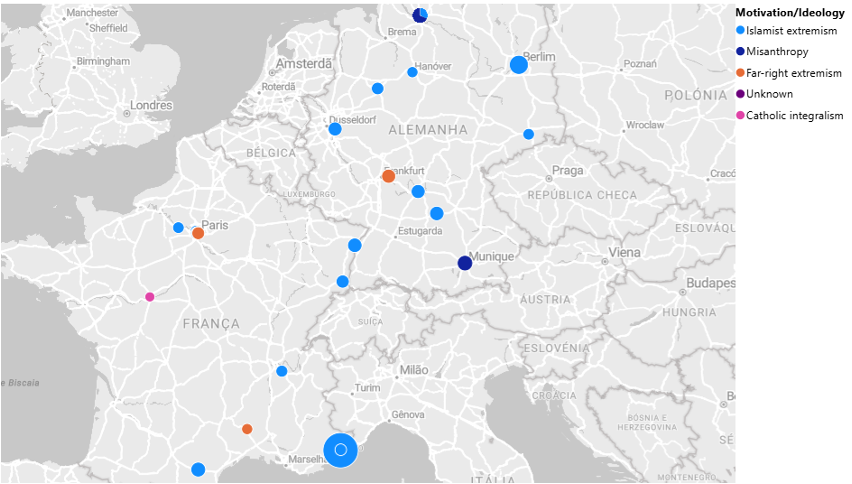
Figure 1: Map of Lone-Actor Terrorist attacks (2015–2025), by Motivation/Ideology and volume of casualties.
In France, 80% of attacks were ideologically motivated by Islamist extremism and accounted for 98.85% of casualties. In Germany, Islamist extremism also predominated, representing 71.43% of attacks and 63.78% of casualties. Regarding citizenship, 33% of attackers in France were EU nationals, compared to 21.43% in Germany, while non-EU nationals accounted for a higher proportion in the German case.
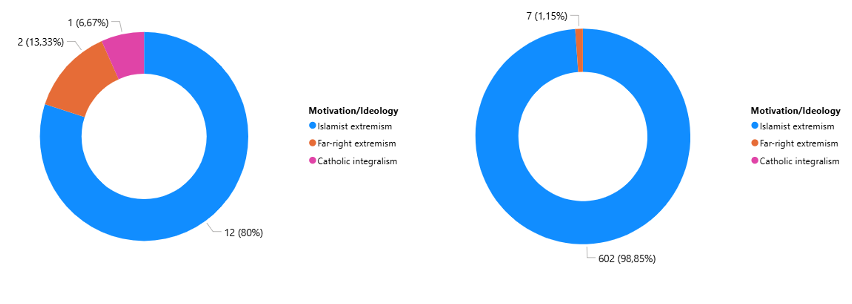
Figure 2: Attacks by Motivation/Ideology (France) Figure 3: Casualties by Motivation/Ideology (France)
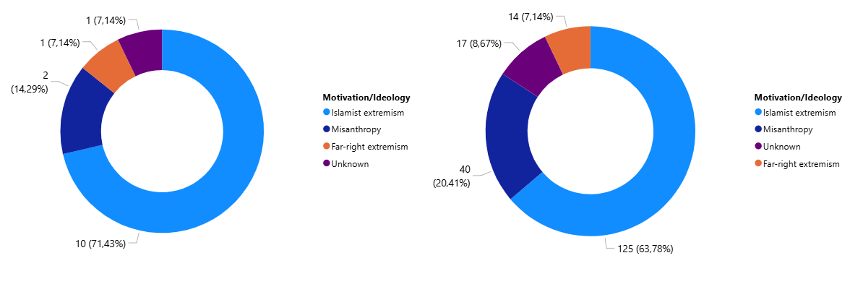
Figure 4: Attacks by Motivation/Ideology (Germany) Figure 5: Casualties by Motivation/Ideology (Germany)
Modus operandi is a particularly relevant variable. In France, 53.33% of attacks involved knives or other cutting weapons, yet 89% of casualties resulted from vehicular attacks. In Germany, knives were used in 57.14% of cases, while vehicular attacks caused the highest proportion of casualties (34.69%). In both countries, the deadliest attacks involved vehicles and were ideologically motivated by Islamist extremism.
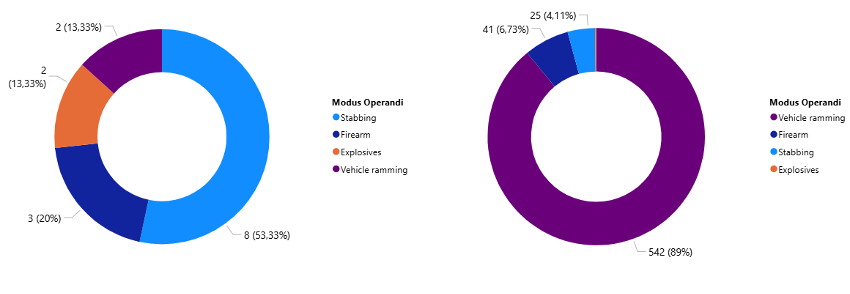
Figure 6: Attacks by Modus Operandi (France) Figure 7: Casualties by Modus Operandi (France)
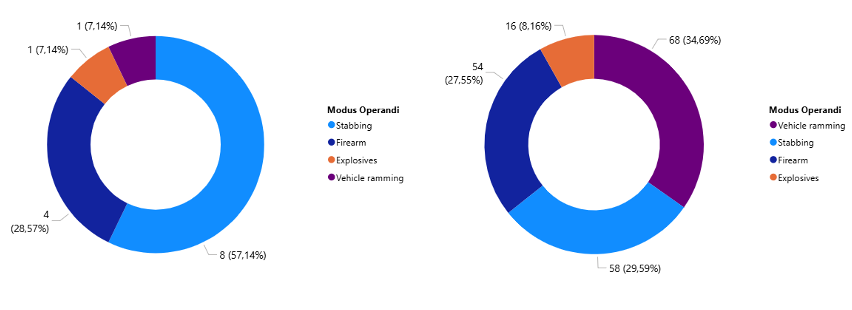
Figure 8: Attacks by Modus Operandi (Germany) Figure 9: Casualties by Modus Operandi (Germany)
Chronologically, 2016 stands out as the deadliest year in both countries, primarily due to the attacks in Nice and Berlin, which caused exceptionally high numbers of casualties. France recorded seven attacks targeting police or military personnel in public settings, compared to one such case in Germany. Consistent with broader Western patterns observed between 1994 and 2016, these attacks reflect a strategic focus on security forces, where momentary exposure increases vulnerability. In this context, police and military personnel operating in public environments may themselves constitute soft targets.
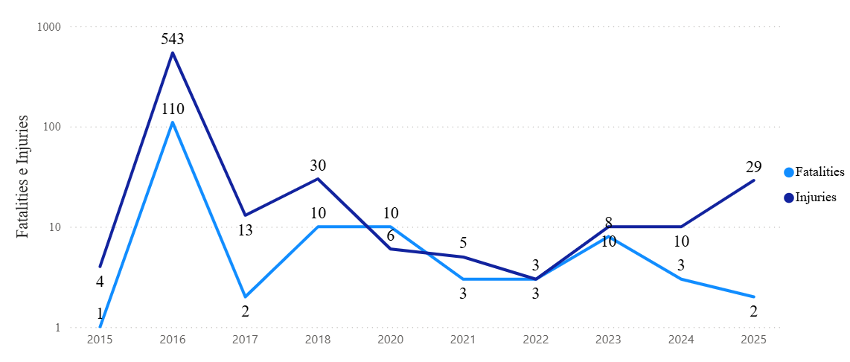
Figure 10: Chronological Evolution of Fatalities and Injuries in Lone-Actor Attacks (France and Germany)
France recorded the highest number of terrorist attacks in the EU in 2023 and the second-highest number of terrorism-related arrests. Its counterterrorism model combines military and psychological approaches within a centralized internal security framework, involving the National Police and the Gendarmerie.
Germany, by contrast, has emphasized prevention and legal measures. Legislative reforms criminalized travel to jihadist conflict zones and terrorist financing, while the 2017 Network Enforcement Act targeted online hate speech and propaganda.
Germany was also among the first EU states to implement multidisciplinary deradicalization programs. At the European level, both countries actively participate in cooperation mechanisms and information-sharing systems. While the EU provides the regulatory framework, MS retain autonomy in implementation, with France and Germany often driving deeper cooperation.
The European Project
Terrorist attacks in Europe have challenged not only the internal security of MS but also the EU as an area of integration and free movement. Lone actors, in particular, exploit structural vulnerabilities, generating social disruption and political pressure that facilitate the adoption of security measures.
At the same time, these dynamics contribute to the rise of populist and nationalist movements, intensifying political fragmentation within the EU. Security-driven narratives often frame migration and European integration as threats, promoting solutions based on national sovereignty and restrictions on free movement. These developments expose fundamental tensions within European governance, particularly between demands for stronger security and the protection of human rights and the rule of law. The abolition of internal border controls under Schengen exemplifies the tension between openness and security, underscoring the difficulty of responding effectively to transnational threats such as lone-actor terrorism through purely national approaches.
Conclusion
This study provides insight into the evolving complexity of contemporary terrorism in the EU, particularly the threat posed by lone actors. The empirical analysis of the French and German cases confirmed the prevalence of this phenomenon, with 29 attacks recorded during the period under review, resulting in 152 fatalities and 653 injuries, highlighting its significant human and social impact.
This phenomenon displays specific characteristics that distinguish it from organized terrorism. Operational decentralization, low technical sophistication, autonomous radicalization, and the predominant targeting of soft targets contribute to the difficulty of detection and prevention by security services. The use of everyday objects as weapons and the targeting of civilian public spaces amplify the psychological and media impact of these attacks. In France, 80% of attacks were motivated by Islamist extremism, accounting for 98.85% of casualties, while in Germany, the same ideological current represented 71.43% of attacks and 63.78% of casualties. Although stabbing was the most common modus operandi, vehicular attacks caused the highest number of casualties.
It can be concluded that this form of terrorism exposes structural vulnerabilities within the European area of free movement and challenges traditional security paradigms, demanding adaptive and integrated governance responses.


