Russia’s Cetacean Irregular Warfare in the North Atlantic

Introduction
For seventy years, America and its allies hunted steel hulls and listened for the heartbeat of propellers in the North Atlantic. Today, the heartbeat belongs to something far older, far smarter, and, according to the more feverish corners of Western intelligence—far more Russian. This is not about silent submarines or acoustic arrays, but Orcas, the apex predator of the ocean, weaponized by Moscow for a new era of Irregular Warfare. Since 2020, the Iberian orca subpopulation has executed more than 700 precision strikes on vessel rudders from Galicia to the Strait of Gibraltar. Yachts sink, autopilots die, and insurance actuaries panic.
The claim sounds like the plot of a B-movie produced in the waning days of the Cold War. Yet, as military analysts grapple with hybrid and asymmetric conflict, it is necessary to recognize that this rumored program is less a sign of fantasy and more a stroke of psychological operations in a biological package. The absurdity of the threat serves to mask serious implications for naval security and deterrence.
A History of Military Marine Mammal Programs
To understand the current situation, one must acknowledge the strangely overlooked history of military marine mammal programs (MMPs). Since the Cold War, the Soviet Union and America have demonstrated interest in marine mammals as national security tools. The earliest reported use of aquatic mammals in active military defense was during the Vietnam War. Five US Navy bottlenose dolphins were sent to Cam Ranh Bay, Vietnam, to defend US military boats from enemy swimmers. While the U.S. Navy taught dolphins to locate enemy divers and sea lions to detect mines, Moscow preferred the stouter physiologies of the Arctic. Despite a history of dolphin deployments, Russia has more recently focused heavily on larger mammals as well.
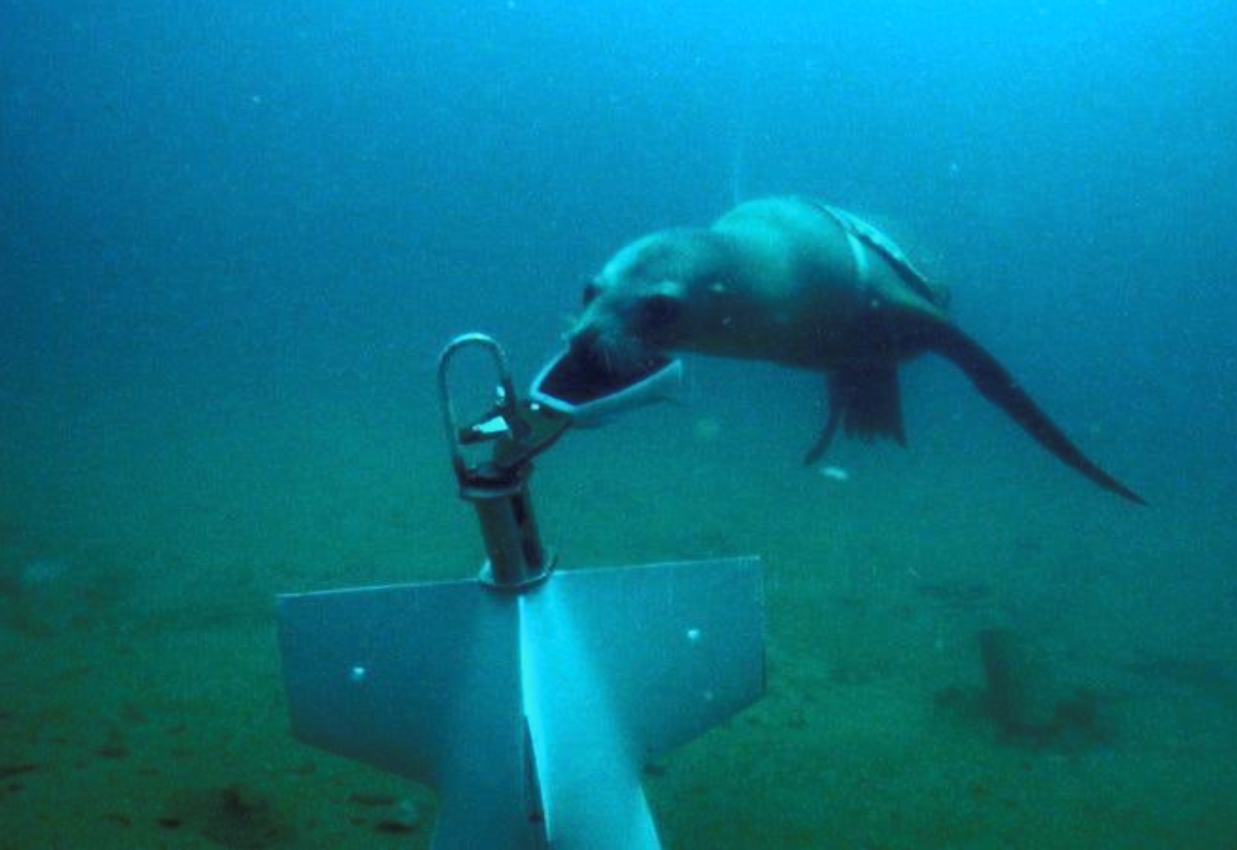
(A US Navy sea lion attaches a recovery line to a piece of test equipment. Image Credit: US Navy)
Enter Hvaldimir. In 2019, a beluga in a camera harness appeared off the coast of Norway’s far northern Finnmark region. First spotted in April near the island of Ingøya, speculation about Hvaldimir’s purpose ranged from carrying weapons and conducting surface surveillance to locating underwater threats. The creature was clearly trained and clearly escaped (or released), but also clearly more interested in socializing than in national security. All reports referenced a friendly whale happy to be around people. Belugas, it turned out, are perhaps too gentle, too social, and too corruptible by affection.
Three years later in 2022, during its second invasion of Ukraine, Russia demonstrated that it had maintained its dolphin programs, as reported by USNI. In February of that year, the Russian Navy placed two dolphin pens at the entrance to Sevastopol harbor, sheltered just inside a sea wall. The most likely intent was counter-diver operations to prevent “Ukrainian special operations forces from infiltrating the harbor underwater to sabotage warships,” USNI reported.
(Image Credit: H I Sutton Illustration for USNI News)
Grupo de Trabajo Orca Atlántica (GTOA) Field Reports
More recent Irregular Warfare activities in the Atlantic, however, involve a more formidable species: the Iberian subpopulation of the Killer Whale. Orca logs maintained by Grupo de Trabajo Orca Atlántica (GTOA) read less like marine biology surveys and more like after-action reports from an amphibious sabotage unit. As Reteuro reported based on GTOA logs:
“Most events involve sailing yachts under 15 meters, yet commercial skippers—coasters, trawlers, whale-watch operators—now report close approaches, stern-circling, and hard bumps that rattle crockery. In May 2024, a sailing vessel sank near the Strait of Gibraltar after repeated rudder strikes, and smaller working boats off Galicia have had gear fouled after sudden turns to protect props. The animals seem to know where control lives.”
(The moment seven orcas destroyed a yacht off the coast of Portugal. Image credit: Scuttlebutt Sailing News)
Translated to military targeting verbiage, the actions of the orcas might read as follows:
- Tactic: Stern-first approach, coordinated by juveniles under matriarchal oversight.
- Target Selection: Vessels under 15m most vulnerable; larger ships merely inconvenienced.
- Weapon: Teeth on rudder stocks, sometimes peeling zinc anodes.
- Duration of Engagement: 6–40 minutes, followed by deliberate disengagement.
- Geographic Spread: Seasonal corridor from Rías Baixas to Moroccan waters, coincidentally overlapping NATO exercise areas and the new Baltic Pipe gas route.
In May 2024, a Polish yacht was sunk in the Strait of Gibraltar after repeated rudder strikes. European authorities now issue “orca interaction advisories” and checklists the way NATO once issued submarine warnings. Oceanographic conditions that stimulate erratic cetacean behavior are a possible cause, but recommended vessel procedures—slow to dead slow, engine neutral, crew forward—reads like a passive defensive posture adopted by a military formation.
Why Orcas are Perfect Irregular Warriors
In 2000, the BBC reported that, “Dolphins trained to kill for the Soviet navy have been sold to Iran…and other aquatic mammals were trained by Russian experts to attack warships and enemy frogmen.” Training cetaceans (usually dolphins) for military purposes is a long, complex process requiring a high degree of expertise, patience, and positive reinforcement. It is a rigorous process that takes years to complete, involving a deep bond of trust between animals and trainers. But Putin’s more recent shift to Orcas suggests a strategic pivot. Irregular Warfare often focuses on destabilizing an opponent through unconventional means, often below the threshold of open conflict. What could be more destabilizing than a fully deniable, self-replicating, aquatic predator? Irregular Warfare doctrine in this regard relies on a handful of principles:
- Psychological Impact: The possibility that an orca might be on Moscow’s payroll costs NATO millions in readiness. Every dorsal fin becomes a potential periscope. A commander spotting an Orca must entertain the possibility that this six-ton creature is a threat.
- Deniability: When a rudder is torn off, no one declares war on a whale. At worst it’s an “act of nature.” At best it’s a tragic accident at sea involving protected wildlife. Russia has possibly weaponized the “grey zone” between natural occurrence and state-sponsored attack.
- Zero Maintenance Overhead: No dry docks, no spare parts, no satellite uplink. They require only a feeding schedule and they self-replicate, free from bureaucratic entanglement.
- Scalability: Social learning is baked in. One trained matriarch can transmit tactics to an entire pod within a single season. The West calls it a “cultural fad.” The FSB calls it doctrine.
- Strategic Geography: The Iberian orcas patrol the exact chokepoint where Atlantic shipping funnels into the Mediterranean—close enough to European capitals to make headlines, far enough from Russian bases to preserve plausible deniability.
NATO working groups, which actually exist, are debating responses. Attempts to mimic communications may involve acoustic “orca pingers” as deterrents (currently ineffective). Industries have been pushed to develop reinforced composite rudders (expensive). And finally, the possibility of the deployment of counter-whales, specifically the reactivation of the U.S. Navy’s Cold War dolphin squadrons, hoping Flipper still answers the bell. There is also an unfortunate, ethical aspect to this evolving form of Irregular Warfare: Russia has demonstrated a willingness to direct orcas as fodder toward target vessels, often resulting in the death for the mammals.
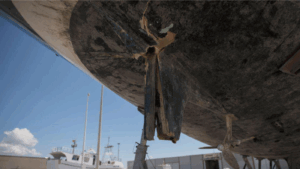
(The rudder of a ship damaged by orcas while in the Strait of Gibraltar is shown in Barbate in southern Spain in 2023. Image credit of Jorge Guerrero/AFP via Getty Images)
Conclusion
The North Atlantic feels crowded in a way it has not since 1986, a time that witnessed the highest operational tempo for both the U.S. and Soviet navies since the immediate post-WWII era. Today, military, civilian, and merchant ship captains plot courses around “high-interaction zones” the way they once avoided Soviet live-fire areas. The era of “Irregular Whale-fare” reminds observers that the most potent weapons are often those that defy categorization. Analysts must seriously prepare for a world where national security is not threatened by advanced missile systems, but perhaps by synchronized, highly intelligent, aquatic predators deployed with malign intent. More than likely, it is a combination of all of the above.
When a black fin slices moonlight off Cape Finisterre, observers might ask the uncomfortable question: is that a hungry adolescent looking for play, or is it something more nefarious? Either way, the vessel must be slowed, the helm centered, and the crew put on alert. The commissar of the deep does not negotiate. As one Galician skipper concluded: “They don’t hate us. They’re just doing their job.”
This is a work of speculative analysis. All citations on dolphins and belugas are based on fact and can be referenced by the reader. The only point of speculation (or narrative fiction) is whether Russia has trained and employed Orcas for irregular warfare. The purpose of the article is to stimulate thought, not to serve as historical fact. The views expressed here are those of the author alone and do not represent the official policy or position of the US Government or the Department of War.